Views: 44
Table of Contents
- 1 Introduction
- 2 1. What is a Cheque Bounce Case?
- 3 2. Section 138 of the Negotiable Instruments Act — The Law Explained
- 4 3. Common Causes of Cheque Bounce in India (2026)
- 5 4. Step-by-Step Legal Procedure for a Cheque Bounce Case
- 6 5. Legal Notice — Format, Drafting, and Mistakes to Avoid
- 7 6. Penalty and Punishment Under Section 138 NI Act (2026)
- 8 7. Timeline and Limitation Period — Critical Deadlines in 2026
- 9 8. Defence Strategies for the Accused in a Cheque Bounce Case
- 10 9. Out-of-Court Settlement in Cheque Bounce Cases
- 11 10. Jurisdiction — Which Court Handles Your Cheque Bounce Case?
- 12 11. Recent Amendments and Key Updates Affecting Cheque Bounce Cases in 2026
- 13 12. Frequently Asked Questions — Cheque Bounce Case 2026
- 14 Conclusion
Introduction
A cheque bounce case under Section 138 of the Negotiable Instruments Act, 1881 is one of the most frequently litigated criminal matters across India’s courts. Whether you are a business owner chasing a dishonoured payment or an individual who has just received a legal notice demanding money, understanding the complete legal framework can make the difference between winning and losing your case.
In 2026, with faster bank processing through NACH operating 24/7, cheque bounce disputes are surfacing more quickly than ever. Courts are also applying stricter timelines and newer amendment provisions. This guide walks you through every stage — from the moment a cheque is returned unpaid by the bank to the final judgment in court.
Many cheque bounce cases in India also arise from matrimonial and family financial disputes — settlement of alimony, division of assets, or maintenance payments. If your situation involves both a dishonoured cheque and a family law matter, QuickDivorce.in provides expert family law consultation that can help you handle both fronts simultaneously.
1. What is a Cheque Bounce Case?
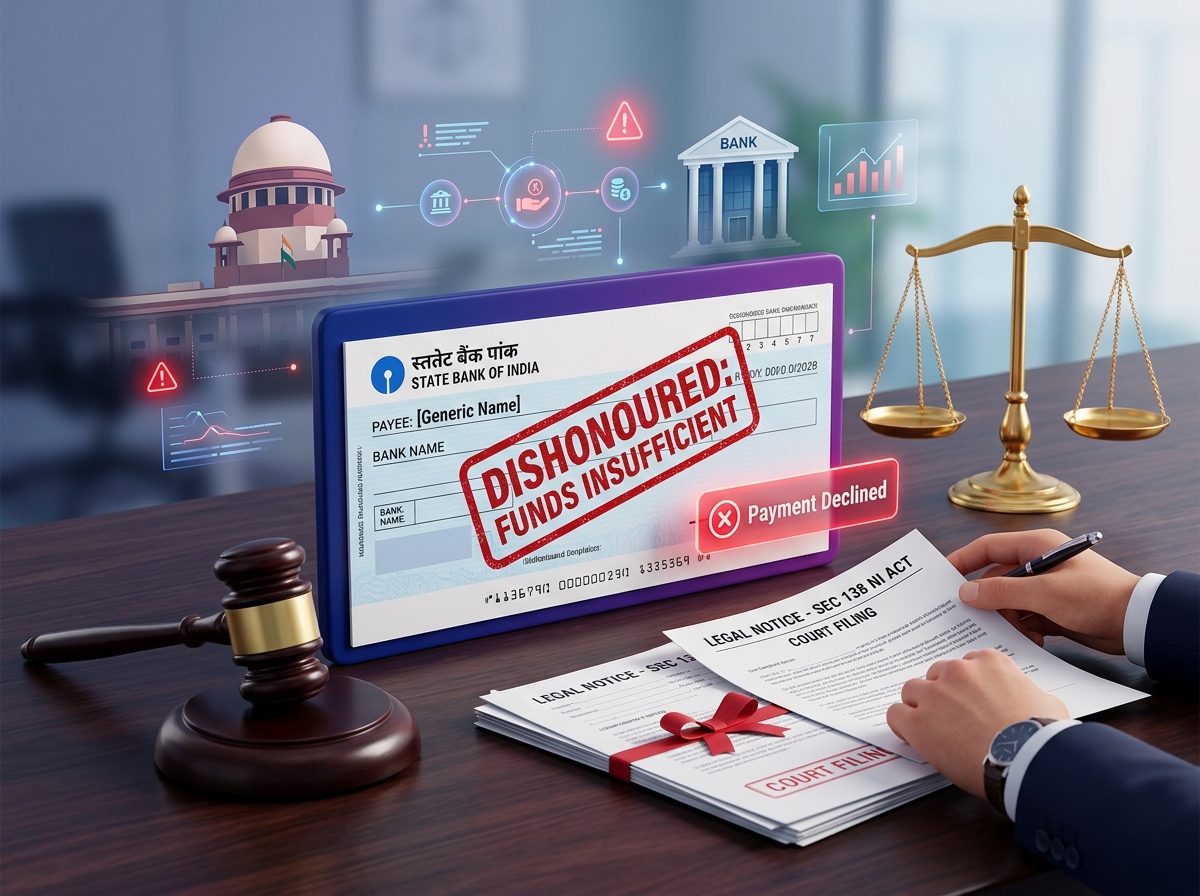
A cheque bounce case, also called a dishonoured cheque case, occurs when a bank refuses to honour a cheque presented by the payee and returns it unpaid. The bank issues a cheque return memo to the payee’s banker, stating the specific reason for dishonour — most commonly “insufficient funds” or “funds insufficient.”
Under Indian law, a cheque bounce due to insufficient funds is not merely a civil wrong — it is a criminal offence under Section 138 of the Negotiable Instruments Act, 1881. This makes the cheque bounce case unique among financial disputes: the payee has both a criminal remedy under Section 138 and a parallel civil remedy through a money recovery suit.
It is important to understand that not every bounced cheque gives rise to a criminal case under Section 138. The section applies specifically when the cheque was drawn to discharge a legally enforceable debt or liability, and the bounce was caused by insufficient funds or the amount exceeding the bank arrangement. Technical dishonours — such as a signature mismatch, overwriting, or a stale cheque — may have different legal implications and may not attract Section 138 at all.
Types of Cheque Dishonour and Whether Section 138 Applies:
- Insufficient Funds — Yes, directly triggers Section 138 criminal liability
- Amount Exceeds Bank Arrangement / Overdraft Limit — Yes, covered under Section 138
- Account Closed or Frozen — Yes, courts consistently hold this attracts Section 138
- Stop Payment Instruction by Drawer — Yes, treated as wilful dishonour
- Signature Mismatch — Technical dishonour; may not attract Section 138; civil remedy available
- Post-Dated Cheque Presented Before Date — Disputed; depends on facts
- Stale Cheque (over 3 months old) — No; cheque expires after 3 months from its date
- Overwriting or Material Alteration — Technical; Section 138 generally does not apply
2. Section 138 of the Negotiable Instruments Act — The Law Explained
The statutory text of Section 138 reads as follows:
“Where any cheque drawn by a person on an account maintained by him with a banker for payment of any amount of money to another person from out of that account for the discharge, in whole or in part, of any debt or other liability, is returned by the bank unpaid, either because of the amount of money standing to the credit of that account is insufficient to honour the cheque or that it exceeds the amount arranged to be paid from that account by an agreement made with that bank, such person shall be deemed to have committed an offence…”
For a cheque bounce complaint under Section 138 to succeed before a court, every one of the following essential ingredients must be present:
- The accused must have drawn a cheque on a bank account maintained by him.
- The cheque must have been drawn for the discharge, in whole or in part, of a legally enforceable debt or liability.
- The cheque must have been presented to the bank within 3 months of the date appearing on the cheque.
- The bank must have returned the cheque unpaid due to insufficient funds or because the amount exceeds the bank arrangement.
- The payee must have issued a written demand notice to the drawer within 30 days of receiving the bank’s dishonour memo.
- The drawer must have failed to make the payment within 15 days of receiving the demand notice.
- The payee must have filed the complaint before the competent Magistrate within 30 days of the expiry of the 15-day payment window.
Missing even one of these conditions can result in the complaint being dismissed at the threshold stage. Courts across India are strict about procedural compliance in cheque bounce cases. This is why professional legal support is essential — LegalTax.in offers end-to-end cheque bounce case assistance including legal notice drafting, complaint filing, and court representation.
Section 139 — Statutory Presumption in Favour of Complainant
Section 139 of the NI Act creates a statutory presumption in favour of the payee. Once the complainant proves that the cheque was issued and was dishonoured, the court presumes that it was drawn for the discharge of a debt or liability. The burden then shifts to the accused to rebut this presumption. This is a rebuttable presumption — the accused can lead evidence to show that no debt existed — but the standard of proof required is high, and courts apply the presumption strictly.
3. Common Causes of Cheque Bounce in India (2026)
Understanding why a cheque has bounced determines which legal remedy is appropriate. In 2026, with the RBI’s National Automated Clearing House (NACH) operating around the clock including Sundays and bank holidays, cheque dishonours are flagged and communicated much faster than in earlier years — meaning payees must act quickly once they receive the return memo.
The most common causes of cheque bounce in India are:
- Insufficient balance in the drawer’s account — the most frequent reason and the primary trigger for Section 138 criminal liability
- Stop payment instruction issued by the drawer — treated by courts as deliberate and wilful dishonour; the accused finds it very hard to defend
- Account closed or made dormant — courts have consistently held this to be equivalent to insufficient funds for the purposes of Section 138
- Signature does not match the bank’s records — typically a technical dishonour; civil remedy is the appropriate route
- Overwriting, cutting, or material alteration on the cheque
- Amount in words and amount in figures do not match
- Post-dated cheque presented to the bank before the date written on it
- Cheque presented to the bank after its 3-month validity period has expired — stale cheque; Section 138 does not apply
- Incorrect or incomplete payee name
- Account frozen due to court order or regulatory action
It is worth noting that a significant portion of cheque bounce disputes in India are connected to matrimonial and family financial settlements — maintenance arrears, alimony agreements, or property division payments. If your cheque bounce case has a family law dimension, it is advisable to consult both a criminal lawyer and a family law expert. QuickDivorce.in specialises in NRI and resident divorce cases and can work alongside your criminal lawyer to address the financial dispute comprehensively.
Similarly, if the dishonoured cheque is connected to a business transaction and your company’s brand or intellectual property is at stake, protecting your trademark through OnlineTrademarkIndia.com ensures your commercial identity remains legally protected during the dispute.
4. Step-by-Step Legal Procedure for a Cheque Bounce Case
The cheque bounce case procedure under Section 138 NI Act follows a strict sequence with statutory deadlines at every stage. Missing any deadline can render the complaint time-barred and incapable of being pursued in court. Here is the complete step-by-step procedure:
Step 1 — Cheque Is Presented and Dishonoured (Day Zero)
The payee deposits the cheque in their bank. The bank attempts to process it and returns it unpaid, issuing a cheque return memo that states the reason for dishonour along with the cheque number, date, and amount. This memo marks Day Zero — the starting point for all subsequent legal deadlines.
Step 2 — Issue a Legal Demand Notice to the Drawer (Within 30 Days of Bank Memo)
Within 30 days of receiving the bank’s dishonour memo, the payee must send a formal legal demand notice to the drawer. This notice must demand payment of the full cheque amount and must inform the drawer that failure to pay within 15 days will result in criminal prosecution under Section 138 NI Act. The notice must be sent by registered post with acknowledgment due (AD) to all known addresses of the drawer — residence, workplace, and registered office if the drawer is a company. It should also be sent by email as corroborating proof of delivery. Retaining the postal receipt and the returned acknowledgment card is critical — these documents are primary evidence in court.
Getting the notice right is the single most important step. Defective notices have caused many well-founded complaints to fail. LegalTax.in provides professional legal notice drafting and documentation services to ensure your notice is legally sound and compliant with Section 138 requirements.
Step 3 — Drawer Has 15 Days to Pay (Grace Period)
After receiving the demand notice, the drawer has exactly 15 days to make full payment of the cheque amount. If the drawer pays in full during this period, the matter ends here — no criminal case arises. This period is also the ideal window for the parties to negotiate a settlement and avoid court proceedings entirely. Our section on out-of-court settlement below explains the available options.
Step 4 — File Complaint Before the Magistrate (Within 30 Days of Expiry of Step 3)
If the drawer fails to make payment within the 15-day notice period, the payee must file a criminal complaint before the competent Judicial Magistrate or Metropolitan Magistrate within 30 days of the expiry of that 15-day window. The complaint must be accompanied by all supporting documents: the original dishonoured cheque, the bank’s return memo, a copy of the demand notice, proof of dispatch (postal receipt), proof of delivery (acknowledgment card or tracking report), and any other evidence of the underlying debt or transaction such as a loan agreement, invoice, or promissory note.
Step 5 — Magistrate Takes Cognizance and Issues Summons
The Magistrate examines the complaint and, if satisfied that a prima facie case under Section 138 NI Act is made out, takes cognizance of the offence and issues a summons to the accused (drawer). The accused must appear before the court on the date specified in the summons. Failure to appear can result in a warrant of arrest being issued.
Step 6 — Trial — Evidence, Cross-Examination, and Arguments
The complainant presents evidence first — leading the dishonoured cheque, bank memo, notice, postal receipts, and any proof of the underlying debt into evidence. Witnesses are examined and the accused’s counsel cross-examines them. The accused then presents their defence, including documentary evidence and witnesses. Both sides argue their case before the Magistrate.
Under Section 143A NI Act (inserted by the 2018 amendment), the trial court has the power to direct the accused to pay interim compensation of up to 20% of the cheque amount to the complainant during the trial itself, even before the final verdict. This is a powerful tool for complainants seeking early partial relief.
Step 7 — Judgment and Sentencing
The Magistrate delivers the judgment. If the accused is convicted, the court may award imprisonment up to 2 years, a fine up to twice the cheque amount, or both. The court typically also directs the accused to pay compensation equivalent to the cheque amount to the complainant. If acquitted, the accused is discharged.
5. Legal Notice — Format, Drafting, and Mistakes to Avoid
The cheque bounce legal notice is the foundation of the entire Section 138 complaint. A defective notice can destroy an otherwise strong case. A valid demand notice must contain the following elements:
- Full name, postal address, and contact details of the payee (the person sending the notice)
- Full name, postal address, and contact details of the drawer (the person receiving the notice)
- Date on which the notice is being sent
- Cheque number, date of issue, issuing bank name, and branch
- Full cheque amount in figures and words
- Date on which the cheque was deposited with the bank
- Date on which the cheque was dishonoured
- Exact reason for dishonour as stated in the bank’s return memo
- Clear and unconditional demand for payment of the full cheque amount
- Deadline of 15 days from the date of receipt of the notice for making payment
- Express statement that criminal proceedings under Section 138 NI Act will be initiated upon failure to pay
- Signature of the payee or their authorised advocate
Common Mistakes That Destroy Cheque Bounce Cases:
Many well-founded cheque bounce complaints have been dismissed by courts due to procedural errors in the notice stage. The most frequent mistakes include: sending the notice only by email without registered post; sending the notice to an old or incorrect address of the drawer; demanding an amount different from the exact cheque amount; issuing the notice after the 30-day deadline has passed; and not mentioning the specific cheque number and dishonour date in the notice.
Always have your cheque bounce notice drafted by a qualified advocate. LegalTax.in offers professional cheque bounce case support including legally compliant notice drafting, complaint preparation, and full court representation across India.
6. Penalty and Punishment Under Section 138 NI Act (2026)
The punishment for cheque bounce under Section 138 of the Negotiable Instruments Act is:
Imprisonment: Up to 2 years. The term of imprisonment is determined by the court based on the gravity of the offence, the conduct of the accused during proceedings, and the facts of the case. Courts rarely award maximum imprisonment in first-time offences where the accused shows willingness to pay.
Fine: Up to twice the amount of the dishonoured cheque. In practice, courts typically award a fine equivalent to the cheque amount as compensation to the complainant, along with interest and legal costs.
Both Together: The court has full discretion to award both imprisonment and fine simultaneously in serious or repeat cases.
Interim Compensation Under Section 143A: During the pendency of the trial — before the final verdict — the court may direct the accused to pay interim compensation of up to 20% of the cheque amount to the complainant. This must be paid within 60 days of the order. If the accused is ultimately acquitted, the court directs repayment of this amount with interest.
Appellate Stage — Section 148: If the accused is convicted by the trial court and files an appeal to challenge the conviction, the appellate court must require the accused to deposit a minimum of 20% of the fine or compensation awarded by the trial court as a condition for suspending the sentence during the appeal. This prevents accused persons from using appeals to indefinitely delay paying the complainant.
Bank Penalties: Banks charge cheque bounce fees to both the drawer and the payee when a cheque is dishonoured. These fees vary across institutions — typically between ₹150 and ₹750 per dishonour — and are separate from any court-ordered penalties.
Beyond the formal legal penalties, a cheque bounce conviction can severely damage the accused’s credit rating, affect their ability to obtain bank loans and credit facilities, and cause significant reputational harm to their business. Companies and entrepreneurs involved in cheque bounce disputes should take proactive steps to protect their brand identity. OnlineTrademarkIndia.com provides trademark registration services that legally secure your business name and brand during and after litigation.
7. Timeline and Limitation Period — Critical Deadlines in 2026
The entire cheque bounce case procedure is governed by strict statutory timelines. Missing any one of these deadlines can make your complaint legally infirm and liable to be dismissed. Every payee considering a Section 138 complaint must track these dates meticulously:
Cheque validity: The cheque must be presented to the bank within 3 months of the date appearing on the cheque. If the cheque is presented after this period, it is a stale cheque and Section 138 does not apply.
Demand notice: The payee must issue the legal demand notice within 30 days of receiving the bank’s dishonour memo. This is a hard deadline — even one day’s delay without sufficient cause makes the notice defective.
Payment window: The drawer has 15 days from the date of receipt of the notice to make full payment. This 15-day period begins from actual receipt of the notice, not from the date it was sent.
Filing of complaint: The payee must file the criminal complaint before the Magistrate within 30 days of the expiry of the drawer’s 15-day payment window. This gives the payee a total window of approximately 75 days from the bank memo date (30 days notice + 15 days payment window + 30 days filing window).
Re-presentment: If the cheque is still within its 3-month validity period, the payee has the option to re-present it to the bank instead of immediately issuing a notice. Each fresh dishonour upon re-presentment opens a new 30-day window for issuing a demand notice and subsequently filing a complaint.
Courts have held that condonation of delay in filing a Section 138 complaint is permissible if the complainant shows sufficient cause, but courts are not always generous in granting such condonation. It is always advisable to act within the statutory deadlines. For legal documentation and compliance support throughout this process, LegalTax.in offers reliable, expert assistance.
8. Defence Strategies for the Accused in a Cheque Bounce Case
Being accused in a cheque bounce case under Section 138 NI Act does not mean automatic conviction. Indian courts have acquitted accused persons on several well-established legal grounds. If you have received a summons or are facing a Section 138 complaint, here are the key defence strategies available to you:
No Legally Enforceable Debt: Section 138 applies only when the cheque was drawn for the discharge of a legally enforceable debt or liability. If the cheque was given as a security deposit, advance against future services not yet rendered, or for a time-barred debt, the accused can argue that no legally enforceable liability existed.
Defective or Time-Barred Notice: If the demand notice was sent after the 30-day deadline, was sent to a wrong address, or was incomplete — missing the cheque number, dishonour date, or a clear demand for payment — the complaint can fail at the threshold stage on procedural grounds.
Complaint Filed Beyond the Limitation Period: If the complainant filed the complaint after the 30-day window following the expiry of the notice period, the complaint is time-barred and liable to be dismissed unless delay is sufficiently explained.
Blank Cheque Given as Security: If the accused can prove that the cheque was handed over as a security instrument and the complainant fraudulently filled in an amount without authority, this is a strong defence. The accused must, however, lead concrete evidence to rebut the Section 139 presumption.
Payment Already Made: If the accused can demonstrate through bank records or written communication that the cheque amount was paid before or after the notice but before the complaint was filed, it weakens or extinguishes the criminal case.
Cheque Not Signed by the Accused: Forgery of signature, theft of cheque, or unauthorised use of the drawer’s cheque book are valid defences if supported by forensic or documentary evidence.
Complainant Not Legally Competent to File: Only the payee or holder in due course can file a complaint under Section 138. If a complaint is filed by an unauthorised person — for instance, an employee without proper authority, or a wrong entity in a corporate dispute — it can be challenged.
Company Accused — Proper Authorization: When a company is the complainant, the complaint must be filed by a person specifically authorised by the company’s board resolution. Absence of such authorisation has led to complaints being dismissed.
Many cheque bounce cases arising from matrimonial disputes — particularly post-divorce financial settlements — involve questions of whether the cheque was issued under duress or for a genuinely enforceable obligation. If you are facing such a situation, QuickDivorce.in can connect you with experienced family lawyers who work in coordination with criminal law specialists to build a comprehensive defence.
9. Out-of-Court Settlement in Cheque Bounce Cases
The majority of cheque bounce cases in India are settled out of court, and this is actively encouraged by the legal system at every level — from the Magistrate’s court to the Supreme Court. Settlement saves both parties time, money, litigation costs, and the stress of prolonged criminal proceedings. Here are the primary settlement routes available in 2026:
Lok Adalat: Cheque bounce cases are expressly included within the jurisdiction of Lok Adalats under the Legal Services Authorities Act, 1987. A settlement through Lok Adalat is final, binding, and cannot be challenged by way of appeal. No court fee is payable for Lok Adalat proceedings, and any court fee already paid on the complaint is fully refunded upon settlement. Lok Adalats offer swift and cost-effective resolution, typically within a few hearings.
Compounding of Offence Under Section 147: Section 147 of the NI Act specifically makes the offence under Section 138 a compoundable offence — meaning the complainant and the accused can agree to settle the matter at any stage of the proceedings, including after conviction. With the court’s permission, the offence is compounded, the accused is acquitted, and the case is closed. Courts are generally supportive of compounding in genuine settlements.
Mediation: The Supreme Court of India has repeatedly directed High Courts and District Courts to encourage mediation in cheque bounce cases before proceeding to trial, given the enormous backlog of Section 138 cases in Indian courts. As of 2026, mediation centres attached to District Courts in major cities actively resolve cheque bounce disputes, often within weeks of referral. Mediation is particularly effective when the parties have an ongoing business or personal relationship.
Private Settlement Agreement: The parties can settle privately at any stage — before filing the complaint, during trial, or even post-conviction. A written settlement agreement documenting the payment terms, timelines, and consequences of default is essential. Once the complainant receives full payment per the agreement, they can withdraw the complaint or report compounding to the court. For professionally drafted settlement agreements, LegalTax.in offers comprehensive legal documentation and drafting services tailored to cheque bounce settlements.
10. Jurisdiction — Which Court Handles Your Cheque Bounce Case?
Following the Negotiable Instruments (Amendment) Act, 2015, the question of jurisdiction in cheque bounce cases was definitively settled. Prior to 2015, there was significant confusion and forum shopping as complainants attempted to file cases in favourable locations. The 2015 amendment provides that the complaint must be filed before the court within whose territorial jurisdiction:
- The bank branch where the payee maintains their account (i.e., where the cheque was deposited and returned) is located, or
- The bank branch of the drawer where the account on which the cheque was drawn is located.
This amendment significantly simplified jurisdiction determination and ended the practice of complainants filing cases at geographically inconvenient locations to harass accused persons.
Cheque bounce cases under Section 138 NI Act are tried by Judicial Magistrates (First Class) or Metropolitan Magistrates, since the maximum punishment does not exceed 2 years. Sessions Courts do not have original jurisdiction over Section 138 matters.
Corporate Accused — Section 141 NI Act: When the drawer is a company or other body corporate, Section 141 NI Act provides that every person who, at the time of the offence, was in charge of and responsible for the conduct of the business of the company is deemed to have committed the offence along with the company. Directors, managers, and officers can all be prosecuted personally. Companies engaged in regular commercial transactions using cheques should protect their legal and commercial standing through brand protection measures — OnlineTrademarkIndia.com offers complete trademark registration and intellectual property protection services that strengthen a company’s legal position in any dispute.
11. Recent Amendments and Key Updates Affecting Cheque Bounce Cases in 2026
Negotiable Instruments (Amendment) Act, 2018:
The 2018 amendment introduced two critical provisions that significantly changed the dynamics of cheque bounce litigation in India:
Section 143A empowers the trial court to order the accused to pay interim compensation of up to 20% of the cheque amount to the complainant during the pendency of the trial, even before the verdict. This must be paid within 60 days of the court’s order. If the accused is ultimately acquitted, the court directs that this amount be repaid with interest.
Section 148 mandates that when an accused convicted under Section 138 files an appeal against the conviction, the appellate court must require the accused to deposit a minimum of 20% of the fine or compensation as a precondition for suspension of the sentence pending appeal. This provision has been highly effective in preventing accused persons from using prolonged appeals as a strategy to delay paying complainants.
RBI Guidelines on NACH — Continuous Effect in 2026:
The Reserve Bank of India’s August 2021 directive mandating that the National Automated Clearing House (NACH) operate 24/7 including Sundays and public holidays continues to have a significant practical impact in 2026. Cheque processing and dishonour notifications now happen faster than ever, meaning payees receive the bank’s return memo sooner and the 30-day clock for issuing a notice starts ticking immediately. Drawers must ensure they maintain adequate minimum balances in their accounts at all times to avoid unintentional bounces.
Supreme Court Directions on Fast-Track Disposal:
The Supreme Court has issued directions to High Courts requiring that Section 138 cases be disposed of within 6 months to 1 year from filing wherever possible. Several states have established dedicated NI Act courts and fast-track benches to address the massive backlog of cheque bounce cases. In 2026, these special courts are operational in Delhi, Mumbai, Bengaluru, Hyderabad, and Chennai, among others.
Electronic Payment Instruments — Evolving Law:
With India’s increasing shift to digital payments, questions have arisen about whether electronic clearing service (ECS) mandates, NACH debit instructions, and digital payment instruments returned unpaid attract Section 138 NI Act. While physical cheques remain the primary subject of Section 138, courts have in several decisions applied the principles of the NI Act by analogy to returned ECS mandates. Section 25 of the Payment and Settlement Systems Act, 2007 provides a parallel statutory remedy for returned electronic payment mandates. As of 2026, this area of law is still developing, and legal advice specific to digital instrument dishonour is advisable.
For businesses operating across multiple domains — whether trademark issues, company compliance, or NI Act disputes — LegalTax.in provides an integrated platform covering cheque bounce case support, trademark registration, GST compliance, and company registration all under one roof, making it a single-stop legal and business compliance partner.
12. Frequently Asked Questions — Cheque Bounce Case 2026
Q. How many times can a cheque be re-presented to the bank?
There is no statutory limit on the number of times a cheque can be re-presented to the bank, as long as each presentment falls within the 3-month validity period from the date printed on the cheque. Each dishonour upon re-presentment gives the payee a fresh right to issue a demand notice under Section 138 and, if payment is not made, to file a fresh complaint. Many payees re-present the cheque once or twice before initiating legal proceedings.
Q. Can a cheque bounce complaint be filed after the limitation period?
The complaint must be filed within 30 days of the expiry of the 15-day notice period. If the complainant misses this window, the complaint is time-barred. However, courts have the power to condone the delay under Section 142 NI Act if the complainant demonstrates “sufficient cause” for the delay. Courts are not uniformly liberal in granting such condonation, so it is always best to file within the statutory period.
Q. Is a cheque bounce case bailable?
Yes. A cheque bounce offence under Section 138 NI Act is a bailable offence. The accused is entitled to bail as a matter of right from the police officer or the Magistrate. Courts may impose conditions on the bail, such as furnishing a surety or depositing a portion of the cheque amount.
Q. Can a company be prosecuted for a cheque bounce?
Yes. Under Section 141 NI Act, if the person who committed the offence under Section 138 is a company, the company itself as well as every person who was in charge of and responsible for the conduct of its business at the time of the offence is deemed to have committed the offence. Directors and key managerial personnel can be prosecuted personally alongside the company. Companies should protect their commercial standing through proactive IP registration at OnlineTrademarkIndia.com.
Q. What if the drawer pays only part of the cheque amount after the notice?
Partial payment does not discharge the drawer’s liability under Section 138. The legal notice and subsequent complaint must demand the full amount of the dishonoured cheque. Courts have consistently held that part payment does not bar a complaint for the remaining unpaid amount. However, a fresh notice must be sent for the balance if the payee wishes to pursue the matter. Accepting a partial payment as full and final settlement — if clearly documented — would extinguish the claim.
Q. Can I simultaneously file a civil suit for recovery along with the Section 138 complaint?
Yes. A civil suit for recovery of the cheque amount can be filed simultaneously with or independently of the Section 138 criminal complaint. Both proceedings can run concurrently in separate courts. In practice, filing both maximises the payee’s chances of recovery, as the civil suit creates an additional avenue for obtaining a decree and executing it through attachment of the accused’s assets. For comprehensive legal support in managing both proceedings, LegalTax.in offers money recovery case services alongside cheque bounce case representation.
Q. What if the drawer of the cheque is an NRI living abroad?
A cheque bounce complaint is fully maintainable under Indian law even if the drawer is an NRI, provided the cheque was drawn on an Indian bank account. The demand notice can be sent to the drawer’s last known address in India and to their address abroad. Courts in India have jurisdiction if the cheque was payable in India, regardless of where the accused is currently residing. If the cheque bounce dispute is connected to divorce proceedings, maintenance, or property division involving an NRI, QuickDivorce.in offers specialised NRI divorce and family law support with fully online consultations, allowing you to handle the matter without travelling back to India.
Q. Can a cheque bounce complaint be filed online in 2026?
Several High Courts and District Courts have introduced e-filing portals for criminal complaints, including Section 138 NI Act cases. However, complete virtual disposal of a cheque bounce case is not yet universal — courts still require physical presence at key stages such as recording of evidence and cross-examination of witnesses. Many courts accept e-filed complaints but schedule physical hearings thereafter. Check the specific e-filing facility available at your relevant District Court or engage a local advocate through LegalTax.in to navigate the filing process.
Q. How long does a cheque bounce case take in India in 2026?
With dedicated NI Act courts and Supreme Court directions mandating disposal within 6 months to 1 year, cheque bounce cases are being resolved faster in 2026 than in previous years. However, the actual timeline depends on the workload of the specific court, whether the accused contests the case, the number of witnesses, and whether the parties explore settlement. Cases that are compounded through Lok Adalat or mediation can be resolved within weeks. Fully contested trials may still take 1 to 3 years in high-workload courts.
Conclusion
A cheque bounce case under Section 138 NI Act is a powerful legal remedy that gives every payee both criminal and civil recourse against a person who dishonours a payment commitment. The law has been made more effective through the 2018 amendments — with interim compensation provisions and appellate deposit requirements — and the faster processing environment created by 24/7 NACH operations means time starts running sooner than ever.
Whether you are the payee seeking to recover your money or the accused defending against a complaint, the procedural details matter enormously. Missing a deadline, sending a defective notice, or filing in the wrong court can make or break your case regardless of its merits.
Get your cheque bounce notice professionally drafted and your case expertly managed through LegalTax.in. If your dispute involves matrimonial finances, visit QuickDivorce.in for expert family law support. And if your business identity or trademark needs protection during or after the dispute, OnlineTrademarkIndia.com is your trusted partner for intellectual property registration in India.

I’m Aman Arora aka Aman G — 10+ years in SEO and Digital Marketing, and I love getting results. I don’t just do SEO & Website Design; I build strategies that work. I’m a CA drop out, but what I enjoy most is helping entrepreneurs and NGOs reach their goals. For me, happy customers are the real reward.
Our Clients