Views: 21
Table of Contents
- 1 Introduction
- 2 Section 1: What is FSSAI? The Three-Tier Framework
- 3 Section 2: FSSAI Basic Registration — The Entry-Level Compliance
- 4 Section 3: FSSAI License — State and Central Tiers Explained
- 5 Section 4: Side-by-Side Comparison
- 6 Section 5: Who Needs What? A Category-by-Category Breakdown
- 7 Section 6: Step-by-Step Application Process
- 8 Section 7: Documents Required
- 9 Section 8: Penalties for Non-Compliance
- 10 Section 9: Frequently Asked Questions
- 11 Helpful Resources
- 12 Ready to Get FSSAI Compliant? Let Experts Handle It.
Introduction
If you run — or plan to run — any food-related business in India, three letters will define your legal compliance journey: FSSAI. The Food Safety and Standards Authority of India is the central regulatory body established under the Food Safety and Standards Act, 2006. It operates under the Ministry of Health and Family Welfare and governs everything from the neighborhood chaat stall to the multinational packaged-food conglomerate.
FSSAI’s mandate is straightforward: ensure that every piece of food sold, manufactured, stored, or distributed in India meets defined safety and hygiene standards. To enforce this, the authority has created a three-tiered licensing and registration architecture that categorizes food businesses by their size, turnover, and nature of operations.
The confusion begins because both “Registration” and the entry tier of “Licensing” are often loosely called “FSSAI Registration” in everyday business conversations. This guide cuts through that ambiguity with a precise, category-by-category breakdown so you never have to guess which authorization your business actually needs.
Section 1: What is FSSAI? The Three-Tier Framework
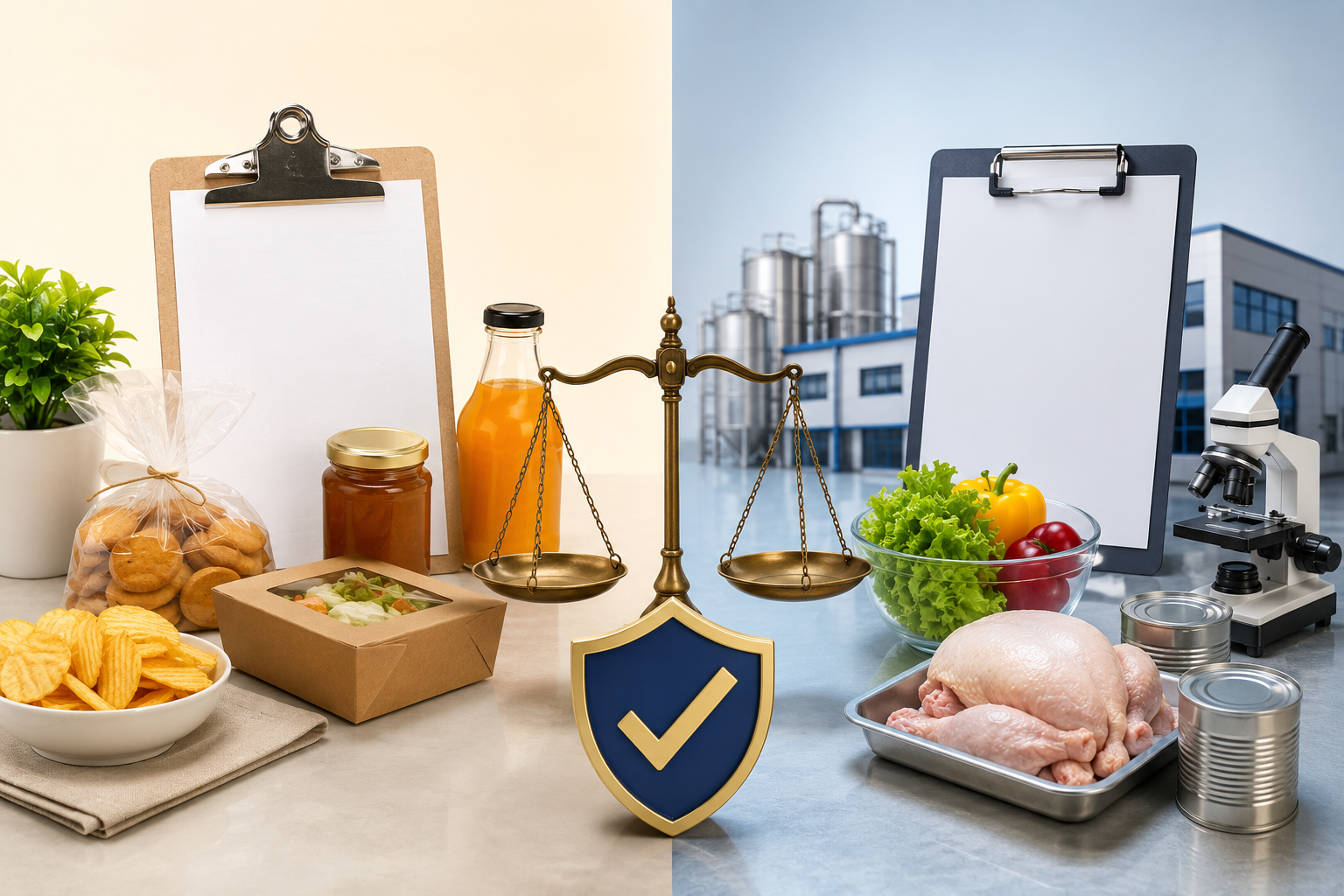
The FSSAI framework classifies every food business in India into one of three tiers:
Basic Registration — For very small, petty food businesses with annual turnover up to ₹12 lakh.
State License — For medium-sized businesses with annual turnover between ₹12 lakh and ₹20 crore, operating within a single state.
Central License — For large-scale manufacturers, importers, exporters, and multi-state operators with turnover above ₹20 crore.
The authorization you hold is not a badge of prestige — it is a legal obligation. Operating in the wrong tier, or worse, operating without any authorization at all, exposes your business to serious financial and criminal penalties under the FSS Act, 2006.
Section 2: FSSAI Basic Registration — The Entry-Level Compliance
FSSAI Basic Registration is designed for petty food businesses — individual hawkers, street vendors, small home-based food makers, and tiny retailers who form the backbone of India’s food ecosystem. If your annual turnover does not exceed ₹12 lakh, Basic Registration is your mandatory compliance path.
Upon approval, you receive a 14-digit registration number that must be displayed prominently at your place of business and on any packaging or labeling you use. The certificate is valid for 1 to 5 years, and the fee is just ₹100 per year — payable upfront for your chosen duration.
Who qualifies for Basic Registration?
Petty retailers dealing in food products, whether at a fixed premises or as a temporary stallholder, hawker, or itinerant vendor. Home-based food businesses — including early-stage cloud kitchens and home bakers — with annual turnover below ₹12 lakh. Small food manufacturers with a production capacity below 100 kg or litres per day (excluding milk and meat). Dairy units handling less than 500 litres per day of milk or producing dairy products up to 100 kg per day. Slaughterhouses with a capacity below 2 large animals or 10 small animals per day. Food catering at religious or social gatherings of a temporary nature. Dhabbas, small restaurants, and eateries operating below the ₹12 lakh turnover threshold.
An important nuance: Basic Registration is state-specific. You register with the designated officer in the state or union territory where you operate. If you have operations in multiple states, you need registration in each — until you cross the threshold that mandates a license.
Basic Registration is not a lesser form of compliance. It is the appropriate form of compliance for India’s vast informal food economy, and the law treats it with equal seriousness in terms of food safety obligations.
Section 3: FSSAI License — State and Central Tiers Explained
Once your food business grows beyond the petty operator threshold, you enter the licensing regime. FSSAI licenses come in two forms — State License and Central License — and the distinction is primarily determined by the scale of your operations, your annual turnover, and whether you operate across state borders.
State FSSAI License
A State License is issued by the respective State Food Safety Commissioner and applies to medium-sized food businesses. The annual turnover range is above ₹12 lakh and up to ₹20 crore. The license fee ranges from ₹2,000 to ₹5,000 per year depending on business type, and is valid for 1 to 5 years.
State Licenses are appropriate for medium-scale food manufacturers and processors operating from a single state, hotels, restaurants, caterers, and cloud kitchens with turnover above ₹12 lakh, retailers and distributors with multi-outlet operations within one state, storage units — cold storage and warehouses — with capacity below 50,000 MT, transporters of food products operating within state borders, and food businesses in markets, malls, multiplexes, and state-controlled airports.
Central FSSAI License
The Central License is issued directly by FSSAI’s headquarters in New Delhi. The fee is ₹7,500 per year, valid for 1 to 5 years. If your business crosses ₹20 crore in annual turnover, operates in more than one state, or falls under specific categories, you must hold a Central License.
Central Licenses are mandatory for all food importers bringing products into India — regardless of turnover, volume, or product type. Even if you import a single SKU of specialty food, you need a Central License. This tier also applies to food exporters operating under the Export Inspection Council mandate, large manufacturers with annual turnover above ₹20 crore, food businesses operating in two or more states simultaneously, operators at central government premises such as airports, seaports, and railways, milk and dairy units handling more than 50,000 litres per day, slaughterhouses above 50 large animals or 150 small animals per day, manufacturers of proprietary food and nutraceuticals, and e-commerce food businesses operating at national scale.
One critical rule: a food business may hold only one type of FSSAI authorization at a given premises at a time. If your business grows and crosses a threshold, you must upgrade — you cannot hold a Basic Registration while running operations that legally require a State License.
For professional guidance on navigating the licensing process, LegalTax.in offers end-to-end FSSAI compliance support for food businesses of all sizes, from registration to Central License procurement and renewal management.
Section 4: Side-by-Side Comparison
| Parameter | Basic Registration | State License | Central License |
|---|---|---|---|
| Annual Turnover | Up to ₹12 lakh | ₹12 lakh – ₹20 crore | Above ₹20 crore |
| Issuing Authority | Designated State Officer | State Food Safety Commissioner | FSSAI Central Authority |
| Annual Fee | ₹100/year | ₹2,000–₹5,000/year | ₹7,500/year |
| Validity | 1 to 5 years | 1 to 5 years | 1 to 5 years |
| Scope of Operations | Single state / local area | Single state | Pan-India / Import-Export |
| Food Recall Required | No | Yes | Yes |
| Application Form | Form A | Form B | Form B |
| Inspection Required | Rarely | Often | Yes (for manufacturers) |
| Complexity Level | Low | Medium | High |
Section 5: Who Needs What? A Category-by-Category Breakdown
Regulatory requirements are most confusing at the margins — the restaurant that just crossed ₹12 lakh, the cloud kitchen unsure whether its platform counts as “e-commerce,” the home baker wondering if Instagram sales qualify as a business. Here is a practical guide by business type.
Restaurants and Food Service Establishments: A small dhabba or single-outlet restaurant with turnover below ₹12 lakh needs Basic Registration. A restaurant chain with multiple outlets or turnover above ₹12 lakh operating within one state needs a State License. A pan-India chain or one operating at airports requires a Central License.
Food Manufacturers and Processors: Production capacity below 100 kg or litres per day warrants Basic Registration. Medium-scale manufacturing within one state requires a State License. Large-scale manufacturing with multi-state supply chains or turnover above ₹20 crore requires a Central License.
Cloud Kitchens and Home-Based Food Businesses: A home baker selling locally with under ₹12 lakh turnover needs Basic Registration. A cloud kitchen operating professionally on Swiggy or Zomato with growing revenue likely needs a State License. A cloud kitchen aggregator or dark kitchen brand operating nationally needs a Central License.
Importers and Exporters: Non-negotiable — all food importers require a Central License regardless of volume or product type.
Retailers and Grocery Stores: Small kirana stores with turnover under ₹12 lakh need Basic Registration. Supermarkets, hypermarkets, and grocery chains need a State or Central License based on scale and geography.
E-Commerce Food Businesses: Online food sellers — whether through their own website, Instagram, or a marketplace — must obtain the license appropriate to their turnover and operational geography. If you sell nationally, a Central License is advisable even at modest turnover, as your commercial presence spans multiple states.
If your food business also involves a brand, logo, or unique product name, protecting your intellectual property is equally critical. LegalIP.in specializes in trademark registration for food brands, helping you secure your business identity alongside your FSSAI compliance.
Section 6: Step-by-Step Application Process
FSSAI applications are filed through the FoSCoS (Food Safety Compliance System) portal at foscos.fssai.gov.in.
For Basic Registration (Form A): Create an account on FoSCoS with your mobile number and email. Fill in Form A — a single-page application covering your business name, address, nature of food products, and production capacity. Upload the required documents (detailed in Section 7). Pay ₹100 per year for your chosen validity period (1–5 years). Receive your Registration Certificate, typically within 7 working days. No premises inspection is usually required.
For State and Central License (Form B): File the comprehensive Form B on FoSCoS, covering production details, food categories, installed capacity, and full business particulars. Prepare and upload the complete document dossier. Pay the applicable fee — ₹2,000–₹5,000 per year for State, ₹7,500 per year for Central. Undergo premises inspection if required, especially for manufacturing units. Receive your license upon approval, typically within 30 to 60 days. The 14-digit license number must be prominently displayed at your premises and on all product packaging.
Section 7: Documents Required
For Basic Registration: Photo ID proof (Aadhaar, Voter ID, PAN, or Passport), proof of business address (utility bill or rental agreement), one recent passport-size photograph, self-declaration on the nature and scale of food operations, and the completed Form A via FoSCoS.
For State License: Completed Form B on FoSCoS, Certificate of Incorporation or Partnership Deed or GST Registration as applicable, proof of premises ownership or rental agreement, layout plan or blueprint of the food business premises, list of food products to be manufactured or traded, list of equipment and machinery with capacity details, water analysis report from an accredited lab (for manufacturers), a Food Safety Management System plan, NOC from Municipality or Gram Panchayat, and medical fitness certificates for food handlers.
For Central License — Additional Requirements: Import-Export Code (IEC) from DGFT for importers and exporters, NOC or Port Authority documents from Port Health Officers for import businesses, a recall plan for food products (mandatory for all Central License holders), a detailed HACCP (Hazard Analysis Critical Control Points) plan for manufacturers, a certificate from an accredited testing laboratory for proprietary food products, and a Board Resolution or authorization letter for the authorized signatory.
For trademark protection of your food brand — essential if you are packaging products or building a label — OnlineTrademarkIndia.com provides fast, affordable trademark registration services specifically designed for food and beverage brands across India.
Section 8: Penalties for Non-Compliance
Operating a food business without appropriate FSSAI authorization is a punishable offense under the FSS Act, 2006. Penalties are structured by the severity of the violation.
Operating without any FSSAI Registration or License (Section 63) attracts a fine of up to ₹5 lakh for petty businesses, and imprisonment of up to 6 months for repeat offenses. Selling food that does not meet safety standards — sub-standard food under Section 51 — carries a fine of up to ₹5 lakh. Misbranded or mislabeled food products (Section 52) attract fines up to ₹3 lakh. Misleading food advertisements (Section 53) carry penalties up to ₹10 lakh. Adulterated food that causes injury or death (Section 59) can result in life imprisonment and a fine up to ₹10 lakh. Failure to comply with directions of a Food Safety Officer (Section 58) attracts fines up to ₹2 lakh.
These penalties apply cumulatively in many cases. A manufacturer found operating without a license, selling sub-standard food, and using misleading labeling can face all three penalties simultaneously. In addition, the business may be shut down by the Food Safety Officer, and all stock may be seized and destroyed at the operator’s cost.
Section 9: Frequently Asked Questions
Can I sell food online with just a Basic Registration? Yes, if your annual turnover is below ₹12 lakh and you operate locally. However, if you sell nationally or cross the turnover threshold, you need to upgrade to a State or Central License. E-commerce platforms like Swiggy and Zomato typically require a valid FSSAI number before onboarding — Basic Registration qualifies, but growth will necessitate an upgrade.
Do home bakers and home cooks need FSSAI authorization? Yes. Any commercial food activity — including selling homemade food via WhatsApp groups, Instagram, or local delivery — requires at minimum a Basic Registration if turnover is below ₹12 lakh.
What happens if my turnover crosses the threshold mid-year? You are required to apply for the appropriate higher-tier license as soon as you reasonably foresee crossing the threshold. Waiting until year-end is not advisable — FSSAI officers have discretion to inspect and penalize businesses operating in the wrong tier.
Can I get a Central License directly, skipping State License? Yes. If your business qualifies for Central License criteria from the start — such as an importer or a multi-state operator — you apply directly for the Central License without going through the State tier.
Is FSSAI Registration the same as food safety certification? No. FSSAI Registration or License is a legal authorization to operate a food business. Food safety certifications like HACCP, ISO 22000, or FSSC 22000 are voluntary (or contractually required by buyers) quality management certifications that demonstrate your operational food safety standards.
How long does FSSAI registration or license take? Basic Registration is typically processed within 7 working days. State and Central Licenses take 30 to 60 days, depending on document completeness and whether an inspection is required.
Helpful Resources
For comprehensive legal and compliance support for your food business: LegalTax.in — FSSAI Registration & Business Compliance Services
For intellectual property and trademark protection for your food brand: LegalIP.in — Trademark & IP Registration for Food Brands
For fast, affordable trademark registration specifically for food and beverage businesses: OnlineTrademarkIndia.com — Food Brand Trademark Registration
Ready to Get FSSAI Compliant? Let Experts Handle It.
Choosing the wrong FSSAI tier, submitting incomplete documents, or missing renewal deadlines can stall your business and invite penalties. The smartest move any food entrepreneur can make is to get the compliance right from day one — so you can focus entirely on growing your food business.
Get your FSSAI Registration or License done professionally. Visit LegalTax.in today for a free consultation.
Protect your food brand name and logo with a registered trademark. Visit LegalIP.in or OnlineTrademarkIndia.com to secure your intellectual property before someone else does.

Anjali is a Digital Marketing Expert at LegalTax.in who builds websites that rank and convert. She specializes in SEO-driven web development, helping people find the right legal help online.
Our Clients