Views: 6
Madrid Protocol is the simplest way for an Indian business to protect its trademark in many countries at once. Your Indian trademark protects your brand only in India. If you sell on Amazon US, export to the UAE, or plan to open in the UK or Europe, someone there can register your brand first and block you. Since India joined the system in 2013, you can file one application, in one language, through the Indian Trade Marks Registry and cover all your target markets.
This guide explains how the Madrid Protocol works for Indian businesses: who can file, seven easy steps, the fees, timelines, the five-year dependency rule, when direct national filing is better, and the mistakes to avoid. For help, call LegalTax on +91 97119 39395.
Table of Contents
- 1 What Is the Madrid Protocol?
- 2 Who Can Use the Madrid Protocol From India?
- 3 Madrid Protocol: 7 Easy Steps From India
- 4 Madrid Protocol Fees
- 5 The 5-Year Dependency and Central Attack
- 6 Madrid Protocol vs Direct National Filing
- 7 Adding Countries Later: Subsequent Designation
- 8 Which Countries Should You Designate?
- 9 How the Madrid Protocol Works Behind the Scenes
- 10 Provisional Refusals: What to Expect
- 11 Documents and Information Needed
- 12 Madrid Protocol for Startups and D2C Brands
- 13 Madrid Protocol and Franchise Businesses
- 14 Timeline at a Glance
- 15 Common Mistakes With the Madrid Protocol
- 16 Managing Your Portfolio After Registration
- 17 Is the Madrid Protocol Right for Your Business?
- 18 Country Notes: US, EU and UAE
- 19 Costs Beyond Official Fees
- 20 Real Example
- 21 Checklist Before You File
- 22 Protecting Your Logo and Word Mark Abroad
- 23 After Registration: Enforcing Your Rights Abroad
- 24 Keeping Records Consistent
- 25 Why Choose LegalTax?
- 26 Conclusion
What Is the Madrid Protocol?
The Madrid System is an international trademark filing system run by the World Intellectual Property Organization (WIPO). Instead of hiring lawyers and filing separate applications in each country, you file one application, pay fees in Swiss francs, and manage renewals and changes centrally. More than 100 countries and regions are members, including the US, UK, European Union, UAE, China, Japan, Australia and Singapore. You can read about the system on WIPO’s Madrid System page.
- One application covering many countries;
- One set of fees, paid centrally;
- One registration number, renewed every 10 years;
- Option to add more countries later.
Who Can Use the Madrid Protocol From India?
- An Indian national, or a person or company domiciled in India, or with a real and effective business in India;
- who has a trademark application or registration in India for the same mark (the basic mark);
- for the same or narrower goods and services than in the Indian application.
You can file the international application as soon as your Indian application is filed; you do not have to wait for Indian registration. If you have not filed in India yet, start with trademark registration in India.
Madrid Protocol: 7 Easy Steps From India
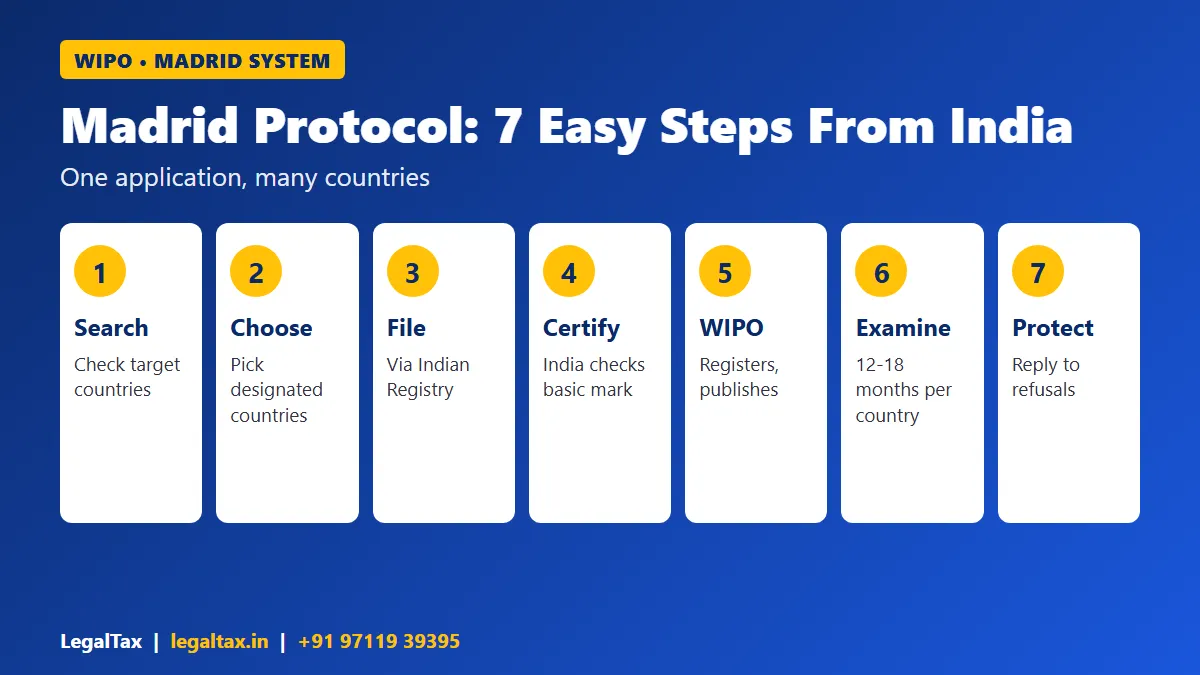
- Clearance search in each target country. A mark available in India may be taken abroad. See how to do a trademark search.
- Choose countries based on real sales, manufacturing and online plans.
- File the international application online with the Indian Trade Marks Registry as office of origin, listing the designated countries and goods.
- Certification by the Indian Registry, which checks the details against your basic mark and forwards the application to WIPO.
- WIPO examination and registration in the International Register, with publication in the WIPO Gazette.
- Examination by each designated country under its own law, with a 12 or 18 month window to refuse.
- Respond to refusals through local attorneys if needed, and receive protection country by country.
The registration lasts 10 years from the international registration date and is renewed centrally.
Madrid Protocol Fees
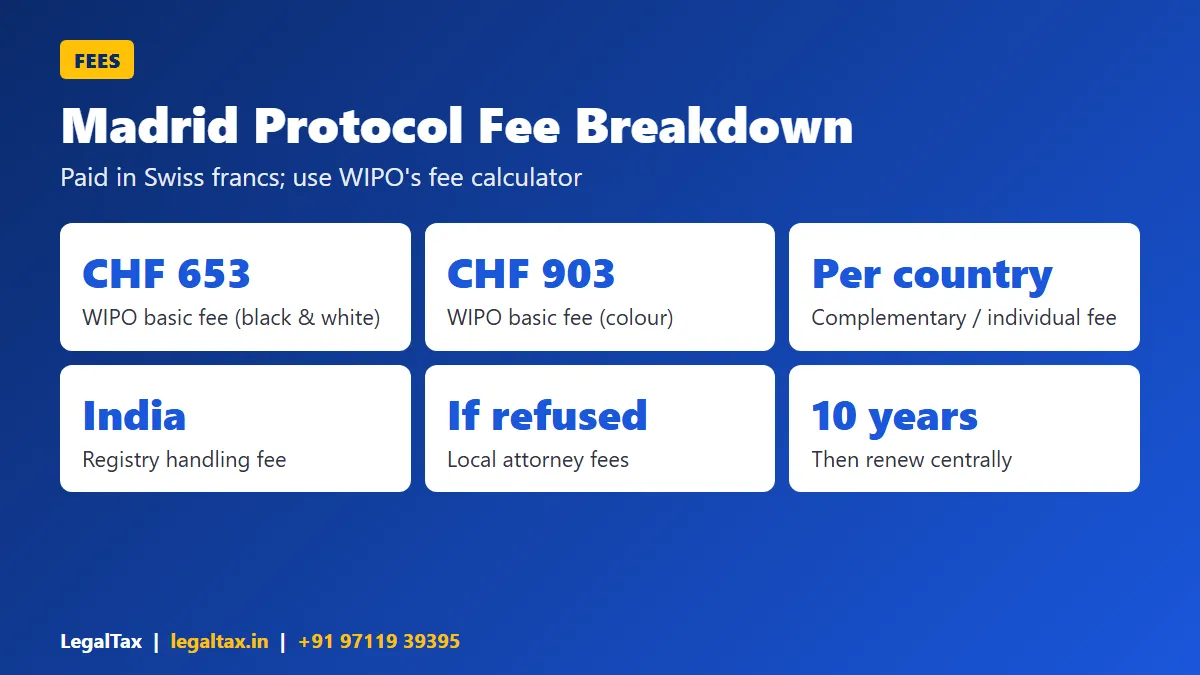
- Indian Registry handling fee for forwarding the application, as per the Trade Marks Rules fee schedule.
- WIPO basic fee: CHF 653 for a black-and-white mark, or CHF 903 for a colour mark.
- Country fees: a complementary fee or an individual fee for each designated country. Countries such as the US, Japan and the EU charge individual fees, which make up most of the cost.
- Local attorney fees only if a country raises an objection.
Use the WIPO fee calculator to get the exact WIPO fee for your countries and classes. Fees are in Swiss francs, so the rupee cost changes with the exchange rate.
Taking your brand abroad?
LegalTax handles Madrid filings from India, country selection and refusal replies.
The 5-Year Dependency and Central Attack
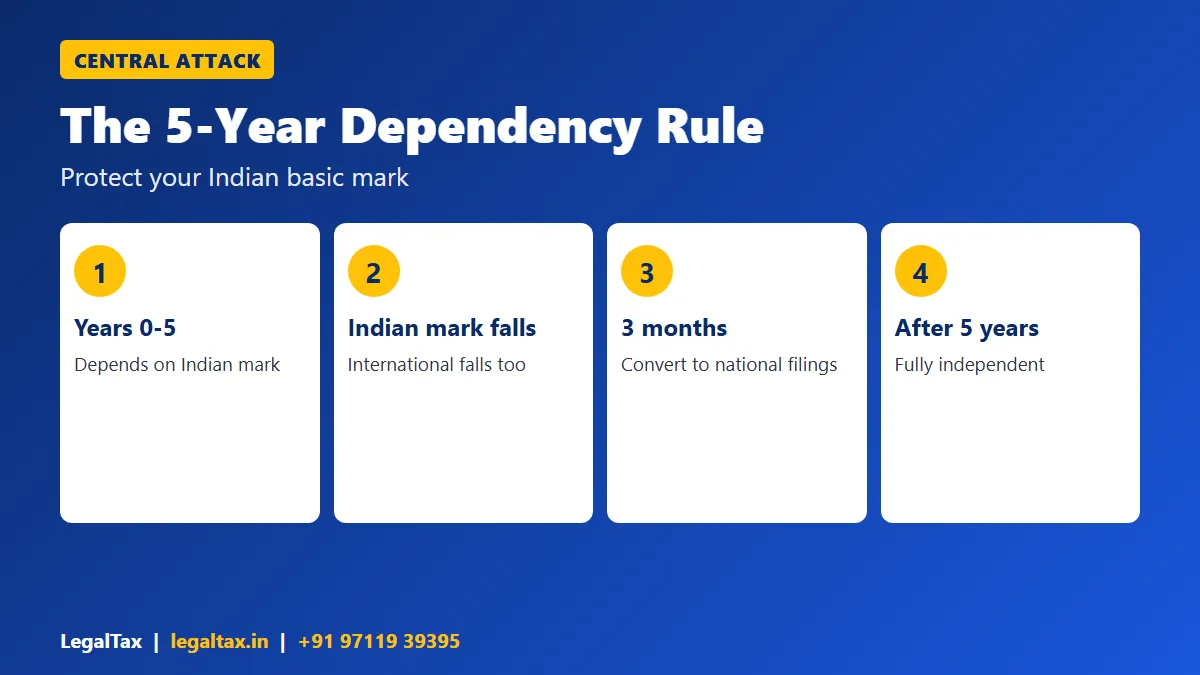
For five years from the international registration date, your international registration depends on the Indian basic mark. If the Indian application is refused, successfully opposed, withdrawn or cancelled in that period, the international registration is cancelled to the same extent in all designated countries. This risk is called central attack.
- File a strong, distinctive mark in India before going international.
- Handle any trademark objection carefully.
- Defend any trademark opposition in India seriously.
If a central attack succeeds, you can convert the international registration into national applications in each designated country within three months, keeping the original date. After five years, the international registration becomes independent of the basic mark.
Madrid Protocol vs Direct National Filing
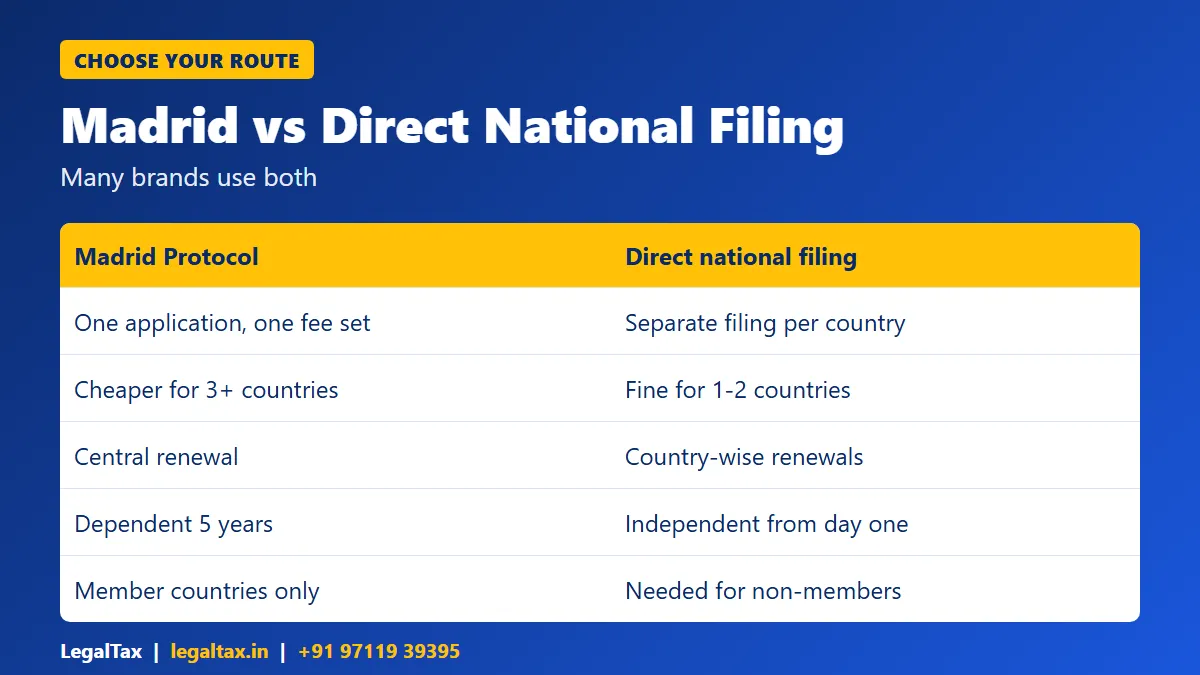
| Madrid Protocol | Direct national filing |
|---|---|
| One application, one language, one set of fees | Separate application and attorney in every country |
| Usually cheaper for three or more countries | Can be better for one or two countries |
| Central renewal and recording of changes | Renewals tracked country by country |
| Dependent on Indian mark for five years | Independent from day one |
| Only for member countries | Needed for non-member countries |
Many brands use both: the Madrid Protocol for most markets, and direct filings where a country is not a member or where local advice suggests a national filing.
Adding Countries Later: Subsequent Designation
Your plans will change. A subsequent designation lets you add new countries to an existing international registration at any time, paying fees only for the new countries. This keeps one registration number and one renewal date for your whole global portfolio, which makes the Madrid Protocol especially useful for growing brands.
Which Countries Should You Designate?
- Where you sell now, including major online marketplaces.
- Where you manufacture, because counterfeits often start at the factory.
- Where you plan to expand in the next two to three years.
- Where copycats are common in your industry.
Choosing designated countries by real business plans, not by guesswork, keeps costs under control.
How the Madrid Protocol Works Behind the Scenes
Understanding the three offices involved helps you track your application.
- Office of origin (India): the Indian Trade Marks Registry checks that your international application matches your Indian mark and certifies it.
- International Bureau (WIPO): checks formalities, classification and fees, records the mark in the International Register and notifies each country.
- Designated offices: each country’s trademark office examines the mark under its own law and either grants protection or issues a provisional refusal.
Because each designated office applies its own rules, a mark can be protected in some countries and refused in others. That is normal, and it does not affect protection where the mark is accepted.
Provisional Refusals: What to Expect
A provisional refusal is not a final rejection. It usually raises one of three issues: the goods description is too broad, the mark lacks distinctiveness in that country, or there is a conflicting earlier mark. You respond through a local attorney within the deadline set by that office. Many refusals are resolved by narrowing the goods description or filing arguments and evidence of use. Budget for possible refusals in key markets, especially the US, where descriptions are examined closely.
Documents and Information Needed
- Indian application or registration number and its details;
- Applicant’s name, address and legal status exactly as in the Indian file;
- A clear image of the mark, in colour if you claim colour;
- List of goods and services in each class, consistent with the Indian application;
- List of designated countries;
- Payment of the Indian handling fee and the WIPO fee.
Keeping these details identical to your Indian file avoids delays at the certification stage.
Madrid Protocol for Startups and D2C Brands
Startups selling online often reach foreign customers before they open any office abroad. Marketplaces such as Amazon run brand registry programmes that usually need a registered or pending trademark in the relevant country. The Madrid Protocol lets a startup protect its brand in priority markets early, at a predictable cost, and add more countries as it grows. Investors also check that the brand is protected in the markets in the pitch deck.
Madrid Protocol and Franchise Businesses
Restaurant, education and retail brands that plan to franchise abroad should secure their marks before signing franchise agreements. A franchisee in a country where your mark is unregistered could later dispute ownership. Registering through the Madrid Protocol first, and recording licences properly, keeps you in control of the brand in every franchise market.
Timeline at a Glance
- Search and country selection: one to two weeks.
- Indian certification and WIPO processing: usually a few months.
- Examination by designated offices: within 12 or 18 months.
- Protection confirmed country by country as each office decides.
Common Mistakes With the Madrid Protocol
- Skipping the search in target countries.
- Using broad goods descriptions that some countries reject as unclear.
- Filing internationally on a weak Indian mark likely to face objection.
- Ignoring a provisional refusal because there is no local attorney.
- Forgetting to record changes of owner or address centrally.
Managing Your Portfolio After Registration
Once registered, keep the portfolio healthy. Record assignments when the brand is sold or licensed (see trademark assignment), renew before the 10-year expiry (see trademark renewal), and monitor marketplaces for copycats. Famous Indian brands can also seek well-known trademark status in India.
Is the Madrid Protocol Right for Your Business?
The Madrid Protocol suits exporters, D2C brands selling online abroad, franchise businesses and startups raising international funding. It is less useful if you need only one non-member country. Exporters should also keep their IEC and Indian registrations in order, since buyers and platforms ask for them.
Country Notes: US, EU and UAE
United States
The US charges an individual fee per class and examines goods descriptions strictly. After registration, US protection also requires a declaration of use within the prescribed window around the fifth and sixth years, so plan genuine use of the mark in the US market.
European Union
Designating the European Union covers all EU member states with one designation, examined by the EU trademark office. It is often more cost-effective than designating several EU countries separately.
United Arab Emirates
The UAE is a member of the system, which makes it easier for Indian exporters and franchise brands to protect marks in an important Gulf market through one application.
Costs Beyond Official Fees
- Search reports in key countries before filing;
- Professional fees for preparing the application and tracking deadlines;
- Local attorney fees for responding to refusals;
- Translation, where an office asks for documents in its language;
- Renewal fees every 10 years and recordal fees for changes.
Plan these early so the total budget is realistic.
Real Example
A Delhi-based ayurvedic skincare brand began selling on international marketplaces and saw copycat listings in two countries. It already had an Indian application, so it filed one international application designating the US, UK, UAE and the European Union. The US raised a refusal on the goods description, which was fixed by narrowing the wording. Protection was granted in all four, and the brand used the registrations to remove copycat listings through marketplace brand-protection tools.
Checklist Before You File
- Indian application filed, with a distinctive mark and correct class;
- Searches done in priority countries;
- Goods described clearly and narrowly enough for strict offices;
- Country list linked to real sales and expansion plans;
- Budget approved for official fees and possible refusals;
- Deadline calendar set for responses, renewals and declarations.
Protecting Your Logo and Word Mark Abroad
Many Indian brands own both a word mark and a logo. Each international application covers one mark, so decide which to protect first. A word mark usually gives broader protection because it covers the name in any style. A logo protects the design and is useful where the visual identity matters, for example on packaging. Large brands often file both, starting with the word mark in priority markets and adding the logo later.
After Registration: Enforcing Your Rights Abroad
An international registration gives you the same rights in each country as a national registration there. To enforce them, you act under that country’s law, usually through a local lawyer or the platform’s brand-protection tools. Keep evidence of your use and sales in each market, monitor online marketplaces regularly, and act quickly against copycats, because delay can weaken your position in some countries.
Keeping Records Consistent
Use the same applicant name, address and mark details across your Indian and international files. If your company changes its name or address, record the change centrally with WIPO and in India. Inconsistent records are a common cause of problems during renewals, assignments and enforcement. A simple master sheet listing every application, its countries, deadlines and current owner details is enough for most small and mid-sized brands, and it makes handover easy if your team or advisers change.
Why Choose LegalTax?
- End-to-end international trademark registration under the Madrid Protocol.
- Indian filing, objection replies and international application under one roof. See our trademark services across India.
- Country-wise fee planning and coordination with local attorneys. Find your Indian office in our guide to trade marks registry offices, or contact us.
Conclusion
The Madrid Protocol lets an Indian business protect its brand in many countries with one application, based on its Indian trademark. Secure a strong Indian mark, search target markets, choose countries carefully, budget for WIPO and country fees, and protect the Indian mark during the five-year dependency. Used well, the Madrid Protocol is the most cost-effective path to international trademark registration.
How can I register my trademark internationally from India?
Use the Madrid Protocol. File an international application through the Indian Trade Marks Registry, based on your Indian trademark application or registration, and designate the countries where you want protection. The Registry certifies and forwards it to WIPO, which registers it and sends it to each designated country for examination.
Do I need an Indian trademark before filing under the Madrid Protocol?
Yes. You need an Indian application or registration for the same mark, called the Indian mark. It does not have to be registered yet; a pending application is enough to file. The international application must cover the same or narrower goods and services than your Indian application or registration in every case.
What is the WIPO fee for a Madrid application?
The WIPO basic fee is CHF 653 for a black-and-white mark or CHF 903 for a colour mark. On top of that, you pay a complementary or individual fee for each designated country, plus the Indian Registry’s handling fee. WIPO’s online fee calculator gives the exact total for your chosen countries and classes.
What is central attack in the Madrid Protocol?
Central attack means that if your Indian Indian mark is refused, successfully opposed, withdrawn or cancelled within five years of the international registration, the international registration falls to the same extent in every designated country. You can convert it into national applications within three months while keeping the original filing date.
How long does international trademark registration take?
WIPO usually registers the application within a few months of receiving it. Each designated country then has 12 or 18 months to issue a provisional refusal. So for most applicants, the position of international trademark registration in every chosen country becomes clear within about 12 to 18 months of filing.
Can I add more countries later?
Yes. A subsequent designation lets you add new countries to an existing international registration at any time. You pay fees only for the new countries, and the registration keeps one number and one renewal date. This makes it easy to expand protection as your business enters new markets over the years.

Adv. Manish Kashyap is an IPR Law Expert with 10+ years of professional experience in Intellectual Property Rights. He specializes in matters related to Trademark, Copyright, Patent, and other IPR-related legal services, helping individuals and businesses protect and manage their intellectual property effectively.
Our Clients