Views: 35
Why Understanding the Relationship Between GST Registration and IEC Code Is Essential for Every Indian Importer and Exporter
India’s regulatory framework for businesses engaged in international trade involves multiple registrations, compliance obligations, and government databases that must work together seamlessly. Among these, two registrations stand out as the most foundational for any business involved in cross-border transactions: GST registration under the Central Goods and Services Tax Act 2017, and the Import Export Code issued by the Directorate General of Foreign Trade under the Ministry of Commerce and Industry.
Most Indian business owners who are new to international trade understand that they need both a GST registration and an IEC code to operate legally. What far fewer understand is how these two registrations relate to each other, how they interact in practice during actual import and export transactions, what happens when information in one registration does not match the other, how GST refunds on exports are linked to the IEC, and what the compliance implications are when either registration is absent, incorrect, or mismatched with the other.
Understanding the relationship between GST registration and IEC code is not just academic knowledge. It has direct and practical consequences for your ability to clear customs, claim GST refunds on exports, access Foreign Trade Policy benefits, receive foreign remittances without regulatory complications, and maintain clean compliance records with both the GST department and the DGFT simultaneously.
This complete guide covers every dimension of the relationship between GST registration and IEC code, from the foundational linkage between the two systems to the practical compliance implications for importers and exporters operating in India in 2026.
For expert GST compliance support, IEC registration assistance, and comprehensive tax legal services for your import export business, visit LegalTax.in or call our team directly at +91 9711939395.
Table of Contents
- 1 Understanding GST Registration: The Foundation of Domestic Tax Compliance
- 2 Understanding the IEC Code: The Gateway to International Trade
- 3 The Direct Relationship Between GST Registration and IEC Code in Practice
- 4 GST Registration Is Mandatory for Export Benefits: The Zero-Rating Framework
- 5 The GSTIN in Shipping Bills and Bills of Entry: Why Consistency Matters
- 6 Situations Where GST Registration and IEC Code Must Be Reconciled
- 7 Mandatory Annual Update of IEC and Its GST Implications
- 8 Service Exporters: A Special Case in the GST-IEC Relationship
- 9 GST Refund Process for Exporters: Where GST and IEC Come Together
- 10 Foreign Trade Policy Benefits Requiring Both GST and IEC Compliance
- 11 Common Compliance Mistakes at the Intersection of GST and IEC
- 12 Building a Compliant Import Export Business: The Complete Registration and Compliance Framework
- 13 FAQs
- 14 Conclusion: GST Registration and IEC Code Are Two Halves of the Same Compliance Framework for Indian Importers and Exporters
Understanding GST Registration: The Foundation of Domestic Tax Compliance
What GST Registration Means for a Business
GST registration is the process through which a business obtains a Goods and Services Tax Identification Number, universally known as GSTIN, from the GST department. Once registered, the business is legally authorized to collect GST from its customers on taxable supplies, claim input tax credit on its purchases, and file periodic GST returns reporting its tax transactions to the government.
GST registration is mandatory for businesses whose aggregate annual turnover exceeds the prescribed threshold, which is currently Rs. 40 lakhs for goods suppliers and Rs. 20 lakhs for service providers in most states, with lower thresholds applicable in certain special category states. It is also mandatory for certain categories of businesses regardless of turnover, including businesses making inter-state supplies, e-commerce operators, and those required to pay tax under the reverse charge mechanism.
For businesses engaged in export of goods or services, GST registration takes on additional significance because exports are treated as zero-rated supplies under the GST framework, meaning that the exporter can either export without payment of IGST under a Letter of Undertaking and claim refund of accumulated ITC, or export with payment of IGST and claim refund of the IGST paid. Both of these export benefits are available only to GST-registered exporters.
The GSTIN: A Unique Identifier Across All Tax Systems
The GSTIN is a fifteen-digit alphanumeric code that serves as the unique identifier of a registered taxpayer in the GST system. The first two digits represent the state code, the next ten digits are the PAN of the taxpayer, the thirteenth digit represents the number of registrations in the same state for the same PAN, the fourteenth digit is typically Z, and the fifteenth digit is a checksum. This structure means that the GSTIN is inherently linked to the PAN of the taxpayer, which is the same PAN that forms the basis of the IEC issued by the DGFT.
Understanding the IEC Code: The Gateway to International Trade
What the IEC Code Means for a Business
The Import Export Code is a ten-digit identification number issued by the DGFT that is mandatory for any person or entity engaging in import or export of goods from India. The IEC is linked to the PAN of the applicant, and for a given PAN, only one IEC is issued regardless of the number of business locations or branches the entity has. This one-PAN-one-IEC principle is a foundational feature of the IEC system that distinguishes it from GST registration, where a business may have multiple GSTINs across different states.
The IEC is required at every stage of the import export process. Customs authorities require the IEC for clearance of imported goods and for processing export shipping bills. Banks require the IEC for processing foreign currency transactions, opening foreign currency bank accounts, and handling foreign remittances related to trade. The DGFT requires the IEC for processing applications under various Foreign Trade Policy schemes and incentive programs.
The PAN-Based Linkage Between IEC and GST
The most fundamental structural link between GST registration and IEC code is that both are anchored to the PAN of the business entity. The IEC is the PAN itself in the new IEC system introduced by the DGFT, where the ten-digit IEC is identical to the ten-digit PAN of the entity. This integration, introduced as part of the government’s initiative to reduce the compliance burden on businesses and create interoperability between different regulatory systems, means that the PAN serves as a common thread connecting the income tax identity, the GST identity, and the foreign trade identity of every business in India.
For trademark and brand protection of your import export business identity across both domestic and international markets, visit OnlineTrademarkIndia.com for professional trademark registration services tailored to Indian businesses engaged in cross-border trade.
The Direct Relationship Between GST Registration and IEC Code in Practice
How GST and IEC Data Flow Together in Export Transactions
When an Indian exporter ships goods to an overseas buyer, the export transaction creates a flow of data across multiple government systems that must be consistent and matching. The exporter files a Shipping Bill with Indian Customs through the ICEGATE platform. The Shipping Bill contains the exporter’s IEC, the exporter’s GSTIN, the invoice details, the description and value of goods, and the destination country. This Shipping Bill data flows into the GST system where it is matched against the exporter’s GST returns, particularly the Table 6A of GSTR-1 where export invoices are reported.
For the GST refund on exports to be processed correctly, the data in the Shipping Bill filed with Customs must match the data in the exporter’s GSTR-1. The IEC and GSTIN of the exporter must be consistent across both systems. Any mismatch between the IEC in the Shipping Bill and the GSTIN in the GSTR-1 can block the processing of GST refunds and create compliance complications that take significant time and effort to resolve.
How GST and IEC Data Flow Together in Import Transactions
When an Indian importer clears goods at Indian Customs, the Bill of Entry filed with Customs contains the importer’s IEC, the importer’s GSTIN, the invoice details from the overseas supplier, the description and value of goods, and the applicable customs duty and IGST amounts. The IGST paid on imports at the customs point is available as ITC to the importer in their GST electronic credit ledger, flowing in through the import data in GSTR-2B.
For this ITC flow to work correctly, the GSTIN in the Bill of Entry must match the GSTIN of the importing entity in the GST portal. If the GSTIN is missing from the Bill of Entry or does not match the entity’s registered GSTIN, the import IGST will not appear in the entity’s GSTR-2B and the ITC cannot be claimed, representing a direct financial loss to the importer.
For all compliance matters related to import IGST, ITC on imports, customs duty accounting, and GST implications of your international trade transactions, visit LegalTax.in or call our experts at +91 9711939395 for comprehensive support.
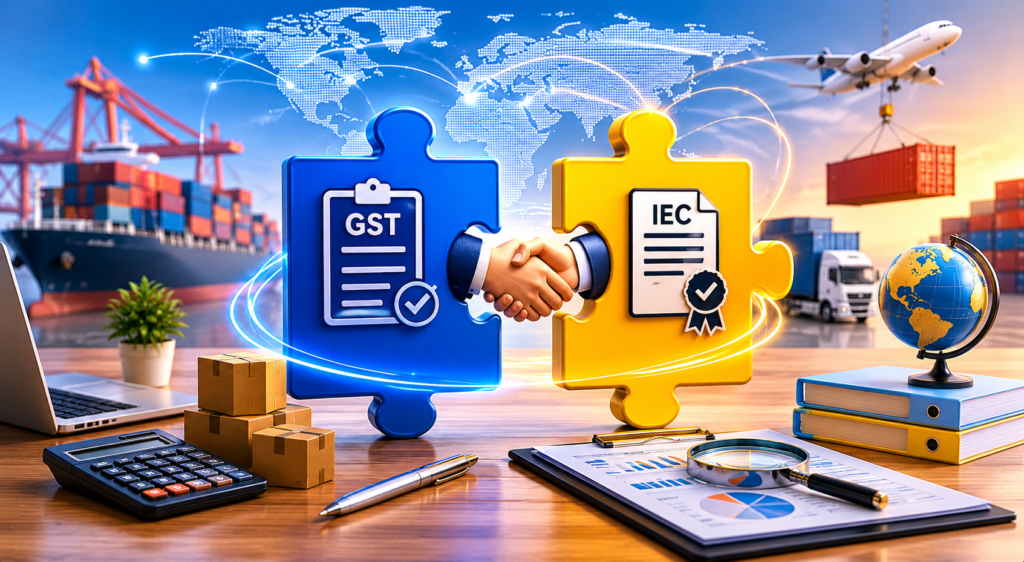
GST Registration Is Mandatory for Export Benefits: The Zero-Rating Framework
Exports as Zero-Rated Supplies Under GST
One of the most commercially important aspects of the relationship between GST registration and IEC code is the GST treatment of exports. Under Section 16 of the Integrated Goods and Services Tax Act 2017, the supply of goods or services for export is treated as a zero-rated supply. Zero-rated supply means that the output is taxed at zero rate, but unlike exempt supplies, the exporter is entitled to claim ITC on the inputs used in making the zero-rated supply.
This treatment of exports as zero-rated supplies is what makes GST registration indispensable for exporters, even for those whose domestic turnover might be below the mandatory registration threshold. Without GST registration, an exporter cannot access the zero-rated supply framework, cannot claim ITC on export-related inputs, and cannot access either of the two mechanisms for GST relief on exports.
The Two Mechanisms for GST Relief on Exports
Export Under LUT Without Payment of IGST
The first and most commonly used mechanism for GST relief on exports is export under a Letter of Undertaking without payment of IGST. Under this mechanism, a GST-registered exporter files a LUT on the GST portal at the beginning of each financial year undertaking to export the goods or services within the prescribed time period. Once the LUT is accepted, the exporter can export without collecting or paying IGST on the export supply and can claim a refund of the accumulated ITC that has built up on their export-related inputs.
The LUT facility is available only to GST-registered exporters who have a clean GST compliance record with no conviction for any offence under the CGST Act or IGST Act involving tax evasion exceeding Rs. 250 lakhs. Businesses that do not meet this clean record requirement must export under bond instead of LUT.
Export With Payment of IGST and Claim Refund
The second mechanism is to export with payment of IGST on the export invoice and then claim a refund of the IGST paid. Under this mechanism, the exporter charges IGST on the export invoice at the applicable rate, pays this IGST to the government through GSTR-3B, and then files for a refund of the paid IGST through the GST refund mechanism. The refund is processed based on the matching of Shipping Bill data with GSTR-1 data in the GST system.
For expert guidance on which export mechanism is appropriate for your specific business, LUT filing, GST refund on exports, and all GST compliance for your export operations, visit LegalTax.in or call +91 9711939395.
The GSTIN in Shipping Bills and Bills of Entry: Why Consistency Matters
Mandatory Quoting of GSTIN in Export Documents
The GSTIN of the exporter is a mandatory field in all export Shipping Bills filed with Indian Customs. This requirement ensures that the export transaction is linked to the exporter’s GST identity, enabling the automated matching of export data between the Customs system and the GST system that drives the refund processing mechanism.
If the wrong GSTIN is quoted in a Shipping Bill, or if the Shipping Bill is filed without a GSTIN, the export transaction will not match with the exporter’s GSTR-1, which will block GST refund processing. Correcting a GSTIN error in a filed Shipping Bill requires an amendment process at Customs that can be time-consuming and may require additional documentation and approvals.
Mandatory Quoting of GSTIN in Import Bills of Entry
Similarly, the GSTIN of the importer is a mandatory field in Bills of Entry filed at the time of customs clearance of imported goods. The IGST paid on imports flows to the importer’s GSTR-2B only when the correct GSTIN is quoted in the Bill of Entry. If the GSTIN is missing or incorrect, the import IGST does not appear in GSTR-2B, and the importer loses the ability to claim ITC on that import transaction.
For businesses that import goods through multiple ports or through freight forwarders and customs brokers, ensuring that the correct GSTIN is always quoted in every Bill of Entry is an operational discipline that directly protects the ITC entitlement on every import transaction.
Situations Where GST Registration and IEC Code Must Be Reconciled
Business Name and Address Consistency
The business name and registered address must be consistent across both the GST registration certificate and the IEC registration. When these details differ, whether due to an address change that was updated in one system but not the other, or due to a name variation that was not standardized across registrations, it can create complications in customs clearance, bank foreign exchange transactions, and DGFT benefit applications.
A business that has undergone a name change must ensure that the name change is updated in both the GST registration and the IEC registration simultaneously. Similarly, an address change must be reflected in both systems.
When a Business Has Multiple GST Registrations
A business may have multiple GST registrations across different states if it has business operations in multiple states. However, because the IEC is issued against the PAN and there is only one IEC per PAN, a business with GST registrations in five states has five GSTINs but only one IEC.
In this situation, the IEC and the primary GSTIN of the business, typically the GSTIN of the state from which export operations are primarily conducted, are linked in the DGFT portal. For export transactions originating from different state registrations, the relevant GSTIN for that state must be quoted in the Shipping Bill, and the exporter must ensure that the export invoice and GSTR-1 filing in the relevant state’s registration correctly captures the export transaction.
When GST Registration Is in a Different State from the Port of Export
A common practical challenge arises when a business’s GST registration is in one state but its exports are shipped from a port in another state. For example, a manufacturer in Rajasthan shipping goods from the Mundra Port in Gujarat. In such cases, the GSTIN in the Shipping Bill will be the Rajasthan GSTIN of the exporter, and the export data must be reported in the Rajasthan GSTIN’s GSTR-1 for the refund to be processed correctly.
Understanding how to handle cross-state export transactions in the GST compliance framework is an area where professional guidance adds significant value. For expert support on GST compliance for cross-state export operations, visit LegalTax.in or contact our team at +91 9711939395.
Mandatory Annual Update of IEC and Its GST Implications
The Annual IEC Update Requirement
The DGFT requires all IEC holders to update or confirm their IEC details on the DGFT portal once every financial year, during the April to June window. During this annual update, the IEC holder must verify that all the information in the IEC registration is current and accurate, including the entity name, address, bank details, and importantly, the linked GSTIN.
If the GSTIN linked to the IEC in the DGFT portal is outdated or incorrect, the annual update process is the opportunity to correct this linkage. Failure to complete the annual IEC update results in the IEC becoming inactive, which means the business cannot use the IEC for import or export transactions until it is reactivated by completing the update.
Linking and Updating GSTIN in the IEC Registration
The DGFT portal allows IEC holders to link their GSTIN to their IEC. For businesses with GST registrations in multiple states, the primary GSTIN used for export operations should be linked. Businesses that obtain new GST registrations after their IEC was issued must update the IEC to reflect the new GSTIN linkage.
The GSTIN linkage in the IEC system is important because it enables the DGFT to access GST return data when processing applications under Foreign Trade Policy schemes, verifying export performance for Status Holder certification, and processing duty credit scrips and other export incentives.
Service Exporters: A Special Case in the GST-IEC Relationship
Services Are Not Covered by IEC in Most Cases
The IEC requirement under the Foreign Trade Policy applies primarily to the import and export of goods. Service exporters, meaning businesses that provide services to overseas clients and receive foreign currency remittances for those services, do not strictly require an IEC for the purpose of the service transaction itself, as services are not physical goods that pass through customs.
However, service exporters who wish to avail benefits under the Foreign Trade Policy, particularly the Service Exports from India Scheme and its successor schemes, are required to have an IEC. Additionally, any service exporter who also exports goods, or who imports goods related to their service business, requires an IEC for those goods transactions.
GST Compliance for Service Exporters
For GST purposes, export of services is also treated as a zero-rated supply under the IGST Act 2017, provided the conditions of the definition of export of services are met, including receipt of payment in convertible foreign exchange. Service exporters with GST registration can export services under LUT without payment of IGST and claim refund of accumulated ITC, or export with payment of IGST and claim refund.
For service exporters, the GST-IEC relationship is less directly operational than for goods exporters, but the GST compliance obligations for zero-rated service exports are equally important for accessing refunds and maintaining clean compliance records.
For intellectual property protection for service exporters, including copyright registration for exported software and creative works, and trademark registration for service brands offered internationally, visit LegalIP.in for comprehensive IP protection services tailored to Indian service exporters.
GST Refund Process for Exporters: Where GST and IEC Come Together
The Automated Refund Processing System
The GST refund process for exporters is designed to be largely automated, with the Customs system and the GST system sharing data to enable refund processing without the exporter needing to manually file refund applications for most export transactions. This automated system works as follows.
When a Shipping Bill is filed at Customs and the goods are exported, the Customs system transmits the Shipping Bill data including the IEC, GSTIN, invoice details, and export value to the GSTN. The GSTN matches this Shipping Bill data with the export invoice data reported by the exporter in Table 6A of their GSTR-1 for the relevant period. When the data matches, the refund claim is automatically generated and processed through the banking channel.
For this automated matching to work, the invoice number, date, value, and other details in the Shipping Bill must exactly match the corresponding data in the GSTR-1. Even minor variations such as a space difference in the invoice number or a decimal point variation in the value can cause matching failures that block automated refund processing and require manual intervention.
Manual Refund Applications When Automated Processing Fails
When the automated matching fails due to data discrepancies or other reasons, the exporter must file a manual refund application through Form GST RFD-01 on the GST portal. Manual refund applications require submission of supporting documents including copies of Shipping Bills, export invoices, bank realization certificates for advance payment or FIRC for post-shipment realizations, and a statement of invoices covered by the refund application.
For professional assistance with GST export refund applications, refund claim preparation, response to deficiency memos from the GST department, and all aspects of export GST compliance, contact LegalTax.in or call +91 9711939395 for expert support.
Foreign Trade Policy Benefits Requiring Both GST and IEC Compliance
Advance Authorisation Scheme
The Advance Authorisation scheme allows eligible exporters to import inputs duty-free for use in the manufacture of export products. To avail this benefit, the applicant must have a valid IEC and must be GST compliant. The DGFT verifies GST return filing status as part of the eligibility assessment for Advance Authorisation. Businesses with irregular GST filing histories may face difficulties in obtaining Advance Authorisation approvals.
Export Promotion Capital Goods Scheme
The EPCG scheme allows exporters to import capital goods at concessional customs duty rates against an export obligation. Eligibility for the EPCG scheme requires a valid IEC and GST compliance. The export obligation fulfillment is verified through Shipping Bill data that is linked to the IEC and GSTIN of the exporter.
Remission of Duties and Taxes on Exported Products
The RoDTEP scheme provides reimbursement of embedded duties and taxes on exported products that are not rebated through any other mechanism. The RoDTEP benefits are credited as transferable duty credit scrips in the IEC holder’s account on the ICEGATE portal. These scrips are issued based on verified Shipping Bill data that links the export transaction to the IEC and the GSTIN of the exporter.
For all DGFT scheme applications, export benefit claims, compliance management for Foreign Trade Policy obligations, and comprehensive export import legal support for your business, visit LegalTax.in and LegalIP.in for expert professional services.
Common Compliance Mistakes at the Intersection of GST and IEC
Filing Exports in Wrong GSTR-1 Registration
A common mistake among businesses with multiple GST registrations is filing export invoices in the GSTR-1 of a state registration that is different from the GSTIN quoted in the Shipping Bill. This mismatch between the GSTIN in the Shipping Bill and the GSTIN in the GSTR-1 where the export is reported breaks the automated matching and blocks refund processing. All export invoices must be reported in the GSTR-1 of the specific GSTIN quoted in the corresponding Shipping Bill.
Not Filing LUT Before the Financial Year Begins
Many exporters fail to file their LUT for the new financial year before starting exports in April. Without a valid LUT for the current financial year, exports must be made with payment of IGST, which creates a cash flow burden. The LUT must be filed and accepted on the GST portal before the first export of each financial year to ensure seamless zero-rated export without tax payment.
GSTIN Not Updated in DGFT Portal After New Registration
When a business obtains a new GST registration, particularly for a new state or after restructuring, the new GSTIN must be updated in the DGFT portal to link it to the IEC. Failure to update the GSTIN in the DGFT portal can cause complications when the business attempts to use the new GSTIN in Shipping Bills while the DGFT portal still shows the old GSTIN linked to the IEC.
Bank Not Informed of Both GSTIN and IEC
Banks handling foreign exchange transactions for import export businesses require both the IEC and the GSTIN of the business for processing foreign currency remittances, opening export or import LCs, and handling FEMA compliance for cross-border transactions. Ensuring that your bank’s records are updated with both the current IEC and the current GSTIN is an important operational step that is sometimes overlooked.
For comprehensive compliance management covering both GST and DGFT obligations for your import export business, proactive compliance calendar management, and expert guidance on avoiding common compliance pitfalls at the GST-IEC intersection, visit LegalTax.in or call our team at +91 9711939395.
Building a Compliant Import Export Business: The Complete Registration and Compliance Framework
Step One: Ensure Both Registrations Are in Place and Correctly Linked
The foundation of a compliant import export business is having both GST registration and IEC registration in place, with the GSTIN correctly linked to the IEC in the DGFT portal. Verify that the entity name, PAN, and address are consistent across both registrations. Any inconsistencies should be corrected before beginning import export operations.
Step Two: File LUT at the Beginning of Each Financial Year
Every GST-registered exporter who exports goods without payment of IGST must file a fresh LUT at the beginning of each financial year. This should be a standing item on the compliance calendar for every export business, to be completed before the 1st of April each year to ensure seamless export operations from the first day of the financial year.
Step Three: Maintain Consistent Invoice Data Across All Systems
The invoice data used in export transactions must be consistent across all systems: the export invoice issued to the overseas buyer, the data entered in the Shipping Bill filed with Customs, and the export invoice data reported in GSTR-1. Any variation between these three data sets will cause matching failures and block automated GST refund processing.
Step Four: Complete the Annual IEC Update
Complete the DGFT’s annual IEC update process during the April to June window every year. Verify that all information including the GSTIN linkage is current and accurate. This annual update keeps the IEC active and ensures that the DGFT’s records remain aligned with the current status of the business.
Step Five: Protect Your Brand and IP Assets
As your import export business grows, protect your brand through trademark registration and protect your products and creative assets through copyright and design registration. An established export brand without trademark protection is vulnerable to being copied in domestic and international markets. For trademark registration and comprehensive IP protection for your export business, visit OnlineTrademarkIndia.com and LegalIP.in.
FAQs
Q1. Is GST registration mandatory for getting an IEC code in India?
No. GST registration is not compulsory for obtaining an Import Export Code (IEC). Businesses can apply for an IEC without GST registration in many cases.
Q2. Are GST and IEC the same thing?
No. GST registration is for taxation and compliance within India, while an IEC code is required for importing and exporting goods and services internationally.
Q3. Why do businesses often need both GST and IEC?
Businesses involved in international trade generally require both. IEC enables import-export activities, while GST helps manage tax compliance and claim benefits like refunds on exports.
Q4. Can I export goods with an IEC code but without GST registration?
It depends on the business structure and turnover. Certain exporters may operate with IEC alone initially, but GST registration can become mandatory based on turnover limits or business activities.
Q5. Does GST help in claiming export benefits after obtaining an IEC?
Yes. GST registration can help exporters claim input tax credits, refunds, and other export-related tax benefits after obtaining an IEC.
Conclusion: GST Registration and IEC Code Are Two Halves of the Same Compliance Framework for Indian Importers and Exporters
The relationship between GST registration and IEC code is not merely administrative. It is structural and operational. Both registrations are anchored to the same PAN. Both must carry consistent entity information. Both are linked in government systems that share data to process refunds, verify compliance, and administer trade benefits. When both registrations are in order and correctly aligned with each other, the compliance machinery of India’s import export regulatory framework works smoothly and efficiently. When they are misaligned, the consequences cascade across customs clearance, GST refund processing, DGFT benefit claims, and foreign exchange management.
Every Indian business engaged in international trade must treat GST registration and IEC code not as two separate compliance boxes to be ticked independently but as two interconnected components of a unified compliance framework that must be managed together with the same attention and professionalism.
Get both registrations right. Keep them updated and aligned. File your LUT on time. Report your exports correctly in GSTR-1. Ensure your GSTIN is in every Shipping Bill and Bill of Entry. Complete the annual IEC update without fail. And build your international trade operations on the foundation of complete and accurate compliance with both the GST system and the DGFT system simultaneously.
For expert GST and IEC compliance management, export refund processing, LUT filing, DGFT scheme applications, and comprehensive tax and trade legal support for your import export business, call directly at +91 9711939395 to speak with an expert today.
For trademark registration and brand protection for your export business in India and international markets, visit OnlineTrademarkIndia.com. For intellectual property strategy, copyright registration, design protection, and comprehensive IP legal support for your business and its products, visit LegalIP.in.
Register correctly. Link accurately. Trade compliantly.

Adv. Manish Kashyap is an IPR Law Expert with 10+ years of professional experience in Intellectual Property Rights. He specializes in matters related to Trademark, Copyright, Patent, and other IPR-related legal services, helping individuals and businesses protect and manage their intellectual property effectively.
Our Clients