Views: 93
A Trademark Hearing Online in Delhi is a virtual proceeding where the applicant or authorized attorney explains why a trademark application should be accepted despite objections. The process involves checking the hearing notice, preparing the examination report response and supporting evidence, attending the video hearing, answering the Hearing Officer’s questions, and awaiting an order to accept, adjourn, or refuse the application.
Trademark Hearing Online in Delhi is a video-conference proceeding before a Trademark Registry Hearing Officer where an applicant explains why their trademark application should be accepted despite objections raised in the examination report. Held under Rule 115 of the Trade Marks Rules, 2017, it lets applicants or their attorneys join from anywhere, present evidence, and get a decision on acceptance, refusal, or adjournment — without traveling to the Delhi Trademark Office.
If you have just checked your application status and seen “Ready for Show Cause Hearing,” you are probably feeling two things at once: relief that your file is finally moving, and worry about what a “hearing” actually involves. You are not alone. Thousands of business owners, startups, and brand owners across Delhi get this same status update every month, and most of them have never sat through a legal hearing of any kind before.
Here is the good news. A trademark hearing is not a courtroom trial. It is a structured, fairly predictable conversation with a Hearing Officer at the Trademark Registry, and it is now conducted almost entirely online. With the right preparation, most applicants can walk away with an accepted mark — even after receiving objections earlier in the process.
A Show Cause Hearing notice usually shows up because the Examiner was not fully satisfied with your written reply to the examination report, because the objection involved a legal ground under Section 9 or Section 11 of the Trade Marks Act, 1999, or because supporting evidence was incomplete. A common misconception is that a hearing notice means your trademark is being rejected — it does not. It simply means the Registry wants to hear directly from you before making a final call.
In this 2026 guide, you will learn exactly what a Trademark Hearing Online in Delhi involves, why the Registry issues a Show Cause Hearing, who must attend, the full step-by-step hearing process, documents you need, how to argue your case in front of the Hearing Officer, what happens after the hearing, and the mistakes that most often cause applicants to lose a winnable case. We have also included a real-world example, a short case study, expert tips, and answers to the questions people ask most.
Table of Contents
- 1 What Is Trademark Hearing Online in Delhi?
- 2 Why Does the Trademark Registry Issue a Show Cause Hearing?
- 3 Who Needs to Attend a Trademark Hearing?
- 4 Can Trademark Hearings Be Attended Online?
- 5 Trademark Hearing Process in Delhi (Step-by-Step)
- 6 Documents Required Before the Hearing
- 7 How to Prepare for a Trademark Hearing
- 8 How to Present Arguments Before the Hearing Officer
- 9 What Happens After the Hearing?
- 10 Common Mistakes to Avoid
- 11 Expert Tips to Increase Approval Chances
- 12 Real-Life Example
- 13 Short Case Study
- 14 Legal Pro Tips
- 15 Latest Trademark Hearing Updates (2026)
- 16 Frequently Asked Questions
- 17 Trademark Hearing Complete Checklist
- 18 Conclusion
What Is Trademark Hearing Online in Delhi?
A Trademark Hearing Online in Delhi is a virtual proceeding conducted by the Trade Marks Registry, Delhi branch, where a Hearing Officer reviews your application, listens to your arguments, and decides whether your trademark should be accepted, adjourned, or refused. It happens after your written reply to an objection has not fully satisfied the Examiner, and it is one of the final checkpoints before your mark reaches the Trademark Journal for public advertisement.
Rule 115 of the Trade Marks Rules, 2017, expressly allows a hearing to be held through video-conferencing or any other audio-visual communication device, and treats the hearing as having taken place at the appropriate Registry office even when conducted this way. In practice, this means an applicant sitting in Delhi — or anywhere else in India — can attend the hearing from a laptop rather than commuting to the Trademark Registry office.
The Delhi Trademark Office is one of the five branches of IP India (the others being Mumbai, Chennai, Kolkata, and Ahmedabad), and it handles applications filed with Delhi as the appropriate office based on the applicant’s principal place of business or address for service.
Did You Know? The IP India portal maintains Dynamic Hearing Cause Lists and Virtual Hearing Rooms specifically so applicants and attorneys can check hearing dates and join proceedings online.
Why Does the Trademark Registry Issue a Show Cause Hearing?
A Trademark Show Cause Hearing is triggered when your written reply to the examination report does not fully satisfy the Registrar, and the matter is escalated to a proceeding before the Registrar of Trade Marks where you or your authorized attorney get a direct opportunity to argue against the objection. Under the Trade Marks Rules, 2017, if the response to the examination report is not satisfactory, or if the applicant has specifically requested a hearing, the Registrar must provide an opportunity of hearing as per Rule 115.
In simple terms: the Examiner read your reply, was not fully convinced, and wants you to explain your case in person (virtually) before deciding.
Common Reasons for Trademark Objections
Most Show Cause Hearings trace back to one or more of these objection types:
| Reason for Objection | Legal Ground | What It Usually Means |
|---|---|---|
| Mark is too generic or descriptive | Section 9(1)(b) | The mark simply describes the product/service, e.g., “Fresh Bakery” for a bakery |
| Similar or identical prior mark exists | Section 11(1) | An earlier registered or pending mark looks/sounds too similar |
| Mark lacks distinctive character | Section 9(1)(a) | The mark does not clearly identify a single source of goods/services |
| Mark is deceptive or causes confusion | Section 9(2)(a) | The name misleads the public about nature, quality, or origin |
| Incomplete or mismatched Form TM-A details | Rule 25/procedural | Applicant details, class, or goods/services description errors |
| Mark contains a restricted word or symbol | Section 9(2)(d), Emblems Act | Use of national symbols, government references, etc. |
Who Needs to Attend a Trademark Hearing?
The applicant, or an authorized trademark attorney/agent holding a Power of Attorney (Form TM-48), can attend on the applicant’s behalf. In most cases, businesses prefer to send their trademark attorney because the arguments involve legal grounds under the Trademark Act, 1999, and case law references that a legal professional is better placed to present.
- Individual applicants filing their own mark may attend personally.
- Startups and MSMEs usually authorize a trademark attorney or IP consultant.
- Companies and brand owners typically send in-house legal counsel or an external trademark attorney.
- Multiple applicants (joint ownership) may need all parties represented, or one authorized representative for all.
Can Trademark Hearings Be Attended Online?
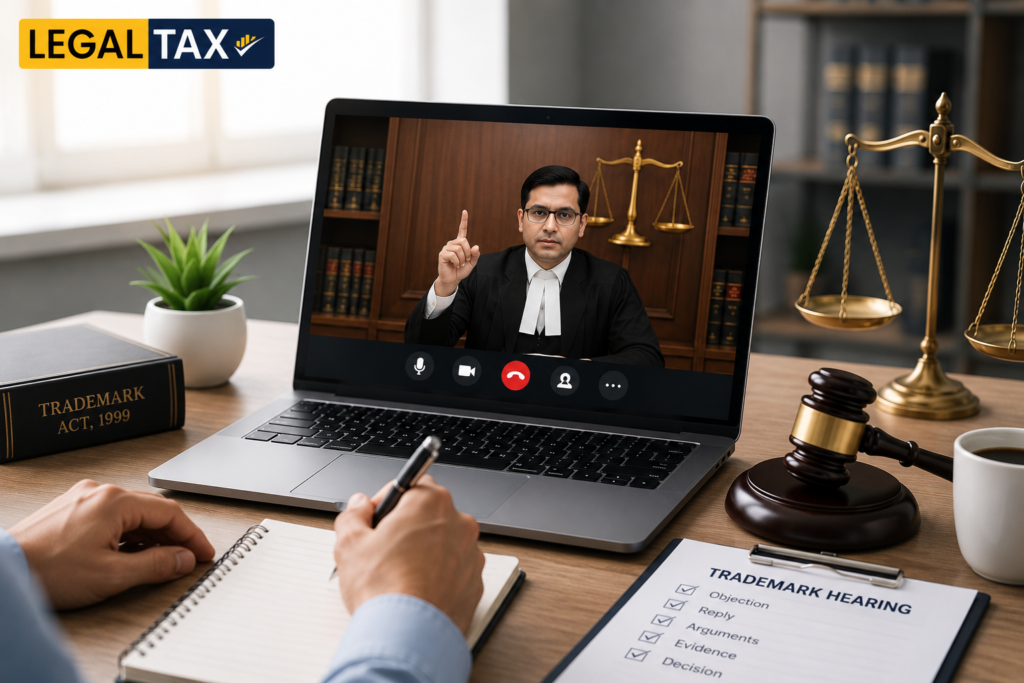
Yes. Trademark hearings are conducted online by default under Rule 115 of the Trade Marks Rules, 2017, typically through video-conferencing platforms, with the link and login details shared by email or on the IP India portal a few days in advance. This means a Trademark Hearing Online in Delhi can be attended from anywhere in India — you do not need to be physically present at the Delhi Trademark Office.
Online vs Physical Trademark Hearing
| Factor | Online Hearing | Physical Hearing |
|---|---|---|
| Location requirement | Attend from anywhere with internet | Must travel to Delhi Trademark Office |
| Time & cost | Saves travel time and expense | Higher cost (travel, waiting time) |
| Current default | Standard practice since 2020–21 | Rare; only in exceptional cases |
| Document sharing | Uploaded/shared digitally in advance | Physical copies often required |
| Legal validity | Deemed to have taken place at the appropriate Registry office | Same legal standing |
| Technical requirements | Stable internet, webcam, quiet space | None beyond travel logistics |
Key takeaway: For almost every applicant today, a Trademark Hearing Online in Delhi is simply the standard way hearings happen — not an exception you need to request.
Trademark Hearing Process in Delhi (Step-by-Step)
The process begins when the application is filed online through the IP India website, after which a unique application number is issued and used for all future tracking. Here is how the journey to a hearing typically unfolds:
- Application filing — You (or your attorney) file the trademark application on Form TM-A through the IP India portal.
- Examination report — The Trademark Office reviews the application and may raise objections in an Examination Report; this does not mean the application is rejected, only that clarification is needed.
- Written reply — You submit a written response addressing each objection, ideally with supporting evidence and case law.
- Status changes to “Ready for Show Cause Hearing” — If the examiner is not satisfied with the reply, a hearing is usually scheduled, though timelines vary depending on backlog at the specific branch.
- Hearing notice issued — The Trademark Office allots the hearing date and notifies the applicant on the IP India portal and by email, typically visible under the “Notice & Correspondence” section after logging in.
- Check the Cause List — The hearing notice and the video conference link are made available under Dynamic Utilities → Cause List → Trade Marks Show Cause & Review on the official IP India website.
- Attend the hearing — You or your attorney join the video call, present arguments, and answer the Hearing Officer’s questions.
- Order passed — Where the applicant has submitted a satisfactory reply or appeared and made submissions, the Registrar passes an appropriate order — accepting, refusing, or adjourning the matter.
Trademark Hearing Timeline (Typical Benchmarks)
| Stage | Approximate Timeframe |
|---|---|
| Filing to Examination Report | Around 1 month in ordinary course after examination processing improvements |
| Examination Report to Written Reply | Usually 30 days (extendable in limited cases) |
| Reply to Hearing Notice | Roughly 6 to 12 months, depending on branch backlog |
| Hearing to Final Order | Days to a few weeks after the hearing |
| Adjournment (if requested) | Maximum 2 adjournments, each up to 30 days |
Note: These are planning benchmarks based on general Registry patterns and can vary by case complexity — they are not guarantees.
Documents Required Before the Hearing
Being under-prepared on documents is one of the most common (and most avoidable) reasons applicants struggle at a hearing. The documents typically required include the trademark application copy with goods/services and applicant details, the examination report listing the objections, your previous response to the examination report, an affidavit of usage where the mark has already been used in business, and evidence of use such as product labels, packaging, advertisements, invoices, sales records, customer reviews, press coverage, and website or social media data. Ownership proof — such as a business registration certificate, trademark registration, or an assignment/licensing agreement — is also important to establish your legal claim over the mark.
Documents Required Checklist
| Document | Purpose | Mandatory? |
|---|---|---|
| Trademark application copy (Form TM-A) | Confirms mark, class, and applicant details | Yes |
| Examination Report | Shows exact objections raised | Yes |
| Written reply to Examination Report | Your earlier response on record | Yes |
| Affidavit of Use (Form TM-M/affidavit format) | Establishes use-based distinctiveness | If mark is in use |
| Evidence of use (invoices, ads, packaging) | Proves genuine commercial use | Recommended |
| Ownership proof (business registration, assignment deed) | Confirms legal right to the mark | Recommended |
| Power of Attorney (Form TM-48) | Authorizes attorney to represent you | If attorney is attending |
| Prior registration/search report | Distinguishes your mark from cited marks | Case-dependent |
How to Prepare for a Trademark Hearing
Preparation is where hearings are actually won or lost. A few practical steps make a significant difference:
- Re-read the examination report line by line and match each objection to a specific, documented answer.
- Organize your evidence chronologically, especially for use-based arguments — this helps the Hearing Officer follow your timeline quickly.
- Prepare short, direct point-wise notes rather than a long narrative; hearings often move fast.
- Test your video setup a day in advance — stable internet, working camera and microphone, and a quiet, well-lit space.
- Keep your application number, examination report, and PoA readily accessible on-screen during the call.
- Rehearse your opening two minutes — Hearing Officers often form an early impression based on how clearly you state your case.
Expert Tip: Firms like LegalTax, which regularly handle trademark hearing representation, recommend preparing a one-page “objection-to-answer” map before the hearing — it keeps your arguments organized and makes it easy for the Hearing Officer to follow your logic point by point.
How to Present Arguments Before the Hearing Officer
- Start with a brief, confident summary of your mark, business, and why it deserves registration.
- Address each objection individually, in the same order as the examination report — do not skip or bundle them.
- Support distinctiveness arguments with evidence — sales figures, advertising spend, years in use, geographic reach.
- Cite relevant case law or prior Registry decisions, if applicable, especially for descriptiveness or similarity objections.
- Offer to amend the goods/services description or add a disclaimer, if that resolves the objection without abandoning the core mark.
- Stay factual and respectful — the Hearing Officer is evaluating both your legal argument and your credibility.
- Answer questions directly; if you don’t know something on the spot, it is acceptable to say you will submit a written clarification.
Warning: Do not read out your written reply verbatim without adding anything new. Hearing Officers already have your written reply on file — the hearing is your chance to clarify, not repeat.
What Happens After the Hearing?
After the hearing, the Registrar reviews the submissions made and passes an appropriate order. This order is usually one of three outcomes, each with a different next step for the applicant.
Trademark Accepted vs Adjourned vs Refused
| Outcome | What It Means | Next Step |
|---|---|---|
| Accepted | Objections are resolved; mark proceeds to advertisement | Mark is published in the Trademark Journal for opposition (4-month window) |
| Adjourned | Hearing Officer needs more information/time | New date is scheduled; you may need to submit further documents |
| Refused | Objections were not satisfactorily addressed | You may file a review petition on Form TM-M under Section 127(c), read with Rule 119, within one month of the order, extendable by one more month, or file an appeal |
If your mark is accepted, it does not mean registration is complete yet — it moves to the Trademark Journal for a statutory opposition period before final registration.
Common Mistakes to Avoid
- Missing the hearing without requesting an adjournment in advance — if you fail to appear and haven’t submitted a reply, the Registrar may treat the application as abandoned.
- Submitting adjournment requests too late — requests must be made at least three days before the hearing date, along with the prescribed fee.
- Attending without a stable internet connection, causing disruptions mid-hearing.
- Presenting new evidence for the first time without prior context, confusing the timeline.
- Treating the hearing as a formality and under-preparing responses to each specific objection.
- Ignoring the four-month opposition window after acceptance and failing to monitor the Trademark Journal.
- Using an outdated or expired Power of Attorney for the representing attorney.
Expert Tips to Increase Approval Chances
- Keep a running file of usage evidence (invoices, packaging, social media posts) from day one of using your brand — it strengthens future hearings and renewals alike.
- If your mark faces a similarity objection, consider a letter of consent from the cited prior owner, which the Registrar often accepts as resolving the conflict.
- For descriptive mark objections, evidence of “acquired distinctiveness” through years of continuous use can be decisive.
- Where possible, engage a trademark attorney experienced specifically with the Delhi Trademark Office — local familiarity with typical Hearing Officer expectations helps.
- Track your hearing status regularly through the IP India portal rather than relying solely on email, since notices can occasionally be missed.
Real-Life Example
A Delhi-based skincare startup applied to register a distinctive brand name for its product line. The Examiner objected on the ground that the mark was similar to an existing registered mark in the same class. In the written reply, the startup argued the marks differed in sound, structure, and target audience, but the Examiner was not fully convinced, and the file moved to a Show Cause Hearing.
At the hearing, the founder’s trademark attorney presented a side-by-side comparison chart of the two marks, highlighted differences in the visual and phonetic elements, and submitted evidence of the startup’s distinct target market and years of continuous social media presence under the brand name. The Hearing Officer accepted the arguments, and the mark proceeded to advertisement in the Trademark Journal.
Short Case Study
Background: An MSME manufacturing unit in Delhi received an objection under Section 9(1)(b), with the Examiner considering the applied mark descriptive of the product category.
Approach: Instead of simply restating that the mark was not descriptive, the applicant’s attorney compiled three years of invoices, advertising material, and a market survey showing that consumers associated the mark specifically with the applicant’s business rather than the product category generally.
Outcome: At the hearing, this evidence of acquired distinctiveness under Section 9(1) proviso was presented systematically, addressing the exact wording of the objection. The Hearing Officer accepted the application, subject to a minor amendment in the goods description.
Lesson: Evidence-backed, objection-specific arguments consistently outperform generic assertions of distinctiveness.
Legal Pro Tips
- Always reference the exact section of the Trademark Act, 1999, that the objection is based on — this shows the Hearing Officer you understand the legal basis, not just the business context.
- Where an objection cites a “conflicting mark,” check that mark’s actual status on IP India — it may have lapsed, been opposed, or restricted to a different class, which can resolve your objection entirely.
- Maintain an organized digital folder of your Trademark Registry correspondence — hearing officers appreciate applicants who can locate specific past filings quickly.
- If the objection touches on trademark opposition or trademark rectification proceedings involving your mark, address the overlap clearly rather than treating them as separate issues.
Latest Trademark Hearing Updates (2026)
- As of 2026, IP India’s e-Register and application-status portal uses one-time password (OTP) based access, meaning applicants and the public alike can check hearing status and cause lists using their application number.
- Applicants can track not only their overall status but also their specific position in the Hearing Queue for show cause matters through the Registry’s queue listing tool, which requires no login.
- Expedited examination under Form TM-M is ordinarily completed within about three months, though the statutory four-month opposition window after advertisement cannot be shortened.
- Virtual hearings via video conferencing remain the default mode for Show Cause Hearings at the Delhi Trademark Office and other branches, in line with Rule 115 of the Trade Marks Rules, 2017.
- Applicants continue to rely on Form TM-M for adjournment requests, early listing requests, and review petitions after refusal — making familiarity with this single form especially valuable.
Frequently Asked Questions
What is a Trademark Show Cause Hearing?
A Trademark Show Cause Hearing is a proceeding before the Registrar of Trade Marks where an applicant explains why their application deserves acceptance despite an unresolved objection from the examination report. It is not a court trial — it is an opportunity to clarify your case directly to a Hearing Officer.
Can I attend my trademark hearing online in Delhi without a lawyer?
Yes, individual applicants can represent themselves at a Trademark Hearing Online in Delhi. However, since arguments often involve legal grounds under the Trademark Act, 1999, many applicants choose a trademark attorney to present the case more effectively.
How do I check my trademark hearing date online?
Log in to the IP India portal, search your application number under “Trademark Status,” and check the “Notice & Correspondence” section. The hearing date and video conference link also appear under Dynamic Utilities → Cause List on the official website.
What happens if I miss my trademark hearing?
If you miss the hearing and have not filed a reply to the objection beforehand, the Registrar may treat your application as abandoned. If you already anticipate a scheduling conflict, request an adjournment through Form TM-M at least three days in advance.
How many times can I request an adjournment for a trademark hearing?
The Trade Marks Rules, 2017, allow a maximum of two adjournments per party, with each adjournment limited to thirty days, granted upon payment of the prescribed fee through Form TM-M.
What documents do I need for a trademark hearing?
You typically need the application copy, examination report, your written reply, an affidavit of use (if applicable), evidence of use such as invoices or advertisements, and ownership proof. A Power of Attorney is also required if an attorney is representing you.
What happens if my trademark is refused after the hearing?
If your trademark is refused, you can file a review petition on Form TM-M under Section 127(c) read with Rule 119 within one month of the order (extendable by one more month), or pursue a further appeal as applicable.
Is a Trademark Hearing Online in Delhi legally the same as an in-person hearing?
Yes. Under Rule 115 of the Trade Marks Rules, 2017, a hearing conducted through video-conferencing is deemed to have taken place at the appropriate Registry office, giving it the same legal standing as a physical hearing.
Trademark Hearing Complete Checklist
- [ ] Confirm hearing date and video link via IP India portal and email
- [ ] Re-read examination report and match each objection to your reply
- [ ] Prepare/update evidence of use (invoices, ads, packaging, sales data)
- [ ] Organize ownership and prior registration documents
- [ ] Confirm Power of Attorney is current, if attorney is attending
- [ ] Test internet, camera, and microphone in advance
- [ ] Prepare a one-page objection-to-answer summary
- [ ] Note the adjournment deadline (3 days prior) in case of scheduling conflict
- [ ] Plan to monitor the Trademark Journal after acceptance for the opposition window
Conclusion
A Trademark Hearing Online in Delhi is not something to fear — it is simply the Registry’s way of giving you one more direct opportunity to explain your case before a final decision is made. With a clear understanding of the process, complete documentation, and evidence-backed arguments addressing each specific objection, most applicants can significantly improve their chances of acceptance.
If the process still feels overwhelming — between examination reports, hearing notices, and legal arguments under the Trademark Act, 1999 — you do not have to handle it alone. LegalTax works with business owners, startups, and brand owners across Delhi to prepare hearing documentation, represent applicants before Hearing Officers, and guide them through trademark registration, objection replies, and renewals from start to finish. Whether you’re preparing for your first hearing or responding to a Show Cause Notice, speaking with a trademark expert early can make the difference between an adjournment and an acceptance.

Adv. Manish Kashyap is an IPR Law Expert with 10+ years of professional experience in Intellectual Property Rights. He specializes in matters related to Trademark, Copyright, Patent, and other IPR-related legal services, helping individuals and businesses protect and manage their intellectual property effectively.
Our Clients