Views: 13
Quick answer: A trademark status objected message generally means the Trade Marks Registry has raised concerns about your application during examination. It is not a final refusal. Download the examination report, note the response deadline (one month under Rule 33(4) of the Trade Marks Rules, 2017), and file a reasoned reply. There is no government fee for the reply itself. LegalTax files an objection reply for ₹999, within 1 hour of receiving your case details. Registration is never automatic, so act promptly.
If your application now shows trademark status objected, it can feel like a setback. In most cases, though, it is a procedural stage rather than the end of the road. The Registry has examined your application and wants specific concerns addressed before the application can move forward.
This guide covers everything in one place: what the status means, why objections are raised, the full timeline, government fees, our service fee, what happens at a hearing and what to do next. If you are not sure where to look, you can check your trademark status online on the IP India portal and then return here to understand what you find. The information is general and does not replace advice on your specific application.
What Does “Objected” Mean in Trademark Status?
An Objected status generally means that, after examining your application under the Trade Marks Act, 1999, the Registrar has issued an examination report raising one or more concerns. Put simply, the trademark objected status meaning is that your application has been examined but has not yet been accepted for advertisement in the Trade Marks Journal.
The trademark examination report is the key document. It sets out the objections, the provisions of the Act relied on and, where relevant, the earlier marks the examiner considers similar. The portal status is only a label; the report tells you what must actually be answered.
An objection is not automatically a final rejection. The Registrar decides whether to accept, refuse or accept subject to conditions only after you have had the opportunity to respond and, where applicable, to be heard. Many applications are objected to at examination and later accepted.
Start with three checks: confirm the application number is yours, note the date on the report, and read what each objection actually says. Also confirm that the status really reads Objected and not Refused or Abandoned, because the next step differs for each.
Trademark Status Objected vs Rejected vs Abandoned
People often use “rejected” loosely. The Act and the portal generally speak of refusal and abandonment, and these are different procedural outcomes. The table below gives a general comparison; your exact status and the documents on your file decide what applies.
| Status | Meaning | Procedural stage | What to check | Possible next step |
|---|---|---|---|---|
| Objected | The examination report has raised concerns | After examination, before acceptance | Date of the report, each ground, the response period | File a reasoned response with evidence, or seek a hearing where applicable |
| Refused (“rejected” in everyday use) | The Registrar has decided not to proceed with the application | After the objection stage, usually following a response or hearing | The reasoned order and the time allowed for any remedy | Take advice on the remedies the Act provides |
| Abandoned | The application is treated as no longer pursued, for example for non-response | After a required step was not taken in time | The reason, the date, and whether a response was actually filed on time | Take advice on remedies; a fresh application may be an option in some cases |
An objected application is still alive. A refused or abandoned application is a different situation, and the available remedies are narrower.
Why Does a Trademark Status Get Objected?
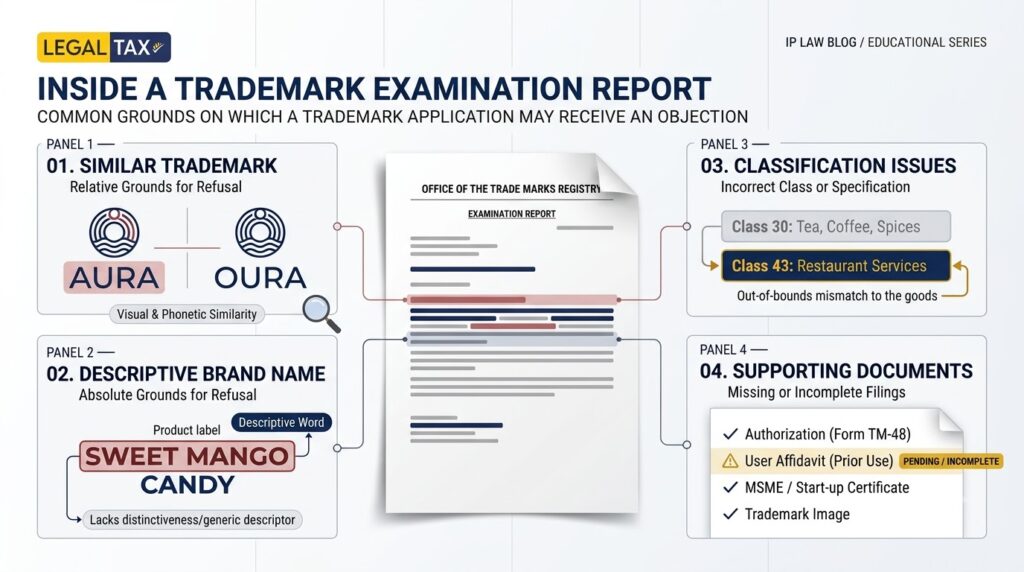
The common trademark objection reasons fall under Section 9 (absolute grounds), Section 11 (relative grounds) or formality issues. One report can combine several of them.
Section 9 (Absolute Grounds)
Section 9 looks at the mark itself, regardless of anyone else’s rights. Under Section 9(1), a mark may be refused if it is devoid of distinctive character, if it consists only of indications describing the kind, quality, quantity, purpose, value, geographical origin or time of production of the goods or services, or if it has become customary in the current language or trade practice.
Section 9(2) covers other grounds, such as marks likely to deceive or cause confusion, marks that may hurt religious susceptibilities, scandalous or obscene matter, and marks whose use is prohibited under the Emblems and Names (Prevention of Improper Use) Act, 1950. Section 9(3) deals with certain shapes of goods.
Not every Section 9 objection is the same. A descriptiveness objection is answered differently from an objection about a prohibited name. For Section 9(1) grounds, the Act also recognises that a mark may be registrable if it acquired a distinctive character through use before the application date, or is a well-known trade mark.
Hypothetical example: a mark such as “Fresh Dairy” for milk products could attract a descriptiveness objection, because it directly describes the goods.
Section 11 (Relative Grounds)
Section 11 concerns conflict with earlier trademarks. Under Section 11(1), a mark may be refused where its identity or similarity with an earlier mark, together with identity or similarity of the goods or services, creates a likelihood of confusion on the part of the public, including a likelihood of association.
Section 11(2) addresses certain cases involving well-known earlier marks, even where goods or services differ. Section 11(3) refers to marks whose use could be prevented under the law of passing off or copyright.
Examiners typically compare marks visually, phonetically and by meaning, and consider whether the goods or services are related. A response may argue that the marks are not deceptively similar, that the goods differ, or that other facts such as prior use or a consent from the earlier owner support registration. The Registrar assesses these points case by case.
Formality and Other Objections
Not every objection concerns registrability. A report may also raise procedural or documentation points, such as an unclear description of goods or services, missing details about the claimed date of first use, a translation or transliteration of a non-English word, or supporting papers.
These issues are different in nature from Section 9 and Section 11 grounds, but they are part of the same report and must be answered through the same process and within the same period.
How to Check If Your Trademark Is Objected
You can find the trademark status and the examination report through the official IP India portal. The layout changes from time to time, so follow the on-screen options. The usual approach is:
- Open the trade mark public search page on the IP India website.
- Search using your application number (or the wordmark and applicant name).
- Read the status shown against your application.
- If it says Objected, locate the examination report linked to the application, and download it.
- Note the report’s issue date and each stated ground.
For a fuller walkthrough with screens and search options, see this guide to check your trademark status online on the IP India portal. The report may also have been emailed to the applicant or the authorised agent, so check the registered email, including the spam folder, and ask your agent if you have one.
Time Limit to Respond to a Trademark Objection
Many readers search for the trademark objection time limit 30 days. The period is often described as 30 days, but the official wording matters. Under Rule 33(4) of the Trade Marks Rules, 2017, the response to an examination report is due within one month, and non-response can lead to the application being treated as abandoned (see also Section 132 of the Act). Registry public notices speak of the date the report was issued, while some commentary counts from receipt, so count from the date printed on your report to stay safe.
Which document decides the deadline? The examination report and its issue date. Do not start counting from the day you first noticed the status.
How should you calculate it? Months differ in length, so treat the earlier possible date as your deadline, and file well before it.
Can the deadline be extended? A request for extension of time can be made on Form TM-M under Rule 109, but it is discretionary and limited, so never plan around it. Treat the one-month period as a hard deadline.
What should you do immediately? Download the report, mark the date, gather your documents, and get the reply filed.
What if the deadline is missed? The application may be treated as abandoned. A trademark abandoned after objection is not the same as a refusal; remedies depend on the facts and can be limited, and a fresh application may sometimes be needed.
Because rules and Registry notices can change, rely on the report issued for your application and on current official sources, not on a generic blog statement, including this one.
Trademark Objection Timeline: Stage by Stage
Timelines depend on the Registry’s workload, so the periods below are typical ranges, not promises. The one-month reply period is the only strict deadline you control.
| Stage | Typical time | What happens |
|---|---|---|
| Application filed | Day 1 | Application number and filing receipt generated |
| Examination report issued | Roughly 3 to 9 months after filing (varies) | Examiner accepts the mark or raises objections |
| Your reply | Within 1 month of the report | Written reply with arguments and evidence, filed online |
| Examiner reviews the reply | Varies | Examiner accepts for advertisement, raises further points, or fixes a hearing |
| Show cause hearing (if needed) | Date fixed by hearing notice | Arguments before the Registrar, online or in person |
| Order after reply or hearing | Varies | Acceptance (with or without conditions) or refusal |
| Journal publication | Usually 1 to 4 months after acceptance | Mark advertised in the Trade Marks Journal |
| Opposition window | 3 months from advertisement plus up to 1 month; commonly treated as 4 months | Any third party may oppose |
| Registration certificate | Typically 1 to 3 months after the window closes, if there is no opposition | Mark registered |
Overall picture. A clean application with no objection or opposition is commonly reported to take roughly 6 to 12 months. An objection and hearing can push this to roughly 12 to 18 months or more. A contested opposition can extend it to two to three years or longer. Registration is valid for 10 years and can be renewed.
Government Fees: What You Pay the Registry
Government fees are paid directly to the Registry and are the same whoever files for you. The figures below are for online (e-filing) and may change, so confirm them on the official Trade Marks Rules, 2017 fee schedule before paying.
| Item | Government fee (online) |
|---|---|
| Trademark application (Form TM-A), individual, startup or small enterprise | ₹4,500 per class |
| Trademark application (Form TM-A), all other applicants | ₹9,000 per class |
| Reply to the examination report | No government fee |
| Attending a show cause hearing | No separate government fee |
| Extension of time or hearing adjournment request (Form TM-M) | Commonly ₹900 per request (confirm the current schedule) |
So if your application is objected, the government fee for replying is nil. What you pay for is the professional drafting and filing.
What Does It Cost to Reply to a Trademark Objection with LegalTax?
Objection reply: ₹999.
That covers studying your examination report, drafting a reasoned reply to the Section 9, Section 11 or formality objections, and filing it on the official portal. There is no government fee on top for the reply.
How fast do we file?
- Standard: once you share your case details, we file the reply within 1 hour.
- Urgent cases: if your deadline is very close, we have filed replies in as little as 10 minutes after receiving the details.
What we need from you:
- Your application number and brand name
- The examination report (or your registered email so we can check it)
- Any proof of use you have, such as invoices, bills, website or advertising material, if the objection relates to distinctiveness or prior use
- Your confirmation to proceed
Hearing charges. If the examiner is not satisfied with the written reply, the application may be listed for a show cause hearing. Hearing representation is priced according to the facts and complexity of your case, and we discuss that with you after the reply is filed. You will know the cost before we proceed.
No one can guarantee how the Registrar will decide, so we do not promise acceptance. What we do promise is a properly drafted reply filed on time.
Get your trademark objection reply filed
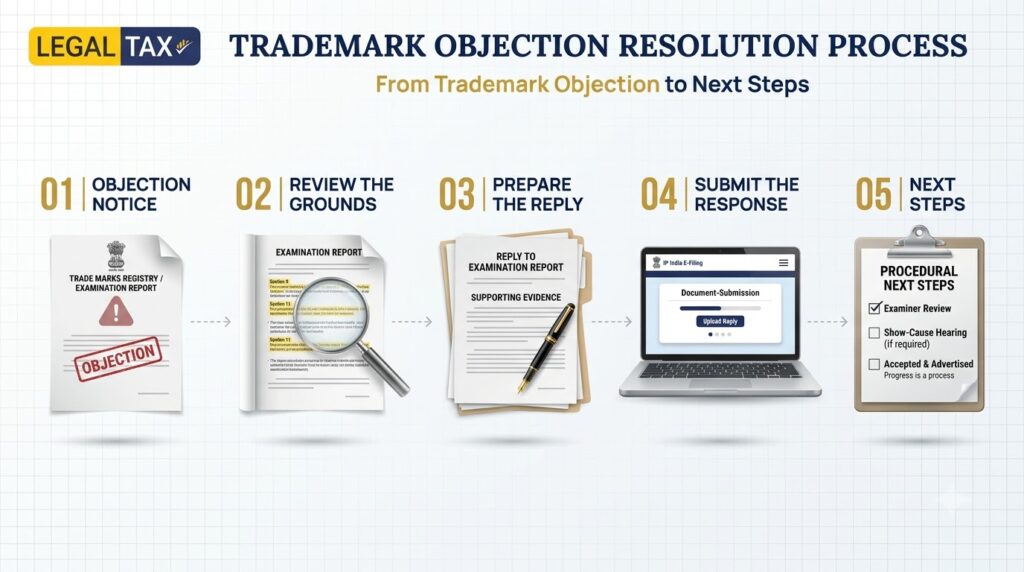
What to Do When Your Trademark Status Shows Objected (Step by Step)
- Locate the correct application. Confirm the application number, class and applicant name.
- Download and read the examination report. Read every objection, not just the first.
- Identify the grounds and provisions. Note whether they fall under Section 9, Section 11 or formality points.
- Collect documents and evidence. Depending on the grounds, this may include proof of use, invoices, advertisements, a user affidavit, details of an earlier mark, or any consent document.
- Get the reply prepared. Decide whether a reasoned written reply, an amendment, supporting evidence or a request for a hearing is required. Our trademark objection reply service handles this at ₹999.
- Submit through the official process. The reply is filed online on the IP India portal. Keep the acknowledgement.
- Monitor the status. Watch for further notices, hearing dates or an acceptance.
A well-prepared response improves your position, but no response guarantees acceptance.
What Happens After You Respond for trademark status objection?
The Registrar considers your response and any evidence. Depending on the case, the outcomes include acceptance, acceptance subject to conditions or amendments, further objections, a hearing, or refusal.
If the Examiner Is Satisfied
The mark is accepted and ordered to be advertised in the Trade Marks Journal.
If the Examiner Is Not Satisfied: The Show Cause Hearing
Your status may change to a hearing stage and a hearing notice is issued. A trademark hearing lets you present your arguments to the Registrar. The applicant does not have to attend personally; an authorised representative can appear on their behalf. The mode and procedure depend on the notice you receive. For online hearings, read how to attend a trademark hearing online in Delhi.
Things worth knowing about hearings:
- There is no separate government fee to attend.
- If you cannot attend on the date, an adjournment can be requested on Form TM-M (government fee commonly ₹900), and it should be filed in advance, not on the day.
- After the hearing, the Registrar passes an order accepting or refusing the application, in whole or subject to conditions.
- If the application is refused, the Act provides an appeal remedy with a limited time period, so take advice immediately.
Hearing representation at LegalTax is priced according to your case and discussed after the objection reply is filed.
After Acceptance: Advertisement and Opposition
Acceptance does not mean the mark is already registered. An accepted application is advertised in the Trade Marks Journal, which the Trade Marks Registry publishes online, and third parties can then file a trademark opposition within the limited period allowed. Section 21(1) of the Act provides three months from advertisement, with a further period of up to one month in the aggregate, and in practice the window is commonly treated as four months. Check your Journal date and current rules for the exact period. If no opposition is filed, or an opposition fails, the application can proceed to registration.
An examination objection comes from the Registry during examination, while an opposition comes from a third party after acceptance. If your application is refused, the Act provides further remedies, and you should take advice promptly because time limits apply.
Can You Use the TM Symbol While the Trademark Is Objected?
Generally, the TM symbol indicates that you claim a name or logo as your trademark. It does not depend on registration, and businesses commonly use it from the time they apply.
The ® symbol is different. It signals a registered trademark, and representing a mark as registered before registration can create legal risk, including under Section 107 of the Act. Use ® only after registration is granted.
An objected application does not confer registration or guarantee enforceable registered rights. Whether you have any rights from actual use depends on your facts, so get advice if you face a dispute.
How to Avoid a Trademark Objection
You cannot remove every risk, but good preparation reduces it.
- Run a preliminary trademark search for identical and similar marks in related goods or services before filing. The free IP India public search supports wordmark, phonetic and Vienna code searches.
- Choose a distinctive mark. Invented or arbitrary names face fewer descriptiveness issues than ordinary descriptive words.
- Pick appropriate goods and services and describe them accurately and in the correct class.
- Provide accurate application details, including the applicant’s information and any claimed date of first use.
- Keep supporting evidence ready where you claim prior use or an acquired reputation.
- Review the application before filing for errors, translations and missing details.
If you are starting out, our trademark registration page explains the process and the services available.
Need Help With Your Objected Trademark?
If the examination report looks complicated, or the deadline is close, do not wait. Share your application number and examination report with LegalTax, and our trademark objection reply service will get the reply filed for ₹999, within 1 hour (and in urgent cases within 10 minutes). Hearing support, if needed, is quoted according to your case. We cannot promise any particular result, because the decision rests with the Registrar.
In short, trademark status objected is a stage you can respond to, not an automatic end. Read the report, note the deadline, and act in time.
Frequently Asked Questions (FAQs)
1. What Does Objected Mean in Trademark Status?
When your application shows “Objected” in trademark status, it means the Trademark Registry has raised concerns in an examination report. Your application has not been finally rejected, and you generally have an opportunity to submit a reply.
2. Why Does a Trademark Application Get Objected?
A trademark application may be objected to due to a lack of distinctiveness, similarity to an existing mark, descriptive wording, or errors in the application. The examination report specifies the grounds for the objection.
3. How Can I Check My Trademark Status and Examination Report?
You can check your trademark status through the official IP India Public Search Portal. Search for your application and access the examination report, where available, to understand the objection and required response.
4. What Is the Deadline to Reply When Trademark Status Shows Objected?
Under Rule 33(4) of the Trade Marks Rules, 2017, the applicant generally has one month from the date of receipt of the examination report to respond. Check the report and applicable requirements promptly, as missing the deadline may lead to abandonment.
5. Is There a Government Fee for Replying to a Trademark Objection?
There is generally no government filing fee for submitting a reply to an examination report. However, professional charges may apply if you hire a trademark consultant or legal service provider to prepare and file your response.
6. How Quickly Can LegalTax File a Trademark Objection Reply?
LegalTax offers assistance with preparing and filing replies, including cases where the trademark status shows “Objected.” Filing may be completed within one hour after receiving the necessary details, subject to document readiness and review.
7. What Happens If I Miss the Trademark Objection Reply Deadline?
If you do not respond within the applicable deadline, your application may be treated as abandoned for non-prosecution. If your trademark status remains “Objected” and the deadline has passed, seek professional advice promptly to assess whether any remedy is available.
8. Can a Trademark Be Registered After an Objection?
Yes, a trademark can still proceed towards registration after an objection. The Registrar may accept the written reply or require a hearing before deciding the application. Registration is not guaranteed, and a third party may oppose the mark after it is advertised.
9. Is a Hearing Compulsory for Every Objected Trademark?
No, a hearing is not compulsory in every case. If the Registrar is satisfied with the written response, the application may proceed without one. If your trademark status remains objected after the reply, a hearing may be scheduled according to the applicable procedure.
10. How Much Does It Cost to Resolve an Objected Trademark?
The cost depends on the complexity of the objection, the supporting evidence required, and whether a hearing is necessary. LegalTax offers trademark objection reply assistance for ₹999, subject to the applicable service scope. Confirm any additional professional charges before proceeding.
11. What Is the Difference Between Trademark Objection and Trademark Opposition?
An objection is raised by the Trademark Registry during examination, while an opposition is filed by a third party after the mark is accepted and advertised in the Trade Marks Journal. Both procedures have different requirements and deadlines.
12. Can I File a Reply Myself If My Trademark Status Shows Objected?
Yes, an applicant can generally prepare and submit their own reply. However, the response should address the specific examination grounds and include relevant arguments and supporting evidence. Professional assistance may be helpful in complex cases.
13. Can I Change My Brand Name After Receiving a Trademark Objection?
Minor corrections may be possible where permitted, but a substantial change to the mark may not be accepted as an amendment to the existing application. If your trademark status shows “Objected” because of similarity, assess the objection before deciding whether to amend or file a new application.
14. How Long Does It Take to Resolve an Objected Trademark Application?
The timeline varies depending on the objection, the Registry’s workload, and whether a hearing is required. After submitting a reply, monitor your trademark status regularly for updates. There is no guaranteed resolution period for every application.
15. How Can I Prevent My Trademark Status from Showing Objected in the Future?
Before filing a new application, conduct a trademark search, choose a distinctive brand name, select the appropriate goods or services classification, and ensure the application details are accurate. These steps can reduce the risk of objections, although they cannot guarantee acceptance.
Official References
- Trade Marks Registry, IP India (Government of India)
- Trade Marks Public Search, IP India
- The Trade Marks Act, 1999, India Code
- Trade Marks Rules, 2017 (rules and fee schedule), IP India
- Trade Marks Rules, 2017 (HTML text), IP India
Sources: Registerkaro timeline, S.S. Rana filing process, S.S. Rana fees, Intepat Rule 33(4), Mondaq: Trade Marks Rules 2017 fees, Registerkaro TM-M
Disclaimer: This article is for informational purposes only and does not constitute legal advice. Please consult your case attorney or a qualified trademark professional before taking any action.

Adv. Manish Kashyap is an IPR Law Expert with 10+ years of professional experience in Intellectual Property Rights. He specializes in matters related to Trademark, Copyright, Patent, and other IPR-related legal services, helping individuals and businesses protect and manage their intellectual property effectively.
Our Clients