Views: 12
Table of Contents
- 1 Introduction
- 2 What Is Startup India Registration?
- 3 What Is MSME Registration (Udyam Registration)?
- 4 Key Difference 1: Purpose and Philosophy
- 5 Key Difference 2: Eligibility Criteria
- 6 Key Difference 3: Benefits Provided
- 7 Key Difference 4: Registration Process
- 8 Key Difference 5: Validity
- 9 Key Difference 6: Who Should Register for What
- 10 Can a Business Hold Both Registrations Simultaneously?
- 11 Summary: Startup India vs MSME at a Glance
- 12 Frequently Asked Questions
- 13 Conclusion
- 14 Need Help With Startup India or MSME Registration?
Introduction
Two of the most talked-about government registration schemes for small and growing businesses in India are Startup India and MSME (Udyam) Registration. Both are government initiatives. Both provide benefits and recognition to businesses. Both are free to register for. And both are frequently confused, with many business owners unsure whether they qualify for one, the other, both, or neither.
The confusion is understandable. At first glance, both schemes seem to target the same audience: small, growing Indian businesses that need government support. But the two registrations are fundamentally different in their purpose, their eligibility criteria, the benefits they provide, and the type of business they are designed for.
Startup India is administered by the Department for Promotion of Industry and Internal Trade (DPIIT) and is designed for innovative, high-growth businesses that have the potential to scale significantly and create employment. It provides recognition, tax benefits, IP support, and access to funding ecosystems.
MSME Registration is now called Udyam Registration and is administered by the Ministry of Micro, Small and Medium Enterprises. It is designed for the vast universe of small and medium businesses across India including traders, manufacturers, service providers, artisans, and local businesses of every description. It provides financial access, government procurement priority, credit protection, and operational support.
Understanding the difference between the two clearly and precisely is the starting point for any business owner deciding which registration to pursue, which benefits to claim, and whether both registrations make sense for their specific business.
This guide explains every dimension of the difference between Startup India and MSME Registration in India in 2026, covering purpose, eligibility, benefits, process, validity, and which registration is right for which type of business.
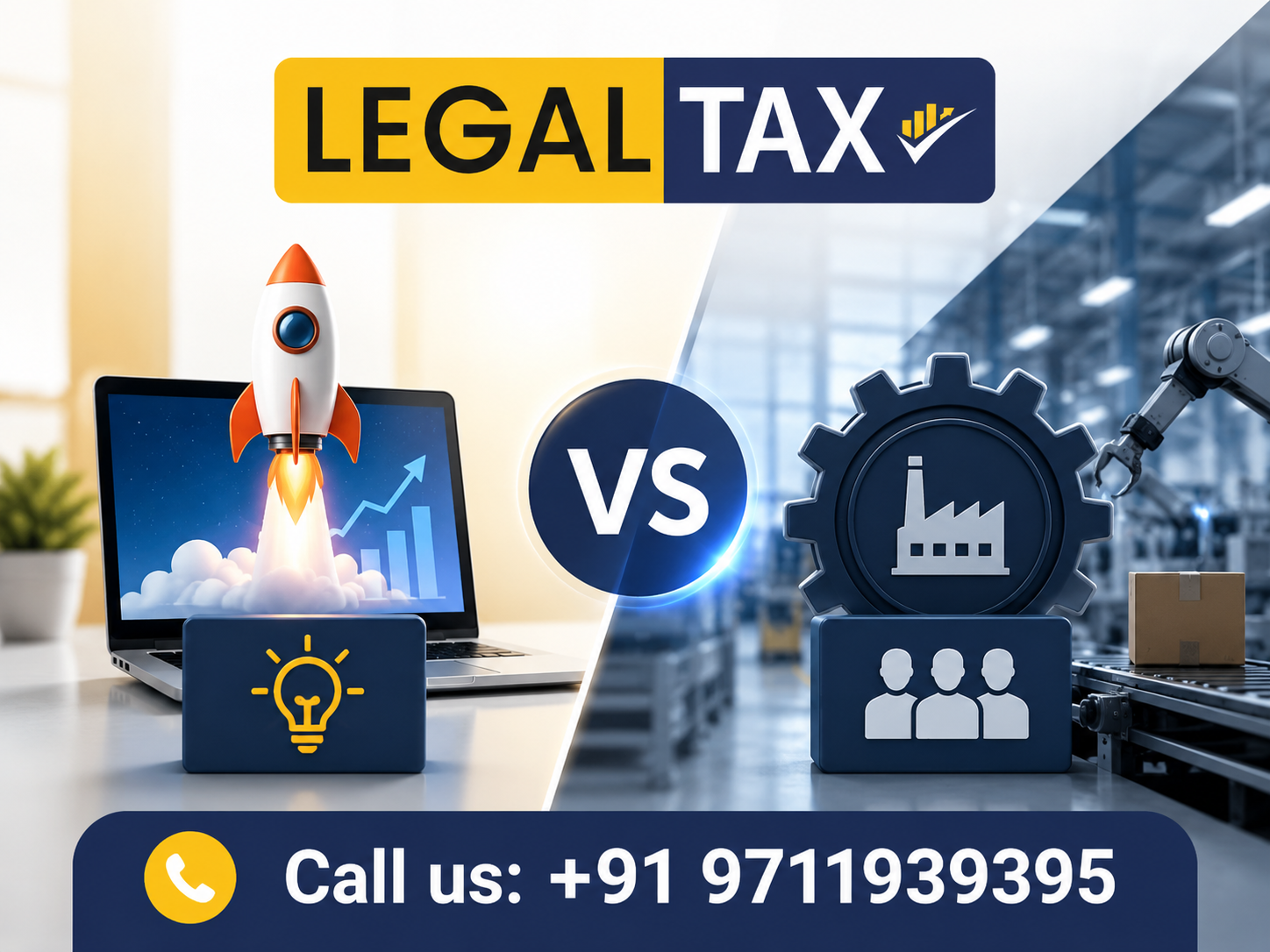
What Is Startup India Registration?
Startup India is a flagship initiative of the Government of India launched in January 2016. Its objective is to build a strong ecosystem for nurturing innovation and startups in India, driving sustainable economic growth and generating large-scale employment opportunities.
Under the Startup India initiative, eligible businesses apply for DPIIT recognition through the Startup India portal. Once recognised, the business receives a DPIIT recognition certificate and becomes eligible for the full range of Startup India benefits including tax exemptions, self-certification under labour and environmental laws, fast-track patent examination, and access to the government’s Fund of Funds for Startups.
Startup India recognition is not a financial or credit benefit in the traditional sense. It is primarily a legal and regulatory recognition that unlocks a specific set of privileges designed to reduce the compliance burden and cost of early-stage innovation-driven businesses.
What Is MSME Registration (Udyam Registration)?
MSME Registration, rebranded as Udyam Registration in July 2020, is a government registration that formally recognises a business as a Micro, Small, or Medium Enterprise under the MSMED Act, 2006.
The Udyam Registration is administered through the Udyam Registration Portal and is based on the business’s investment in plant and machinery or equipment, and its annual turnover. Once registered, the business receives a Udyam Registration Certificate with a unique Udyam Registration Number.
Udyam Registration is fundamentally a financial and operational benefit scheme. Its primary advantages are in credit access, government procurement, delayed payment protection, and priority sector treatment by banks and financial institutions. It is designed for the enormous number of small businesses that form the backbone of the Indian economy, not specifically for innovative or high-growth startups.
Key Difference 1: Purpose and Philosophy
The most fundamental difference between the two registrations is their underlying purpose.
Startup India is built around the concept of innovation and scalability. It targets businesses that are working on new products, services, or processes, or that are applying technology or a novel business model to solve a problem in a significantly better way. The philosophy is: identify high-potential innovative businesses early and reduce the friction they face in growing quickly.
MSME Registration is built around the concept of size and economic inclusion. It targets businesses based on their investment and turnover, regardless of whether they are innovative or scalable. The philosophy is: recognise the contribution of small businesses to the economy and provide them with the support they need to survive, access credit, and compete fairly.
A business does not need to be innovative to qualify for Udyam Registration. A small manufacturing unit, a local retailer, a roadside eatery, or a neighbourhood service provider can all be MSMEs. Innovation is irrelevant to MSME eligibility.
A business does need to demonstrate innovation or a novel approach to qualify for Startup India recognition. A traditional trading or manufacturing business, however small or entrepreneurial, does not qualify for Startup India benefits.
Key Difference 2: Eligibility Criteria
Startup India Eligibility
To be eligible for DPIIT recognition under Startup India, a business must satisfy all of the following conditions:
📋 Entity type: The business must be incorporated as a Private Limited Company, Limited Liability Partnership (LLP), or Registered Partnership Firm. Sole proprietorships and unregistered firms do not qualify.
📋 Age of the entity: The business must not be more than 10 years old from the date of incorporation or registration. Startup India recognition is available only to young companies.
📋 Annual turnover: The entity’s annual turnover must not have exceeded Rs. 100 crore in any financial year since incorporation.
📋 Original entity: The entity must not have been formed by splitting up or reconstructing an existing business.
📋 Innovation criterion: The entity must be working towards innovation, development, or improvement of products, processes, or services, or it must have a scalable business model with a high potential of employment generation or wealth creation. This is assessed through a self-declaration and, in some cases, an inter-ministerial board recommendation.
MSME (Udyam) Eligibility
To be eligible for Udyam Registration, a business must satisfy the following:
📋 Entity type: Any business entity qualifies including sole proprietorships, partnership firms, Hindu Undivided Families (HUF), companies, LLPs, co-operative societies, and trusts. There is no restriction on entity type.
📋 Investment and turnover criteria: The business must fall within the prescribed investment and turnover limits:
Micro Enterprise: Investment in plant and machinery or equipment up to Rs. 1 crore and annual turnover up to Rs. 5 crore.
Small Enterprise: Investment up to Rs. 10 crore and annual turnover up to Rs. 50 crore.
Medium Enterprise: Investment up to Rs. 50 crore and annual turnover up to Rs. 250 crore.
📋 No innovation requirement: There is no requirement for the business to be innovative, technology-driven, or scalable. Any business within the investment and turnover limits qualifies.
📋 No age restriction: There is no upper age limit. A business that has been operating for 30 years and still falls within the turnover and investment limits can register as an MSME.
Key Difference 3: Benefits Provided
Benefits of Startup India Recognition
Tax Benefits
📋 Income Tax exemption for 3 years: DPIIT-recognised startups are eligible for a 100% tax exemption on profits for any 3 consecutive years out of the first 10 years of operation, subject to approval by the Inter-Ministerial Board of Certification. This benefit is available under Section 80-IAC of the Income Tax Act.
📋 Exemption from Angel Tax: Investments received by DPIIT-recognised startups from eligible investors are exempt from the Angel Tax provisions under Section 56(2)(viib) of the Income Tax Act. This is a significant benefit for startups raising early-stage funding.
📋 Capital Gains Tax exemption: Investors who sell long-term capital assets and reinvest the proceeds in eligible startups may claim capital gains tax exemption under Section 54GB of the Income Tax Act.
Intellectual Property Benefits
📋 Fast-track patent examination: DPIIT-recognised startups are eligible for expedited examination of patent applications at a significantly reduced fee. The government also provides an 80% rebate on patent filing fees for startups.
📋 Trademark fee concession: Startups receive a 50% concession on trademark filing fees compared to the fee applicable to large entities.
📋 IP facilitation: The government has empanelled facilitators to provide free assistance to startups for patent, trademark, and design filing and prosecution.
Regulatory and Compliance Benefits
📋 Self-certification under labour laws: DPIIT-recognised startups can self-certify compliance with 9 labour laws for a period of 3 to 5 years from incorporation, without routine inspections.
📋 Self-certification under environmental laws: Startups in non-hazardous categories can self-certify compliance with 3 environmental laws.
📋 Fast-track company winding up: Startups incorporated as companies can be wound up within 90 days under the Insolvency and Bankruptcy Code, compared to the longer process applicable to regular companies.
Funding and Procurement Benefits
📋 Fund of Funds for Startups: The government has set up a Fund of Funds with SIDBI to invest in SEBI-registered Alternative Investment Funds that in turn invest in startups.
📋 Exemption from prior experience and turnover requirements in government procurement: DPIIT-recognised startups are exempt from the prior experience and turnover requirements that are standard conditions in government procurement tenders, making it easier for startups to bid for government contracts.
📋 Access to startup hubs, incubators, and acceleration programs supported by the government.
Benefits of MSME (Udyam) Registration
Credit and Financial Benefits
📋 Priority Sector Lending: Banks are mandated to lend a portion of their advances to the MSME sector as part of Priority Sector Lending requirements. Udyam-registered businesses benefit from this preferential credit availability.
📋 Collateral-free loans: Under the Credit Guarantee Fund Trust for Micro and Small Enterprises (CGTMSE) scheme, MSMEs can avail of collateral-free loans up to specified limits without providing property or assets as security.
📋 Lower interest rates: Banks provide loans to MSMEs at lower interest rates compared to general commercial loans. The government also provides interest subvention schemes for specific MSME categories.
📋 Priority in credit appraisal: Udyam-registered businesses receive priority treatment in loan processing at banks and NBFCs.
Government Procurement Benefits
📋 25% procurement reservation: The government has mandated that 25% of all central government procurement must be from MSMEs, with a sub-target of 4% from SC/ST-owned MSMEs. Udyam registration is required to participate in this reserved procurement.
📋 Exemption from Earnest Money Deposit (EMD): MSMEs are exempt from the requirement to pay EMD in government tenders, reducing the upfront cost of bidding.
📋 GeM portal benefits: MSME sellers on the Government e-Marketplace (GeM) receive preferential treatment and dedicated categories.
Protection Against Delayed Payments
📋 Under the MSMED Act, 2006, buyers are required to pay MSMEs within 45 days of accepting goods or services. If payment is delayed beyond this period, the buyer is liable to pay compound interest at three times the RBI bank rate.
📋 MSMEs can file complaints with the MSME Samadhaan portal for delayed payment disputes, which are adjudicated by Micro and Small Enterprises Facilitation Councils.
📋 This delayed payment protection is one of the most practically valuable benefits of MSME registration for businesses supplying to large corporate or government buyers.
Other Benefits
📋 Subsidy on ISO certification: Registered MSMEs are eligible for reimbursement of ISO certification costs under government schemes.
📋 Electricity tariff concessions: Several state governments provide concessional electricity tariffs to registered MSMEs.
📋 Stamp duty and registration fee waivers: Many states provide exemptions or concessions on stamp duty and registration fees for MSME units.
📋 Technology and quality upgradation support: Government schemes like the Credit Linked Capital Subsidy Scheme (CLCSS) provide capital subsidies for MSMEs upgrading technology.
📋 Reduced patent and trademark fees: MSMEs also receive fee concessions on intellectual property filings, though the concession is smaller than what DPIIT-recognised startups receive.
Key Difference 4: Registration Process
Startup India Registration Process
📋 Visit the Startup India portal at startupindia.gov.in 📋 Create an account and log in 📋 Fill the DPIIT recognition application form 📋 Provide details of the entity including incorporation certificate, PAN, nature of business, and innovation details 📋 Submit a self-declaration confirming that the entity meets all eligibility criteria and is working on innovation or a scalable business model 📋 Upload the incorporation certificate and other required documents 📋 Submit the application
For most eligible entities, DPIIT recognition is granted based on self-declaration without a formal review. For entities seeking the 3-year income tax exemption under Section 80-IAC, an additional application to the Inter-Ministerial Board is required along with a more detailed review of the innovation credentials.
Time to recognition: Typically 2 to 7 working days for DPIIT recognition based on self-declaration. The Inter-Ministerial Board review for tax exemption takes longer.
MSME (Udyam) Registration Process
📋 Visit the Udyam Registration portal at udyamregistration.gov.in 📋 For new registrations: enter the Aadhaar number of the proprietor, managing partner, or authorised signatory 📋 Verify identity through OTP sent to the Aadhaar-linked mobile number 📋 Enter PAN and GSTIN details 📋 Fill in business details including investment in plant and machinery, annual turnover, bank account details, and business activity 📋 Submit the self-declared application
Udyam Registration is entirely based on self-declaration. No documents need to be uploaded. The registration is processed automatically and the Udyam Registration Certificate is issued immediately upon submission.
Time to registration: Immediate upon successful submission, the certificate is generated on the portal.
Key Difference 5: Validity
Startup India Recognition Validity
📋 DPIIT recognition is valid as long as the entity continues to meet the eligibility criteria: not more than 10 years old and annual turnover not exceeding Rs. 100 crore. 📋 Once the entity exceeds 10 years of age or crosses the Rs. 100 crore turnover threshold, it no longer qualifies as a startup and the recognition effectively ceases to be applicable. 📋 There is no renewal process for Startup India recognition. The certificate is issued once and remains valid until the entity outgrows the eligibility criteria.
MSME (Udyam) Registration Validity
📋 Udyam Registration has no expiry date and does not need to be renewed annually. 📋 However, the MSME category of the business (Micro, Small, or Medium) is assessed annually based on the turnover and investment data linked through the GST and Income Tax systems. 📋 If a business’s turnover or investment crosses the threshold for its current category, it is automatically reclassified to the next category. If it crosses the Medium Enterprise threshold, it ceases to be an MSME. 📋 Businesses must update their Udyam Registration if there are changes in business activity, address, or ownership.
Key Difference 6: Who Should Register for What
Register for Startup India If:
📋 The business is incorporated as a Private Limited Company, LLP, or Registered Partnership Firm 📋 The business is less than 10 years old 📋 The business is working on an innovative product, service, process, or technology 📋 The founders intend to raise angel or venture capital funding 📋 The business needs the Angel Tax exemption for investor funding rounds 📋 The business wants fast-track and discounted patent or trademark filing 📋 The business intends to bid for government contracts and wants exemption from prior experience requirements
Register for MSME (Udyam) If:
📋 The business’s investment and turnover fall within the Micro, Small, or Medium Enterprise thresholds 📋 The business needs a bank loan and wants priority sector lending benefits or collateral-free credit 📋 The business supplies to government departments and wants to participate in the 25% MSME procurement reservation 📋 The business wants protection against delayed payments from large buyers 📋 The business wants fee concessions on government registrations, certifications, and tenders 📋 The business is a traditional trading, manufacturing, or service business without a specific innovation focus
Register for Both If:
📋 The business is an innovative startup that also falls within MSME investment and turnover thresholds 📋 Many early-stage startups qualify for both registrations simultaneously 📋 Holding both registrations provides the maximum combination of benefits: Startup India’s tax and IP benefits plus MSME’s credit access and procurement advantages 📋 There is no conflict between holding both registrations
Can a Business Hold Both Registrations Simultaneously?
Yes, absolutely. A DPIIT-recognised startup that also falls within the MSME investment and turnover thresholds can hold both the Startup India recognition certificate and the Udyam Registration certificate at the same time.
In fact, for most early-stage startups in India, holding both registrations is the optimal strategy:
📋 Startup India recognition provides the Angel Tax exemption, IP fee concessions, tax holiday eligibility, and government tender access 📋 Udyam Registration provides collateral-free credit access, delayed payment protection, and government procurement reservation
The two registrations complement each other and there is no overlap or conflict. A startup should pursue both as part of its foundational compliance setup.
Summary: Startup India vs MSME at a Glance
Purpose
📋 Startup India: Promote innovation, reduce compliance burden, support high-growth startups 📋 MSME: Support small businesses with credit, procurement, and payment protection
Eligibility
📋 Startup India: Private Limited Company, LLP, or Registered Partnership Firm, less than 10 years old, turnover under Rs. 100 crore, innovation-driven 📋 MSME: Any entity type, no age limit, investment up to Rs. 50 crore and turnover up to Rs. 250 crore
Key Benefits
📋 Startup India: Income tax exemption, Angel Tax exemption, fast-track patents, self-certification, government tender access 📋 MSME: Priority sector loans, collateral-free credit, delayed payment protection, government procurement reservation, fee concessions
Registration Portal
📋 Startup India: startupindia.gov.in 📋 MSME: udyamregistration.gov.in
Time to Register
📋 Startup India: 2 to 7 working days 📋 MSME: Immediate
Validity
📋 Startup India: Until 10 years from incorporation or turnover crosses Rs. 100 crore 📋 MSME: No expiry, auto-reclassification based on annual turnover and investment
Cost
📋 Both: Free of charge
Frequently Asked Questions
1. Can a business have both Startup India and MSME registration?
Yes, eligible businesses can apply for both registrations and enjoy benefits from both schemes.
2. Which registration is better for small businesses?
MSME registration is generally better for traditional small businesses, while Startup India is suitable for innovative startups.
3. Is Startup India registration free?
Yes, Startup India recognition is free on the official government portal.
4. What are the benefits of MSME registration?
MSME registration provides easier bank loans, subsidy schemes, lower interest rates, and government tender benefits.
5. Does Startup India provide tax benefits?
Yes, eligible startups can get tax exemptions and other incentives under Startup India schemes.
Conclusion
Startup India and MSME Registration are not competing schemes and they are not interchangeable. They are complementary government registrations designed for overlapping but distinct purposes.
Startup India recognition is for innovative, scalable businesses that are building something new and need regulatory breathing room, tax relief, and IP support to grow. MSME Registration is for every small and medium business in India that needs credit access, payment protection, and procurement opportunity.
For a business that qualifies for both, registering for both is the right answer. For a traditional business that does not meet the innovation criterion of Startup India, Udyam Registration is the appropriate and valuable choice. For an innovative startup that has outgrown MSME thresholds, Startup India recognition remains the relevant registration.
The process for both is free, online, and straightforward. There is no reason for any eligible business to delay obtaining either registration. The benefits are real, the cost is zero, and the compliance burden is minimal.
Know which registration fits your business. Register today. Use the benefits you are entitled to.
Need Help With Startup India or MSME Registration?
🟡 Legal Tax provides complete support for Startup India recognition, Udyam Registration, company incorporation, GST filing, and all business compliance needs across India.
👉 Startup India Registration 👉 MSME / Udyam Registration 👉 Private Limited Company Registration 👉 LLP Registration 👉 GST Registration and Filing 👉 Income Tax Filing
🟡 Protect Your Business Brand 👉 Trademark Registration 👉 Patent Registration 👉 Copyright Registration 👉 Design Registration
🟡 Need IT or Digital Support for Your Business? 👉 Website Development 👉 SEO Services 👉 Social Media Marketing 👉 Lead Generation
📞 Call Now: +91 9711939395 ✉️ Email: info@legaltax.in 🕐 Free Consultation: Monday to Saturday, 9 AM to 6 PM

Anjali is a Digital Marketing Expert at LegalTax.in who builds websites that rank and convert. She specializes in SEO-driven web development, helping people find the right legal help online.
Our Clients