Views: 2
Did You Know? Many companies pass Stage 1 and still get stuck at Stage 2, because documents alone do not prove that people follow them. Knowing the Stage 1 vs Stage 2 ISO audit difference early can save you weeks of delay and a repeat audit fee.
Table of Contents
- 1 Introduction
- 2 Understanding the ISO Certification Audit Flow
- 3 Key Roles in Stage 1 vs Stage 2 ISO Audit
- 4 Stage 1 vs Stage 2 ISO Audit: Quick Comparison
- 5 What Is a Stage 1 Audit?
- 6 What Is a Stage 2 Audit?
- 7 What Happens on Audit Day: Step by Step
- 8 Documents to Keep Ready for Stage 1 vs Stage 2 ISO Audit
- 9 Non-Conformities: Major vs Minor
- 10 Gap Between Stage 1 vs Stage 2 ISO Audit: How Much Time?
- 11 Common Audit Scenarios
- 12 Common Mistakes in Stage 1 vs Stage 2 ISO Audit
- 13 Best Practices to Pass the Stage 1 vs Stage 2 ISO Audit the First Time
- 14 Stage 1 vs Stage 2 ISO Audit for Different Standards
- 15 After Stage 2 and Escalation Options
- 16 Frequently Asked Questions
- 17 Conclusion
Introduction
Getting ISO certified is not a single inspection. Almost every certification body splits the initial audit into two parts, and many business owners are surprised by this. If you plan certification this year, understanding the Stage 1 vs Stage 2 ISO audit sequence will save you time, money and stress.
For Indian manufacturers, traders, MSMEs, hospitals and service companies, an ISO certificate opens doors to tenders, export buyers and corporate clients. But the certificate is not issued on paperwork alone. The auditor first checks your design on paper, then checks your practice on the ground.
This guide explains the Stage 1 vs Stage 2 ISO audit process in plain language. You will learn what each stage checks, what actually happens on audit day, which documents to keep ready, and how to avoid non-conformities that delay your certificate. Whether you are pursuing ISO 9001, ISO 14001, ISO 27001 or ISO 45001, the logic is the same.
Preparing for your first ISO audit?
Our team helps with gap analysis, documentation, internal audit and mock audits before you book your certification body.
Get Free ISO Consultation
Understanding the ISO Certification Audit Flow
Before comparing the two stages, it helps to see the full journey. The initial ISO certification audit is carried out in two stages. Stage 1 is a readiness and documentation review. Stage 2 is the full implementation audit, where the auditor checks whether your management system actually works in daily operations.
Think of the Stage 1 vs Stage 2 ISO audit as a “plan” and “proof” pairing. Stage 1 asks, “Is your system designed correctly?” Stage 2 asks, “Is your team really following it?” This structure comes from the rules that govern certification bodies, mainly ISO/IEC 17021-1. In India, you can check whether a certification body is accredited through NABCB (the National Accreditation Board for Certification Bodies) before you sign a contract.
The Complete ISO Certification Flow:
Gap Analysis and System Design
        ↓
Implementation Across Departments
        ↓
Internal Audit
        ↓
Management Review
        ↓
Stage 1 Audit (Readiness Review)
        ↓
Closing Areas of Concern
        ↓
Stage 2 Audit (Implementation Audit)
        ↓
Non-Conformity Closure, If Any
        ↓
Certification Decision and Certificate Issue
        ↓
Annual Surveillance Audits and Recertification in Year 3
The two-stage approach protects both sides. If the auditor arrived and found that your manual was missing or no internal audit had been done, a single big audit would be wasted effort. So the Stage 1 vs Stage 2 ISO audit structure works as a safety net: you find gaps before the decisive audit, not during it.
Key Roles in Stage 1 vs Stage 2 ISO Audit
Many audit problems come from confusion about who does what. Knowing the roles keeps the day organized.
Lead Auditor: Leads the audit team, runs the opening and closing meetings and finalizes findings. The lead auditor also recommends certification.
Auditor or Technical Expert: Samples evidence in specific processes. In technical sectors, a technical expert may join to understand your operations.
Top Management: The owner, director or CEO. The auditor checks leadership commitment, policy, objectives and resources through direct interviews.
Management Representative: Usually the quality or compliance head who coordinates the system and answers most system-level questions.
Process Owners and Staff: Department heads and employees who show how work is done and produce records on request.
💡 Practical Tip: Nominate one guide to accompany the auditor, arrange interviews and fetch records quickly. Fast retrieval of records signals control. Slow retrieval signals confusion.
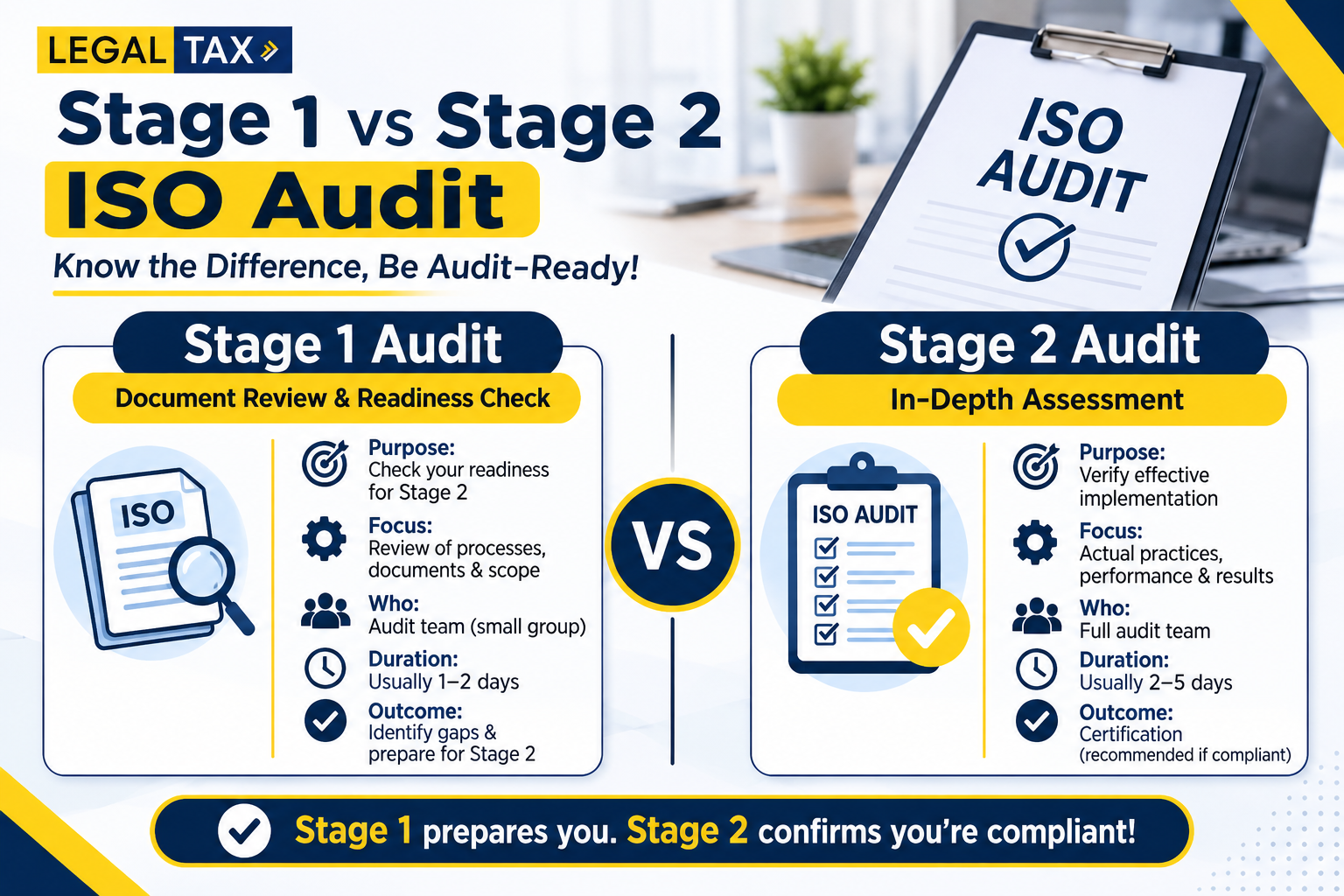
Stage 1 vs Stage 2 ISO Audit: Quick Comparison
The table below gives a side-by-side view of the Stage 1 vs Stage 2 ISO audit. Exact practice can vary slightly between certification bodies, so confirm details in your audit plan.
| Point | Stage 1 Audit | Stage 2 Audit |
|---|---|---|
| Main purpose | Readiness and documentation review | Full implementation and effectiveness audit |
| Core question | Is the system designed and documented properly? | Is the system implemented and working? |
| Focus | Scope, policy, objectives, procedures, planning | Records, interviews, processes, site observation |
| Evidence sampled | Limited; mostly documents | Detailed; records, people and operations |
| Typical duration | Shorter | Longer |
| Location | Onsite or remote, as the certification body decides | Normally onsite at your premises |
| Findings | Areas of concern or improvement points | Major or minor non-conformities, observations |
| Result | Go-ahead for Stage 2, or a request to fix issues first | Recommendation for certification, or corrective action first |
What Is a Stage 1 Audit?
The Stage 1 audit is the first formal step. The auditor does not try to prove that everything is perfect. Instead, the auditor confirms that your management system is ready to be audited in depth. Many companies underestimate it. In the Stage 1 vs Stage 2 ISO audit comparison, Stage 1 looks lighter, but a weak Stage 1 can postpone your whole project.
What Auditors Check in Stage 1
- Your scope of certification and the sites, products or services it covers
- The policy and measurable objectives
- The documented information required by the standard
- Risk and opportunity planning, or risk assessment for ISO 27001
- Evidence that an internal audit and management review are planned or completed
- Legal and regulatory requirements that apply to you
- Your understanding of the standard and your readiness for Stage 2
Stage 1 Outcomes
At the end of Stage 1, the auditor shares findings, often called areas of concern. These are not formal non-conformities yet, but if you ignore them, they can become non-conformities in Stage 2. The auditor also confirms the Stage 2 dates, audit team and plan. If the system is clearly not ready, the certification body may ask you to fix gaps and repeat part of Stage 1 first.
What Is a Stage 2 Audit?
Stage 2 is the main event. The auditor visits your premises, observes work, speaks to staff and reviews records to judge whether your system meets every requirement of the standard.
The key difference in the Stage 1 vs Stage 2 ISO audit is evidence. Stage 1 relies on documents. Stage 2 relies on proof of practice, such as completed forms, logs, reports, photographs and staff answers.
What Happens on Audit Day: Step by Step
“Audit day” worries many owners, but it follows a predictable pattern. Here is how a typical Stage 2 day unfolds.
Step 1: Opening Meeting
The lead auditor introduces the team, confirms the scope, explains the audit method and agrees on the schedule. Top management should attend. This is the time to mention safety rules, restricted areas and any process changes since Stage 1.
Step 2: Process-Based Audit and Interviews
The auditor moves through your processes. Modern ISO audits are process-based, not just document-based. The auditor may follow one order from enquiry to delivery, or one employee from hiring to training. Expect open questions such as “Show me how you handle a customer complaint.” Staff should answer honestly and show the actual record.
Step 3: Records and Evidence Sampling
The auditor cannot read every record, so samples are taken. Common examples include purchase orders, supplier evaluations, training records, calibration certificates, incident reports and corrective action logs. This is where the Stage 1 vs Stage 2 ISO audit gap becomes obvious: Stage 1 checks that a procedure exists, while Stage 2 checks that records prove it was followed.
Step 4: Site Walk-Through
The auditor walks through your office, factory, warehouse or project site. For ISO 14001 and ISO 45001 this matters most, because the auditor observes waste handling, labelling, fire safety, protective equipment and housekeeping directly.
Step 5: Top Management Interview
Leadership commitment is a core clause in most ISO standards. The auditor usually interviews the director or owner about policy, objectives, resources, management review and risk. Leaders who cannot explain their own policy are a common source of findings.
Step 6: Auditor’s Internal Review
Before the closing meeting, the audit team meets privately to consolidate evidence and decide on findings. You may be asked to wait. This is normal and does not mean there is a problem.
Step 7: Closing Meeting
The lead auditor presents findings, strengths, observations and any non-conformities. You can ask questions and clarify facts. The auditor then explains next steps, including corrective action timelines and the certification decision process.
⚠️ Warning: Do not create or backdate records the night before audit day. Auditors can easily spot records that were made in a rush, and this damages trust in your entire system.
Documents to Keep Ready for Stage 1 vs Stage 2 ISO Audit
Good preparation is mostly good organization. The following list works as a general ISO audit checklist, though the exact documents depend on the standard.
Documents for Stage 1:
- Scope statement and organization chart
- Policy and measurable objectives
- Manual or documented procedures, where used
- Risk register, risk assessment or aspects and impacts register
- Statement of Applicability (for ISO 27001)
- Internal audit plan and, if done, the report
- Management review plan and, if done, the minutes
- List of applicable legal and other requirements
Records for Stage 2:
- Completed internal audit report with corrective actions
- Management review minutes with decisions and action points
- Training records and competence evidence
- Supplier approval and evaluation records
- Customer feedback, complaints and resolution records
- Calibration and maintenance records
- Production, service delivery or project records
- Incident, non-conformity and corrective action registers
- Objective tracking and performance monitoring data
Keep these in one folder, physical or digital, so staff can produce them within minutes. For a deeper list, read our guide on documents for ISO certification.
Non-Conformities: Major vs Minor
A non-conformity means a requirement of the standard, your own system, a customer or a legal rule has not been met. Auditors usually grade them into two types.
Minor Non-Conformity: An isolated lapse or small weakness that does not threaten the system’s overall ability to deliver intended results. Examples include one missing signature on a record, or one overdue calibration where all others are on time.
Major Non-Conformity: A failure that affects the system’s ability to meet its objectives. Examples include no internal audit at all, no management review, or an entire process running without controls. A major finding must normally be fixed and verified before certification can be recommended.
What happens after findings: You submit a root cause analysis, correction and corrective action plan within the timeline set by the certification body. If a major issue is not closed in time, the certification body may require a repeat of Stage 2. Always check your contract for exact rules.
The best defence is a thorough internal audit before the Stage 1 vs Stage 2 ISO audit sequence begins. Internal audits that find real problems are a strength, not a weakness.
Finding the audit process confusing?
A weak corrective action reply can keep a minor finding open for weeks. Get your response reviewed by an expert before you submit it.
Talk to an ISO Expert
Gap Between Stage 1 vs Stage 2 ISO Audit: How Much Time?
There is no single fixed gap, because it depends on your readiness, the findings and your certification body’s policy. Many organizations schedule Stage 2 a few weeks after Stage 1, giving time to close areas of concern.
If too long passes, the certification body may require you to repeat Stage 1, since the conditions it reviewed may no longer be valid. Treat the gap as a working window, not a break. Use it to fix findings, collect records and train staff. Ask your certification body for its maximum permitted gap in writing so planning stays clear.
Common Audit Scenarios
The scenarios below are illustrative examples to explain how audits can go. They are not real client cases. Each one shows how the Stage 1 vs Stage 2 ISO audit can play out in practice.
Scenario 1: No Internal Audit Before Stage 1
A small manufacturer prepares a full manual but has never run an internal audit. At Stage 1, the auditor flags this as an area of concern. The company completes an internal audit and management review in the gap period. At Stage 2, the evidence is available and no major finding is raised.
Scenario 2: Staff Cannot Explain the Policy
A service company has a polished policy on the wall, but operators cannot explain it during interviews. The auditor raises a minor non-conformity on awareness. The company runs short training sessions and records attendance, which closes the finding.
Scenario 3: Missing Calibration Records
During the site walk-through, the auditor finds several measuring instruments without a valid calibration sticker. Because the problem is limited to a few items, it is graded as minor. Had the company never calibrated any instrument, the finding would likely have been major.
Scenario 4: Scope Does Not Match Reality
A company lists “design and manufacture” in its scope but outsources all design work. The auditor asks for a scope correction before Stage 2 can proceed. Fixing the scope early avoids an incorrect certificate and later confusion with customers.
Common Mistakes in Stage 1 vs Stage 2 ISO Audit
- Copy-paste documentation: Templates that do not match your operations fail quickly when the auditor asks staff to explain them.
- No internal audit or management review: These are mandatory activities, and skipping them is a frequent cause of major findings.
- Backdated records: Records created the night before audit day are easy to spot.
- Untrained staff: Employees who have never seen the policy cannot demonstrate implementation.
- Vague objectives: “Improve quality” is not measurable. Use numbers, targets and dates.
- Ignoring Stage 1 findings: Areas of concern left unresolved often return as non-conformities.
- Wrong scope: A scope that does not match what you actually do creates confusion and certificate issues later.
Best Practices to Pass the Stage 1 vs Stage 2 ISO Audit the First Time
1. Choose an accredited certification body
Verify accreditation before signing. An unaccredited certificate may not be accepted by tenders or buyers.
2. Keep the system simple and proportionate
A lean system that people really follow beats a heavy system that nobody uses.
3. Run a real internal audit
Use someone who did not write the system. Record real findings and close them with evidence.
4. Hold a proper management review
Discuss results, risks, resources and objectives, and record decisions with owners and dates.
5. Train every employee on their own role
Staff should know the policy, their objectives and where to find procedures.
6. Close Stage 1 findings before Stage 2
Treat each area of concern as a formal action item with an owner and a deadline.
7. Brief everyone one week before audit day
Confirm the audit plan, meeting room and guide. Remind staff to answer only what is asked, honestly and with records. If you cannot answer, say you will check, then check.
💡 Practical Tip: Run a one-day mock audit between Stage 1 and Stage 2. Most findings that appear in a mock audit can be closed before the real auditor arrives.
Stage 1 vs Stage 2 ISO Audit for Different Standards
The structure stays the same across management system standards, though emphasis shifts.
- ISO 9001 (Quality): Customer requirements, process control, complaints and continual improvement.
- ISO 14001 (Environment): Environmental aspects, compliance obligations, waste handling and emergency preparedness.
- ISO 45001 (Occupational Health and Safety): Hazard identification, incident handling, worker participation and site safety.
- ISO 27001 (Information Security): Risk assessment, Statement of Applicability, access control, backups and incident response.
In each case, the Stage 1 vs Stage 2 ISO audit pattern repeats: documentation and readiness first, implementation and evidence second. Remote methods such as video calls may support parts of Stage 1, but Stage 2 normally needs the auditor onsite to observe real operations. Confirm the arrangement with your certification body in advance.
After Stage 2 and Escalation Options
If there are no major findings, or once corrective actions are accepted, the audit team recommends certification. A separate, independent reviewer at the certification body usually makes the final decision. After approval, your certificate is issued. It normally remains valid for three years, subject to annual surveillance audits, with recertification in year three. Surveillance is lighter than the Stage 1 vs Stage 2 ISO audit, but it is still a real audit, so keep records current all year.
If you disagree with a finding:
- Level 1: Closing meeting. Ask for the evidence behind the finding and clarify facts politely.
- Level 2: Written response. Submit your objection with supporting records within the timeline the certification body gives you.
- Level 3: Certification body’s review. Ask for a review by someone not involved in the audit.
- Level 4: Appeals and complaints process. Accredited certification bodies are expected to maintain a documented appeals and complaints process. Ask for a copy of theirs.
Frequently Asked Questions
What is the main difference in a Stage 1 vs Stage 2 ISO audit?
Stage 1 reviews readiness and documentation, while Stage 2 verifies implementation and effectiveness through records, interviews and observation.
Can Stage 1 and Stage 2 be done on the same day?
Generally, no. The stages are separate so you have time to fix findings. Some certification bodies may schedule them close together for very small organizations, but they are still treated as distinct steps.
Can I fail a Stage 1 audit?
Stage 1 is not usually pass or fail in the strict sense. If the system is clearly not ready, the certification body may delay Stage 2 until you fix the gaps. Early findings help you improve, which is the purpose of the Stage 1 vs Stage 2 ISO audit structure.
Is Stage 2 done onsite?
Stage 2 is normally conducted at your premises, because the auditor must observe real operations. Remote methods may support some activities, depending on the certification body’s rules and the standard.
What documents are required for a Stage 1 vs Stage 2 ISO audit?
For Stage 1, keep the scope, policy, objectives, procedures, risk assessment and audit plans ready. For Stage 2, add internal audit reports, management review minutes, training, supplier, calibration and corrective action records.
Can LegalTax help me prepare for ISO certification?
Yes. We assist with gap analysis, documentation, internal audit support and mock audits. Contact us for a free consultation.
Want to get ISO certified without delays?
We handle gap analysis, documentation and audit preparation so you can face audit day with confidence.
Get Started Now
Conclusion
The Stage 1 vs Stage 2 ISO audit sequence is not designed to trip you up. It is designed to confirm that your management system is documented, understood and really working. Stage 1 gives you a chance to correct course. Stage 2 gives you a chance to prove that your team follows the system every day.
Audit findings, delays and repeat visits are not exceptions. Many first-time applicants face them. The difference between a smooth certificate and a delayed one is preparation: a genuine internal audit, trained staff and honest, organized records. A clear grasp of the Stage 1 vs Stage 2 ISO audit process is the fastest way to a smooth certificate.

I’m Aryan Yadav, passionate about SEO and Digital Marketing with a strong interest in helping businesses grow online. I enjoy learning new strategies, exploring digital trends, and creating ideas that deliver value. I believe in continuous growth, creativity, and building meaningful results through smart work and dedication.
Our Clients