Views: 20
Table of Contents
- 1 What Is Trademark Class 24?
- 2 What Products Fall Under Trademark Class 24?
- 3 Why Is Trademark Registration Under Class 24 So Important?
- 4 Who Should Apply for Trademark Class 24?
- 5 Trademark Class 24 vs Other Classes — Important Distinctions
- 6 Step-by-Step Process to Register Trademark Under Class 24
- 7 Documents Required for Trademark Class 24 Registration
- 8 Government Fees for Trademark Class 24 Registration
- 9 Expected Timeline for Trademark Registration
- 10 Common Mistakes to Avoid When Filing Under Class 24
- 11 Why Choose LegalTax.in for Trademark Registration?
- 12 Frequently Asked Questions (FAQs)
- 13 Conclusion
- 14 Get Expert Trademark Registration and IP Protection Services
What Is Trademark Class 24?
India is one of the world’s largest producers and exporters of textiles. From handloom sarees to modern synthetic fabrics, from bed linen to industrial cloth — the textile industry is the backbone of millions of livelihoods across the country. In this massive and highly competitive sector, your brand name is everything.
Under India’s trademark registration system, all goods and services are classified into 45 categories based on the internationally recognized Nice Classification. Trademark Class 24 is specifically reserved for textiles, textile goods, bed covers, and table covers.
If your business manufactures fabric, sells bed sheets, exports towels, or deals in any kind of woven or knitted material — Class 24 is the trademark class that protects your brand in that exact product space.
Without a registered trademark in Class 24, any competitor — big or small — can legally copy your brand name, your label, and your identity. And in a market as crowded as India’s textile industry, that is a threat no business can afford to ignore.
What Products Fall Under Trademark Class 24?
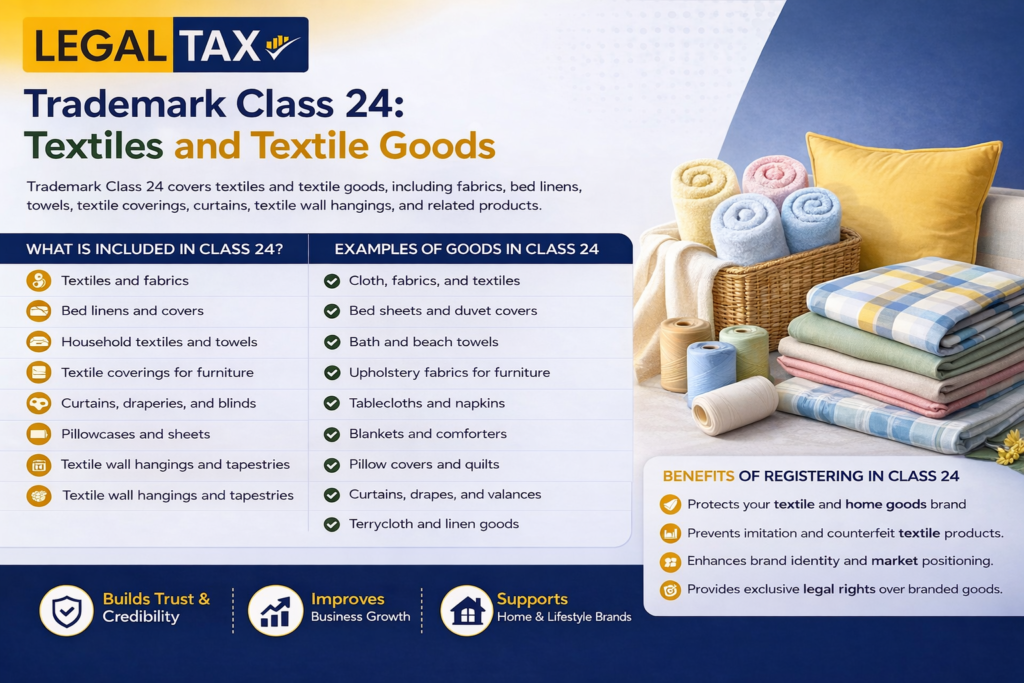
Class 24 has a well-defined but broad scope. Here is a comprehensive look at what qualifies:
Fabrics and Textiles: Woven fabrics, knitted fabrics, cotton fabric, silk fabric, linen fabric, synthetic fabric, polyester fabric, velvet, denim, canvas, muslin, flannel, georgette, chiffon, and satin
Bed and Bedroom Linen: Bed sheets, bedcovers, duvet covers, pillow covers, pillowcases, quilts, blankets, throws, mattress covers, and crib sheets
Table Linen: Tablecloths, table runners, table mats, napkins, and placemats
Bathroom Textiles: Towels, bath towels, hand towels, face towels, bath mats, and washcloths
Kitchen Textiles: Kitchen towels, dish cloths, aprons made of textile, and oven mitts
Curtains and Furnishing Fabrics: Curtains, drapes, blinds made of fabric, upholstery fabric, sofa covers, and chair covers
Other Textile Goods: Flags made of textile, banners, pennants, textile wall hangings, and sleeping bags (textile parts)
What Is NOT Covered Under Class 24: Finished garments and clothing items fall under Class 25, not Class 24. Class 24 is strictly for the fabric and textile goods themselves — not stitched or assembled clothing.
Why Is Trademark Registration Under Class 24 So Important?
India’s textile and apparel market is projected to reach hundreds of billions of dollars in the coming years. Domestic consumption is rising, exports are growing, and e-commerce has opened up new channels for both small weavers and large manufacturers. In this environment, brand identity has become a serious competitive advantage.
Here is why trademark registration under Class 24 is not optional for serious textile businesses:
Exclusive Brand Rights Across India Once your trademark is registered under Class 24, you hold the exclusive right to use that name and logo for textile products across the entire country. No distributor, copycat, or competitor can legally use a similar mark in the same product category.
Protection Against the Grey Market India’s textile market has a significant unorganized segment where brand copying is rampant. Cheap imitations sold under similar-sounding names damage your reputation and eat into your revenue. A registered trademark is your legal weapon to stop this.
Enables Brand Building on E-Commerce Marketplaces like Amazon, Flipkart, and Myntra have brand protection programs that require trademark registration. Without it, unauthorized sellers can list products using your brand name, confusing customers and undermining your hard-earned reputation.
Strengthens Export Business If you export textiles, many international buyers, distributors, and retail chains require proof of trademark registration before entering into supply agreements. A registered trademark signals professionalism and brand seriousness to global partners.
Foundation for Licensing and Franchising Many textile brands license their name to regional manufacturers or franchise their retail stores. This is only legally possible with a registered trademark that gives you enforceable rights over your brand.
Asset Value for Investors and Banks Whether you are raising capital from investors or applying for a business loan, a registered trademark is counted as an intellectual property asset that strengthens your business profile and increases your overall valuation.
Who Should Apply for Trademark Class 24?
You should consider filing under Trademark Class 24 if your business operates in any of the following areas:
- Fabric and cloth manufacturers — cotton, silk, synthetic, or blended
- Handloom weavers and traditional textile artisans
- Bed linen and home furnishing brands
- Towel and bath textile manufacturers
- Curtain and upholstery fabric suppliers
- Table linen and kitchen textile brands
- Textile exporters and wholesalers
- Home décor brands that sell fabric-based products
- Private label textile businesses selling on Amazon or Flipkart
- Ethnic and traditional fabric brands — Banarasi, Chanderi, Pochampally, etc.
- Saree and dress material brands (for the fabric itself, not stitched garments)
Even cottage industries and small weavers producing handmade textiles should register their brand under Class 24. India’s Geographical Indication (GI) tags protect craft traditions, but a trademark protects your specific brand within that tradition.
Trademark Class 24 vs Other Classes — Important Distinctions
The textile space involves multiple related trademark classes, and filing under the wrong one can leave your brand partially unprotected. Here is how Class 24 relates to its neighbors:
Class 24 vs Class 25: This is the most common source of confusion. Class 24 covers fabrics, bed sheets, towels, and textile goods as materials. Class 25 covers finished clothing and footwear — shirts, trousers, sarees as garments, dresses, and shoes. If you manufacture both fabric and finished garments, you may need to file under both classes.
Class 24 vs Class 22: Class 22 covers ropes, strings, nets, tents, and raw fibrous textile materials like raw cotton, jute, and wool in their unprocessed state. Once the fiber is processed into fabric, it moves into Class 24.
Class 24 vs Class 27: Class 27 covers carpets, rugs, mats, and floor coverings. Even though these are textile-adjacent products, they are classified separately. A brand selling both bedsheets and carpets needs Class 24 and Class 27.
Class 24 vs Class 20: Class 20 covers furniture, including certain types of cushions and pillows as furniture items. However, pillowcases and pillow covers made of textile fall under Class 24.
Class 24 vs Class 35: If you run a retail store or online shop selling textile products, the retail service itself falls under Class 35. Your products need Class 24; your store brand may need Class 35 as well.
These distinctions can be tricky. Our team at LegalTax.in will assess your exact business model and recommend the right combination of classes to give your brand complete coverage.
Step-by-Step Process to Register Trademark Under Class 24
The trademark registration process in India is governed by the Trade Marks Act, 1999 and managed by the Controller General of Patents, Designs and Trade Marks (CGPDTM). Here is how it works from start to finish:
Step 1 — Trademark Search Begin with a thorough search on the official IP India portal at ipindia.gov.in to ensure no similar mark exists in Class 24. This is the single most important step — it determines whether your chosen brand name is registrable and free from conflict.
Step 2 — Choose Your Mark Type Decide whether you want to register a word mark (your brand name in plain text), a device mark (your logo), or a composite mark (name and logo together). Each offers different types of protection and has its own strategic advantages.
Step 3 — File Form TM-A Online Submit your application on the IP India e-filing portal at tmrsss.ipindia.gov.in. Select Class 24, provide a clear description of your textile goods, upload your mark, and pay the applicable government fee.
Step 4 — Examination by the Trademark Registry The Registry examines your application for technical compliance and potential conflicts. If they raise objections, you receive an Examination Report and must respond within 30 days with detailed legal arguments.
Step 5 — Hearing (If Required) If your written response does not fully satisfy the examiner, a personal or virtual hearing may be scheduled. A qualified trademark attorney represents your interests at this stage.
Step 6 — Publication in the Trademark Journal After examination clearance, your trademark is published in the official Trademark Journal. Any person or business that believes your mark conflicts with theirs has 4 months to file an opposition.
Step 7 — Issuance of Registration Certificate If no opposition is filed — or if opposition is resolved in your favor — the Trademark Registry issues your Registration Certificate. Your trademark is now legally registered and valid for 10 years from the original date of filing.
Documents Required for Trademark Class 24 Registration
Prepare the following before initiating the filing process:
- Clear image of the trademark — brand name, logo, or both
- Applicant’s identity proof — Aadhaar card, PAN card, or passport
- Address proof — bank statement, utility bill, or rental agreement
- Business proof — GST registration certificate, Shop Act license, MSME certificate, or Company Incorporation Certificate
- Form TM-48 — Power of Attorney, required if a trademark agent is filing on your behalf
- User Affidavit — required if you are claiming prior use of the mark before the filing date
- MSME or Startup India Certificate — for eligibility to pay the reduced government fee of ₹4,500
Government Fees for Trademark Class 24 Registration
Individuals, Startups, and MSMEs: ₹4,500 per class for e-filing
Companies, LLPs, and Large Enterprises: ₹9,000 per class for e-filing
These are purely government charges. Professional fees for end-to-end handling — including search, filing, documentation, and examination response — are charged separately.
At LegalTax.in, we provide complete trademark registration services with transparent, all-inclusive pricing and zero hidden fees.
📞 Call or WhatsApp: 9711939395
Expected Timeline for Trademark Registration
- Application Filing: Same day (e-filing)
- TM Number Allotment: Immediately upon submission
- Examination Report: 3 to 6 months from filing date
- Response Window: 30 days from receipt of examination report
- Publication in Trademark Journal: 1 to 3 months after clearance
- Opposition Period: 4 months from the date of publication
- Registration Certificate: 6 to 12 months after opposition period ends
Total expected duration: Approximately 18 to 24 months under normal processing conditions
From the day you file, you are legally entitled to use the ™ symbol on your products and marketing materials. The ® symbol can only be used once the Registration Certificate is officially issued.
Common Mistakes to Avoid When Filing Under Class 24
Confusing Class 24 with Class 25: This is the most frequent error in the textile industry. A fabric manufacturer filing under Class 25 (garments) instead of Class 24 (fabrics and textile goods) will find that their actual products are completely unprotected. Always verify your class before filing.
Choosing a Name That Is Too Generic: Names like “Soft Sheets” or “Cotton King” are highly likely to be rejected for being descriptive of the product itself. Your trademark must be distinctive — something that uniquely identifies your brand rather than simply describing what you sell.
Not Doing a Trademark Search: Filing without searching the existing database is one of the costliest mistakes a business can make. If a similar mark already exists in Class 24, your application may be rejected after months of waiting and fees already paid.
Missing the Examination Report Deadline: If you do not respond to the Examination Report within 30 days, your application is treated as abandoned. Many applicants lose their trademark simply because they did not have proper professional support tracking their application.
Filing Only Under Class 24 When More Coverage Is Needed: If you also sell garments, your brand needs Class 25. If you also offer retail services, you need Class 35. Filing only under Class 24 when your business spans multiple categories leaves significant gaps in your brand protection.
Letting the Trademark Lapse: Trademark registration is valid for 10 years and must be renewed before the expiry date. A lapsed trademark loses all its legal protection and can be claimed by someone else. Always maintain a renewal schedule.
Why Choose LegalTax.in for Trademark Registration?
LegalTax.in is a trusted name in Indian trademark and business law services. Our team of qualified trademark attorneys and legal professionals brings years of hands-on experience across all 45 trademark classes — including extensive work with textile, apparel, and home furnishing brands.
What We Offer:
- Free consultation before you pay a single rupee
- In-depth trademark search to identify and eliminate risks before filing
- Complete documentation preparation and form filing
- Professional drafting of responses to Examination Reports
- Representation at hearings if required
- Opposition proceedings handled by experienced attorneys
- Timely renewal reminders so your trademark never lapses
- 100% online and paperless process — no office visits required
- Transparent, fixed pricing with no hidden charges
Your brand is the product of years of hard work, creativity, and investment. We make sure it stays legally yours — protected, registered, and enforceable.
Frequently Asked Questions (FAQs)
1. What is Trademark Class 24?
Trademark Class 24 covers textiles and textile goods that are not included in other classes. It primarily includes fabrics, textile materials, bed and table covers, and related textile products.
2. Which products are covered under Trademark Class 24?
Class 24 includes cotton fabrics, silk fabrics, woolen textiles, bed sheets, blankets, curtains, pillow covers, tablecloths, towels, and other textile goods.
3. Why should textile businesses register a trademark under Class 24?
Trademark registration protects the brand identity of textile products, prevents unauthorized use by competitors, and helps establish customer trust and market recognition.
4. Are bed sheets and blankets included in Trademark Class 24?
Yes, bed sheets, blankets, quilts, comforters, pillowcases, and other bedding textiles are covered under Trademark Class 24.
5. Does Trademark Class 24 cover curtains and upholstery fabrics?
Yes, curtains, drapes, upholstery fabrics, furnishing fabrics, and decorative textile materials fall within Class 24.
6. Are textile fabrics for clothing included in Trademark Class 24?
Yes, fabrics used for making garments, such as cotton, silk, linen, polyester, and wool fabrics, are included in Class 24. However, finished clothing items are generally covered under Trademark Class 25.
7. How long is a Trademark Class 24 registration valid in India?
A trademark registered under Class 24 remains valid for 10 years from the date of registration and can be renewed indefinitely for successive 10-year periods.
Conclusion
India’s textile industry is ancient, diverse, and enormously competitive. Whether you are a mill owner in Surat, a handloom weaver in Varanasi, a home linen brand selling on Instagram, or a towel exporter based in Karur — your brand identity is the thread that holds your business together.
Trademark Class 24 gives that identity the legal protection it deserves. It tells the market, your competitors, your customers, and your partners that your brand belongs to you — exclusively, legally, and permanently.
The process is simple when you have the right team by your side. At LegalTax.in, we have helped businesses of every size — from solo entrepreneurs to listed companies — protect their brands with confidence and clarity.
Do not wait for a copycat to force your hand. Take control of your brand today.
Get Expert Trademark Registration and IP Protection Services
🟡 For complete trademark registration, IP advisory, opposition response, renewal, and brand protection services for businesses across all industries and product categories.
👉 Trademark Registration
👉 Patent Registration
👉 Copyright Registration
👉 Design Registration
🟡 LegalTax.in provides complete business registration, compliance, and legal documentation services.
👉 Legal Documentation and Drafting
👉 GST Registration and Filing
👉 Income Tax Return
👉 Private Limited Company Registration
👉 LLP Registration
👉 Partnership Firm Registration
👉 MSME and Udyam Registration
👉 Import Export Code Registration
👉 Startup Registration
👉 GeM Registration
🟡 IT and Digital Services
👉 Website Development
👉 SEO Services
👉 Social Media Marketing
👉 Logo Design
👉 Google and Facebook Ads
👉 Branding Services
📞 Call Now: +91 9711939395
🕐 Free Consultation: Monday to Saturday, 9 AM to 6 PM

I’m Aryan Yadav, passionate about SEO and Digital Marketing with a strong interest in helping businesses grow online. I enjoy learning new strategies, exploring digital trends, and creating ideas that deliver value. I believe in continuous growth, creativity, and building meaningful results through smart work and dedication.
Our Clients