Views: 6
CMMI Level 3 requirements are what stand between many Indian IT companies and large government, enterprise and overseas contracts. Tender documents often say “CMMI Level 3 or above”, and buyers use it as proof that a company follows defined, organisation-wide processes rather than depending on a few star employees. Understanding exactly what is required saves months of effort and avoids a failed appraisal.
This guide explains the five maturity levels, the requirements at Level 3, eight proven steps to get there, the Benchmark appraisal, timeline, cost factors, validity and how buyers verify your rating. For a readiness assessment, call LegalTax on +91 97119 39395.
Table of Contents
- 1 What Is CMMI?
- 2 CMMI Maturity Levels at a Glance
- 3 CMMI Level 3 Requirements: What Appraisers Look For
- 4 8 Proven Steps to Meet CMMI Level 3 Requirements
- 5 The Benchmark Appraisal Explained
- 6 How Long Does It Take?
- 7 Cost Factors
- 8 Validity and the Sustainment Appraisal
- 9 How Buyers Verify Your Rating
- 10 CMMI vs ISO 9001 vs ISO 27001
- 11 Who Needs to Meet CMMI Level 3 Requirements?
- 12 CMMI Level 3 Requirements: Development vs Services
- 13 The Practice Areas in Simple Words
- 14 Roles You Need
- 15 Evidence Appraisers Usually Ask For
- 16 Tools That Help
- 17 Combining CMMI With ISO 27001 and Privacy Frameworks
- 18 Real Example
- 19 CMMI Level 3 Requirements Checklist
- 20 Budget and Timeline Planning
- 21 Choosing Your Appraiser
- 22 Keeping the Rating Alive
- 23 Benefits Beyond the Tender
- 24 Frequently Overlooked Practices
- 25 A Simple Communication Plan
- 26 Moving From Level 3 to Level 5
- 27 Common Mistakes
- 28 Why Choose LegalTax?
- 29 Conclusion
What Is CMMI?
CMMI (Capability Maturity Model Integration) is a process improvement model owned by ISACA through the CMMI Institute. It describes practices that help organisations deliver software, services and other work predictably. Unlike ISO standards, CMMI does not lead to a certificate. Instead, an organisation receives a maturity level rating through an appraisal.
- It is used widely in software development and IT services.
- The current model also covers areas such as services, supplier management, data, people, and security and safety.
- Ratings are awarded only through appraisals led by certified appraisers.
CMMI Maturity Levels at a Glance
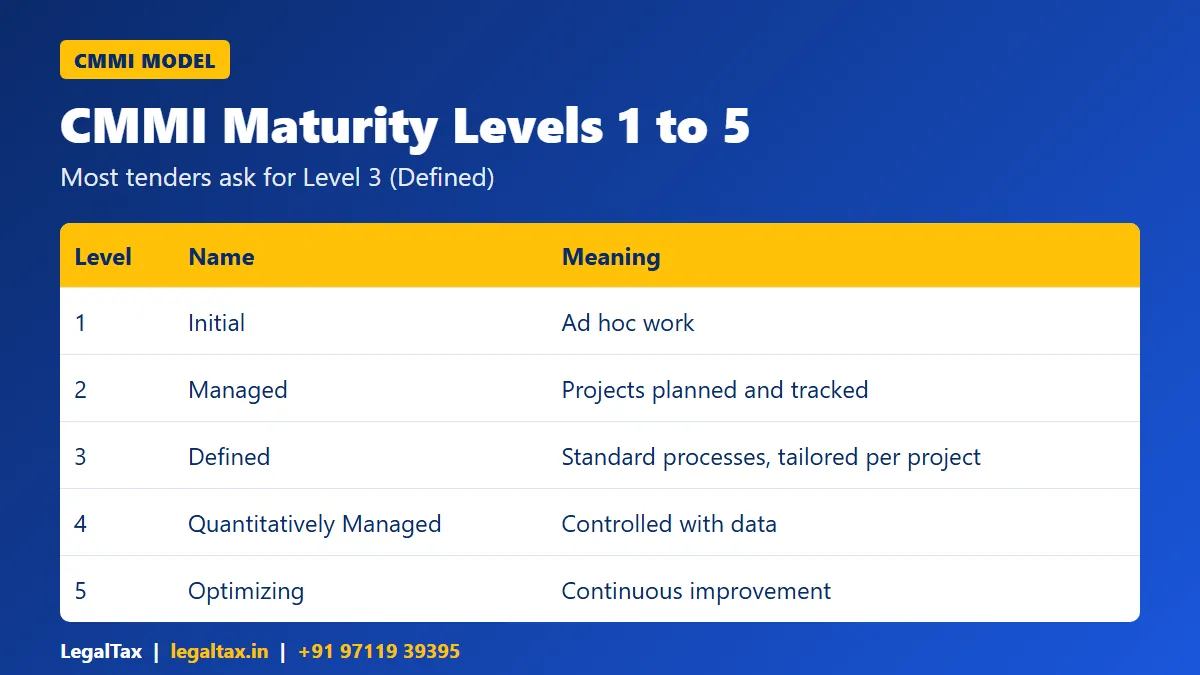
| Level | Name | What it means |
|---|---|---|
| 1 | Initial | Work gets done, but ad hoc |
| 2 | Managed | Projects are planned, tracked and controlled |
| 3 | Defined | Organisation-wide standard processes, tailored per project |
| 4 | Quantitatively Managed | Performance is measured and controlled with data |
| 5 | Optimizing | Continuous, data-driven improvement |
Most tenders ask for maturity level 3; some large or critical projects ask for Level 5.
CMMI Level 3 Requirements: What Appraisers Look For
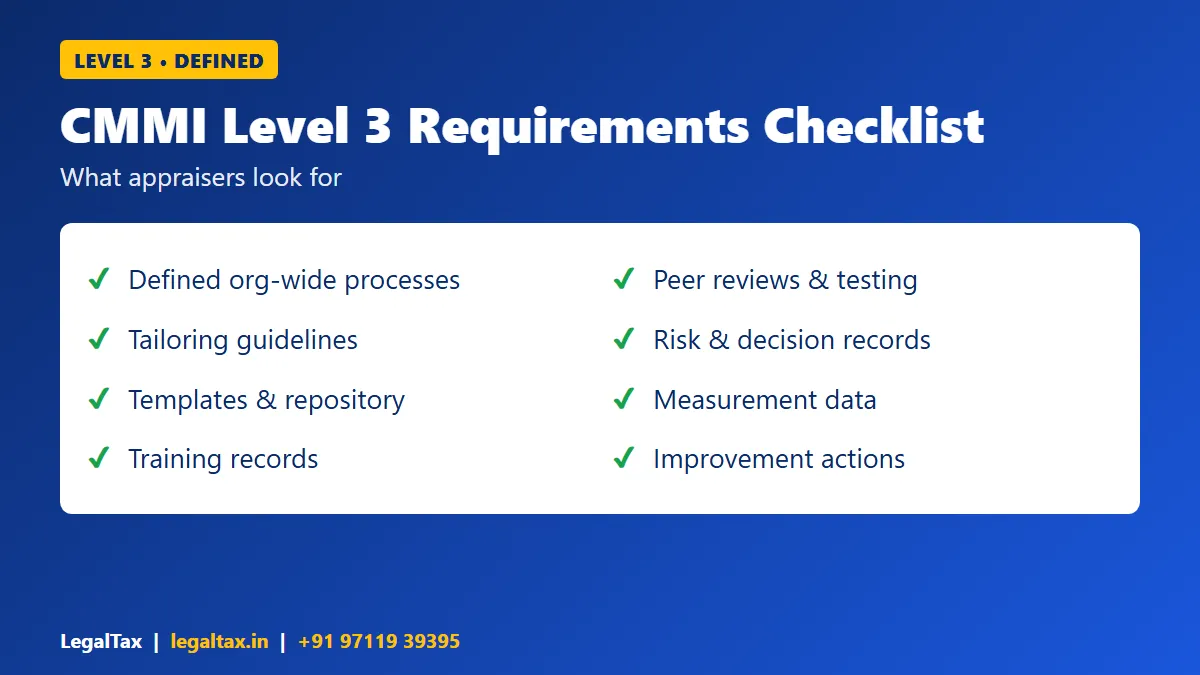
The core idea of Level 3 is “defined”: the organisation has standard ways of working, and every project follows them with controlled tailoring. In practice, CMMI Level 3 requirements cover:
- Defined organisational processes for requirements, planning, estimation, design, development, testing, configuration management, quality assurance, risk and supplier management.
- Tailoring guidelines so each project adapts the standard process in a controlled, documented way.
- Process assets: templates, checklists, a lessons-learned repository and measurement data that teams actually use.
- Training so people know and apply the processes.
- Peer reviews, verification and validation built into delivery.
- Organisational process improvement, usually led by a process group.
- Objective evidence from real projects: appraisers sample projects and interview people, so documents alone are not enough.
Meeting CMMI Level 3 requirements is therefore about behaviour as much as documentation.
8 Proven Steps to Meet CMMI Level 3 Requirements
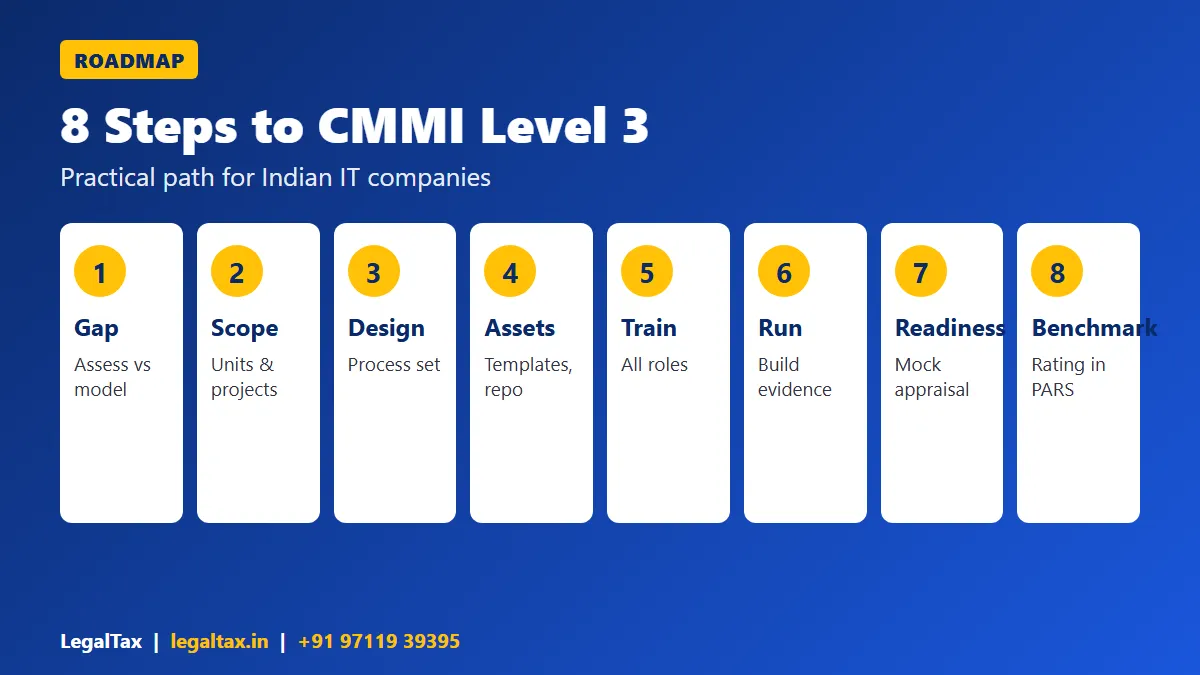
- Gap assessment of current practices against the model.
- Define the scope: business units, projects and the model domain to be appraised.
- Design the process set and tailoring guidelines with the people who will use them.
- Build process assets: templates, checklists, measurement plan and repository.
- Train teams and roll out on live projects.
- Run projects on the new processes long enough to generate evidence.
- Readiness check through an informal or evaluation appraisal.
- Benchmark appraisal led by a certified lead appraiser.
Need CMMI Level 3 for a tender?
LegalTax runs a gap assessment, sets up your process assets and prepares your teams for the appraisal.
The Benchmark Appraisal Explained
A benchmark appraisal is the formal appraisal that results in a maturity level rating. It is led by a CMMI certified lead appraiser with a trained appraisal team, often including some of your own staff. The team reviews documents, samples projects, interviews practitioners and managers, and rates whether practices are implemented across the organisational unit. Results are reported to ISACA.
Choose the lead appraiser carefully. Confirm the appraiser’s current certification with ISACA, ask about experience in your domain, and agree the scope and sampling in writing before the appraisal starts.
How Long Does It Take?
For a company with basic project management already in place, meeting CMMI Level 3 requirements typically takes several months to about a year. Most of the time goes into running projects on the new processes to build evidence. Companies that already hold ISO 9001 or ISO 27001 usually move faster, because process discipline and record-keeping habits exist.
Cost Factors
- Size of the organisation and number of projects in scope;
- Lead appraiser fees and appraisal team days;
- Consulting and training support;
- Internal effort of your teams and any tools you adopt;
- ISACA’s appraisal-related fees.
Ask for quotes that separate consulting, training and appraisal costs, so you can compare them fairly.
Validity and the Sustainment Appraisal
A formal appraisal rating is valid for three years from the appraisal date. A sustainment appraisal before expiry can extend it, after which a new benchmark is needed. Plan the next appraisal well before expiry so tender eligibility does not lapse.
How Buyers Verify Your Rating
Buyers check ratings in ISACA’s Published Appraisal Results System (PARS). The published appraisal results show the maturity level, the organisational unit covered, the model domain and the appraisal date. A PDF “certificate” without a matching entry in the published appraisal results is a red flag. You can learn more about CMMI services on ISACA’s CMMI page.
CMMI vs ISO 9001 vs ISO 27001
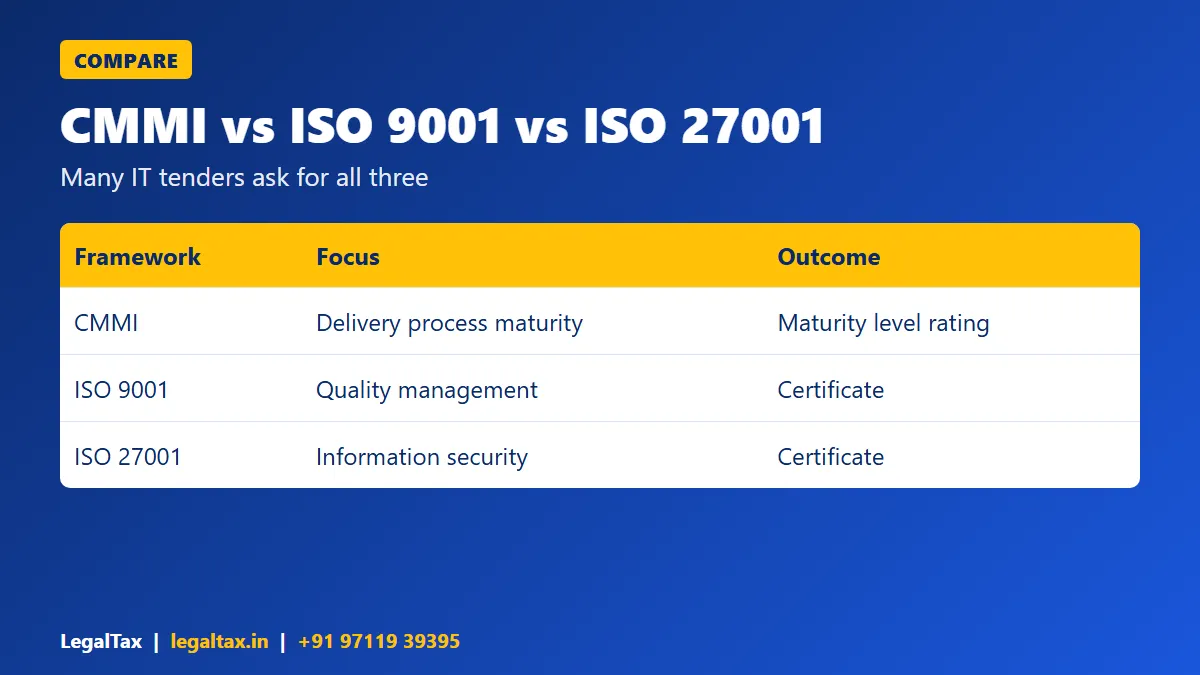
| Framework | Focus | Outcome |
|---|---|---|
| CMMI | Process maturity in delivery | rating rating |
| ISO 9001 | General quality management | Certificate |
| ISO 27001 | Information security management | Certificate |
Many IT companies hold all three. See ISO 9001 certification, ISO 27001 certification and why ISO matters for IT companies.
Who Needs to Meet CMMI Level 3 Requirements?
- IT and software companies bidding for central and state government projects, including on the GeM portal;
- Vendors to banks, insurers, telecom companies and PSUs;
- Offshore development centres serving US, European and Middle East clients;
- IT service providers who want to move from small to large contracts.
If tenders in your space regularly ask for it, meeting CMMI Level 3 requirements is a business decision, not just a quality project.
CMMI Level 3 Requirements: Development vs Services
Software product and project companies usually focus on requirements, design, coding, testing and release practices. IT service companies such as managed services, support and infrastructure providers focus on service delivery, incident and problem handling, capacity and continuity. The underlying expectation is the same: defined processes, used consistently, and improved over time. Choose the model domain that matches how you earn revenue.
The Practice Areas in Simple Words
- Planning and monitoring: estimates, plans, tracking and corrective action.
- Requirements: understanding, documenting and managing changes in client needs.
- Technical work: design, build, integration, verification and validation.
- Quality and configuration: reviews, audits, version control and baselines.
- Risk and decisions: identifying risks early and making structured decisions.
- Organisation-level work: process definition, training, measurement and improvement.
At Level 3, the organisation-level work is what usually needs the most new effort.
Roles You Need
- Sponsor: a senior leader who owns the programme and removes roadblocks.
- Process group: a small team that defines, trains and improves processes.
- Project managers: who apply and tailor processes and generate most of the evidence.
- Quality assurance: who checks adherence objectively.
- Appraisal team members: trained staff who join the lead appraiser.
Without a committed sponsor, CMMI Level 3 requirements rarely get met on time. In smaller companies, one person may hold more than one role, which is fine as long as responsibilities are written down and the quality assurance role stays independent of the projects it checks. Review the role list every quarter as teams grow, change or take on new clients.
Evidence Appraisers Usually Ask For
- Project plans, estimates and status reports;
- Requirements documents and change records;
- Design documents, review records and test reports;
- Configuration and release records;
- Risk registers and decision records;
- Training records and the organisational process repository;
- Measurement data and improvement actions.
The appraisal team also interviews practitioners, so people must be able to explain how they work in their own words.
Tools That Help
You do not need expensive tools to meet CMMI Level 3 requirements, and buying new software rarely fixes a process problem on its own. Most companies use the project management, ticketing, version control and documentation tools they already have, configured to capture the right information. The key is consistency: one place for each type of record, used by every project. Agree naming rules for folders and files at the start, so evidence can be found in minutes during the appraisal instead of hours.
Combining CMMI With ISO 27001 and Privacy Frameworks
Many IT companies already hold ISO 27001 or are working on it. Shared practices such as document control, internal audits, risk management and training reduce the effort of meeting CMMI Level 3 requirements. See how to implement ISO 27001 and our ISO 27001 certification guide. Companies handling health or EU personal data may also need HIPAA compliance or GDPR compliance, which fit well into the same management system.
Real Example
A 120-person Noida software company kept losing state government tenders that required CMMI Level 3. A gap assessment showed good engineering habits but no organisation-wide process set and no measurement. Over eight months, it defined a lean process set, trained 15 project managers, ran six projects on it and passed its formal appraisal. It qualified for the next tender cycle with the rating published and verifiable.
CMMI Level 3 Requirements Checklist
- Organisation-wide process descriptions approved and published.
- Tailoring guidelines used and recorded by every project.
- Templates and checklists stored in one repository.
- Training plan and attendance records for all roles.
- Peer review and testing records on sampled projects.
- Risk registers, decision records and measurement data.
- Improvement actions logged and closed by the process group.
Use this list as a quick self-check before booking the appraisal. If any item is weak, the CMMI Level 3 requirements are not yet fully met.
Budget and Timeline Planning
Treat the programme like a client project with a plan, milestones and a budget. Allocate time for process design, pilot projects, training, internal reviews and the appraisal itself. Fix the appraisal window early, because experienced appraisers are booked months ahead. Many companies align the appraisal date with an upcoming tender, but leave a buffer of a few weeks in case findings need to be fixed.
Choosing Your Appraiser
The person leading the appraisal shapes the experience. Check current certification with ISACA, ask for references from companies of similar size and domain, and agree the scope, sampling and schedule in writing. A good appraiser is strict about evidence but clear and fair in communication.
Keeping the Rating Alive
After the appraisal, keep the processes running. Continue reviews, measurements and improvement actions, and update process assets when teams find better ways of working. Companies that keep meeting CMMI Level 3 requirements day to day find the sustainment or next appraisal much easier than those that relax after the result.
Benefits Beyond the Tender
- Predictable delivery: estimates and plans become more reliable.
- Fewer defects: reviews and testing catch problems earlier.
- Faster onboarding: new joiners learn one standard way of working.
- Less dependence on individuals: knowledge sits in the process, not only in people’s heads.
- Better client confidence: buyers trust a verifiable, independent rating.
Frequently Overlooked Practices
Companies often focus on development steps and forget the supporting practices that appraisers also check. Decision analysis for important technical choices, formal risk tracking, causal analysis of recurring defects, and documented lessons learned at project closure are common gaps. So is supplier management for subcontracted work. Building these into project templates early is far easier than adding them in the weeks before the appraisal.
A Simple Communication Plan
People support what they understand. Announce the programme with a short note from leadership explaining why it matters, share a one-page roadmap, and give monthly updates on progress. Recognise the project teams that adopt the processes first. Clear communication turns the effort from a compliance exercise into a shared improvement, and it makes interviews during the appraisal far more natural, because people can describe their own work confidently.
Moving From Level 3 to Level 5
Some clients and large tenders ask for Level 5. The jump requires statistical and quantitative management of performance, and continuous improvement driven by data. Most companies spend at least one full cycle at Level 3 to build reliable measurement history before attempting higher levels. Meeting CMMI Level 3 requirements properly is the foundation for that journey.
Common Mistakes
- Writing processes that nobody uses, just to pass the appraisal.
- Choosing a scope too large for the first appraisal.
- Running projects on the new process for too short a time.
- Not training project managers, who carry most of the evidence.
- Letting the rating expire and losing tender eligibility.
Why Choose LegalTax?
- CMMI Level 3 and Level 5 readiness support: gap assessment, process design, training and mock appraisals.
- Coordination with certified lead appraisers and support across ISO certifications.
- Combined compliance roadmap with VAPT and SOC 2 for tender-ready IT companies. Contact us.
Conclusion
CMMI Level 3 requirements centre on defined, organisation-wide processes that every project follows and improves. Start with a gap assessment, keep the first scope realistic, build useful process assets, train your teams, and generate real project evidence before the formal appraisal. With a clear roadmap, meeting CMMI Level 3 requirements becomes a manageable project that opens bigger contracts.
What are the CMMI Level 3 requirements?
CMMI Level 3 requirements centre on defined, organisation-wide standard processes that every project tailors and follows. Appraisers look for process descriptions, tailoring guidelines, templates and guides, training, peer reviews, verification and validation, and organisational process improvement, backed by objective evidence from real projects rather than documents alone, collected over several months.
Who awards CMMI Level 3 in India?
No one issues an ISO-style certificate. The rating comes from a formal appraisal led by a CMMI certified appraiser under the CMMI Institute, which is part of ISACA. The appraisal results are reported to ISACA and published in its Published Appraisal Results System, where buyers and tender committees can verify them online.
How long is a CMMI Level 3 rating valid?
A formal appraisal rating is valid for three years from the appraisal date. Before it expires, an organisation can conduct a sustainment appraisal to extend it, after which a new formal appraisal is required. Planning ahead avoids a gap in validity that could make your company ineligible for important tenders.
How long does it take to achieve CMMI Level 3?
Usually several months to about a year, depending on your current processes and the scope. Most of the time is needed to run projects on the defined processes and build evidence. Companies that already follow ISO 9001 or ISO 27001 often meet CMMI Level 3 requirements faster than those starting fresh.
How can I verify a company’s CMMI maturity level?
Search the company in ISACA’s Published Appraisal Results System. Check the rating, the organisational unit covered, the model domain and the appraisal end date. A rating may apply only to one division, and a certificate-style document without a matching published entry should be treated as a clear warning sign by any buyer.
Is CMMI Level 3 required for government tenders in India?
Many IT and software tenders in India list CMMI Level 3 or above as an eligibility condition, sometimes alongside ISO 9001 and ISO 27001. Always read the exact wording on rating, validity date and scope, because some tenders require the rating to cover the specific business unit that will deliver the project.

Adv. Manish Kashyap is an IPR Law Expert with 10+ years of professional experience in Intellectual Property Rights. He specializes in matters related to Trademark, Copyright, Patent, and other IPR-related legal services, helping individuals and businesses protect and manage their intellectual property effectively.
Our Clients