Views: 7
Halal certification process steps decide how quickly your products can reach buyers in the Gulf, Malaysia, Indonesia and other markets with large Muslim populations, and how confidently domestic customers trust your label. For Indian meat exporters, the rules also changed in 2024: certain halal meat exports now require a specific government-recognised certification system. Knowing the process in advance saves months of back-and-forth.
This guide explains the halal certification process in India in seven easy steps, the I-CAS Halal framework for meat exports, documents, the audit, cost factors, validity and the mistakes to avoid. For help with your unit, call LegalTax on +91 97119 39395.
Table of Contents
- 1 What Is Halal Certification?
- 2 Is Halal Certification Mandatory in India?
- 3 Who Needs to Follow the Halal Certification Process?
- 4 Halal Certification Process: 7 Easy Steps
- 5 Step 1: Choosing the Right Certification Body
- 6 Step 2 and 3: Application and Ingredient Review
- 7 Step 4: Documentation
- 8 Step 5 and 6: The Halal Audit and Corrective Actions
- 9 Step 7: Certificate, Validity and Surveillance
- 10 I-CAS Halal for Halal Meat Export
- 11 Documents Checklist
- 12 Cost Factors in the Halal Certification Process
- 13 Key Markets and What Buyers Expect
- 14 Common Products and Their Risk Points
- 15 Using the Halal Logo Correctly
- 16 Mistakes to Avoid
- 17 Halal Certification Process for Restaurants and Caterers
- 18 Halal Certification Process for Cosmetics and Pharma
- 19 Building a Halal Brand for Export
- 20 Halal Certification Process Timeline
- 21 Segregation and Shared Lines
- 22 Preparing Your Team for the Audit
- 23 Questions to Ask a Certification Body
- 24 Halal Certification Process for Small Businesses
- 25 Maintaining Certification
- 26 Real Example
- 27 Why Choose LegalTax?
- 28 Conclusion
What Is Halal Certification?
Halal certification confirms that a product, its ingredients and the way it is made, stored and handled comply with Islamic dietary and hygiene requirements. It covers what goes into the product and also how the product is protected from contact with non-halal materials during processing, storage and transport.
- It is issued by a halal certification body after document review and an on-site audit.
- It covers specific products and a specific site, not the whole company by default.
- It is usually renewed periodically, with surveillance checks in between.
Is Halal Certification Mandatory in India?
For most products, no. Halal certification for processed food, cosmetics, pharmaceuticals and nutraceuticals is voluntary, but importers, distributors and retail buyers often make it a condition of purchase.
The important exception is halal meat export. The Directorate General of Foreign Trade (DGFT) notified export policy conditions effective 16 October 2024. Under them, halal-labelled meat and meat products for the notified countries must be produced, processed and/or packaged in facilities certified under the I-CAS Halal scheme of the Quality Council of India, with certification by a NABCB accredited body. A DGFT notification in February 2026 added more countries to the list. Check the current notification on the DGFT website before shipping.
Who Needs to Follow the Halal Certification Process?
- Meat and meat product exporters to notified countries;
- Processed food, snacks, confectionery, spices, dairy and beverage manufacturers exporting to the GCC and South-East Asia;
- Cosmetics and personal care brands, because ingredients like gelatin, alcohol and animal derivatives matter;
- Pharmaceutical and nutraceutical makers using capsules and excipients;
- Ingredient and flavour suppliers whose customers need halal inputs;
- Restaurants, hotels and caterers serving halal-conscious customers.
Halal Certification Process: 7 Easy Steps
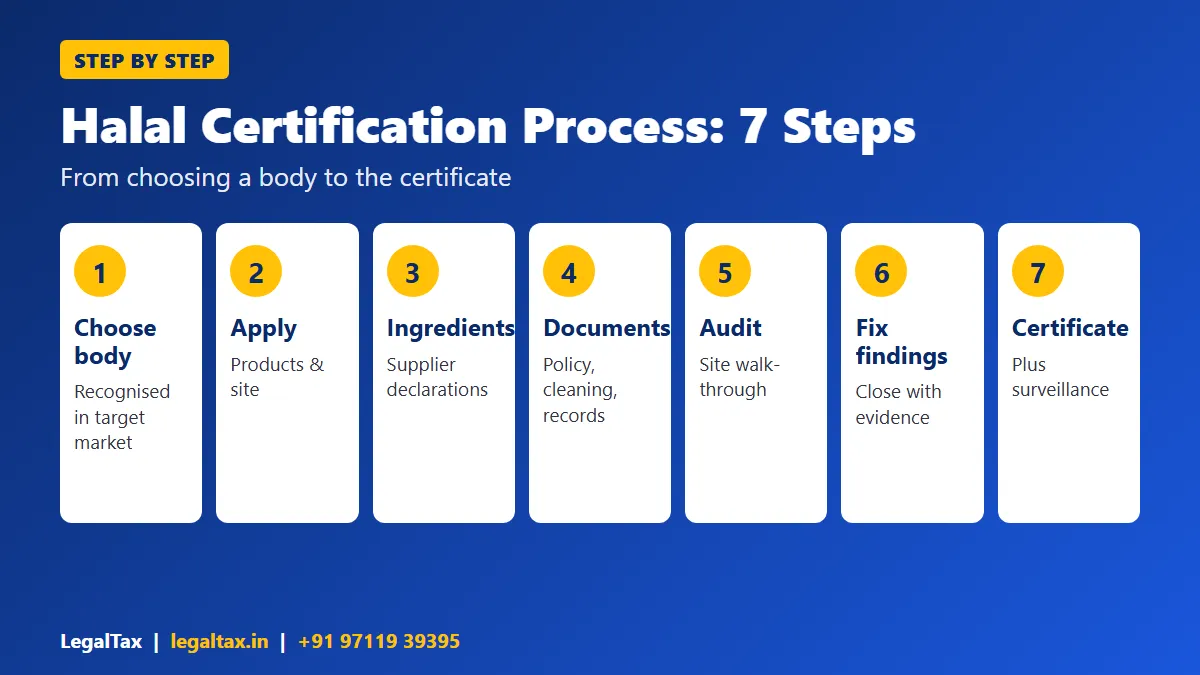
- Choose the certification body recognised in your target market, and a NABCB accredited body under I-CAS Halal where it applies.
- Apply with company, product and site details.
- Ingredient review of every raw material, additive and processing aid, with supplier declarations or certificates.
- Prepare documentation: halal policy, procedures to prevent contamination, cleaning, traceability and training records.
- Halal audit of the facility, storage, production lines and cleaning, and for meat, slaughter practices.
- Close corrective actions raised during the audit.
- Receive the certificate for approved products and site, followed by periodic surveillance.
Each step is explained below. Most delays in the halal certification process happen at step 3, when supplier documents are missing.
Step 1: Choosing the Right Certification Body
Recognition differs by country. A certificate accepted in one Gulf country may not be accepted in Malaysia or Indonesia, which maintain their own recognition lists. Before signing, ask the body for proof that its certificates are accepted in your buyer’s country, and for meat exports, confirm that it is a NABCB accredited body operating under I-CAS Halal. You can learn more about the scheme on the QCI I-CAS Halal portal.
Step 2 and 3: Application and Ingredient Review
The ingredient review is the heart of the halal certification process. The body checks each ingredient’s source and status.
- Animal-derived ingredients must come from halal sources with valid certificates.
- Flavours, emulsifiers, enzymes and colours often hide animal or alcohol-based components.
- Processing aids and cleaning chemicals that touch the product may also be reviewed.
- Packaging materials are checked where they contain animal-derived additives.
Collect supplier specifications and halal declarations early. A single unverified flavour can hold up the entire application.
Step 4: Documentation
- Halal policy signed by management;
- Procedures for receiving, storage, production and dispatch that prevent cross-contact;
- Cleaning and sanitation procedures, especially for shared lines;
- Traceability from raw material to finished product;
- Training records for staff handling halal products;
- Complaint and corrective action records.
Units that already have ISO 22000 or GMP find this step much easier, because the food safety records already exist.
Exporting to the Gulf or South-East Asia?
LegalTax prepares your documents, checks ingredients and coordinates with a suitable halal certification body.
Step 5 and 6: The Halal Audit and Corrective Actions
During the halal audit, the auditor walks through receiving, storage, production, cleaning and dispatch, checks records, interviews staff and verifies that approved ingredients are actually used. For meat, the audit also covers slaughter practices and supervision. Findings are classified, and you must close them with evidence within the time given before the certificate is issued.
Step 7: Certificate, Validity and Surveillance
The certificate lists the approved products and site. Validity depends on the body and the scheme, often one to three years, with surveillance checks during that period. Adding new products usually needs an extension application and ingredient review. Keep the certificate and product list current, because buyers check them before every order.
I-CAS Halal for Halal Meat Export
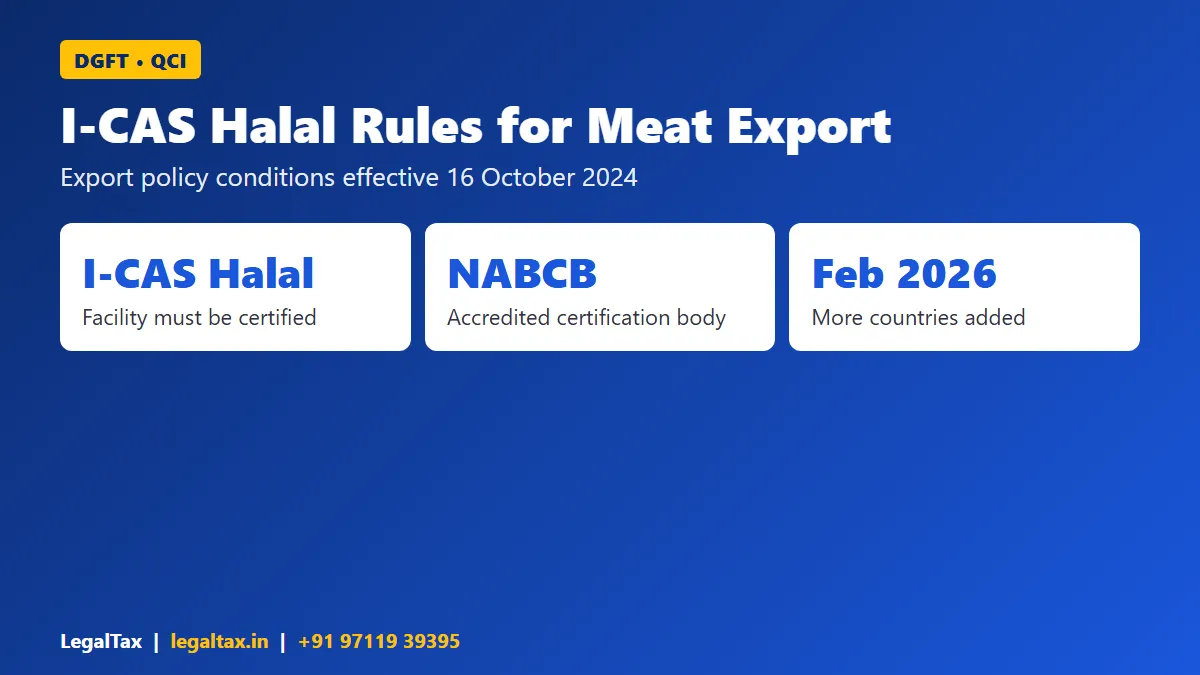
For exporters of meat and meat products, the I-CAS Halal framework adds specific requirements to the general halal certification process:
- The production, processing or packaging facility must be certified under I-CAS Halal.
- The halal certificate must come from a NABCB accredited certification body.
- The requirement applies to exports to the countries notified by DGFT, a list expanded in February 2026.
- The policy for non-halal meat exports was left unchanged.
Exporters should also keep their Import Export Code, FSSAI central licence and other export documents in order. Read IEC registration in India for the basics.
Documents Checklist
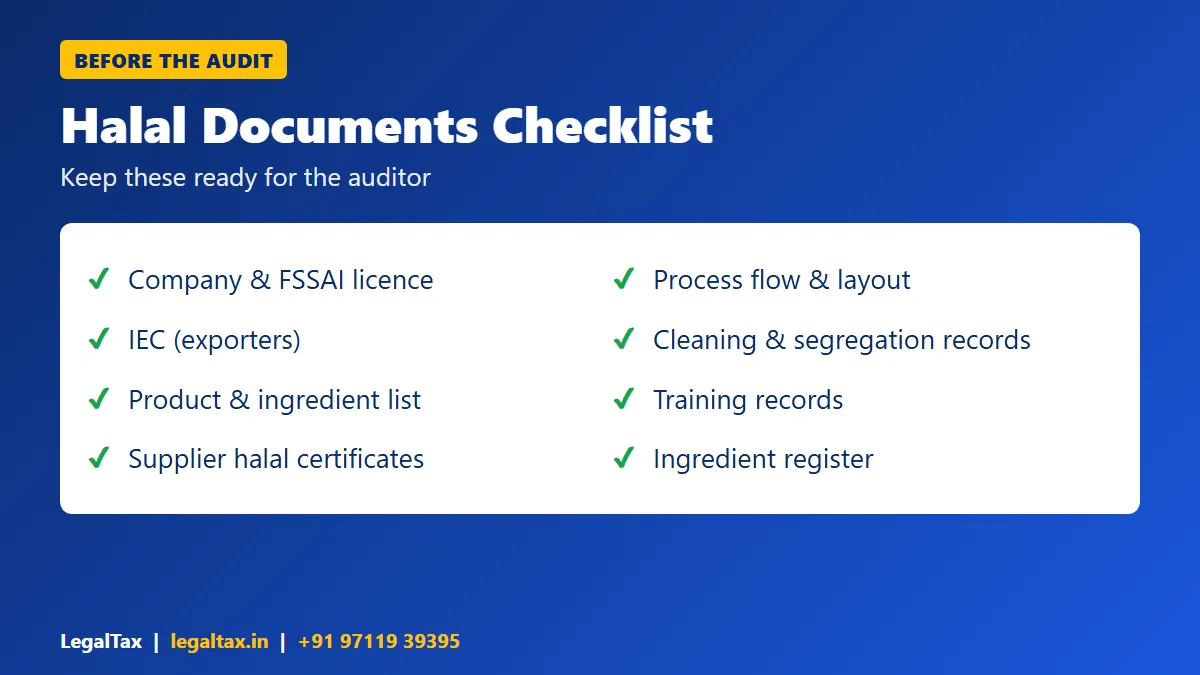
- Company registration and FSSAI licence (food) or drug/cosmetic licence;
- IEC for exporters;
- Product list with complete ingredient specifications;
- Supplier halal certificates or declarations for critical ingredients;
- Process flow charts and factory layout;
- Cleaning, pest control and storage procedures;
- Existing food safety certificates, if any.
Cost Factors in the Halal Certification Process
The total cost depends on:
- the certification body and the recognition your target markets require;
- number of products, ingredients and sites;
- complexity of the ingredient check;
- audit days and travel;
- surveillance checks and product additions during validity;
- any facility changes needed to segregate halal and non-halal production.
Compare the total cost over the full validity period, not only the first-year fee. Ask whether adding a new product later needs a fresh audit or only a document review, because frequent launches can change the total significantly.
Key Markets and What Buyers Expect
Different markets look at different things. Gulf buyers usually ask for a certificate from a body their authorities recognise, along with clear product lists and validity dates. South-East Asian markets such as Malaysia and Indonesia maintain their own recognition systems and can be strict about which foreign bodies they accept. Large retail chains in any market may also audit suppliers themselves. Before you sign an export order, ask the buyer in writing which certification body and documents they will accept, and plan the certificate accordingly.
Common Products and Their Risk Points
- Confectionery: gelatin, colours and glazing agents.
- Bakery: emulsifiers, enzymes and flavour carriers.
- Dairy: rennet, cultures and flavourings.
- Beverages: alcohol-based flavour extracts.
- Supplements: capsule shells and coatings.
- Cosmetics: glycerin, collagen and animal fats.
Knowing these risk points helps you prepare supplier documents before the audit begins. Build a simple ingredient register with columns for supplier, source, certificate number and expiry date, and review it every month. When a supplier changes a source or a certificate is about to expire, you will see it in time and avoid using a non-approved material in a certified product by mistake.
Using the Halal Logo Correctly
The halal logo of your certification body may be printed only on products covered by the certificate, in the form the body approves. Using the halal logo on uncovered products, after expiry, or in a modified form can lead to suspension and loss of buyer trust. Keep artwork approvals on file and update labels when the product list changes.
Mistakes to Avoid
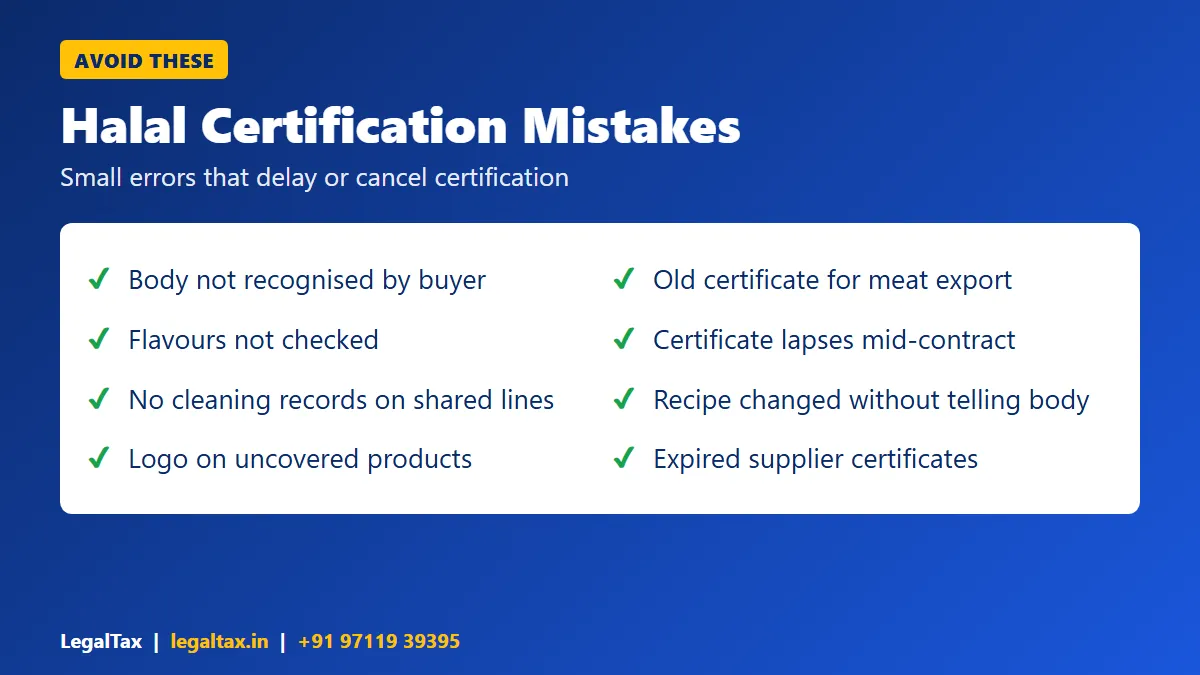
- Choosing a body that is not recognised in your buyer’s country.
- Skipping the ingredient check for flavours, emulsifiers and processing aids.
- Shared lines without documented cleaning and segregation.
- Printing the halal logo on products not covered by the certificate.
- For meat exporters, assuming an older certificate meets the I-CAS Halal requirement.
- Letting the certificate lapse during an active export contract.
Halal Certification Process for Restaurants and Caterers
Restaurants, cloud kitchens and caterers follow a simpler version of the halal certification process. The focus is on approved meat and ingredient suppliers, separate storage and utensils, and staff training. Many hotels serving international guests seek certification to reassure customers, especially in tourist and business districts.
Halal Certification Process for Cosmetics and Pharma
For cosmetics and pharmaceuticals, the halal certification process concentrates on raw materials such as gelatin, glycerin, alcohol, collagen and animal-derived excipients, and on preventing cross-contact during manufacturing. Capsule shells and coatings are common problem areas. Manufacturers often combine halal with GMP so one set of records serves both. See GMP certification cost in India.
Building a Halal Brand for Export
Certification works best when it is part of a wider export plan. Protect your brand name with a trademark before entering new markets (see trademark registration for food and beverage brands), confirm your FSSAI licence category, and arrange origin documents such as a certificate of origin where trade agreements apply.
Halal Certification Process Timeline
- Body selection and application: about one week.
- Ingredient check and supplier documents: one to three weeks, depending on suppliers.
- Documentation and training: one to two weeks.
- Audit and closure of findings: one to three weeks.
A well-prepared unit can complete the halal certification process in a few weeks; units with many ingredients or new suppliers take longer.
Many factories make halal and non-halal products on the same equipment. That is often allowed, but only with clear controls. Keep separate, labelled storage areas for halal-only materials, schedule halal production after a documented cleaning, and verify cleaning before restarting the line. Record every changeover, including who cleaned the line, when, and who verified it. Auditors pay close attention to these records, because cross-contact is the biggest practical risk in a mixed facility.
Preparing Your Team for the Audit
Staff interviews are part of the audit. Make sure people in stores, production, quality and dispatch can explain in simple words how they identify approved materials, how they keep halal products separate, and what they do if something goes wrong. A short training session with practical examples, repeated before the audit, makes a big difference to how confidently the team answers. Include new joiners and contract workers, who are often missed in training records but may still be interviewed.
Questions to Ask a Certification Body
- In which countries are your certificates formally recognised?
- Do you hold NABCB accreditation under the I-CAS Halal scheme, if we export meat?
- How many audit days and surveillance checks will we need, and at what cost?
- How do we add new products during the validity period?
- What are your rules for using your logo on packs and marketing?
Written answers to these questions make it easy to compare bodies before you start the halal certification process.
Halal Certification Process for Small Businesses
Small and home-scale food businesses can also get certified. Keep the product range focused, buy ingredients only from suppliers who provide clear declarations, and maintain simple cleaning and stock records. The halal certification process for a small unit is usually faster, because there are fewer ingredients and fewer areas to audit.
Maintaining Certification
After certification, keep supplier documents current, review any new ingredient before use, and keep cleaning and training records up to date. Inform the body before changing a recipe or supplier for a certified product. Units that treat the halal certification process as an ongoing system rather than a one-time project rarely face problems during surveillance checks.
Real Example
A Gujarat snack maker wanted to supply a UAE distributor. Its first application stalled because two seasoning blends had no supplier declarations. After switching to certified suppliers and documenting line cleaning between batches, the unit cleared the audit in the next attempt and shipped its first container within the season.
Why Choose LegalTax?
- End-to-end halal certification support for food, cosmetics, pharma and exporters.
- ingredient check, documentation and audit preparation.
- Export compliance under one roof: IEC, FSSAI, ISO 22000 and GMP. Contact us today.
Conclusion
The halal certification process is straightforward when you prepare well: choose a body recognised in your target market, complete the ingredient check, document segregation and cleaning, pass the audit and keep the certificate current. Meat exporters must also meet the I-CAS Halal requirements notified by DGFT. With good preparation, the halal certification process becomes a reliable gateway to new markets.
What is the halal certification process in India?
The halal certification process in India involves choosing a recognised certification body, applying with product details, completing an ingredient check, preparing documentation, passing an on-site halal audit and closing any findings. The body then issues a certificate covering the approved products and site, followed by periodic surveillance during its validity.
Is halal certification mandatory in India?
For most products it is voluntary, though buyers and importers often require it. For halal meat export to notified countries, DGFT rules effective 16 October 2024 require production in I-CAS Halal certified facilities, with certification by a NABCB accredited body. Always check the current DGFT notification and country list before you ship any consignment.
What is I-CAS Halal?
I-CAS Halal is the India Conformity Assessment Scheme for halal, run by the Quality Council of India. Under DGFT export policy, specified halal meat and meat products for notified countries must be produced, processed or packaged in I-CAS Halal certified facilities, with certificates issued only by certification bodies accredited by NABCB.
How long does halal certification take?
It usually takes a few weeks once documents and supplier declarations are ready. The ingredient check and the halal audit are the longest steps. Missing supplier certificates for flavours, emulsifiers or processing aids are the most common cause of delay, so collect them before applying to keep the timeline short.
Can a vegetarian product need halal certification?
Yes. Buyers often ask for it because additives, flavours, alcohol-based extracts or processing aids can affect halal status even in vegetarian products. The ingredient check checks these inputs, and the audit checks that shared equipment is cleaned properly between batches to prevent any cross-contact with non-halal materials or residues from earlier batches.
Where can I use the halal logo?
You can use the logo only on products listed in your valid certificate, in the form approved by your certification body. Using it on uncovered products, after the certificate expires or in a modified design can lead to suspension. Keep label artwork approvals on file and update them whenever products change.

Adv. Manish Kashyap is an IPR Law Expert with 10+ years of professional experience in Intellectual Property Rights. He specializes in matters related to Trademark, Copyright, Patent, and other IPR-related legal services, helping individuals and businesses protect and manage their intellectual property effectively.
Our Clients