Views: 4
Table of Contents
- 1 Introduction
- 2 What Is Copyright in India?
- 3 What Is a Trademark in India?
- 4 Copyright vs Trademark in India: The Key Differences Explained
- 5 When Do You Need Copyright, Trademark, or Both?
- 6 Copyright vs Trademark in India: Special Situations Every Business Should Know
- 7 Building a Complete IP Protection Strategy for Your Indian Business
- 8 FAQs
- 9 Conclusion: Copyright and Trademark Are Not Rivals, They Are Partners
Introduction
Why Understanding Copyright vs Trademark in India Is Essential for Every Business Owner
Every Indian entrepreneur, creator, and business owner produces valuable intellectual assets as a natural part of running their business. A startup builds a brand identity. A content creator produces original writing, videos, and music. A software company develops proprietary code. A designer creates logos, illustrations, and packaging. A manufacturer develops a distinctive product name and distinctive trade dress. All of these are intellectual property assets, and all of them need legal protection.
But when it comes to protecting intellectual property in India, two terms come up more than any other: copyright and trademark. Most business owners have heard both terms. Far fewer truly understand what each one protects, how they differ from each other, when you need one versus the other, and when you actually need both.
Understanding Copyright vs Trademark in India is not an academic exercise. It is a practical business decision that determines whether the creative work you produce, the brand you build, and the commercial value you create are legally protected against copying, imitation, and unfair exploitation by competitors and bad actors. This complete guide explains the difference between copyright and trademark in India in plain language, covers when and how to register each, and helps you build a complete intellectual property protection strategy for your business.
For expert intellectual property guidance, trademark registration, copyright protection, and comprehensive IP strategy for your Indian business, visit LegalIP.in or call our team at +91 9711939395.
What Is Copyright in India?
Copyright is a form of intellectual property protection that automatically applies to original creative works the moment they are created and expressed in a tangible form. Under the Copyright Act 1957, which is the governing legislation for copyright protection in India, copyright protects original literary works, artistic works, musical works, dramatic works, cinematograph films, and sound recordings.
Copyright protection in India arises automatically upon creation of an original work. You do not need to register your copyright to own it. The act of creating an original work and expressing it in a fixed form, whether on paper, in a digital file, in a recording, or in any other tangible medium, is sufficient to give the creator copyright ownership. This is one of the most important things to understand about copyright: it is automatic.
However, while copyright arises automatically, registration of copyright with the Copyright Office of India provides significant practical advantages including a public record of your ownership, a legal presumption of ownership in disputes, and a much stronger evidentiary position in infringement proceedings. Registration is therefore strongly recommended even though it is not legally mandatory.
What Does Copyright Protect in India?
Copyright in India protects the expression of ideas, not the ideas themselves. This is a critical distinction. If you write a novel about a detective solving a crime, copyright protects your specific novel with its specific characters, plot, dialogue, and writing style. It does not protect the idea of a detective solving a crime, which anyone else is free to write about in their own original expression.
Copyright protects literary works including books, articles, blog posts, website content, software code, databases, and scripts. It protects artistic works including paintings, drawings, photographs, logos, illustrations, and graphic designs. It protects musical works including compositions and lyrics. It protects dramatic works including plays and screenplays. It protects cinematograph films and sound recordings as separate categories of protected works.
For Indian businesses, some of the most practically important copyright-protected assets include website content and copy, blog articles and marketing materials, software and mobile applications, product photography and brand imagery, logo designs and graphic elements, and original music or audio content used in advertising.
How Long Does Copyright Last in India?
For most original works, copyright protection in India lasts for the lifetime of the author plus sixty years from the beginning of the calendar year following the year of the author’s death. For cinematograph films, sound recordings, photographs, and works published posthumously, the duration is sixty years from the beginning of the calendar year following the year of publication.
For comprehensive guidance on copyright registration, duration, assignment, and enforcement for your specific creative works, visit LegalIP.in or contact our IP experts at +91 9711939395.
What Is a Trademark in India?
A trademark is a sign, symbol, word, phrase, logo, design, or combination thereof that distinguishes the goods or services of one business from those of another. Under the Trade Marks Act 1999, which is the governing legislation for trademark protection in India, a trademark serves as a badge of origin that tells customers where a product or service comes from and allows them to associate their experience of quality with a specific source.
Unlike copyright, trademark protection in India does not arise automatically. While you have certain common law rights in an unregistered trademark if you can prove prior use in commerce, formal registration with the Trademark Registry of India is the only way to obtain the full range of statutory trademark rights, including the exclusive right to use the mark nationwide for the specified goods and services, the right to sue for trademark infringement, and the ability to record the mark with Customs to prevent importation of infringing goods.
Trademark registration in India gives the owner exclusive rights to use the registered mark for the goods and services specified in the application. It creates a public record of ownership. It gives the owner the right to use the registered trademark symbol. And it provides a powerful legal foundation for taking action against anyone who copies, imitates, or creates confusion with your registered mark.
What Does a Trademark Protect in India?
A trademark in India protects the commercial identity of a business and its products or services. It protects brand names including the name under which a business trades, product names, and service names. It protects logos and graphic marks that identify the source of goods or services. It protects taglines and slogans that are distinctive and function as identifiers of commercial origin. It can protect distinctive sounds, colors, shapes, and packaging elements that function as source identifiers, though these non-traditional marks face a higher threshold of distinctiveness for registration.
For Indian businesses, the most commonly registered trademark types include the business name or brand name as a word mark, the logo as a device mark, the product name as a separate word mark, and in some cases a distinctive tagline. Many businesses register their marks in multiple categories to ensure comprehensive protection across all the goods and services they offer or plan to offer.
How Long Does Trademark Protection Last in India?
A registered trademark in India is valid for ten years from the date of application. Unlike copyright, which has a fixed duration after which it expires, a trademark can be renewed indefinitely every ten years as long as the mark continues to be used in commerce and the renewal fees are paid. This means a strong trademark, maintained and renewed consistently, can protect a brand identity forever.
For professional trademark registration, trademark search, renewal management, and opposition proceedings for your Indian business, visit OnlineTrademarkIndia.com for end-to-end trademark services that make protecting your brand simple and affordable.
Copyright vs Trademark in India: The Key Differences Explained
Now that you understand what copyright and trademark each protect separately, here is a comprehensive breakdown of the key differences between the two forms of intellectual property protection that every Indian business owner needs to understand.
What Each One Protects
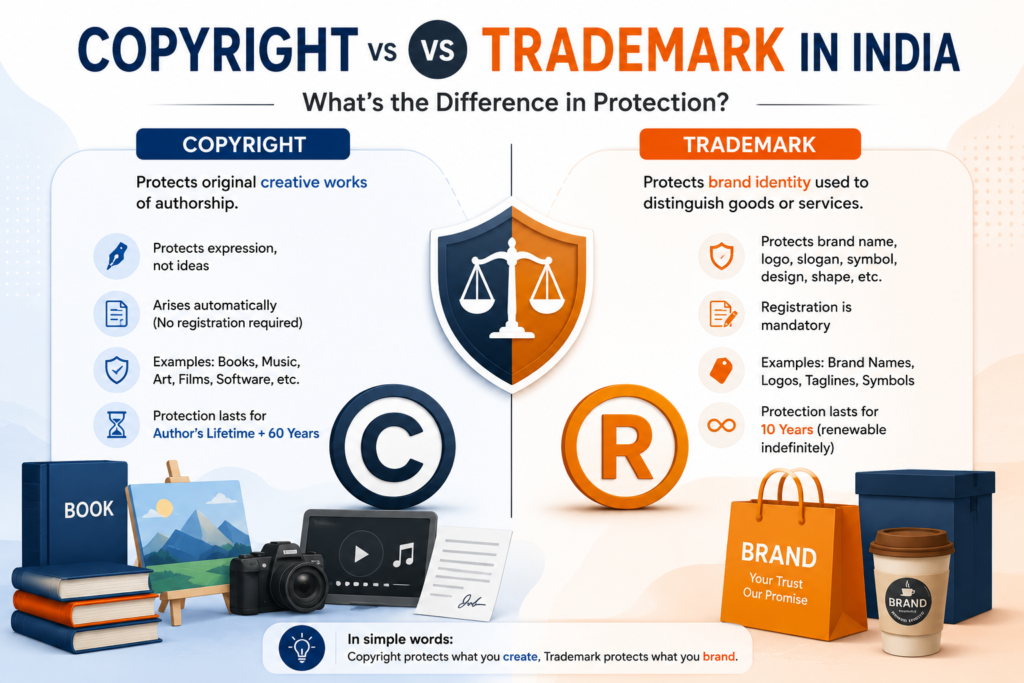
Copyright protects original creative expression. Trademark protects commercial identifiers that distinguish the source of goods and services. Copyright is about the creative work itself. Trademark is about the business identity attached to goods and services in commerce. This is the most fundamental difference between the two, and everything else flows from it.
How Protection Arises
Copyright protection arises automatically upon creation of an original work. No registration is required, though registration is strongly recommended for practical enforcement reasons. Trademark protection, in its full statutory form, requires formal registration with the Trademark Registry. Unregistered trademarks have limited protection based on common law rights that are difficult and expensive to enforce.
Registration Process and Timeline
Copyright registration in India is handled by the Copyright Office under the Department for Promotion of Industry and Internal Trade. The application can be filed online or physically. The process involves filing Form XIV with the prescribed fees, a mandatory waiting period of thirty days for objections, examination of the application, and issuance of the registration certificate. The entire process typically takes six to twelve months.
Trademark registration in India is handled by the Office of the Controller General of Patents, Designs and Trade Marks. The process involves conducting a trademark search to check availability, filing the application with the Trademark Registry, examination of the application by a trademark examiner, publication in the Trademark Journal for a four month opposition period, and if no successful opposition is filed, issuance of the registration certificate. The entire process typically takes twelve to twenty-four months, though the TM symbol can be used from the date of application.
For businesses that need both copyright and trademark protection as part of a complete IP strategy, LegalIP.in provides expert guidance on both registration processes, helping you build a comprehensive intellectual property portfolio efficiently and cost-effectively.
Duration of Protection
Copyright in India lasts for the lifetime of the creator plus sixty years. After that, the work enters the public domain and can be used freely by anyone. Trademark protection in India lasts for ten years from the date of application and can be renewed indefinitely every ten years. A trademark never enters the public domain as long as it continues to be used and renewed.
What Happens if You Do Not Register
If you do not register your copyright, you still have automatic copyright protection, but enforcing it is significantly more difficult. You will need to prove your ownership through other evidence, and without a registration certificate, your legal position in an infringement dispute is weaker. If you do not register your trademark, you have no statutory trademark rights at all, only common law rights based on prior use, which are limited in geographic scope, difficult to prove, and very expensive to enforce.
Cost of Registration
Copyright registration in India is relatively inexpensive. The official government fee for registering a copyright depends on the category of work and the type of claimant, and generally ranges from a few hundred to a few thousand rupees. Trademark registration involves a government fee that currently ranges from Rs. 4,500 for individual applicants and small enterprises to Rs. 9,000 for companies per class of goods or services. Professional fees for assistance with both registrations are additional.
For GST-registered businesses, the professional fees paid for copyright registration and trademark registration services attract 18 percent GST, which can typically be claimed as input tax credit, reducing the effective cost of IP protection. For all tax compliance matters related to your intellectual property investments, visit LegalTax.in or call +91 9711939395 for expert guidance.
Enforcement and Infringement Remedies
Copyright infringement in India can be addressed through civil remedies including injunctions, damages, and account of profits, as well as through criminal prosecution which can result in imprisonment and fines. Trademark infringement similarly allows for civil remedies including injunctions, damages, and passing off claims, as well as criminal prosecution. Both forms of protection give the owner the right to approach courts for urgent interim relief to stop ongoing infringement while the main case is decided.
When Do You Need Copyright, Trademark, or Both?
When Copyright Is the Primary Protection You Need
You primarily need copyright protection when your business creates original content as a core asset. If you are a writer, journalist, blogger, or content creator, copyright protects your articles, books, and posts. If you are a software developer, copyright protects your code. If you are a photographer, filmmaker, or musician, copyright protects your creative output. If you are a graphic designer, copyright protects your designs as artistic works.
For these creators and businesses, copyright is the foundational form of IP protection because the primary asset is the creative work itself rather than a brand identity in commerce.
When Trademark Is the Primary Protection You Need
You primarily need trademark protection when your business has a brand identity in commerce that needs protection against imitation and confusion. If you are a manufacturer selling branded goods, trademark protects your brand name and logo. If you are a service business, trademark protects your trading name and service marks. If you are launching a new product with a distinctive name, trademark protects that name from being copied by competitors.
For businesses competing in consumer markets, trademark is often the most commercially critical form of IP protection because it directly protects the brand equity and customer trust that drive purchasing decisions.
When You Need Both Copyright and Trademark
Most businesses actually need both copyright and trademark protection, because most businesses both create original content and operate under a brand identity. Your logo is simultaneously an artistic work protected by copyright and a commercial identifier that should be protected by trademark. Your website content is protected by copyright. Your brand name and tagline should be protected by trademark. Your marketing materials are protected by copyright. Your product name should be protected by trademark.
The most robust intellectual property strategy for any serious Indian business involves both copyright registration for key creative assets and trademark registration for all significant brand identifiers. For building a complete IP protection portfolio that covers both your creative works and your commercial identity, LegalIP.in and OnlineTrademarkIndia.com are your most trusted professional resources in India.
Copyright vs Trademark in India: Special Situations Every Business Should Know
Logo Protection: Copyright and Trademark Together
Your logo is one of the most important assets your business owns, and it deserves protection under both copyright and trademark. As an original artistic work, your logo is automatically protected by copyright from the moment of its creation. Registering that copyright provides an additional layer of documented protection. Simultaneously registering your logo as a trademark with the Trademark Registry gives you exclusive commercial rights to use that mark in connection with your specified goods and services.
Many businesses make the mistake of relying on copyright alone for their logo, thinking that because it is an original artistic work, copyright is sufficient protection. But copyright does not prevent a competitor from using a similar mark in commerce if that competitor can argue that their use is sufficiently different as an artistic work. Trademark registration is what gives you the exclusive commercial rights that copyright alone cannot provide.
Software Protection: Copyright with Patent Consideration
Software and mobile applications in India are primarily protected by copyright as literary works. The code, the user interface design, and the original creative elements of the software are all protected by copyright from the moment of creation. For software companies, formal copyright registration of their key software products is a prudent step in building a defensible IP portfolio.
Where software embodies a novel technical process or invention, patent protection may also be relevant, though software patents in India face significant legal restrictions. For a complete IP strategy for your software business, LegalIP.in provides expert guidance on the full spectrum of available protections.
Brand Names vs Business Names: A Critical Distinction
Many Indian business owners confuse company registration with trademark registration. Registering your company name with the Ministry of Corporate Affairs through the MCA21 portal gives you a registered company. It does not give you trademark rights in that name. Someone else could register a similar or identical name as a trademark and potentially prevent you from using your own company name commercially.
Trademark registration of your brand name and business name is therefore a separate and essential step that must not be overlooked. For fast, professional, and affordable trademark registration of your business name and brand, visit OnlineTrademarkIndia.com and begin the process today.
Building a Complete IP Protection Strategy for Your Indian Business
Step One: Audit Your Intellectual Property Assets
The first step in building a complete IP protection strategy is to identify and catalog all the intellectual property your business owns or is developing. This includes all original creative works, all brand identifiers, all proprietary processes and inventions, and all confidential business information. Most businesses are surprised by how many valuable IP assets they have that are currently unprotected.
Step Two: Prioritize Your Registrations
Once you have a complete picture of your IP assets, prioritize which ones need formal registration most urgently. Your brand name and logo should be at the top of the trademark registration list. Key creative assets that are commercially important should be prioritized for copyright registration. Any novel technical inventions should be evaluated for patent protection.
Step Three: File and Maintain Your Registrations
File your trademark and copyright applications promptly. For trademarks, remember that the TM symbol can be used from the date of application, giving you a degree of public notice even before registration is complete. Maintain a calendar of renewal dates to ensure your trademark registrations do not lapse. Ensure all IP assignment agreements with designers, developers, and other creators are properly documented to confirm your business owns the IP it paid for.
Step Four: Monitor and Enforce
Registered IP rights are only as valuable as your willingness to monitor and enforce them. Set up watch services for trademark monitoring. Conduct regular checks for unauthorized use of your copyrighted content online. Act promptly when you discover infringement, because delay can weaken your legal position and give infringers time to build equity in your protected assets.
For all aspects of IP registration, strategy, monitoring, and enforcement for your Indian business, LegalIP.in is your comprehensive professional resource. For trademark registration specifically, OnlineTrademarkIndia.com provides dedicated, expert-guided services. And for all tax compliance, GST matters, and financial legal support related to your business and its IP investments, visit LegalTax.in or call +91 9711939395 for personalized expert assistance.
FAQs
1. What is the main difference between copyright and trademark in India?
Copyright protects original creative works such as content, music, books, designs, and software, while a trademark protects brand identity elements like business names, logos, taglines, and symbols.
2. What can be protected under copyright in India?
Copyright protection applies to literary works, artistic creations, music, films, software, photographs, and other original creative content.
3. What can be registered as a trademark in India?
Business names, logos, brand names, slogans, symbols, product names, and unique identifiers can be registered as trademarks if they meet eligibility requirements.
4. Is copyright registration mandatory in India?
No. Copyright protection generally exists automatically once an original work is created. However, registration provides stronger legal proof and can help during disputes.
5. Which is better for a business: copyright or trademark?
Both serve different purposes. Businesses often need trademarks to protect their brand identity and copyrights to protect original content, designs, and creative assets. Using both can provide broader protection.
Conclusion: Copyright and Trademark Are Not Rivals, They Are Partners
The question of Copyright vs Trademark in India is ultimately not an either-or question. For most serious Indian businesses, the right answer is both. Copyright protects what you create. Trademark protects who you are in the marketplace. Together, they form the two pillars of a complete intellectual property protection strategy that safeguards your creative output, your brand identity, and the commercial value you have worked hard to build.
India’s legal framework provides strong protection for both copyright and trademark owners. The Copyright Act 1957 and the Trade Marks Act 1999 together give Indian businesses powerful legal tools to protect their most valuable intangible assets. But these tools only work for you if you use them. Unregistered rights are difficult to enforce. Registered rights are a powerful commercial and legal asset.
Whether you are a first-time entrepreneur building your first brand, a creative professional protecting your original work, a startup developing proprietary technology, or an established business expanding into new markets, investing in proper copyright and trademark protection is one of the highest-return legal decisions you can make for your business.
For intellectual property registration, IP strategy consulting, copyright protection, and all legal matters related to your creative and commercial assets, visit LegalIP.in. For trademark registration of your brand name, logo, and product names with the Indian Trademark Registry, visit OnlineTrademarkIndia.com. For GST compliance, income tax planning, and all financial legal matters supporting your business growth, visit LegalTax.in or call directly at +91 9711939395.
Protect what you create. Protect who you are. That is how Indian businesses build brands and businesses that last.

I’m Aryan Yadav, passionate about SEO and Digital Marketing with a strong interest in helping businesses grow online. I enjoy learning new strategies, exploring digital trends, and creating ideas that deliver value. I believe in continuous growth, creativity, and building meaningful results through smart work and dedication.
Our Clients