Views: 110
Table of Contents
- 1 Introduction
- 2 What Is IEC Registration and Who Needs It?
- 3 Documents Required for IEC Registration in India 2026: Complete List by Entity Type
- 4 Step by Step Process for IEC Registration in India 2026
- 5 Common Mistakes That Lead to IEC Application Rejection or Delay
- 6 IEC Registration Fees and Timeline in 2026
- 7 Updating and Modifying IEC After Registration
- 8 IEC and Its Connection to Export Benefits and Incentives
- 9 Protecting Your Export Brand: Trademark and IP Considerations for IEC Holders
- 10 FAQs
- 11 Conclusion
Introduction
Why Knowing the Exact Documents Required for IEC Registration in India 2026 Can Make or Break Your Export Import Journey
India’s foreign trade sector is growing at a remarkable pace. With the government’s ambitious targets for merchandise exports, the rapid expansion of service exports including IT services, consulting, and digital products, and the increasing number of Indian businesses sourcing raw materials, components, and finished goods from international markets, the Import Export Code has become one of the most important business registrations an Indian entrepreneur can obtain.
The Import Export Code, universally known as the IEC, is a ten-digit unique identification number issued by the Directorate General of Foreign Trade under the Ministry of Commerce and Industry, Government of India. No person or business entity can legally import goods into India or export goods from India without a valid IEC, except in specific categories exempted by the DGFT. The IEC is the foundational prerequisite for all cross-border trade activity, for opening foreign currency bank accounts, for receiving foreign remittances, for availing export incentives and schemes under the Foreign Trade Policy, and for clearing customs at Indian ports and airports.
Yet despite being one of the most straightforward and affordable business registrations available in India, many aspiring exporters and importers find the IEC application process confusing, primarily because they are uncertain about exactly what documents are required, what specifications those documents must meet, and how the requirements vary depending on the type of business entity applying.
This complete guide covers every aspect of the documents required for IEC registration in India 2026, organized by entity type, with clear explanations of why each document is required and what common mistakes applicants make that lead to application rejections and delays. By following this guide, any Indian business owner can prepare a complete and correct IEC application the first time.
For comprehensive business legal compliance support, tax registration, and all legal matters related to setting up and running your export import business, visit LegalTax.in or call our team directly at +91 9711939395.
What Is IEC Registration and Who Needs It?
The Legal Basis for IEC Registration
IEC registration is governed by the Foreign Trade (Development and Regulation) Act 1992 and the Foreign Trade Policy issued periodically by the DGFT. Under these provisions, every person intending to import or export goods or services from India must obtain an IEC unless specifically exempted. The IEC serves as the primary identifier of an importer or exporter in all customs and DGFT transactions.
The IEC is linked to the PAN of the business entity for companies, LLPs, partnership firms, and proprietorships. This linkage ensures that the import export activities of a business are traceable to its income tax identity, enabling regulatory oversight of foreign trade transactions.
Who Requires IEC Registration?
Every individual, proprietorship, partnership firm, company, LLP, trust, HUF, or any other entity that intends to import goods into India or export goods from India requires an IEC. This requirement applies regardless of the scale of the import export activity, the value of individual transactions, or whether the business is primarily domestic with occasional cross-border transactions.
Service exporters who receive foreign remittances for services rendered to overseas clients are also required to obtain IEC if they wish to receive the benefits available to service exporters under the Foreign Trade Policy, including the Service Exports from India Scheme and other incentive programs.
Who Is Exempted from IEC Requirement?
Certain categories of importers and exporters are exempted from the IEC requirement. These include government ministries and departments and their attached and subordinate offices, persons importing or exporting goods for personal use not connected with trade or manufacture or agriculture, persons importing or exporting goods from or to Nepal and Myanmar through Indo-Myanmar border areas and China through Nathula port up to specified value limits, and certain categories of items specified by the DGFT from time to time.
For all GST compliance, income tax matters, and financial legal support related to your export import business operations, call +91 9711939395 for expert professional guidance.
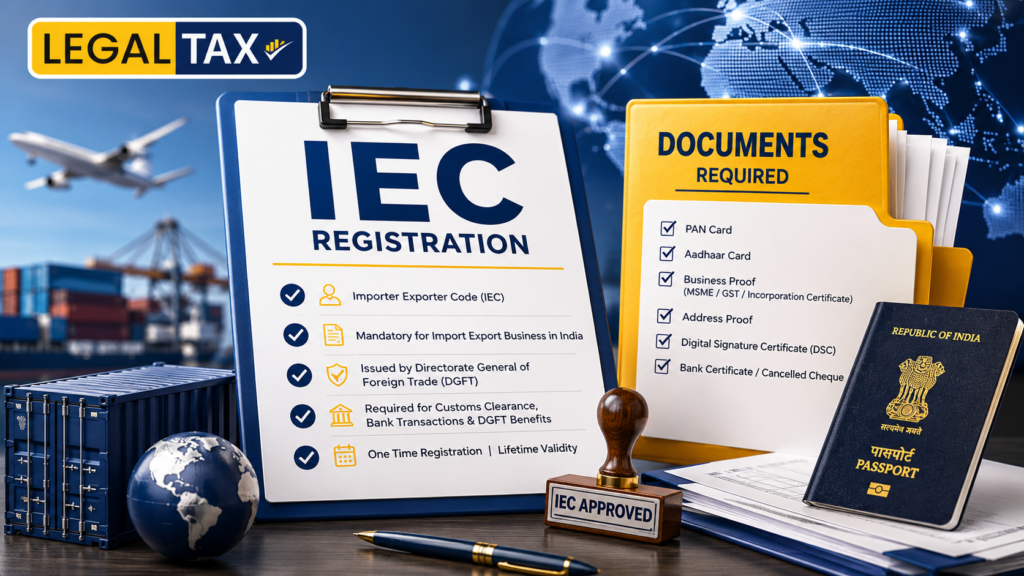
Documents Required for IEC Registration in India 2026: Complete List by Entity Type
The documents required for IEC registration in India 2026 vary depending on the type of business entity applying. Here is a comprehensive breakdown for each major entity type.
Documents Required for IEC Registration: Proprietorship Firm
A sole proprietorship is the simplest and most common business structure among small traders and merchants engaged in import export activities. The documents required for IEC registration in India 2026 for a proprietorship firm are as follows.
Identity and Address Proof of the Proprietor
A copy of the PAN card of the proprietor is mandatory. The PAN card serves as the primary identity document and the IEC is issued against the proprietor’s PAN. A copy of the Aadhaar card of the proprietor is required as identity proof. Alternatively, a passport copy, voter ID card, or driving license can be submitted as identity proof, though Aadhaar is the most commonly used and most straightforward option.
For address proof of the proprietor, an Aadhaar card showing the current address, a passport, a voter ID, a driving license, or a utility bill in the proprietor’s name not older than two months can be submitted.
Business Address Proof
The business premises address proof is a critical document in the IEC application. If the business premises are owned by the proprietor, a copy of the property ownership document such as sale deed, property tax receipt, or electricity bill in the proprietor’s name serves as address proof. If the business premises are rented, a rent agreement along with a No Objection Certificate from the landlord and a utility bill for the premises is required.
Bank Account Details
A cancelled cheque bearing the pre-printed name of the proprietor or the business, or a bank certificate in the prescribed format confirming the bank account details, is required. The bank account must be a current account in the name of the business. The IFSC code and account number verified through the cancelled cheque or bank certificate are used for linking the IEC to the bank account.
Photograph
A recent passport-size photograph of the proprietor is required and must be uploaded on the DGFT portal during the online application process.
Documents Required for IEC Registration: Partnership Firm
For a registered or unregistered partnership firm engaged in import export activities, the documents required for IEC registration in India 2026 include the following.
Entity Documents
A copy of the Partnership Deed, which is the foundational document establishing the partnership, its partners, their profit-sharing ratios, and the terms of the partnership, is mandatory. If the partnership is registered with the Registrar of Firms, the Registration Certificate issued by the Registrar is also required. An unregistered partnership can still apply for IEC but should note that having a registered partnership provides stronger legal standing for all business activities.
PAN of the Partnership Firm
The PAN card of the partnership firm itself is required as the primary identifier. The IEC for a partnership firm is issued against the firm’s PAN, not the individual partners’ PANs. If the firm does not have a PAN, obtaining a firm PAN is a prerequisite for IEC application.
Identity and Address Proof of All Partners
PAN cards and address proof documents for all the partners of the firm are typically required as supporting documents. This requirement ensures that the ultimate beneficial owners of the importing or exporting entity are identified.
Business Address Proof and Bank Account Details
Business address proof and bank account details following the same requirements as described for proprietorship firms are also required for partnership firm IEC applications.
For trademark registration of your business name and logo as you establish your import export operations, visit OnlineTrademarkIndia.com for professional, affordable trademark services that protect your trading brand in India and internationally.
Documents Required for IEC Registration: Private Limited Company or Public Limited Company
For companies registered under the Companies Act 2013, the documents required for IEC registration in India 2026 reflect the additional corporate documentation that establishes the company’s legal identity and its authorized representatives.
Certificate of Incorporation
The Certificate of Incorporation issued by the Registrar of Companies at the time of company registration is a mandatory document. This certificate establishes the legal existence of the company, its registered name, its Corporate Identity Number, and its date of incorporation.
Memorandum of Association and Articles of Association
Copies of the Memorandum of Association and Articles of Association of the company are required. These documents define the company’s objects, powers, and internal governance rules. For IEC purposes, the MOA confirms that the company’s objects include trading, import, export, or related activities.
PAN of the Company
The company’s PAN card is the primary identifier for the IEC. The IEC is issued against the company’s PAN. This is the corporate PAN, not the PAN of any individual director.
Board Resolution
A certified copy of a Board Resolution authorizing the company to apply for IEC and designating a specific director or authorized signatory to sign the application and related documents on behalf of the company is required. The Board Resolution must specifically mention the IEC application and the name and designation of the authorized person.
Identity and Address Proof of the Authorized Signatory
The PAN card and address proof of the director or authorized signatory designated in the Board Resolution are required. These documents verify the identity of the person authorized to represent the company in the IEC application.
Registered Office Address Proof
Proof of the company’s registered office address as recorded with the Registrar of Companies is required. Acceptable documents include the latest electricity bill, telephone bill, property tax receipt, rent agreement with NOC from the landlord, or any other official document confirming the registered office address.
Bank Account Details
A cancelled cheque bearing the company’s pre-printed name or a bank certificate confirming the company’s bank account details is required. The bank account should be a current account in the company’s name.
For all income tax compliance, GST registration, transfer pricing for import transactions, and comprehensive tax management for your company’s import export operations, contact LegalTax.in or reach our experts at +91 9711939395.
Documents Required for IEC Registration: Limited Liability Partnership
For an LLP registered under the Limited Liability Partnership Act 2008, the documents required for IEC registration in India 2026 include the following set.
LLP Agreement and Certificate of Incorporation
The LLP Agreement, which is the foundational document establishing the LLP, its partners, their contributions, and the terms of operation, and the Certificate of Incorporation issued by the Registrar of Companies at the time of LLP registration are both mandatory documents.
PAN of the LLP
The LLP’s own PAN card is required as the primary identifier for the IEC application.
Designated Partner Resolution
A resolution or authorization signed by the Designated Partners of the LLP authorizing the IEC application and designating an authorized signatory is required, similar to the Board Resolution requirement for companies.
Identity and Address Proof of Designated Partners and Authorized Signatory
PAN cards and address proof for the designated partners and the authorized signatory of the LLP are required as supporting identity documents.
Registered Office Address Proof and Bank Details
Registered office address proof and bank account details following the same standards as described for companies are required for LLP IEC applications.
Documents Required for IEC Registration: Trust or Society
For trusts and registered societies that engage in import export activities, typically for charitable, educational, or non-profit purposes, the documents required for IEC registration in India 2026 include the Trust Deed or Society Registration Certificate, the PAN of the trust or society, a resolution from the governing body authorizing the IEC application and designating an authorized signatory, identity and address proof of the authorized signatory, address proof of the registered office, and bank account details.
Documents Required for IEC Registration: HUF
For a Hindu Undivided Family engaged in import export trade, the documents required include the PAN of the HUF, identity and address proof of the Karta of the HUF, a declaration of HUF constitution if required, address proof of the business premises, and bank account details of the HUF’s bank account.
Step by Step Process for IEC Registration in India 2026
Step 1: Create a Login on the DGFT Portal
The IEC application process in India is fully online through the DGFT portal at dgft.gov.in. The first step is to create a user account on the portal using a valid email address and mobile number. The OTP-based verification ensures that the contact details provided are genuine and accessible.
Step 2: Link PAN and Verify Business Details
After creating the portal account, link the PAN of the applying entity and verify the basic business details including the name and address as they appear in the PAN database. The DGFT system pulls information from the PAN database to pre-populate certain fields in the application, reducing manual data entry and potential errors.
Step 3: Fill the IEC Application Form ANF-2A
The IEC application is filed using Form ANF-2A on the DGFT portal. The form requires entry of the applicant’s details including name, constitution of the business, PAN, registered address, contact details, nature of business activity, and bank account details. It also requires upload of all the required documents in the prescribed format and file size specifications.
Step 4: Upload Documents in Prescribed Format
All supporting documents must be uploaded as scanned copies in PDF or JPEG format within the file size limits specified by the portal. Documents should be clear, legible, and complete. Common reasons for application rejection include illegible document scans, incomplete documents where some pages are missing, documents with expired validity dates, and mismatches between the information in the application form and the information in the uploaded documents.
Step 5: Pay the Application Fee
The current government fee for IEC registration in India is Rs. 500 payable online through the DGFT portal using net banking, credit card, debit card, or UPI. This fee is non-refundable regardless of the outcome of the application.
Step 6: Submit the Application and Track Status
After uploading all documents and paying the fee, submit the application. The DGFT system processes the application and if everything is in order, issues the IEC certificate electronically within one to two working days for straightforward applications. The IEC certificate can be downloaded directly from the DGFT portal.
For complex applications, applications involving entities with unusual structures, or applications that require additional verification, the processing may take longer. The application status can be tracked through the DGFT portal.
Common Mistakes That Lead to IEC Application Rejection or Delay
Name Mismatch Between Documents
One of the most common reasons for IEC application delays and rejections is a mismatch between the applicant’s name as it appears in different documents. For example, the name on the PAN card may differ slightly from the name in the incorporation certificate, or the address in the bank account may not match the address in the address proof document. All documents submitted must consistently reflect the same legal name and address of the applying entity.
Submitting Documents for Wrong Entity Type
Applicants sometimes submit the documents applicable to one entity type when their actual entity falls in a different category. For example, a proprietorship applicant submitting company-type documents, or vice versa. The document requirements are entity-specific and the correct set must be submitted.
Bank Account Not in Business Name
A common mistake among proprietorship applicants is submitting bank details for a savings account in the proprietor’s personal name rather than a current account in the business name. The bank account linked to the IEC must ideally be a current account in the name of the business entity.
Outdated or Expired Documents
Address proof documents such as utility bills should not be older than two months at the time of application. Submitting older documents can lead to rejection. Similarly, identity documents with expired validity should not be submitted.
Incomplete Board Resolution or Partnership Authorization
For companies and LLPs, the Board Resolution or Partner Authorization must specifically mention the IEC application and clearly designate the authorized signatory by name and designation. Vague or generic resolutions that do not specifically reference IEC registration are often rejected.
Mismatch Between Digital Signature and Application Details
For applications that require digital signatures, the digital signature used must belong to the authorized signatory whose details are provided in the application. Using another person’s digital signature creates a mismatch that leads to rejection.
For intellectual property protection of your brand in international markets as you expand your import export business, including international trademark registration and copyright protection for your export products, visit LegalIP.in for comprehensive IP strategy and registration services for Indian exporters and importers.
IEC Registration Fees and Timeline in 2026
Government Fee
The government fee for IEC registration in India 2026 is Rs. 500 per application, payable online at the time of submission. This fee applies uniformly to all types of entities and is not differentiated by entity type or business size.
Professional Assistance Fees
Many businesses choose to engage a professional consultant or legal service provider to assist with IEC registration to ensure that the application is complete, correctly prepared, and supported by properly organized documents. Professional assistance fees for IEC registration in India typically range from Rs. 1,500 to Rs. 5,000 depending on the service provider and the complexity of the application.
For GST-registered businesses, the GST paid on professional assistance fees for IEC registration can typically be claimed as input tax credit, reducing the effective cost of the professional service.
Processing Timeline
For a correctly prepared application with all required documents in order, the DGFT typically processes and issues the IEC certificate within one to two working days. This makes IEC registration one of the fastest government registrations available in India when the application is properly prepared. Incorrectly prepared applications or those requiring additional verification may take five to ten working days or longer.
For complete guidance on GST implications of import transactions, customs duty and GST on imports, ITC on import GST, and all tax compliance matters for your import export business, visit LegalTax.in or call +91 9711939395 for expert tax professional support.
Updating and Modifying IEC After Registration
When IEC Modification Is Required
After obtaining IEC registration, businesses are required to update their IEC details whenever there are changes in the registered information. Common changes requiring IEC modification include change of business address, change of bank account details, change in the name of the business or entity, change in the constitution of the business such as conversion from proprietorship to company, addition or deletion of partners or directors, and change in the email address or mobile number linked to the IEC.
The Annual IEC Update Requirement
The DGFT has introduced a requirement for all IEC holders to update or confirm their IEC details annually between April and June of each financial year. Even if there are no changes to the IEC information, the annual update confirmation must be completed through the DGFT portal. Failure to complete the annual update can result in the IEC being deactivated, which would prevent import and export transactions until the IEC is reactivated.
How to Modify IEC Details
IEC modifications are also processed entirely online through the DGFT portal. The modification application requires the same login credentials used for the original registration, updated information for the fields being changed, supporting documents evidencing the change, and payment of the modification fee of Rs. 200.
IEC and Its Connection to Export Benefits and Incentives
Foreign Trade Policy Benefits Linked to IEC
The IEC is the gateway to accessing the numerous export promotion schemes and incentives available under India’s Foreign Trade Policy. These include the Remission of Duties and Taxes on Exported Products scheme, the Advance Authorisation scheme for duty-free import of inputs for export production, the Export Promotion Capital Goods scheme for duty-free import of capital goods, the Status Holder benefits for high-value exporters, and various product and market-specific export incentive schemes.
All of these benefits are accessible only to IEC holders who file their applications with the DGFT using their IEC as the primary identifier. Businesses that delay obtaining their IEC lose access to these benefits for the period during which they were operating without registration.
Linking IEC with GSTIN for Seamless Export Compliance
For businesses registered under GST, the IEC must be linked with the GSTIN on both the DGFT portal and the GST portal. This linkage enables the seamless flow of information between the two systems, facilitates the processing of GST refunds on exports under the LUT or bond facility for zero-rated supplies, and ensures that export data reported in customs filings matches the data in GST returns.
For complete guidance on GST LUT filing, export under bond or LUT, GST refund on exports, and all GST compliance requirements for your export business, visit LegalTax.in or contact our GST and customs tax experts at +91 9711939395.
Protecting Your Export Brand: Trademark and IP Considerations for IEC Holders
Why Export Businesses Need Trademark Protection
As your business expands into international markets through import export operations enabled by your IEC, protecting your brand identity becomes critically important. In international trade, your brand name, logo, and product names are your most valuable commercial assets. They differentiate your products in competitive global markets, command price premiums, and build the customer relationships that drive repeat business.
Without registered trademark protection, your brand is vulnerable to being copied by competitors in both Indian and international markets. A competitor could register your brand name as a trademark in a target export market before you do, potentially blocking your market entry or forcing expensive legal battles to reclaim your brand identity in that market.
For Indian exporters and importers, a comprehensive trademark strategy should include registration of the brand in India with the Indian Trademark Registry as the foundational step, followed by international trademark registration in key export markets through the Madrid Protocol system. For professional trademark registration in India and guidance on international brand protection strategy, visit OnlineTrademarkIndia.com for expert trademark services tailored to Indian businesses engaged in international trade.
Copyright Protection for Export Product Content
If your export business involves products with original creative content such as handicrafts with original designs, artistic works, software products, published content, or any other creative output, copyright protection is an important complement to trademark protection. Copyright ensures that the creative expression in your products cannot be reproduced without authorization in domestic or international markets.
For comprehensive intellectual property protection covering trademarks, copyrights, designs, and patents for your export products and business, visit LegalIP.in for end-to-end IP strategy and registration services designed for Indian businesses competing in global markets.
FAQs
Q1. What documents are mandatory for IEC registration in India in 2026?
You generally need a PAN card, Aadhaar of the applicant/authorized signatory, bank proof (cancelled cheque or bank certificate), business address proof, and a passport-size photograph.
Q2. Is a PAN card compulsory for obtaining an IEC code?
Yes. PAN is mandatory because the IEC is now linked directly with the applicant’s PAN details.
Q3. Which address proof documents are accepted for IEC registration?
Accepted documents commonly include electricity bills, rent agreements, lease deeds, sale deeds, or utility bills. If the property is rented, an owner NOC may also be needed.
Q4. Do companies and LLPs need extra documents for IEC registration?
Yes. Companies and LLPs usually require incorporation documents, partnership/LLP agreements, and details of directors or partners.
Q5. Is a cancelled cheque required for IEC registration in 2026?
Yes. A cancelled cheque or bank certificate is commonly used to verify bank account details during the DGFT application process.
Conclusion
Getting Your Documents Right Is the First Step to Successful Import Export Business in India
The documents required for IEC registration in India 2026 are not complex or burdensome, but they must be prepared carefully, organized systematically, and submitted correctly the first time to avoid delays and rejections. Understanding exactly which documents apply to your specific entity type, ensuring that all documents are consistent in the information they reflect, and following the DGFT portal’s technical specifications for document upload are the keys to a smooth and successful IEC application.
Once your IEC is in hand, it opens the door to legitimate import export operations, access to foreign trade policy benefits, foreign remittance receipts, and the global business opportunities that India’s growing place in international trade continues to create. Protecting the business you build around your IEC through trademark registration, GST compliance, and comprehensive legal and IP protection is the foundation of a sustainable and scalable export import enterprise.
For all tax compliance, GST management, customs duty guidance, and complete financial legal support for your import export business, call directly at +91 9711939395 to speak with an expert today.
For trademark registration and brand protection for your export business identity in India and international markets, visit OnlineTrademarkIndia.com. For intellectual property strategy, copyright protection, design registration, and comprehensive IP legal support for your business and its products, visit LegalIP.in.
Prepare correctly. Apply confidently. Trade globally.

I’m Aryan Yadav, passionate about SEO and Digital Marketing with a strong interest in helping businesses grow online. I enjoy learning new strategies, exploring digital trends, and creating ideas that deliver value. I believe in continuous growth, creativity, and building meaningful results through smart work and dedication.
Our Clients