Views: 8
Table of Contents
- 1 Introduction
- 2 What Is GSTR-1?
- 3 What Is GSTR-3B?
- 4 GSTR-1 vs GSTR-3B: The Key Differences Explained
- 5 Which Return to File When? The Correct Sequence
- 6 Reconciliation Between GSTR-1 and GSTR-3B: Why It Matters
- 7 Common Mistakes to Avoid
- 8 Penalties for Non-Filing and Late Filing
- 9 Who Must File GSTR-1 and GSTR-3B?
- 10 GST and Tax Treatment of Professional Compliance Services
- 11 Conclusion: GSTR-1 and GSTR-3B Are Two Sides of the Same Coin
Introduction
Why Understanding GSTR-1 vs GSTR-3B Is Critical for Every Indian Business
When most Indian business owners and first-time GST filers think about filing their returns, the two names they hear most often are GSTR-1 and GSTR-3B. These two returns are filed by virtually every GST-registered business in India, yet a surprising number of taxpayers are unclear about what each one does, how they differ from each other, and which one needs to be filed first and when. This confusion leads to costly mistakes including mismatches, penalties, loss of input tax credit, and even scrutiny notices from the GST department.
Understanding GSTR-1 vs GSTR-3B is not just a matter of technical tax knowledge. It is a practical compliance requirement that directly affects your cash flow, your relationships with buyers and suppliers, and your legal standing as a business. This complete guide explains both returns in plain language, breaks down the key differences, walks you through the correct filing sequence, and covers the penalties you must avoid.
For professional GST filing assistance, compliance support, and personalized tax guidance, visit LegalTax.in or call our team directly at +91 9711939395.
What Is GSTR-1?
GSTR-1 is an outward supply return that every regular GST-registered taxpayer is required to file. It is a detailed statement of all the sales or outward supplies made by your business during a given tax period. This return captures invoice-level details of every supply made by the taxpayer, including B2B sales to registered buyers, B2C sales to unregistered buyers, exports, deemed exports, debit notes, and credit notes issued during the period.
The most important thing to understand about GSTR-1 is that it is a pure reporting return. It does not involve any tax payment. Its entire purpose is to declare what you have sold, to whom you sold it, and for how much. This information is then used by the GST system to auto-populate your buyers’ GSTR-2B, which is the document your buyers rely upon to claim their input tax credit.
In simple terms, if you do not file your GSTR-1 on time or file it incorrectly, your buyers suffer because they cannot claim the ITC they are entitled to on the invoices you raised against them. This makes GSTR-1 not just your legal obligation but also a professional courtesy you owe to every registered buyer you deal with.
Key Features of GSTR-1
GSTR-1 is an invoice-level return, meaning every invoice raised during the period must be reported individually with full details including the buyer’s GSTIN, invoice number, invoice date, taxable value, applicable GST rate, and the CGST, SGST, and IGST amounts. It covers all categories of outward supply including taxable supplies, exempt supplies, nil-rated supplies, and non-GST supplies. It includes details of advances received against future supplies. Credit notes and debit notes issued during the period are also reported in GSTR-1.
The filing frequency for GSTR-1 depends on your annual aggregate turnover. Businesses with turnover exceeding Rs. 5 crore must file GSTR-1 every month. Businesses with turnover up to Rs. 5 crore have the option to file GSTR-1 quarterly under the QRMP scheme, which stands for Quarterly Return Monthly Payment.
Due Dates for GSTR-1
For monthly filers, GSTR-1 is due on the 11th of the month following the tax period. For example, the GSTR-1 for April is due on the 11th of May. For quarterly filers under the QRMP scheme, GSTR-1 is due on the 13th of the month following the end of the quarter. So for the quarter of April to June, the GSTR-1 is due on the 13th of July.
For complete guidance on GSTR-1 filing, applicable due dates, and penalty structure, visit LegalTax.in or reach out to our GST experts at +91 9711939395 for end-to-end filing support.
What Is GSTR-3B?
GSTR-3B is a monthly self-declared summary return that every regular GST-registered taxpayer must file. Unlike GSTR-1, which captures invoice-level details of outward supplies only, GSTR-3B is a consolidated summary return that covers both your outward supplies and your input tax credit, and it is the return through which you actually pay your GST liability for the period.
GSTR-3B was originally introduced as a temporary simplified return when GST was first launched in July 2017. It was meant to be a stopgap measure until the full return filing system was operational. However, it has since become a permanent fixture of the GST compliance calendar and remains one of the most important returns in the Indian GST framework.
The key thing to understand about GSTR-3B is that unlike GSTR-1, it does not involve invoice-level data. You report aggregate figures. You declare the total value of your outward taxable supplies, the total ITC available to you, and the net GST liability you owe after adjusting ITC. Then you pay that liability directly at the time of filing.
Key Features of GSTR-3B
GSTR-3B is a summary level return with no invoice-level data required. It covers both outward supply details and inward supply details for ITC purposes. It is the vehicle through which GST liability is paid each period. Late filing attracts both late fees and interest on unpaid tax. The ITC you claim in GSTR-3B must match what is reflected in your GSTR-2B to avoid mismatches and notices.
Under the QRMP scheme, quarterly filers are required to pay their tax liability for the first two months of the quarter using Form PMT-06 challan, and then file a consolidated GSTR-3B for the entire quarter at the end of the three-month period.
Due Dates for GSTR-3B
For monthly filers with annual turnover exceeding Rs. 5 crore, GSTR-3B is due on the 20th of the following month. For QRMP quarterly filers, GSTR-3B is due on the 22nd of the month following the quarter end for businesses in Category 1 states, and on the 24th for businesses in Category 2 states and Union Territories.
Need assistance filing your GSTR-3B correctly and claiming maximum legitimate ITC? Contact the professionals at LegalTax.in or call +91 9711939395 for expert support.
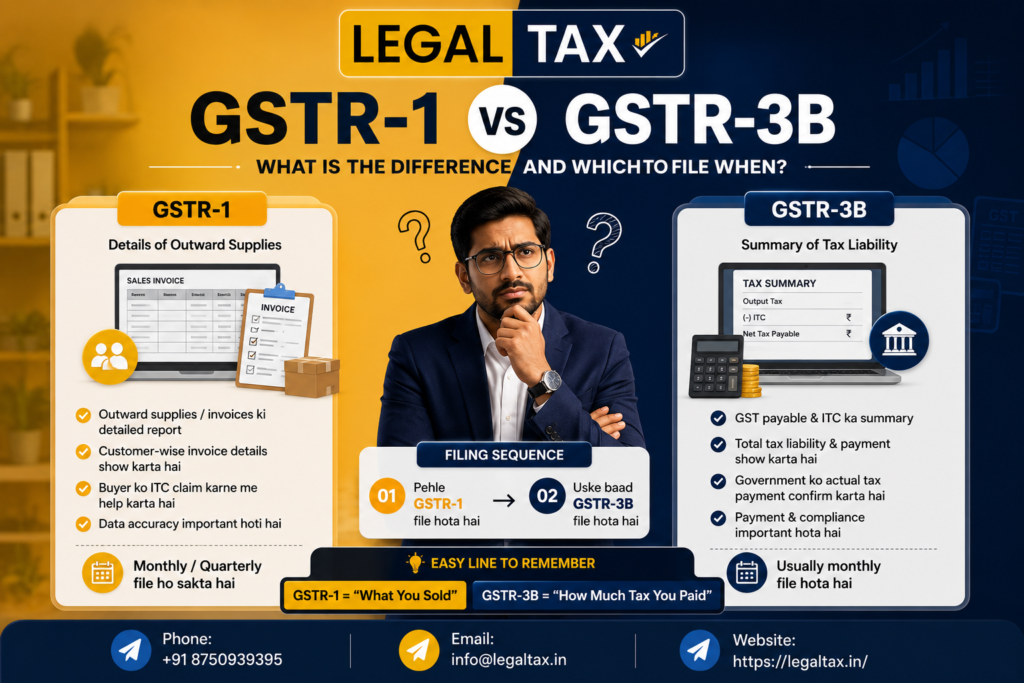
GSTR-1 vs GSTR-3B: The Key Differences Explained
Now that you have a clear understanding of what each return is and what it does, here is a thorough breakdown of all the important differences between GSTR-1 and GSTR-3B that every Indian business owner and tax filer should know.
Purpose and Nature of the Return
GSTR-1 is purely an outward supply statement. Its entire purpose is to report what you have sold during the tax period. It has no role in tax payment and no role in claiming ITC. GSTR-3B, on the other hand, is a combined summary return. It covers both your outward supplies in aggregate form and your ITC claims, and it is the return through which you calculate and pay your net GST liability.
Tax Payment
This is perhaps the single most important difference between the two returns. GSTR-1 involves absolutely no tax payment. You are simply reporting your sales. GSTR-3B is the return through which actual GST is paid to the government. When you file GSTR-3B, you must simultaneously pay any net tax liability that remains after adjusting available ITC. Failure to pay while filing GSTR-3B results in interest charges at 18 percent per annum on the outstanding amount from the due date.
Level of Detail
GSTR-1 is an invoice-level return. Every single invoice, credit note, and debit note must be entered individually with full details. This makes it a detailed and time-consuming return to prepare, especially for businesses with high transaction volumes. GSTR-3B is a summary-level return. You enter only the aggregate totals for each category of supply and ITC. There is no invoice-level data entry required in GSTR-3B.
Impact on Buyers and Sellers
GSTR-1 directly impacts your buyers because the invoices you upload in GSTR-1 flow into your buyers’ GSTR-2B. If you delay filing or make errors in GSTR-1, your buyers’ GSTR-2B will be incorrect, and they may lose ITC they are legitimately entitled to. GSTR-3B impacts your own tax position because it is the return in which you claim ITC on your own purchases and pay the tax due on your own supplies.
For legal compliance matters, trademark protection, and intellectual property issues affecting your business, visit LegalIP.in for comprehensive legal guidance tailored to Indian businesses.
Filing Frequency
GSTR-1 is filed monthly by taxpayers with turnover above Rs. 5 crore and quarterly by QRMP scheme taxpayers with turnover up to Rs. 5 crore. GSTR-3B is filed monthly by most taxpayers. QRMP quarterly filers file GSTR-3B quarterly but make monthly tax payments through PMT-06 for the first two months of the quarter.
Amendment Provisions
Errors in GSTR-1 can be corrected in the GSTR-1 of the subsequent month through the amendment facility. You can amend invoice details, add omitted invoices, or remove incorrect ones. GSTR-3B does not have a formal amendment mechanism. Corrections to figures reported in GSTR-3B are handled through adjustments in the GSTR-3B of subsequent months, which requires careful reconciliation and professional guidance to execute correctly.
Auto-Population
GSTR-3B is partially auto-populated based on the data from GSTR-1 and GSTR-2B. The outward supply figures from your GSTR-1 flow into Table 3.1 of GSTR-3B, and the ITC details from your GSTR-2B flow into Table 4 of GSTR-3B. GSTR-1 is not auto-populated from any other return. All data in GSTR-1 must be entered manually or uploaded through the offline utility or accounting software integration.
Which Return to File When? The Correct Sequence
Understanding which return to file when, and in what order, is essential to maintaining clean GST compliance. Here is the correct approach for both monthly and quarterly taxpayers.
Filing Sequence for Monthly Taxpayers
For businesses filing returns every month, the correct sequence is to file GSTR-1 first, by the 11th of the following month. This is critical because GSTR-2B for your buyers is generated on the 14th of each month based on the GSTR-1 data submitted by suppliers up to that date. If you miss the 11th, your invoices may not appear in your buyer’s GSTR-2B for that month, which means they lose ITC for that period.
After filing GSTR-1, file GSTR-3B by the 20th of the same month. At the time of filing GSTR-3B, review the auto-populated figures, reconcile them with your books, claim legitimate ITC as reflected in your GSTR-2B, and pay the net tax liability before or at the time of submission.
Filing Sequence for Quarterly Taxpayers under QRMP
For quarterly filers, the sequence is more involved because tax payment happens monthly even though the actual returns are filed quarterly. For the first month of the quarter, pay tax via PMT-06 challan by the 25th of the following month. For the second month of the quarter, again pay tax via PMT-06 challan by the 25th of the following month. At the end of the quarter, file GSTR-1 by the 13th and GSTR-3B by the 22nd or 24th of the month following the quarter end.
For detailed guidance on which filing scheme is right for your business and how to manage your compliance calendar effectively, visit LegalTax.in or call +91 9711939395 to speak with a GST professional today.
Reconciliation Between GSTR-1 and GSTR-3B: Why It Matters
One of the most important GST compliance activities that many businesses neglect is the reconciliation between GSTR-1 and GSTR-3B. Since both returns cover outward supplies but at different levels of detail, any discrepancy between the two is a red flag for the GST department and can trigger scrutiny notices.
The outward supply figures you report in aggregate in GSTR-3B should match the total of all invoices you report in GSTR-1 for the same period. If your GSTR-1 shows higher outward supplies than your GSTR-3B, it may indicate that you have underreported your tax liability in GSTR-3B. If GSTR-3B shows higher figures than GSTR-1, it raises questions about why you paid more tax than the invoices on record require.
The GST department has automated mismatch detection systems that cross-check these figures regularly. Businesses with persistent mismatches between GSTR-1 and GSTR-3B are likely targets for audit and scrutiny.
For professional reconciliation services, GST audit preparation, and mismatch resolution, contact LegalTax.in or reach our team at +91 9711939395. For trademark and intellectual property compliance that goes hand in hand with your business’s legal standing, visit OnlineTrademarkIndia.com.
Common Mistakes to Avoid
Mismatch Between GSTR-1 and GSTR-3B
As discussed above, any difference between the figures in your GSTR-1 and GSTR-3B is a compliance risk. Always reconcile before filing. Do not file GSTR-3B based on estimates and then correct through GSTR-1. File both accurately from the beginning.
Claiming ITC Not Reflected in GSTR-2B
The ITC you claim in GSTR-3B must be supported by your GSTR-2B. The GST department’s rule-based ITC restriction means that you can only claim ITC that appears in your GSTR-2B. Claiming excess ITC beyond what GSTR-2B reflects can result in demand notices, reversal of excess credit, interest charges, and penalties.
Missing Due Dates
Filing GSTR-1 late means your buyers lose ITC for that period, which can damage your business relationships. Filing GSTR-3B late means you pay late fees plus interest at 18 percent per annum on any unpaid tax from the original due date. Always set calendar reminders for all due dates.
Not Filing Nil Returns
If you have no transactions in a period, you are still required to file both GSTR-1 and GSTR-3B as nil returns. Many businesses make the mistake of skipping nil returns, which leads to a cascade of non-filing penalties and compliance issues.
Penalties for Non-Filing and Late Filing
Understanding the penalty structure for both returns helps you appreciate why timely and accurate filing is so important.
For GSTR-1, late filing attracts a late fee of Rs. 200 per day of delay, comprising Rs. 100 per day under CGST and Rs. 100 per day under SGST or UTGST, subject to a maximum cap of Rs. 10,000 per return. For nil returns of GSTR-1, the late fee is Rs. 100 per day, up to a maximum of Rs. 5,000.
For GSTR-3B, late filing attracts a late fee of Rs. 50 per day of delay, comprising Rs. 25 per day under CGST and Rs. 25 per day under SGST or UTGST. For nil returns, the late fee is Rs. 20 per day. In addition to late fees, interest at 18 percent per annum is charged on any unpaid tax liability from the original due date until the date of actual payment.
Persistent non-compliance across multiple return periods can also lead to the GST department initiating proceedings for cancellation of your GST registration, which can have severe consequences for your business operations and legal standing.
For any GST notice received, registration cancellation proceedings, or compliance recovery assistance, contact LegalTax.in immediately at +91 9711939395. For protecting your business’s brand and intellectual property alongside your tax compliance, visit LegalIP.in.
Who Must File GSTR-1 and GSTR-3B?
All regular GST-registered taxpayers are required to file both GSTR-1 and GSTR-3B. This includes businesses, professionals, companies, LLPs, and any other entity registered under GST as a regular taxpayer, regardless of whether they had any transactions during the period.
However, there are certain categories of taxpayers who are exempt from these returns and file different returns instead. Composition scheme taxpayers file Form CMP-08 quarterly and GSTR-4 annually instead of GSTR-1 and GSTR-3B. Input Service Distributors file GSTR-6. Non-resident taxable persons file GSTR-5. OIDAR service providers file GSTR-5A. Casual taxable persons have separate filing requirements aligned with their registration period.
If you are unsure about which return category applies to your registration type, or if you have recently changed your registration type and need to understand the compliance implications, consult a GST professional. For trademark registration and brand protection alongside your business setup and compliance, visit OnlineTrademarkIndia.com, and for all your GST and tax compliance requirements, LegalTax.in is your trusted partner.
GST and Tax Treatment of Professional Compliance Services
One practical dimension of GST compliance that many business owners overlook is the tax treatment of the professional services they engage to help them file returns and manage compliance. GST filing services, tax consultancy, reconciliation support, and legal advice all attract 18 percent GST as they are classified as professional services under the GST regime.
If your business is GST registered, the GST you pay on these professional services is eligible to be claimed as input tax credit in your GSTR-3B, effectively reducing the net cost of compliance support. This makes engaging professional GST help even more cost-effective for registered businesses than it might initially appear.
All such professional service invoices must be properly documented and should appear in your GSTR-2B for ITC to be claimable. Maintaining clean records of all compliance-related expenditure is also important for income tax purposes, as these expenses are typically deductible as business expenses under the Income Tax Act.
For complete clarity on how to account for compliance expenses, claim ITC on professional services, and maximize legitimate tax benefits on your business expenditure, contact LegalTax.in or call +91 9711939395.
Conclusion: GSTR-1 and GSTR-3B Are Two Sides of the Same Coin
The difference between GSTR-1 and GSTR-3B can be summarized simply. GSTR-1 is what you tell the government you have sold, in complete invoice-by-invoice detail, so that your buyers can claim their input tax credit accurately. GSTR-3B is what you tell the government about your net tax position for the period, backed by aggregate figures for both your sales and your purchases, and it is the return through which you actually pay the tax you owe.
Both returns are mandatory. Both serve critical and distinct purposes. Both have firm due dates with real financial consequences for missing them. And both must be consistent with each other and with the data flowing in from your suppliers through GSTR-2B, to keep your GST compliance clean and your business protected from notices and audits.
For Indian businesses that want to stay fully compliant, grow confidently, and protect every asset they build including their tax standing, their brand, and their intellectual property, having the right professional support in place from the beginning is the smartest investment you can make.
For GST filing, compliance management, tax planning, and all legal and financial support your business needs, call +91 9711939395 to speak with an expert today. For trademark registration, brand name protection, and logo filing with the Indian Trademark Registry, visit OnlineTrademarkIndia.com for professional, affordable, and reliable trademark services. For intellectual property strategy, copyright guidance, IP assignment agreements, and comprehensive brand asset protection for your Indian business, visit LegalIP.in.
File right. Pay on time. Protect what you build.

I’m Aryan Yadav, passionate about SEO and Digital Marketing with a strong interest in helping businesses grow online. I enjoy learning new strategies, exploring digital trends, and creating ideas that deliver value. I believe in continuous growth, creativity, and building meaningful results through smart work and dedication.
Our Clients