Views: 8
Table of Contents
- 1 Introduction
- 2 Mistake 1: Not Having a Clear Social Media Strategy
- 3 Mistake 2: Ignoring Your Brand Identity and Intellectual Property
- 4 Mistake 3: Posting Without Understanding Your Target Audience
- 5 Mistake 4: Overlooking Legal Compliance in Social Media Posts
- 6 Mistake 5: Neglecting Engagement and Community Building
- 7 Mistake 6: Using Copyrighted Content Without Permission
- 8 Mistake 7: Focusing Only on Follower Count Instead of Quality Metrics
- 9 Mistake 8: Not Having a Crisis Management Plan for Social Media
- 10 Bonus Tips: Building a Strong Social Media Foundation
- 11 FAQs
- 12 Conclusion
Introduction
Social media has completely transformed the way small businesses connect with their customers. Platforms like Instagram, Facebook, LinkedIn, Twitter, and YouTube have given even the smallest brands a powerful stage to showcase their products and services. But with great opportunity comes great responsibility, and unfortunately, many small business owners fall into common traps that hurt their growth, reputation, and even their legal standing.
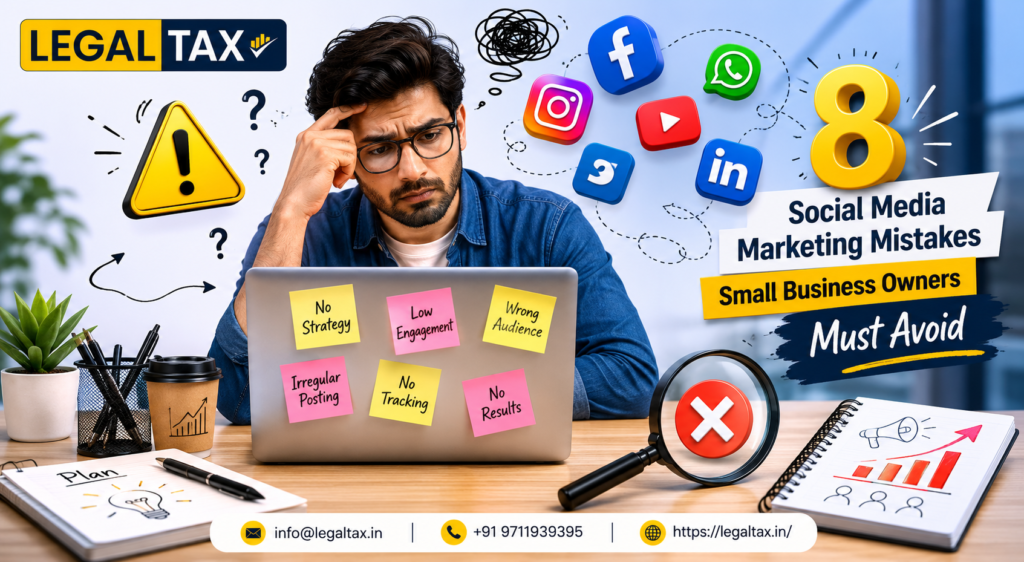
If you are a small business owner trying to build your brand online, this blog is your essential guide. We have identified the 8 social media marketing mistakes small business owners must avoid, along with practical solutions and expert resources to help you market smarter, safer, and more effectively.
Whether you are just starting out or have been running your business for years, avoiding these mistakes can save you time, money, and a lot of unnecessary stress. For any legal or compliance related questions about your business, you can always reach out to the experts at LegalTax.in or call +91 9711939395 for professional guidance.
Mistake 1: Not Having a Clear Social Media Strategy
One of the biggest social media marketing mistakes small business owners must avoid is jumping onto social platforms without a clear plan. Posting randomly, without defined goals, target audience, or content calendar, leads to wasted effort and zero results.
Why a Strategy Matters
A social media strategy gives your business direction. It answers critical questions like: Who is your audience? What platforms are they on? What type of content will engage them? How often should you post? Without answering these questions, your social media presence becomes noise rather than a signal.
What You Should Do Instead
Start by defining your business goals. Are you trying to generate leads, build brand awareness, drive website traffic, or increase sales? Once your goals are clear, map out a content calendar that aligns with those goals. Use scheduling tools like Buffer or Hootsuite to plan your posts in advance and stay consistent.
Consistency is the foundation of social media success. Brands that post regularly and strategically outperform those that post sporadically every single time.
Mistake 2: Ignoring Your Brand Identity and Intellectual Property
Many small business owners create social media pages without first securing their brand legally. They use logos, taglines, and brand names without registering them, which leaves them vulnerable to copying, imitation, and legal disputes.
The Risk of an Unprotected Brand
Imagine spending months building your social media following, only to discover that someone else has registered your brand name as a trademark. This is not a hypothetical situation. It happens to thousands of small businesses every year. Once another party holds the trademark, they can legally force you to stop using your own brand name.
How to Protect Your Brand Online
Before investing heavily in social media marketing, make sure your brand name and logo are legally protected. Trademark registration is the most effective way to secure your brand identity. You can easily start the process through OnlineTrademarkIndia.com, which offers fast and affordable trademark registration services across India.
Protecting your intellectual property is not just a legal formality. It is a business necessity. For comprehensive intellectual property protection including trademarks, copyrights, and patents, visit LegalIP.in or call +91 9711939395 to speak with an IP expert today.
Mistake 3: Posting Without Understanding Your Target Audience
Another critical social media marketing mistake small business owners must avoid is creating content without knowing who they are talking to. Generic content that tries to appeal to everyone ends up appealing to no one.
Understanding Your Audience Deeply
Your target audience has specific needs, preferences, pain points, and aspirations. The content that resonates with a 25-year-old entrepreneur is very different from what appeals to a 50-year-old business owner. If you do not understand your audience, your content will feel irrelevant and people will scroll past it.
How to Research Your Audience
Use the analytics tools provided by each social media platform to understand who is already engaging with your content. Facebook Insights, Instagram Analytics, and LinkedIn Analytics give you detailed demographic data including age, gender, location, and interests.
You can also conduct simple surveys, read comments and DMs, and engage directly with your followers to understand what they want from you. The more you understand your audience, the more powerful your content becomes.
Creating Audience-Centric Content
Once you know your audience, create content that speaks directly to their needs. Use their language, address their specific problems, and offer solutions that are genuinely helpful. This approach builds trust, increases engagement, and converts followers into loyal customers.
Mistake 4: Overlooking Legal Compliance in Social Media Posts
This is one of the most overlooked social media marketing mistakes small business owners must avoid. Many businesses post promotional content, run contests, share customer testimonials, or make claims about their products without understanding the legal implications.
Common Legal Pitfalls in Social Media Marketing
Making false or exaggerated claims about your products can attract consumer protection complaints. Running contests or giveaways without proper terms and conditions can lead to disputes. Sharing customer data or using user-generated content without permission can result in privacy violations.
Additionally, if your business is in a regulated industry like finance, healthcare, or law, there are specific rules about what you can and cannot say on social media. Violating these rules can lead to fines, penalties, and reputational damage.
How to Stay Legally Compliant
Always have a legal expert review your promotional campaigns, contest rules, and advertising claims before you publish them. For businesses operating in India, LegalTax.in offers expert legal and tax consultation services to help you stay compliant. You can also call +91 9711939395 to get immediate assistance from a qualified legal professional.
Do not let a simple social media post become a costly legal problem.
Mistake 5: Neglecting Engagement and Community Building
Many small business owners treat social media as a one-way broadcast channel. They post content but never respond to comments, ignore DMs, and fail to engage with their audience. This is a major mistake that kills community growth and customer loyalty.
Why Engagement Is Everything
Social media algorithms reward engagement. The more people interact with your content, the more the platform promotes it to new audiences. More importantly, engagement builds relationships. People buy from brands they trust, and trust is built through consistent, genuine interaction.
Strategies to Boost Engagement
Respond to every comment, especially in the early stages of your social media growth. Ask questions in your posts to encourage conversation. Go live on Instagram or Facebook to connect with your audience in real time. Create polls, quizzes, and interactive stories that invite participation.
Also, engage with other accounts in your niche. Comment on their posts, share their content when relevant, and collaborate on joint campaigns. Community building is a two-way street, and the more you give, the more you receive.
Mistake 6: Using Copyrighted Content Without Permission
One of the most legally dangerous social media marketing mistakes small business owners must avoid is using images, music, videos, or written content that belongs to someone else without obtaining proper permission or license.
The Consequences of Copyright Infringement
Copyright infringement on social media can lead to content takedowns, account suspensions, and even legal action. Many businesses unknowingly use stock photos, background music in videos, or memes that are protected by copyright. The original creators or copyright holders can file complaints directly with the platform, and platforms are legally obligated to act on these complaints quickly.
How to Avoid Copyright Issues
Always use original content or content that you have properly licensed. Websites like Unsplash, Pexels, and Pixabay offer free-to-use images. For music, use royalty-free tracks from YouTube Audio Library or Epidemic Sound.
If you create original branded content, make sure your brand identity elements like your logo and tagline are protected. Trademark and copyright protection for your own content is equally important. Visit LegalIP.in to understand how to protect your original creative work, or reach out at +91 9711939395 for a consultation.
Trademarking Your Brand Assets
Your logo, slogan, and brand name are valuable business assets. Registering them as trademarks protects you from others misusing them. For a seamless trademark registration experience, check out OnlineTrademarkIndia.com, which simplifies the entire process for small business owners.
Mistake 7: Focusing Only on Follower Count Instead of Quality Metrics
A very common social media marketing mistake small business owners must avoid is obsessing over vanity metrics like follower count while ignoring metrics that actually matter for business growth.
Vanity Metrics vs. Meaningful Metrics
Having 50,000 followers means nothing if none of them are buying from you. Follower count is a vanity metric. The metrics that actually matter include engagement rate, website clicks, lead generation numbers, conversion rate, and return on investment from your social media campaigns.
What Metrics You Should Track
Track how many people click the link in your bio or the links in your posts. Monitor how many inquiries or leads you receive from social media. Measure which types of content generate the most engagement and replicate that success.
Use tools like Google Analytics to track social media referral traffic to your website. Set up conversion goals to measure how many social media visitors complete a desired action like filling out a contact form or making a purchase.
Growing a Quality Audience
Instead of chasing followers, focus on attracting the right followers. Use targeted hashtags, collaborate with relevant influencers, and create content that speaks directly to your ideal customer. A smaller, engaged audience of 1,000 genuine followers is far more valuable than 10,000 disengaged ones.
Mistake 8: Not Having a Crisis Management Plan for Social Media
The final and often most devastating social media marketing mistake small business owners must avoid is operating without a crisis management plan. Every business, no matter how small, is vulnerable to a social media crisis.
What Counts as a Social Media Crisis
A social media crisis can be triggered by a negative customer review going viral, an employee posting something inappropriate from the business account, a product defect that customers publicly complain about, or even a misunderstood post that causes public backlash. These situations can damage your brand reputation quickly if not handled properly.
Building Your Crisis Management Plan
Every small business with a social media presence should have a basic crisis management plan in place before they need it. This plan should include who is responsible for monitoring social media, who has authority to respond publicly, what tone and messaging to use in a crisis, and when to escalate the situation to a legal or PR professional.
Speed matters in a crisis. The longer you wait to respond, the worse the situation becomes. Acknowledge the issue quickly, take responsibility where appropriate, and communicate clearly about what steps you are taking to resolve it.
Legal Considerations During a Crisis
Sometimes a social media crisis has legal dimensions. For example, if a competitor is spreading false information about your business online, you may have grounds for legal action. If a disgruntled employee is making defamatory claims, you need legal advice quickly. For expert legal support during business disputes, contact LegalTax.in or call +91 9711939395 immediately. Having a legal advisor on speed dial is one of the smartest investments a small business owner can make.
Bonus Tips: Building a Strong Social Media Foundation
Register Your Business Properly
Before scaling your social media marketing efforts, make sure your business is properly registered and compliant with all applicable laws. Operating as an unregistered business while running public-facing marketing campaigns exposes you to unnecessary legal risks. LegalTax.in can help you with business registration, GST compliance, and all other legal and tax requirements.
Protect Your Intellectual Property Early
The best time to protect your brand is before you launch your social media marketing campaigns. Once your brand name and logo are out in the public domain, others can attempt to copy or register them before you do. Start the trademark registration process early through OnlineTrademarkIndia.com to secure your brand identity from day one.
Keep Learning and Adapting
Social media platforms constantly evolve. Algorithms change, new features are introduced, and audience behaviors shift. The most successful small business owners are those who commit to continuous learning. Follow industry blogs, attend webinars, and stay updated on the latest social media trends to keep your strategy fresh and effective.
FAQs
What is the biggest social media marketing mistake small businesses make?
The biggest mistake is posting without a clear strategy. Businesses often create content randomly without goals, target audience research, or a content plan.
How often should a small business post on social media?
Consistency matters more than quantity. Most small businesses can start with 3–5 quality posts per week and adjust based on audience engagement.
Why is ignoring analytics a social media marketing mistake?
Analytics help track what content performs best. Ignoring insights can lead to wasted effort and poor marketing decisions.
Can using every social media platform hurt my business?
Yes. Being active on too many platforms can reduce content quality and consistency. Focus on platforms where your target audience is most active.
How can small businesses improve their social media strategy?
Create a content calendar, define goals, understand your audience, post consistently, and regularly analyze performance to improve results.
Conclusion
Social media marketing is one of the most powerful tools available to small business owners today, but only when used correctly. By understanding and avoiding these 8 social media marketing mistakes small business owners must avoid, you can build a stronger brand, reach more customers, and grow your business with confidence.
Remember that great social media marketing goes hand in hand with strong legal and business foundations. Protect your brand with trademark registration at OnlineTrademarkIndia.com, secure your intellectual property through LegalIP.in, and ensure your business stays legally and financially compliant with the expert team at LegalTax.in.
For any questions, guidance, or professional consultation, call +91 9711939395 today. A strong social media presence backed by a legally protected and compliant business is the ultimate formula for small business success.

I’m Aryan Yadav, passionate about SEO and Digital Marketing with a strong interest in helping businesses grow online. I enjoy learning new strategies, exploring digital trends, and creating ideas that deliver value. I believe in continuous growth, creativity, and building meaningful results through smart work and dedication.
Our Clients