Views: 7
When most Indian business owners think about building their digital presence, the first thing they do is search for a web designer or a cheap hosting plan. But before that decision comes a more fundamental one: should your website be static or dynamic? Many business owners make this choice without understanding what it truly means, and the consequences, financial, operational, and strategic, can be significant.
Understanding the difference between a static vs dynamic website for Indian business is not just a technical question. It is a practical business decision that affects how customers find you, how much you spend on maintenance, how well you rank on Google, and how effectively you can scale your digital operations over time.
This complete guide explains both types in plain language, compares them across the factors that matter most to Indian businesses, and helps you make the right choice for your specific situation in 2026.
Table of Contents
- 1 What Is a Static Website? Understanding the Basics
- 2 What Is a Dynamic Website? The Complete Picture
- 3 Static vs Dynamic Website for Indian Business: A Detailed Comparison
- 4 The Indian Business Reality: What Should You Choose?
- 5 Hybrid Approach: The Best of Both Worlds
- 6 Common Mistakes Indian Businesses Make with Website Choice
- 7 FAQs
- 8 Conclusion: Your Website Choice Is a Business Decision
What Is a Static Website? Understanding the Basics
A static website is one where every page is pre-built and delivered to the visitor exactly as it was stored on the server. There is no real-time processing, no database query, and no server-side logic involved when someone opens a static page. Every visitor sees the same content unless a developer manually updates the underlying HTML, CSS, or JavaScript files.
Static websites are built using pure HTML and CSS, sometimes with JavaScript for basic interactivity. They are fast, secure, and affordable to host. Platforms like GitHub Pages, Netlify, and Cloudflare Pages allow static sites to be hosted for free or at near-zero monthly cost.
What a Static Website Does for Your Business
A well-built static website creates an immediate online presence, signals professionalism to first-time visitors, and loads extremely fast even on slower mobile connections. For Indian users in Tier 2 and Tier 3 cities where internet speeds can be inconsistent, this performance advantage is genuinely significant.
However, a static website by itself does not allow you to publish new content without touching code, manage user accounts, process payments, or personalize the experience for different visitors. For those capabilities, you need a dynamic website.
Examples of static website use cases for Indian businesses
A portfolio website for a freelance designer or photographer. A brochure-style site for a local restaurant, salon, or boutique. A one-page landing page for a CA firm or legal advisor. An informational site for a doctor’s clinic or diagnostic centre. A project showcase for a real estate developer or architect.
What Is a Dynamic Website? The Complete Picture
A dynamic website generates content in real-time based on user inputs, database queries, or application logic. When a visitor opens a dynamic website, the server processes the request, fetches data from a connected database, assembles the final HTML page, and delivers it to the browser. This happens in milliseconds but involves significantly more infrastructure than a static site.
Dynamic websites use server-side languages like PHP, Python, or Node.js, connected to databases like MySQL or MongoDB. Content can be updated through a Content Management System (CMS) like WordPress without touching any code, allowing non-technical team members to publish blog posts, update product listings, and manage pages independently.
What a Dynamic Website Does for Your Business
A dynamic website can support user registration and login, e-commerce transactions, booking and appointment systems, client dashboards, lead management, and content marketing at scale. For service businesses, e-commerce brands, legal and financial platforms, and any business that needs to regularly publish content or manage customer data, a dynamic website is not optional — it is essential.
For Indian businesses dealing with legal and financial documentation, services like those offered at legaltax.in are a perfect example of why dynamic websites make sense. A platform handling GST filing, ITR submissions, company incorporation, and compliance needs real-time data handling, user logins, document uploads, and payment processing — none of which is possible with a static website.
Examples of dynamic website use cases for Indian businesses
An e-commerce store selling products across India. A news portal or digital media publication. A legal services platform handling client documents and filings. A booking system for a clinic, hotel, or coaching institute. Any business that needs user registration, data storage, or regular content publishing.
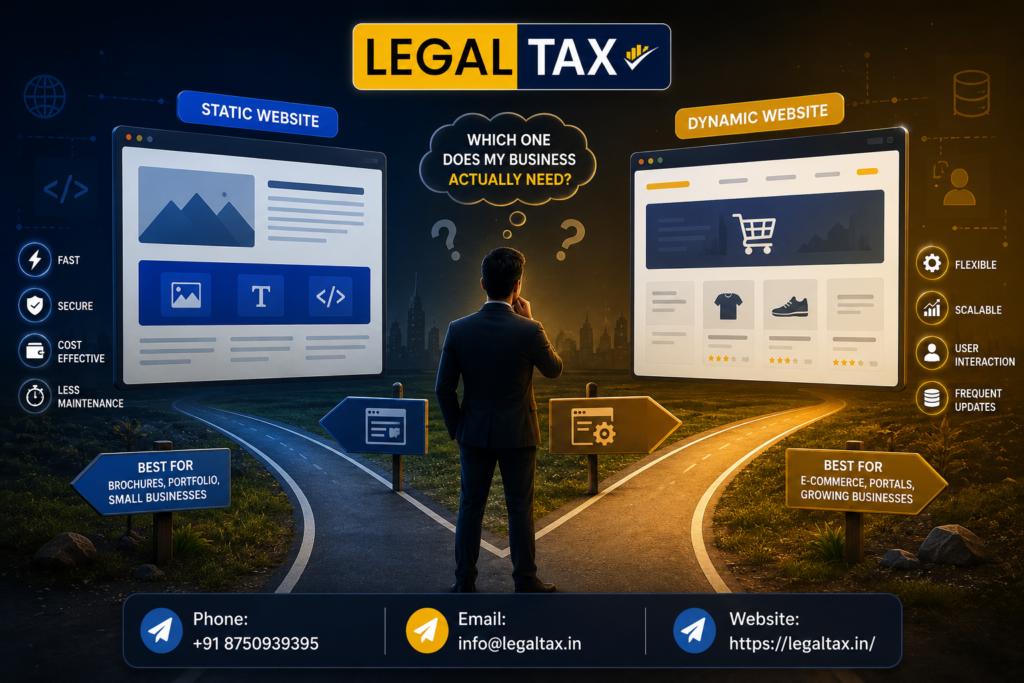
Static vs Dynamic Website for Indian Business: A Detailed Comparison
1. Speed and performance
Static websites load faster because there is no server-side processing. Pages are served directly from a CDN, meaning load times can be under one second even on average connections. Dynamic websites require server computation before delivering the page, which adds latency. However, a well-optimised dynamic site with caching can get close to static performance.
Verdict
Static wins on raw speed. For Indian audiences on mobile networks, this difference is real and measurable in user experience and bounce rates.
2. Cost of development and maintenance
A basic static site can be built for Rs. 5,000 to Rs. 25,000 with hosting costing near zero. A dynamic WordPress site starts at Rs. 20,000 to Rs. 50,000, with monthly hosting and maintenance costs of Rs. 2,000 to Rs. 10,000 or more. Custom-built dynamic web applications for e-commerce or SaaS businesses can range from Rs. 1 lakh to Rs. 10 lakh and above.
Verdict
Static is significantly cheaper upfront and ongoing. For budget-conscious startups and small businesses, it is the right starting point. For personalised guidance on the right option for your budget, call +91 9711939395.
3. Content management
Updating a static website requires direct code editing. Non-technical business owners cannot publish blog posts, update offers, or change product information without a developer. Dynamic websites built on WordPress or similar CMS platforms allow any team member to update content through a user-friendly admin interface without writing a single line of code.
For legal IP service providers like the specialists at legalip.in, where content around trademark filings, copyright registrations, patent applications, and IP law updates needs to be published regularly, a dynamic CMS-powered website is essential to keep the site current without developer dependency.
Verdict
If you plan to regularly publish content, update product listings, or run a business blog, a dynamic website is essential. Static sites are unsuitable for active content marketing strategies.
4. SEO friendliness
Both static and dynamic websites can rank well on Google. Static sites have a natural advantage in page speed, which is a confirmed ranking signal. Dynamic websites built on WordPress with plugins like Yoast or RankMath give you granular control over meta tags, structured data, XML sitemaps, and canonical URLs. The ability to regularly publish fresh content gives dynamic sites a decisive long-term SEO advantage through content marketing.
This is precisely why platforms like onlinetrademarkindia.com operate on dynamic systems. They need to rank for hundreds of service-related keywords, publish regular updates on trademark law, handle inquiry forms, and manage client leads — all of which requires a fully dynamic CMS-backed infrastructure.
Verdict
For long-term organic search visibility through blogging, landing pages, and content marketing, dynamic websites are the clear choice for Indian businesses serious about SEO growth.
5. Security
Static websites are inherently more secure. With no database, no server-side logic, and no CMS login page, the attack surface is minimal. SQL injection, brute-force login attempts, and plugin vulnerabilities simply do not apply. Dynamic websites require regular security maintenance: CMS updates, plugin patches, server hardening, firewall configuration, and SSL management. An unmaintained WordPress installation is one of the most commonly exploited targets on the internet.
Verdict
Static wins on security with zero maintenance effort. If you run a dynamic site, invest in a proper maintenance plan. Contact +91 9711939395 for affordable maintenance packages for Indian SMEs.
6. Scalability
Static websites hit a functional ceiling quickly. You can add more pages, but adding features like user accounts, search functionality, payment processing, or personalised recommendations requires a complete rebuild. Dynamic websites are designed to scale. With the right architecture, a dynamic site can handle millions of users, complex transactions, and evolving feature requirements without starting from scratch.
Verdict
For any business with serious growth ambitions, a dynamic website is the only viable long-term choice.
The Indian Business Reality: What Should You Choose?
Small businesses and local shops
If you run a local restaurant, gym, coaching centre, tailoring shop, or artisan business, a static website with clean design, your contact details, and a Google Maps embed is a perfectly effective starting point. It is affordable, fast, and gets you online quickly. Add your phone number prominently so customers can reach you directly. You can contact digital experts at +91 9711939395 to get guidance on the right solution for your specific business type and budget.
Service-based businesses: CA firms, lawyers, consultants
A legal advisor, chartered accountant, or business consultant needs more than a digital brochure. You need to collect leads, publish case studies, share articles establishing your expertise, and convert visitors into clients. A dynamic WordPress site is the right solution for this category. Firms offering GST registration, income tax filing, or company incorporation services, like those at legaltax.in, benefit enormously from dynamic websites that can manage multiple service pages, lead capture forms, client portals, and a regularly updated blog simultaneously.
E-commerce businesses
If you are selling products online, whether sarees from Varanasi, handicrafts from Rajasthan, electronics from Mumbai, or health products from Delhi, a dynamic website is not optional. You need product catalogues, shopping carts, payment gateways, order tracking, inventory management, and customer account systems. None of this is possible without a dynamic backend.
Intellectual property and legal services
For businesses dealing in trademark registration, copyright filings, patent applications, or IP litigation support, a dynamic website is essential for managing client inquiries, publishing legal updates, handling document uploads, and providing client status portals. Teams like the specialists at legalip.in require a digital presence that matches the complexity of their practice. For trademark-specific services and filings in India, onlinetrademarkindia.com is a dedicated resource for businesses at every stage.
Hybrid Approach: The Best of Both Worlds
Many modern Indian businesses are adopting a hybrid approach. The front end is built using static site generation frameworks like Next.js or Gatsby, delivering blazing page speeds and excellent SEO performance. The backend is powered by a headless CMS or API layer that enables dynamic content updates, form submissions, and database interactions without sacrificing front-end performance.
This architecture gives you the speed and security of static sites with the content flexibility and feature richness of dynamic systems. It is increasingly the preferred approach for high-traffic Indian businesses in the legal, financial, educational, and e-commerce sectors. To explore whether a hybrid approach suits your business, reach out to the team at +91 9711939395.
Common Mistakes Indian Businesses Make with Website Choice
Choosing static when you need dynamic
Many small business owners choose static websites to save money, only to find within a year that they need CMS features, lead capture forms, and an SEO blog. Migrating from static to dynamic mid-growth is expensive, disruptive, and sometimes requires rebuilding from scratch. If you have clear growth ambitions, start with a lightweight dynamic CMS from day one.
Choosing dynamic without a maintenance plan
Building a WordPress website and leaving it unattended is one of the most common and costly mistakes in Indian digital business. Outdated plugins and themes create critical security vulnerabilities that hackers actively exploit. Always have a professional maintenance plan in place from launch day.
Neglecting legal compliance pages
Every Indian business website must include a Privacy Policy, Terms of Use, and for product and service businesses, a Refund Policy. If your business has a registered trademark, it should be correctly displayed. Resources at onlinetrademarkindia.com and legalip.in can help ensure your business is legally protected online. For GST compliance, tax documentation, and all related legal and financial matters, legaltax.in is a reliable professional resource for Indian entrepreneurs at every stage of growth.
FAQs
1: What is the main difference between a static and dynamic website?
A static website shows the same pre-built content to every visitor, while a dynamic website generates content in real time based on user interactions, databases, or server-side processing.
2: Which is better for small businesses in India: static or dynamic websites?
For small businesses with limited budgets and basic informational needs, a static website is often enough. However, businesses planning content updates, lead generation, or expansion should choose a dynamic website.
3: Are dynamic websites better for SEO than static websites?
Both can rank on Google, but dynamic websites often have an advantage because they support regular content updates, blogging, CMS tools, and advanced SEO features that improve long-term rankings.
4: Is a static website more secure than a dynamic website?
Yes. Static websites generally have fewer security risks because they do not use databases, plugins, or server-side processing. Dynamic websites require regular updates and maintenance for security.
5: Can I convert a static website into a dynamic website later?
Yes, but migrating later can require rebuilding parts of the website and may increase costs. If you expect future growth or frequent updates, starting with a dynamic website is often the smarter choice.
Conclusion: Your Website Choice Is a Business Decision
The debate of static vs dynamic website for Indian business ultimately comes down to your specific needs, budget, content plans, and growth ambitions. A static website is the right starting point for simple, affordable, fast-loading informational sites. A dynamic website is the essential infrastructure for any business that wants to scale, publish content, manage customers, or sell online.
Choose a static website if you need a clean, fast, affordable online presence with fixed content that rarely changes. Choose a dynamic website if you need to regularly update content, manage user accounts, run e-commerce, capture leads, or build organic search visibility through content marketing.
For personalised guidance on building the right website for your Indian business, contact the experts at +91 9711939395. Whether you are in legal services, e-commerce, consulting, healthcare, or any other sector, they can assess your goals and recommend the right digital solution for your stage and industry.
Whether you need help with legal compliance, trademark registration, or business documentation, trusted resources like legalip.in, and onlinetrademarkindia.com are available to support every dimension of your Indian business journey. Build with intention. Protect with expertise. That is how Indian businesses build digital assets that last.

I’m Aryan Yadav, passionate about SEO and Digital Marketing with a strong interest in helping businesses grow online. I enjoy learning new strategies, exploring digital trends, and creating ideas that deliver value. I believe in continuous growth, creativity, and building meaningful results through smart work and dedication.
Our Clients