Views: 12
Table of Contents
- 1 Introduction
- 2 Why Tax Exemption Is Not Automatic for Section 8 Companies
- 3 Section 12AB Registration: The Foundation of Tax Exemption
- 4 Section 80G Approval: Enabling Donor Tax Deductions
- 5 Section 10(23C): An Alternative Exemption Framework
- 6 CSR Funding and Section 8 Companies
- 7 Foreign Contribution and FCRA Registration
- 8 Annual Compliance Obligations of an Exempted Section 8 Company
- 9 Common Compliance Mistakes and How to Avoid Them
- 10 Frequently Asked Questions
- 11 Conclusion
- 12 Get Expert Section 8 Company Registration and Tax Exemption Support
Introduction
A Section 8 Company incorporated under the Companies Act, 2013 for charitable, educational, scientific, social welfare, or similar not-for-profit purposes does not automatically enjoy exemption from income tax simply by virtue of being a Section 8 Company. The exemption framework for not-for-profit organisations in India is built around registrations under the Income Tax Act, 1961, and these registrations must be applied for separately from the MCA incorporation process, maintained through ongoing compliance, and renewed within prescribed timelines to remain in force.
Understanding which tax exemptions are available to a Section 8 Company, what each exemption covers, what the conditions for obtaining and retaining each exemption are, and how the compliance obligations of an exempted Section 8 Company differ from those of an unexempted one is essential for founders, trustees, and compliance managers of Section 8 Companies at any stage of the organisation’s lifecycle.
This guide covers the complete tax exemption framework available to Section 8 Companies in India, including Section 12AB registration, Section 80G approval, the implications of Section 11 and Section 13, the CSR funding framework, and the foreign contribution angle, written for founders and compliance teams managing Section 8 Company tax obligations.
For Section 8 Company registration, tax exemption applications, and ongoing compliance support, Legal Tax provides complete services for not-for-profit organisations across India.
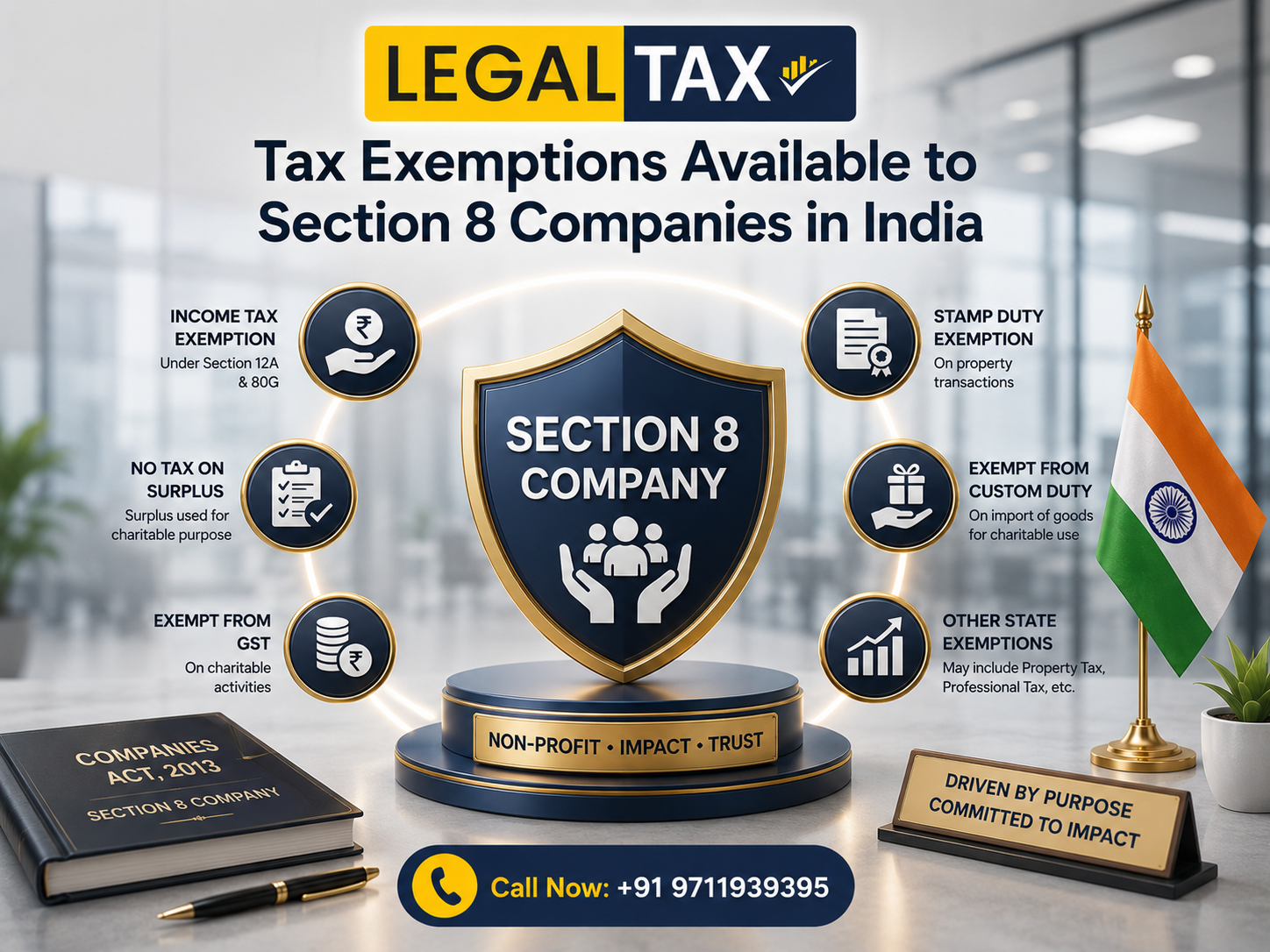
Why Tax Exemption Is Not Automatic for Section 8 Companies
The MCA Registration and the IT Registration Are Separate
When a Section 8 Company is incorporated with the Ministry of Corporate Affairs, it receives a Certificate of Incorporation and a licence under Section 8 of the Companies Act confirming its not-for-profit status. This MCA registration establishes the company as a legal entity and defines its not-for-profit character under company law. It does not, however, confer any income tax exemption.
Income tax exemptions for Section 8 Companies, as for all not-for-profit organisations in India, flow from separate registrations and approvals under the Income Tax Act. Until these IT Act registrations are obtained and maintained, a Section 8 Company’s income is taxable at the rates applicable to companies under the Income Tax Act, without any exemption for income applied towards charitable purposes.
What Happens Without IT Act Registration
A Section 8 Company that has not obtained registration under Section 12AB of the Income Tax Act will be assessed to tax on its total income, including any surplus generated from its activities, donations received, grants obtained, and any investment income, at the applicable corporate tax rate. Given that many Section 8 Companies rely on grants and donations to fund their activities rather than generating commercial income, this can result in a significant tax liability on funds that were intended entirely for application towards the organisation’s charitable objects.
Obtaining the applicable IT Act registrations promptly after incorporation, and maintaining them through renewal and compliance, is therefore one of the most important early compliance steps for any Section 8 Company.
Section 12AB Registration: The Foundation of Tax Exemption
What Section 12AB Provides
Registration under Section 12AB of the Income Tax Act provides a Section 8 Company with exemption from income tax on income that is applied or accumulated for application towards the organisation’s charitable or religious purposes, subject to the conditions prescribed under Sections 11, 12, and 13 of the Income Tax Act.
The practical effect is that a Section 8 Company registered under Section 12AB does not pay income tax on donations, grants, programme income, and other receipts that are applied towards its stated charitable objects, provided the conditions for exemption are met. This is the core income tax exemption that makes the not-for-profit model financially viable.
The Conditions Under Section 11
Section 11 of the Income Tax Act prescribes the conditions under which income of a charitable trust or institution, including a Section 8 Company, is exempt from tax. The key conditions include:
The organisation must be registered under Section 12AB.
At least eighty-five percent of the income of the organisation must be applied towards the charitable or religious purposes of the organisation during the year. If less than eighty-five percent is applied in the year of receipt, the balance can be accumulated for up to five years for application in future years, subject to filing the required notice of accumulation with the Income Tax Department and applying the accumulated funds within the prescribed period.
The income must not be used for any purpose that benefits the founders, trustees, directors, or related parties of the organisation, which is the subject of Section 13 discussed further below.
The organisation must maintain proper books of account and file its income tax return within the due date prescribed for its category.
Section 13: The Conditions That Can Deny Exemption
Section 13 of the Income Tax Act prescribes circumstances in which the exemption under Section 11 is denied, even for a registered organisation. The most significant of these circumstances for Section 8 Companies are:
Income or assets of the organisation being used, directly or indirectly, for the benefit of the founders, directors, trustees, or their relatives or associated concerns, whether through payment of excessive remuneration, loans, use of assets at less than fair value, or other forms of benefit.
The organisation holding prohibited investments, such as shares in private companies beyond prescribed limits.
Income applied for purposes other than the charitable objects stated in the Memorandum of Association.
Violation of the investment pattern prescribed for accumulation of funds.
Where Section 13 applies to any portion of the organisation’s income, the exemption for that portion is denied and the income is taxed at the maximum marginal rate, which is a significant penalty for compliance failures. Section 8 Company compliance managers must be familiar with Section 13 and ensure that all transactions involving founders, directors, and related parties are conducted at arm’s length and within the prescribed limits.
Provisional and Regular Registration Under Section 12AB
The current framework under Section 12AB, as amended by the Finance Acts in recent years, provides for:
Provisional registration for newly established organisations, granted for three years from the date of registration, allowing the organisation to commence operations and claim exemption while it builds the track record of charitable activity required for regular registration.
Regular registration for organisations with a track record of three years or more of charitable activity, granted for a period of five years, after which it must be renewed.
Organisations existing prior to the 12AB framework and previously registered under the old Section 12A framework were required to re-register under 12AB within prescribed timelines to continue claiming exemption.
The renewal process for regular registration must be initiated before expiry of the current registration. Operating under an expired registration without timely renewal results in loss of exemption for the period of the gap, which can create significant tax liability for the organisation.
Section 80G Approval: Enabling Donor Tax Deductions
What Section 80G Provides
Section 80G of the Income Tax Act allows donors, whether individuals or corporates, to claim a deduction from their taxable income for donations made to approved organisations. For individual donors, this deduction is available under the old tax regime. For corporate donors, it is relevant as a business expense deduction.
The availability of 80G approval significantly enhances a Section 8 Company’s ability to attract donations from individuals and corporates who are tax-aware, since a donation to a 80G-approved organisation effectively costs the donor less in net terms after the tax saving. For many donors, particularly corporate donors managing their philanthropic budget strategically, 80G approval is a prerequisite for making a donation at all.
Quantum of Deduction Available to Donors
The deduction available to donors under Section 80G depends on the category of the approved organisation and is subject to a cap in most cases. Donations to certain specified funds and government institutions qualify for a hundred percent deduction without any qualifying limit. Donations to most charitable organisations approved under Section 80G qualify for a fifty percent deduction, subject to a qualifying limit of ten percent of the donor’s adjusted gross total income.
Obtaining 80G Approval
An application for 80G approval is filed before the Commissioner of Income Tax (Exemptions) having jurisdiction over the organisation, along with documents establishing the organisation’s registration, objects, activities, financial statements, and 12AB registration status. The Commissioner examines the application and, if satisfied, grants approval under Section 80G.
80G approval is now granted provisionally for three years for new organisations and for five years for organisations with an established track record, aligned with the 12AB registration framework. Renewal must be applied for before expiry.
Issuing 80G Receipts to Donors
A Section 8 Company with 80G approval must issue receipts to donors in the prescribed format, containing the organisation’s name, PAN, 80G registration number, the date and amount of the donation, and the name and PAN of the donor. The organisation must also file Form 10BD, a statement of particulars of donations received, and issue Form 10BE as a donation certificate to donors, on an annual basis. Failure to file Form 10BD or issue Form 10BE correctly can result in the donor’s deduction claim being disallowed, which can damage the organisation’s relationship with its donors.
Section 10(23C): An Alternative Exemption Framework
What Section 10(23C) Covers
Section 10(23C) of the Income Tax Act provides an alternative income tax exemption framework for certain categories of educational institutions, hospitals, and other organisations of national importance, distinct from the Section 11 and 12AB framework. A Section 8 Company that operates primarily as an educational institution, hospital, or institution of national importance may be eligible for exemption under this provision rather than under Section 12AB, subject to meeting the specific conditions applicable to the relevant sub-clause of Section 10(23C).
When Section 10(23C) Is Relevant for Section 8 Companies
Most Section 8 Companies applying for income tax exemption will do so under Section 12AB rather than Section 10(23C). Section 10(23C) is more specifically relevant for educational institutions and hospitals that meet the prescribed criteria for that provision. Section 8 Companies whose primary activity is running an educational institution or hospital should assess with a qualified professional whether their specific circumstances make Section 10(23C) or Section 12AB the more appropriate route, since the two frameworks have different conditions and administrative processes.
CSR Funding and Section 8 Companies
How Section 8 Companies Receive CSR Funds
Companies above the prescribed thresholds under Section 135 of the Companies Act are required to spend a specified percentage of their average net profits on corporate social responsibility activities. One of the common channels through which these CSR funds are disbursed is through implementing organisations, including Section 8 Companies, that carry out the CSR activities on behalf of the spending company.
For a Section 8 Company to be eligible to receive CSR funds, it must be registered on the Ministry of Corporate Affairs portal under Form CSR-1, which provides the organisation with a unique CSR registration number. This registration is a prerequisite for being listed as a CSR implementing organisation, and corporate donors typically require a valid CSR-1 registration number before channelling CSR funds.
Tax Treatment of CSR Funds Received
Funds received by a Section 8 Company as CSR contributions are treated as income of the organisation, and the exemption under Section 11 and 12AB applies to the extent the funds are applied towards the organisation’s charitable objects, subject to the eighty-five percent application condition.
80G Deduction on CSR Donations
The intersection of 80G and CSR is an area with important nuances. While a corporate donor making a CSR contribution to a Section 8 Company may in principle claim the CSR expenditure as a deduction from business income under Section 37(1), the deductibility of CSR expenditure as a business expense has been specifically restricted under the Income Tax Act, meaning CSR expenditure is generally not deductible as a business expense. The 80G deduction for the same donation is also generally not available simultaneously with the CSR deduction. The interaction between CSR expenditure and tax deductibility is a specialised area where corporate donors and Section 8 Companies alike should seek professional advice.
Foreign Contribution and FCRA Registration
FCRA Registration for Section 8 Companies
A Section 8 Company that wishes to receive donations, grants, or contributions from foreign sources, including foreign individuals, foreign NGOs, foreign foundations, or international agencies, must obtain registration under the Foreign Contribution (Regulation) Act, 2010. Operating with foreign contributions without FCRA registration, or in violation of FCRA conditions, is a serious legal offence with significant penalties including cancellation of registration and freezing of bank accounts.
Eligibility and Conditions for FCRA Registration
To be eligible for FCRA registration, a Section 8 Company must generally have been in existence for at least three years and have a demonstrable track record of charitable activity during that period. Organisations that have not yet completed three years of existence can apply for prior permission under FCRA for a specific foreign contribution from a specific source, rather than general registration.
FCRA-registered organisations must maintain a designated FCRA bank account, file annual returns with the Ministry of Home Affairs, and ensure that foreign contributions are used only for the purposes specified in the FCRA registration and consistent with the organisation’s stated objects. FCRA compliance is administered separately from income tax compliance and involves its own annual reporting cycle.
FCRA and Tax Exemption
FCRA registration does not itself provide income tax exemption; that flows from the 12AB registration. However, for a Section 8 Company with international funding sources, both FCRA registration and 12AB registration are typically needed, and maintaining compliance under both frameworks is an ongoing requirement.
Annual Compliance Obligations of an Exempted Section 8 Company
Income Tax Return Filing
A Section 8 Company registered under Section 12AB must file its income tax return within the due date prescribed for its category. The return is filed using the applicable ITR form for trusts and charitable institutions. The return must reflect the income received, the application of income towards charitable purposes, any accumulation with the required notice, and compliance with the investment and usage conditions under Sections 11 and 13.
Form 10B and Form 10BB Audit
A Section 8 Company registered under Section 12AB whose total income before applying the exemption under Section 11 exceeds the prescribed threshold must have its accounts audited by a Chartered Accountant and file Form 10B, the audit report for charitable trusts and institutions, along with the income tax return. This is separate from and in addition to the statutory audit required under the Companies Act.
Form 10BD and Form 10BE for 80G
As described above, a Section 8 Company with 80G approval must file Form 10BD, the statement of donations received, and issue Form 10BE certificates to donors annually, within the prescribed due dates. These filings are separate from the income tax return filing.
MCA Annual Compliance
In addition to the income tax compliance obligations, a Section 8 Company continues to have all the annual compliance obligations of a company under the Companies Act, including board meetings, annual general meeting, filing of annual financial statements in Form AOC-4 and annual return in Form MGT-7 with the Registrar of Companies, and statutory audit under the Companies Act. The income tax compliance does not substitute for MCA compliance.
Maintenance of Books of Account
A Section 8 Company must maintain detailed books of account recording all receipts, payments, income, and expenditure, with documentation supporting the application of funds towards charitable purposes. These records must be available for inspection by income tax authorities and must support the figures reflected in the income tax return and audit report.
For organisations managing both MCA and Income Tax Act compliance alongside FCRA compliance where applicable, maintaining a consolidated compliance calendar and engaging professionals familiar with the specific requirements of not-for-profit organisations is the most reliable approach to avoiding compliance gaps.
Common Compliance Mistakes and How to Avoid Them
Not Applying for 12AB Registration Promptly After Incorporation
Founders of Section 8 Companies sometimes assume that the MCA incorporation process provides immediate tax exemption and delay applying for 12AB registration. The income earned during the period before 12AB registration is obtained is taxable without exemption. Applying for provisional 12AB registration promptly after incorporation avoids this gap.
Missing the 80G Renewal Deadline
Both 12AB registration and 80G approval must be renewed before expiry. Missing the renewal deadline results in a gap in exemption status and in the organisation’s ability to issue valid 80G receipts to donors, which can damage donor relationships. Tracking renewal deadlines and filing renewal applications well in advance of expiry is a basic calendar management requirement for Section 8 Company compliance teams.
Transactions Attracting Section 13 Scrutiny
Any transaction between the Section 8 Company and its founders, directors, or their relatives, including employment of founders at above-market remuneration, use of organisation assets by founders for personal purposes, or loans to founders or their relatives, can attract Section 13 and result in loss of exemption for the relevant income. Maintaining clear arm’s length terms for all such transactions and obtaining appropriate professional guidance before entering into them is essential.
Not Filing Form 10BD on Time
The requirement to file Form 10BD and issue Form 10BE to donors is a relatively recent addition to the compliance framework and is sometimes overlooked by Section 8 Companies that completed their initial 80G registration under the older framework. Non-filing or late filing of Form 10BD can affect donors’ ability to claim their 80G deduction and can result in penalties for the organisation.
Frequently Asked Questions
Does a Section 8 Company pay GST on donations received?
Donations received by a Section 8 Company are generally not subject to GST, as a donation is not consideration for a supply of goods or services. However, if a Section 8 Company provides specific services in exchange for a payment, even if described as a donation or contribution, the transaction may be subject to GST if the organisation is registered under GST and the activity constitutes a taxable supply. The GST treatment of receipts by not-for-profit organisations can be nuanced, and specific receipts should be assessed by a GST professional.
Can a Section 8 Company earn commercial income alongside its charitable activities?
A Section 8 Company can in principle earn incidental commercial income in the course of pursuing its charitable objects, but it cannot pursue commercial activities as a primary or significant part of its operations without jeopardising its Section 8 licence and potentially its 12AB registration. Commercial income that is incidental to and in furtherance of the charitable objects, such as sale of publications or fee-based training programmes that further the organisation’s educational objects, is generally more defensible than commercial activities unrelated to the objects.
What is the tax rate applicable to income that does not qualify for exemption under Section 11?
Income of a Section 8 Company that does not qualify for exemption under Section 11, whether because the 12AB registration is not in place, because the income falls outside the scope of the exemption, or because Section 13 applies, is taxed at the maximum marginal rate applicable to the relevant assessment year, which has historically been at a rate higher than the standard corporate tax rate. This makes compliance with the conditions of exemption financially critical for Section 8 Companies.
We received a large grant from a foreign foundation. Do we need FCRA registration even if we already have 12AB? Yes. FCRA registration is required separately from 12AB registration for receiving foreign contributions. A Section 8 Company that has 12AB registration but not FCRA registration cannot legally receive the foreign grant. If FCRA registration has not yet been obtained and the grant is imminent, the organisation should explore whether applying for prior permission for the specific grant is possible while the general FCRA registration application is pending.
Can directors of a Section 8 Company receive salaries?
Directors and other officers of a Section 8 Company can receive reasonable remuneration for services rendered to the organisation, subject to the conditions of the Section 8 licence and the arm’s length requirements of Section 13 of the Income Tax Act. Remuneration that is excessive relative to the services rendered and the scale of the organisation risks attracting Section 13 scrutiny and denial of exemption. Remuneration arrangements for founders and directors of Section 8 Companies should be structured with professional guidance to ensure they are within permissible limits.
Conclusion
The tax exemption framework available to Section 8 Companies in India is comprehensive but conditional. It does not arise automatically from incorporation and it is not permanent once obtained; it must be actively applied for, maintained through compliance with the conditions of Sections 11 and 13, and renewed within prescribed timelines to remain in force.
For founders and compliance managers of Section 8 Companies, the practical priority is to obtain 12AB registration and 80G approval promptly after incorporation, maintain the eighty-five percent application condition and the arm’s length requirements of Section 13 through careful financial management, file all required returns and forms within due dates, and track renewal timelines for both 12AB and 80G well in advance of expiry.
The organisations that maximise the benefit of the not-for-profit tax framework are those that treat their Income Tax Act compliance with the same rigour as their MCA compliance, recognising that both are ongoing requirements rather than one-time formalities.
Apply for 12AB and 80G promptly after incorporation. Apply at least eighty-five percent of income towards charitable objects each year. Keep all transactions with founders and related parties at arm’s length. File Form 10BD on time. Track renewal deadlines. And treat IT Act compliance as an ongoing priority, not a background formality.
Get Expert Section 8 Company Registration and Tax Exemption Support
🟡 Legal Tax provides complete Section 8 Company registration, 12AB registration, 80G approval, CSR-1 registration, and ongoing compliance support for not-for-profit organisations across India.
👉 Private Limited Company Registration 👉 Startup Registration 👉 MSME Registration 👉 GST Registration and Filing 👉 Income Tax Return 👉 Legal Documentation and Drafting
👉 Website Development 👉 SEO Services 👉 Branding Services 👉 Logo Design
📞 Call Now: +91 9711939395 🕐 Free Consultation: Monday to Saturday, 9 AM to 6 PM

I’m Aman Arora aka Aman G — 10+ years in SEO and Digital Marketing, and I love getting results. I don’t just do SEO & Website Design; I build strategies that work. I’m a CA drop out, but what I enjoy most is helping entrepreneurs and NGOs reach their goals. For me, happy customers are the real reward.
Our Clients