Views: 4
Table of Contents
- 1 Introduction
- 2 The Traditional Government Tender Process: How It Works for SMBs
- 3 GeM as an Alternative Procurement Channel
- 4 Direct Comparison: GeM vs Traditional Tender for SMBs
- 5 When Traditional Tendering Is Still Worth Pursuing for SMBs
- 6 Combining GeM and Traditional Tendering as a Government Procurement Strategy
- 7 Practical Checklist for SMBs Entering Government Procurement
- 8 Frequently Asked Questions
- 9 Conclusion
- 10 Get Expert Government Procurement Registration Support
Introduction
Small and medium businesses in India have historically found government procurement an attractive but practically inaccessible market. The demand is consistent, the payment comes from public funds with structured processes behind it, and winning a government contract provides a credibility signal that helps with private sector business development as well. Yet the traditional government tendering process, with its complex documentation requirements, earnest money deposits, technical qualification thresholds, and long evaluation timelines, has effectively excluded most small businesses that lack the administrative infrastructure to participate competitively.
The Government e-Marketplace changed this equation when it was introduced and has continued to expand its scope and transaction volume through the years since. GeM provides a procurement channel where small businesses can sell to government buyers without participating in a formal tender process for orders below specified thresholds, and where the platform itself handles much of the administrative infrastructure that previously required a dedicated tendering team.
Yet the traditional tendering process has not disappeared. Large government contracts, specialised procurement, and purchases above GeM’s threshold-based ordering mechanisms continue to flow through formal tenders published on platforms such as the Central Public Procurement Portal and state government e-procurement systems. Understanding when GeM is genuinely the easier and more accessible route for a small or medium business, when traditional tendering may still be the better opportunity despite its complexity, and how to approach each channel strategically is the practical knowledge that allows SMBs to make the most of government procurement as a revenue source.
This guide compares GeM and traditional government tendering from the specific perspective of small and medium businesses, covering registration, documentation, order mechanisms, payment, and the situations in which each channel is more appropriate.
For GeM registration and government procurement support, the Legal Tax covers the complete range of registrations and compliance steps relevant to businesses entering the government marketplace.
The Traditional Government Tender Process: How It Works for SMBs
The Tendering Cycle
Traditional government procurement above specified thresholds follows a formal tendering process governed by the General Financial Rules and procurement policies of the respective ministry, department, or public sector undertaking. The process typically involves:
Publication of a Notice Inviting Tender on the relevant e-procurement portal, setting out the requirement, specifications, eligibility criteria, and timeline for submission.
Purchase or download of the tender document, which contains the detailed specifications, scope of work, eligibility conditions, evaluation criteria, and contract terms.
Submission of a two-envelope bid in most cases, with one envelope containing technical qualification documents and a second containing the financial bid. The financial bids of technically qualified bidders are opened and evaluated separately.
Evaluation of bids by the tendering authority based on the stated criteria, which for most standard procurement is primarily price-based with technical qualification as a threshold requirement.
Award of the contract to the successful bidder, followed by signing of the formal contract agreement and submission of a performance security by the winning bidder.
Why Traditional Tenders Are Challenging for SMBs
The traditional tender process creates several barriers that disproportionately affect small and medium businesses relative to larger established vendors.
Pre-qualification requirements in many tenders specify minimum turnover, minimum years of experience in supplying similar goods or services to government, or technical capability thresholds that newly established SMBs or businesses without prior government supply experience cannot meet, eliminating them from participation regardless of how competitive their offering is.
Earnest Money Deposits are required with most tender submissions as a financial guarantee of the bidder’s seriousness, typically calculated as a percentage of the estimated contract value. For large contracts, the EMD amount can be significant, representing a meaningful working capital commitment for an SMB during the evaluation period, which can span months.
Documentation requirements for traditional tender submissions are extensive, including audited financial statements, experience certificates from previous buyers, quality certifications, factory inspection reports in some cases, and various declarations and undertakings. Assembling and presenting this documentation correctly requires administrative capacity and, in many cases, professional assistance.
Timeline uncertainty is inherent in the traditional tender process. From the date of tender publication to contract award can take several months or longer, during which the SMB has committed management time, EMD funds, and bid preparation costs without any certainty of return.
Payment timelines after contract performance are not always predictable in traditional government procurement, with payment delays being a commonly cited challenge for vendors, particularly smaller ones that lack the leverage to follow up effectively with large government buyers.
GeM as an Alternative Procurement Channel
How GeM Removes the Traditional Barriers
GeM was specifically designed to make government procurement more accessible, and several of its structural features directly address the barriers that make traditional tendering difficult for SMBs.
No pre-qualification thresholds for basic listing. Any business that has completed the GeM seller registration process, regardless of years of existence, prior government supply experience, or turnover, can list products or services and receive orders. The platform does not require SMBs to demonstrate a track record of government supply before they can participate; the track record is built through GeM orders themselves.
MSME EMD exemption. Sellers registered as MSMEs under the Udyam Registration framework are exempt from submitting Earnest Money Deposits in GeM bid processes, removing one of the most significant upfront financial barriers to participating in competitive procurement above the direct purchase threshold.
Simplified documentation. GeM’s registration and listing process involves a defined set of documents that is substantially simpler than the documentation package required for a traditional tender submission. Once registered, the seller’s documentation is associated with the account and does not need to be resubmitted for each order.
Faster order cycles. Direct purchase orders on GeM, below the Rs. 25,000 threshold, can be placed and fulfilled within days without any competitive process. L1 orders above that threshold involve a defined comparison mechanism but without the extended evaluation timelines of formal tenders. Even GeM bids for larger orders typically have shorter timelines than equivalent traditional tenders.
Structured payment timelines. GeM’s payment framework provides more structured payment timelines than unstructured traditional government procurement, and the platform’s visibility into order and payment status gives sellers better information about where their payment is in the process.
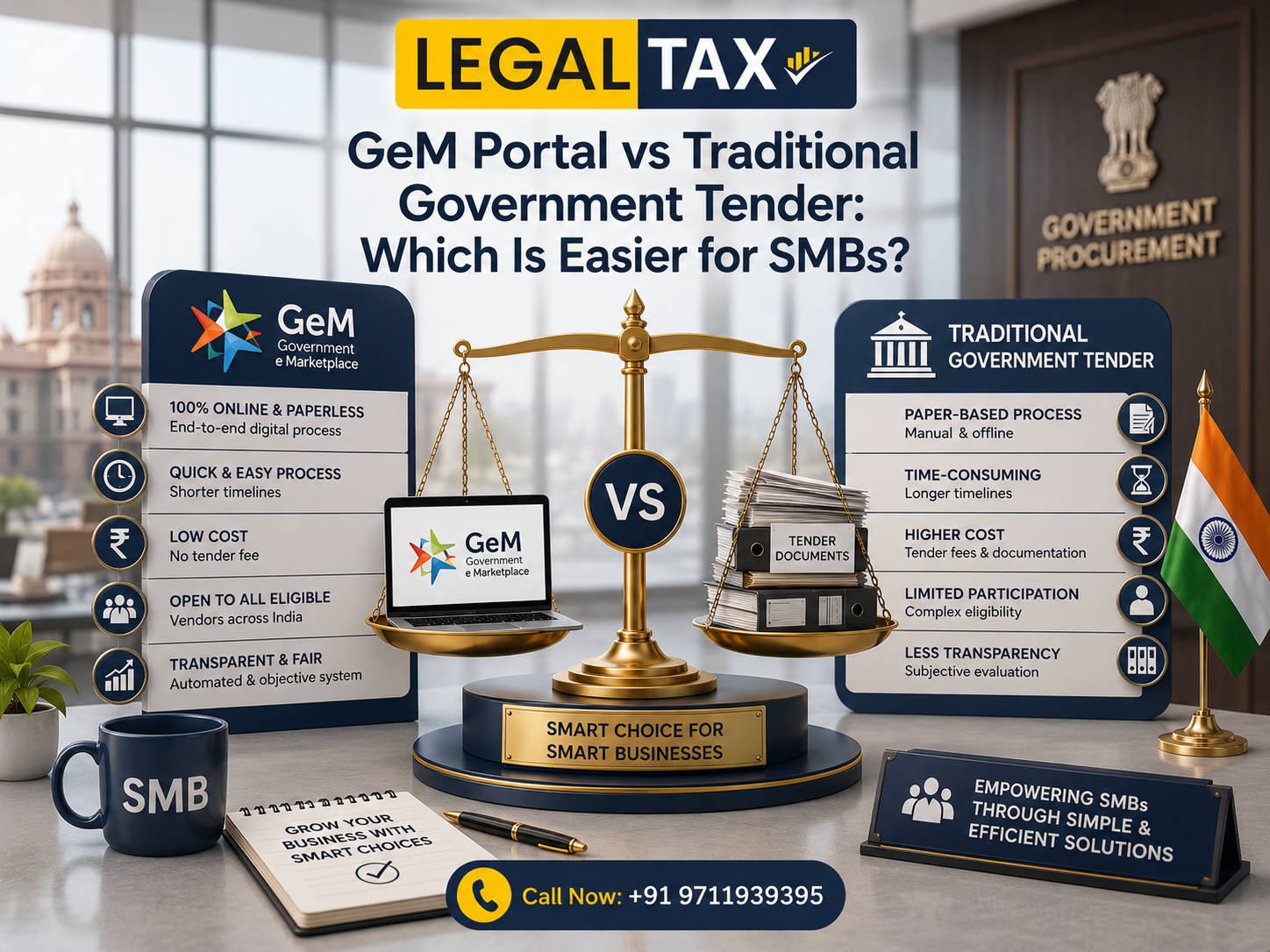
Direct Comparison: GeM vs Traditional Tender for SMBs
Registration and Entry Requirements
Getting onto GeM requires completing the online seller registration process, which involves Aadhaar-based verification, PAN verification, bank account linking, and profile completion. The process is online, relatively fast, and does not require prior government procurement experience. The cost is limited to the caution money deposit and any professional fees for registration assistance.
Getting onto traditional tendering involves no single registration but requires responding to each tender individually with a full documentation package tailored to that tender’s specific eligibility requirements. There is no equivalent to a persistent GeM seller account; each tender is a fresh documentation exercise.
For an SMB with no prior government procurement experience, GeM registration is unambiguously the easier entry point.
Order Values Accessible Without a Competitive Process
On GeM, direct purchase orders below Rs. 25,000 can be placed by buyers with any listed seller without any competitive process. This means an SMB listed on GeM can receive orders from government buyers across India for amounts up to Rs. 25,000 per order without competing on price in any formal way.
In traditional procurement, there is no equivalent mechanism. Even small-value purchases that government departments make outside the formal tender process do not typically involve an open platform where any registered vendor can receive the order; they are generally made through existing vendor relationships or limited quotation processes that SMBs without established government relationships cannot easily access.
For small-value, recurring orders, GeM has no traditional tendering equivalent that is accessible to SMBs without existing relationships.
Order Values Between Rs. 25,000 and Rs. 5 Lakh
On GeM, this range is handled through the L1 mechanism, where the platform compares listed sellers offering the specified product or service and places the order with the lowest compliant price. An SMB with competitive pricing is fully competitive in this range with any other seller, regardless of size or track record, purely on the basis of price.
In traditional procurement, purchases in this value range are typically handled through limited tender processes where the tendering authority selects a set of vendors to invite for quotation. An SMB without an existing relationship with the buyer or without prior empanelment may not be included in the invited vendors list, effectively excluding it from these opportunities regardless of price competitiveness.
For orders in this range, GeM again provides materially better access for SMBs compared to traditional procurement channels.
Orders Above Rs. 5 Lakh
On GeM, purchases above the L1 threshold involve formal bid processes on the platform, including the option for reverse auctions. These GeM bids have defined documentation requirements, competitive evaluation, and in some cases technical qualification criteria, though generally less extensive than traditional tenders. MSME sellers retain the EMD exemption and price preference benefits in these processes.
In traditional procurement, contracts above the open tender threshold involve the full traditional tender process with its documentation requirements, EMD, and evaluation timeline. For an SMB that has built experience and documentation through GeM participation, the gap between GeM bids and traditional tenders narrows but does not disappear entirely at this value level.
For larger contracts, traditional tendering remains more complex but may offer higher individual contract values than most GeM transactions, and for SMBs that have built the track record and documentation through GeM, traditional tenders become more accessible over time.
Payment Timelines and Certainty
GeM’s payment framework prescribes defined timelines for payment after order acceptance and invoice submission, and the platform’s dashboard provides visibility into payment status. While delays do occur in practice, the structured framework and transparency are improvements over the entirely unstructured payment processes of traditional government procurement, where payment timelines are governed only by the general provisions of the government’s financial rules and the buyer department’s internal processes.
For SMBs with limited working capital, the relatively more predictable payment timeline on GeM is a genuine operational advantage compared to traditional procurement, where payment delays of several months are not uncommon and following up with government buyers requires persistence and sometimes professional intervention.
When Traditional Tendering Is Still Worth Pursuing for SMBs
Large Contract Values Not Available on GeM
While GeM’s transaction volume has grown substantially, the largest government contracts for infrastructure, defence, large-scale IT systems, and complex services continue to flow through traditional tendering processes rather than GeM. An SMB that has built sufficient scale, documentation, and track record to be competitive for contracts in the crore-plus range may find that traditional tendering provides access to contract values that exceed what GeM typically delivers, even accounting for the higher process complexity.
Specialised or Custom Requirements
Government requirements that involve highly customised specifications, complex service delivery, or significant technical evaluation components are better suited to traditional tender evaluation than to GeM’s catalogue-based product and service listing approach. An SMB providing specialised engineering services, custom software development, or complex consulting that cannot be easily standardised into a GeM service category may find traditional tendering the only viable route for government procurement.
Building Relationships for Long-Term Government Business
Traditional tendering, despite its complexity, involves direct engagement with government buyers and evaluation committees in a way that GeM’s relatively automated matching process does not. For SMBs that are building long-term relationships with specific government departments or PSUs as strategic customers, participation in traditional tenders, even unsuccessful ones initially, builds the visibility and relationship capital that can translate into sustained procurement relationships over time.
Sector-Specific Procurement Outside GeM’s Scope
Certain categories of government procurement, including land and immovable property transactions, certain defence procurement, and highly specialised technical procurement, are outside GeM’s scope and can only be accessed through traditional procurement channels. SMBs operating in these sectors have no GeM alternative for such contracts.
Combining GeM and Traditional Tendering as a Government Procurement Strategy
Starting with GeM, Building Toward Traditional Tenders
For most SMBs entering government procurement for the first time, GeM is the right starting point. It provides access to real government orders without the documentation and qualification barriers of traditional tendering, generates the track record of government supply that is subsequently useful as experience documentation in traditional tenders, and builds familiarity with government procurement processes and buyer expectations that is transferable to the traditional tendering context.
After one to two years of active GeM participation, an SMB that has accumulated a meaningful order history, maintained strong seller ratings, and built a file of government supply experience documentation is in a significantly better position to participate competitively in traditional tenders in its sector than it was before GeM participation.
Using MSME Registration Across Both Channels
MSME registration under the Udyam framework provides benefits in both GeM and traditional tendering. On GeM, MSME sellers receive EMD exemption, price preference, and procurement preference in reserved categories. In traditional tendering, MSME bidders are entitled to EMD exemption and certain other preferences under the government’s MSME procurement policy. Obtaining and maintaining Udyam Registration is therefore a foundational step for any SMB pursuing government procurement through either channel.
For SMBs yet to obtain Udyam Registration, completing this registration alongside GeM seller registration maximises the procurement advantages available from both channels simultaneously. Guidance on MSME registration and the procurement benefits it unlocks is available on the Legal Tax.
Documentation Building as a Parallel Activity
SMBs that are actively selling on GeM should simultaneously maintain and organise the documentation that would be needed for traditional tender participation, including keeping audited financial statements current, obtaining experience certificates from GeM buyers where possible, maintaining quality certifications relevant to their product or service category, and building a clear and organised company profile document. This parallel documentation activity ensures that when a suitable traditional tender opportunity arises, the SMB is not starting the documentation assembly process from scratch.
Practical Checklist for SMBs Entering Government Procurement
Before Registering on GeM
Complete entity registration, whether as a sole proprietorship, partnership, LLP, or private limited company, with all foundational documents in place including PAN, bank account, and address proof.
Obtain MSME or Udyam Registration to access procurement preference benefits on both GeM and in traditional tenders.
Obtain GST registration, which is a practical necessity for GeM selling even where not yet mandatory based on turnover.
Identify the product or service categories most relevant to the business and research whether they have active government demand on GeM by reviewing existing listings and recent order activity.
After GeM Registration
List products or services with accurate category mapping, complete specifications, and competitive pricing from day one.
Set up order monitoring and ensure the internal process for accepting and fulfilling orders within GeM’s prescribed timelines is in place before the first order arrives.
Prioritise on-time fulfilment of early orders to build a strong seller rating quickly, as the rating affects subsequent order volume.
Monitor the bid section of GeM regularly for tender opportunities in relevant categories and participate in bids where the contract value and specifications are within the business’s delivery capability.
For Traditional Tendering Readiness
Subscribe to the Central Public Procurement Portal and relevant state e-procurement portals to receive notifications of tenders in relevant categories.
Build a standard documentation package including entity registration documents, audited financials, GST registration, MSME certificate, and a company profile, kept current and ready for submission with tender-specific additions.
Start with tenders where the eligibility criteria are within reach based on the business’s current scale and track record, rather than attempting tenders with qualification thresholds that significantly exceed current capabilities.
Frequently Asked Questions
Can an SMB participate in both GeM and traditional government tenders simultaneously? Yes, and this is in fact the recommended approach for SMBs building a government procurement revenue stream. GeM and traditional tendering are complementary channels, not alternatives. GeM provides consistent access to smaller-value orders without complex qualification requirements, while traditional tendering offers access to larger contracts once the SMB has built sufficient track record and documentation.
Is there a risk of the same buyer placing orders through both GeM and traditional tendering for similar products? Government buyers are required to use GeM for purchases below prescribed thresholds before using other procurement routes. For purchases above those thresholds, buyers use GeM bids or traditional tenders depending on the nature and value of the procurement. A seller registered on GeM and also participating in traditional tenders for the same buyer is not a compliance issue; the buyer’s procurement route is determined by value and policy requirements, and the seller’s participation in both channels is entirely legitimate.
We are a newly registered company with no government supply experience. Can we still win GeM orders? Yes. GeM’s direct purchase and L1 mechanisms do not require prior government supply experience. A newly registered company with competitive pricing and complete listings can receive direct purchase orders from day one of being listed. Building the track record comes from the GeM orders themselves, which is precisely why GeM is the right entry point for SMBs without prior government procurement experience.
How does GeM compare to traditional tendering for service businesses specifically? For service businesses, GeM’s service listing and rate contract mechanisms provide access to government service procurement without the formal qualification requirements of traditional service tenders. However, complex, customised, or high-value service requirements tend to be procured through traditional tenders even above GeM’s threshold-based mechanisms, because the specification and evaluation complexity of such services does not fit the catalogue-based GeM model well. Service SMBs benefit from both channels, with GeM suitable for standardised, recurring services and traditional tendering more relevant for complex or customised service delivery.
Conclusion
For small and medium businesses entering government procurement, GeM is unambiguously the easier starting point and the more accessible channel for orders below the competitive bidding threshold. Its online registration, lack of prior experience requirements, MSME preference mechanisms, structured payment framework, and consistent government demand across product and service categories make it the most significant democratisation of government procurement access for SMBs that India has seen.
Traditional tendering remains relevant for larger contracts, specialised requirements, and sectors outside GeM’s scope, and becomes increasingly accessible to SMBs as they build track record, documentation, and government procurement experience through GeM participation.
The most effective government procurement strategy for an SMB is not a choice between GeM and traditional tendering but a sequenced approach that starts with GeM to build access, experience, and documentation, and then extends into traditional tendering as the business’s scale and track record make it competitive for larger contracts through that channel.
Register on GeM before pursuing traditional tenders. Obtain MSME registration to maximise benefits in both channels. Build seller ratings through consistent GeM fulfilment. Use GeM participation to develop the documentation and experience that makes traditional tender participation viable over time. And treat government procurement as a long-term revenue channel requiring sustained attention across both platforms.
Get Expert Government Procurement Registration Support
🟡 Legal Tax provides business registration and compliance services that form the foundation for government procurement participation.
👉 MSME Registration 👉 Private Limited Company Registration 👉 LLP Registration 👉 Startup Registration 👉 GST Registration and Filing 👉 Income Tax Return 👉 Legal Documentation and Drafting
👉 Trademark Registration 👉 Copyright Registration 👉 Brand Protection and Anti-Counterfeiting
🟡 IT and Digital Services
👉 Website Development 👉 SEO Services 👉 Branding Services 👉 Logo Design
📞 Call Now: +91 9711939395 🕐 Free Consultation: Monday to Saturday, 9 AM to 6 PM

Anjali is a Digital Marketing Expert at LegalTax.in who builds websites that rank and convert. She specializes in SEO-driven web development, helping people find the right legal help online.
Our Clients