Views: 13
Table of Contents
- 1 Introduction
- 2 What Makes a Logo Registrable as a Trademark in India?
- 3 Conducting a Trademark Search Before Filing
- 4 Filing the Logo Trademark Application
- 5 The Examination Stage
- 6 The Opposition Stage
- 7 What Trademark Registration Gives a Logo Owner
- 8 Practical Decisions in Logo Trademark Applications
- 9 Frequently Asked Questions
- 10 Conclusion
- 11 Get Expert Logo Trademark Registration and Protection Support
Introduction
A logo is often the most immediately recognisable element of a brand. It appears on products, packaging, websites, marketing materials, and storefronts, and in many cases it communicates brand identity faster and more effectively than a name alone. For businesses that have invested in developing a distinctive logo, the question of whether and how to protect it legally is one of the more practically significant IP decisions they make in the early years of building a brand.
The answer in India is that yes, a logo can be registered as a trademark, and trademark registration is the primary legal mechanism for protecting a logo against unauthorised use by competitors. A registered logo trademark gives the owner the exclusive right to use that logo in connection with the goods or services for which it is registered, the right to prevent others from using a confusingly similar logo in the same or related categories, and a legal basis for enforcement through civil proceedings, criminal complaints, and customs recordal.
This guide explains what makes a logo registrable as a trademark in India, how the registration process works from application to grant, what the examination and opposition stages involve, and the practical decisions a business needs to make to use the trademark system effectively for logo protection.
For complete trademark registration, prosecution, opposition, and enforcement services for logos and other brand elements.
What Makes a Logo Registrable as a Trademark in India?
Not every logo qualifies for trademark registration. The Trade Marks Act, 1999 sets out the conditions a mark must satisfy to be registrable, and understanding these conditions before filing determines whether an application is likely to succeed and what objections it is likely to face.
Distinctiveness: The Central Requirement
The most important condition for registrability is that the logo must be capable of distinguishing the goods or services of one business from those of another. This is the distinctiveness requirement, and it is assessed along a spectrum.
At one end of the spectrum are logos that are inherently distinctive: marks that are invented, fanciful, or arbitrary in relation to the goods or services they identify. A completely invented symbol with no descriptive connection to the product it represents is the strongest category of trademark and the easiest to register.
At the other end are logos that are purely descriptive or generic: marks that simply depict what the product is, or that use imagery so common in the relevant trade that no single business can claim exclusivity over it. A logo consisting entirely of a generic depiction of the product itself, or of imagery universally used in the relevant industry, is unlikely to be registrable without substantial evidence that it has acquired distinctiveness through long and exclusive use.
Between these extremes is the majority of logos encountered in practice: marks that combine distinctive elements with some descriptive or common elements, where the combination as a whole may be distinctive even if individual components are not. The assessment is of the mark as a whole, not element by element.
No Conflict With Existing Registered Marks
A logo application will face objection if it is identical or deceptively similar to a trademark already registered or pending in India for the same or related goods or services. This is why a trademark search before filing is not merely advisable but practically essential: discovering a conflicting prior registration after filing wastes the application fee, delays protection, and may require a redesign of the logo if the conflict is serious.
Not Falling Within the Absolute Grounds of Refusal
The Trade Marks Act sets out absolute grounds on which a mark cannot be registered regardless of use or distinctiveness. These include marks that are likely to deceive or cause confusion, marks that contain scandalous or obscene matter, marks that are contrary to law, marks consisting exclusively of shapes that result from the nature of the goods themselves, and marks that are identical to or that contain official emblems, flags, or symbols of India or foreign states protected under the Paris Convention. A logo that incorporates any of these elements will face objection on absolute grounds at examination.
Conducting a Trademark Search Before Filing
Before filing a logo trademark application in India, a thorough search of the Trade Marks Registry database is the single most valuable preparatory step. The search serves two purposes: identifying existing registrations or pending applications that could conflict with the logo and result in an objection or opposition, and assessing the overall registerability of the logo in the relevant class or classes.
The Trade Marks Registry’s IP India public search portal allows searches by mark name, phonetic similarity, and in some cases visual similarity. For logo marks, a search should cover not only the visual elements of the logo but also any word elements included within it, since a logo containing a distinctive word may conflict with an existing word mark registration covering the same word in the same class.
A professional trademark search, conducted by an attorney with experience in interpreting search results in the context of the goods or services involved, produces a more reliable assessment of conflict risk than a self-conducted portal search, particularly where the logo contains multiple elements or where the relevant class covers a broad range of goods or services.
Filing the Logo Trademark Application
Once the search has been completed and the decision made to proceed, the logo trademark application is filed with the Trade Marks Registry through the IP India online portal.
Identifying the Correct Class or Classes
Trademarks in India are registered in one or more of forty-five classes under the Nice Classification system, with Classes 1 to 34 covering goods and Classes 35 to 45 covering services. A logo trademark application must specify the class or classes in which registration is sought, along with a description of the specific goods or services within those classes for which the logo will be used.
For a business that operates across multiple product or service categories, filing in multiple classes provides broader protection but involves multiple application fees. The decision about which classes to cover should be based on the actual and anticipated commercial activities of the business, since registration in a class in which the business has no genuine intention to use the mark is vulnerable to cancellation for non-use after five years.
The Application Form and Required Information
The trademark application requires the following information: the name and address of the applicant, the representation of the logo (uploaded as a digital image file), the class or classes applied for and the description of goods or services, the date of first use of the logo in India (if it has been in use prior to the application), and a declaration that the applicant is the proprietor of the mark and that the mark is not currently in use by any other person to their knowledge.
For a logo application, the image of the logo must be uploaded in the prescribed format and must clearly represent the mark as it will appear in use. Where the logo is in colour and the applicant wishes to claim colour as a feature of the mark, this must be stated in the application and the colour combination claimed must be described. Where registration is sought for the logo in black and white (which provides protection against the logo shape and design regardless of the colours in which it is used), the image is uploaded without a colour claim.
Application Fee
The official fee for filing a trademark application in India varies by applicant type. Individual applicants, startups recognised by DPIIT, and small enterprises pay a reduced fee. Companies and other entities pay a higher standard fee. The fee applies per class per application. An application covering three classes involves three times the per-class fee.
The Priority Claim Option
Where the applicant has filed a trademark application for the same logo in a Convention country (a country that is a member of the Paris Convention) within the six months prior to filing in India, the Indian application can claim priority from the earlier foreign filing date. This is relevant for businesses that file trademark applications internationally and wish to ensure that the Indian filing date relates back to the date of their earliest foreign filing in the same family.
The Examination Stage
After filing, the application is assigned to an examiner at the Trade Marks Registry who issues an examination report. The examination report sets out any objections the examiner has identified, either on absolute grounds (objections based on the inherent characteristics of the mark) or on relative grounds (objections based on conflict with existing registrations or pending applications).
Responding to Examination Objections
Where objections are raised, the applicant has the opportunity to file a written response addressing each objection. The response must engage specifically with the grounds of objection: for an absolute grounds objection based on lack of distinctiveness, the response may argue that the logo is inherently distinctive, or may submit evidence of use and acquired distinctiveness; for a relative grounds objection based on a conflicting prior mark, the response may argue that the marks are not confusingly similar or that the goods and services are sufficiently different to avoid confusion.
Where the written response does not resolve the examiner’s objections, a hearing is scheduled at which the applicant or their attorney can present oral arguments. The examiner then decides whether to accept the application for publication or to refuse it.
Acceptance and Publication
Where the examiner accepts the application, with or without conditions, the mark is published in the Trade Marks Journal. Publication is the point at which the mark becomes visible to the public and to other trademark owners who may wish to oppose the registration.
The Opposition Stage
Following publication in the Trade Marks Journal, there is a four-month window during which any person may file an opposition to the registration of the logo. Opposition is a formal adversarial proceeding before the Trade Marks Registry in which the opponent argues that the logo should not be registered, and the applicant defends the application.
Grounds for Opposition
The most common grounds on which logo trademark applications are opposed include: that the logo is identical or deceptively similar to the opponent’s earlier registered mark or well-known mark; that the logo was applied for in bad faith; that the applicant is not the true proprietor of the mark; and absolute grounds similar to those available to the examiner at the examination stage.
The Opposition Procedure
Once a notice of opposition is filed, the applicant files a counter-statement defending the application. Both parties then file evidence by way of affidavits, and the matter is heard and decided by the Registrar. Opposition proceedings can extend over a significant period, particularly where evidence rounds are contested and hearings are adjourned. A logo trademark application that proceeds through a contested opposition before reaching registration can take several years from the original filing date.
Where No Opposition Is Filed
Where no opposition is filed within the four-month publication window, or where an opposition is filed but decided in the applicant’s favour, the mark proceeds to registration. The Trade Marks Registry issues a registration certificate, and the registration takes effect from the date of the original application filing.
What Trademark Registration Gives a Logo Owner
Once a logo is registered as a trademark in India, the registration confers several practically significant rights.
The registered proprietor has the exclusive right to use the logo in connection with the goods or services for which it is registered. The ® symbol can be used alongside the logo to indicate registered status. The registration is valid for ten years from the date of application and can be renewed indefinitely in ten-year increments on payment of the renewal fee.
Registered trademark status provides a basis for infringement proceedings against anyone who uses a confusingly similar logo in relation to the same or similar goods or services without the owner’s consent. In infringement proceedings, the registered proprietor does not need to prove that the mark has acquired reputation or that consumers were actually confused: the registration itself establishes the right, and the court assesses whether the infringing mark is likely to cause confusion.
Registration also enables customs recordal, under which the Customs authorities can be notified of the registered trademark and instructed to intercept goods bearing infringing logos at the border before they enter the domestic market. For businesses facing counterfeit products imported from abroad, customs recordal combined with trademark registration is a significant enforcement tool.
Practical Decisions in Logo Trademark Applications
Several practical decisions recur in logo trademark applications and are worth addressing explicitly.
Word and Logo Separately or Together?
A business that has both a distinctive brand name and a distinctive logo has the option of filing separate trademark applications for the word mark (the name alone) and the logo mark (the device alone), or filing an application for the composite mark (name and logo together as they appear in use). Registering the word and logo separately provides broader protection: a word mark registration protects the name regardless of the font or design in which it is used, and a logo mark registration protects the visual design regardless of whether the name appears within it. Filing only a composite mark provides narrower protection, covering the combination as a whole rather than each element independently.
Colour or Black and White?
Filing in black and white provides protection against the logo design in any colour combination. Filing with a colour claim limits the registration to the logo as used in the claimed colours but may be appropriate where the colour combination is itself a distinctive and important element of the brand identity. Many trademark attorneys recommend filing in black and white as a first application and filing a separate colour application if colour is commercially significant.
How Many Classes?
The class selection decision should be made in light of the actual and planned commercial activities of the business. Filing in too few classes leaves gaps that competitors can exploit by registering in the uncovered classes. Filing in too many classes increases cost and creates non-use vulnerability in classes where the business never genuinely operates. The right scope of class coverage is determined by a realistic assessment of the business’s current and anticipated product and service categories.
Frequently Asked Questions
Can a logo be registered as a trademark even if it contains common or descriptive elements?
Yes, provided the logo as a whole is distinctive. A logo that combines a descriptive word or common imagery with a distinctive visual arrangement, unique stylisation, or original graphic elements may be registrable on the basis of the overall combination’s distinctiveness, even if individual components would not be independently registrable. Where distinctiveness is marginal, evidence of long and exclusive use in the market can support registrability.
How long does logo trademark registration take in India?
Where the application proceeds without objection at examination and without opposition after publication, registration typically takes between eighteen months and three years from the filing date under current Trade Marks Registry timelines. Expedited examination is available for startups and small enterprises recognised by DPIIT, which can significantly shorten the examination phase. Applications that face examination objections or post-publication opposition take longer.
Can a foreign company register a logo trademark in India?
Yes. Foreign companies and individuals can file trademark applications in India directly or through a registered trademark agent. Where a foreign applicant has filed an application for the same logo in a Convention country within the previous six months, a priority claim can be made in the Indian application.
What is the difference between a logo trademark and a design registration for a logo?
Trademark registration protects a logo as a brand identifier: it prevents others from using the same or similar logo to identify competing goods or services and can be renewed indefinitely. Design registration under the Designs Act, 2000 protects the visual appearance of a product and lasts for a maximum of fifteen years. For logos used as brand identifiers on goods or in marketing, trademark registration is the appropriate protection. For the visual design of a product itself (its shape, pattern, or ornamentation), design registration is relevant. Some logos, particularly those that form part of the surface decoration of a product, may benefit from both.
What happens if someone uses a logo similar to a registered trademark without permission?
The registered proprietor can bring an infringement action in the District Court or the High Court seeking an injunction to stop the infringing use, damages or an account of profits, and delivery up or destruction of infringing goods. A criminal complaint can also be filed where the infringement is intentional and involves dishonest use of a mark identical to the registered trademark.
Conclusion
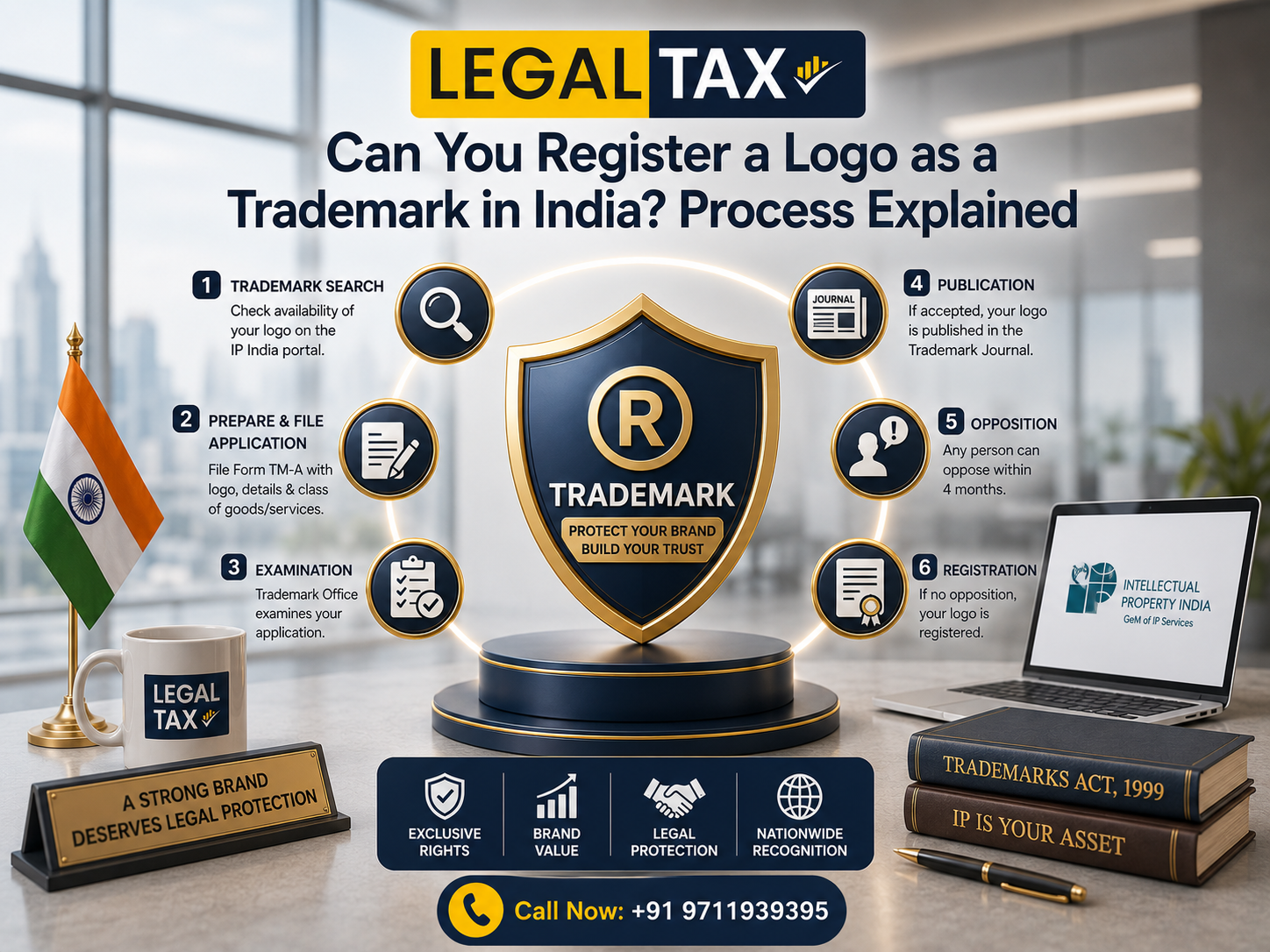
Registering a logo as a trademark in India is a well-established process that provides the logo owner with legally enforceable exclusive rights, a public record of ownership, and a basis for enforcement action against infringers and counterfeiters. The process involves a trademark search before filing, an application to the Trade Marks Registry specifying the correct class or classes, examination by a Registry officer, publication in the Trade Marks Journal, a four-month opposition window, and ultimately the issuance of a registration certificate.
The practical decisions that most affect the quality of the protection obtained are the thoroughness of the pre-filing search, the class coverage chosen, whether to file in colour or black and white, and whether to file for the word mark and logo separately or as a composite. Getting these decisions right at the outset produces a registration that provides real commercial protection, rather than one that technically exists but covers narrower ground than the business actually needs.
Conduct a thorough search before filing to identify conflicts early. Choose class coverage based on actual and planned commercial activities. File the word mark and logo separately for maximum protection. Consider black and white filing unless colour is a core distinctive element. Respond to examination objections with specific technical arguments, not general assertions of distinctiveness.
Get Expert Logo Trademark Registration and Protection Support
🟡 Legal Tax provides complete business registration, legal documentation, and commercial dispute support for businesses across all sectors.
👉 Trademark Registration 👉 Trademark Opposed 👉 Complex IP Enforcement 👉 Brand Protection and Anti-Counterfeiting 👉 Copyright Registration 👉 Design Registration 👉 Patent Registration 👉 Litigation 👉 IP Transaction 👉 Corporate Law 👉 Arbitration 👉 Mediation
👉 Startup Registration 👉 Commercial and Corporate Cases 👉 Legal Documentation and Drafting 👉 Arbitration and ADR 👉 Trademark Registration 👉 GST Registration and Filing 👉 MSME Registration
🟡 IT and Digital Services
👉 Website Development 👉 SEO Services 👉 Branding Services
📞 Call Now: +91 9711939395 🕐 Free Consultation: Monday to Saturday, 9 AM to 6 PM

Anjali is a Digital Marketing Expert at LegalTax.in who builds websites that rank and convert. She specializes in SEO-driven web development, helping people find the right legal help online.
Our Clients