Views: 20
Table of Contents
- 1 Introduction
- 2 How the Examination Process Works
- 3 Absolute Grounds Objections
- 4 Relative Grounds Objections
- 5 Procedural and Formal Objections
- 6 The Hearing: When the Written Response Is Not Enough
- 7 Reducing the Risk of Objection Before Filing
- 8 Frequently Asked Questions
- 9 Conclusion
- 10 Get Expert Trademark Objection and Registration Support
Introduction
Filing a trademark application in India is the beginning of the process, not the end of it. Between the filing date and the grant of registration, the Trade Marks Registry examines every application and issues an examination report setting out any objections the examiner has identified. For a significant proportion of applications, this examination report contains one or more objections that the applicant must address before the mark can proceed to publication and ultimately to registration.
A trademark objection is not a refusal. It is the examiner’s communication of a concern that needs to be addressed, and most objections can be overcome with the right response. The critical factor is understanding precisely what the objection is based on, what the examiner is looking for in a response, and what combination of legal argument, evidence, and where appropriate, amendment to the application, is most likely to resolve it.
This guide explains the most common grounds on which trademark objections are raised in India, what each ground means in practice, and how to respond effectively to each category. Understanding these objections before filing also helps applicants make better decisions at the application stage, choosing marks and filing strategies that reduce the likelihood of objection in the first place.
For complete trademark registration, examination response, and opposition support, Legal Tax provides specialised trademark services for businesses and individuals across all sectors and entity types.
How the Examination Process Works
After a trademark application is filed with the Trade Marks Registry, it is assigned to an examiner who reviews it against the provisions of the Trade Marks Act, 1999 and the Trade Marks Rules, 2017. The examiner issues a First Examination Report setting out any objections. The applicant then has thirty days from the date of the examination report to file a written response. If the written response does not satisfy the examiner, a hearing is scheduled at which oral arguments can be presented. The examiner then decides whether to accept the application for publication or to maintain the objection and refuse the application.
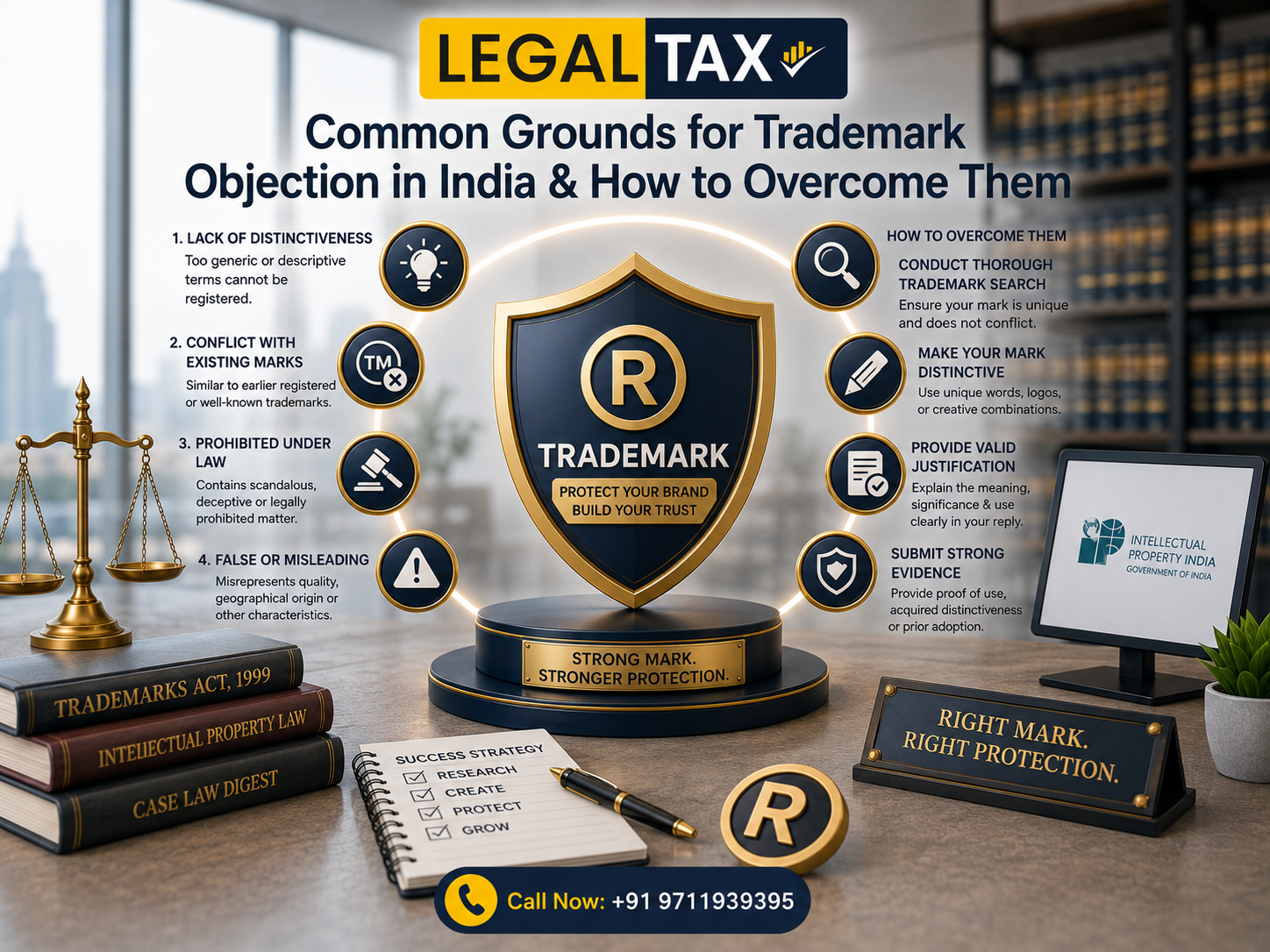
Objections fall into two broad categories: absolute grounds objections, which relate to the inherent characteristics of the mark itself, and relative grounds objections, which relate to conflicts with existing registered marks or pending applications. Both categories can appear in the same examination report, and the response must address each objection specifically and separately.
Absolute Grounds Objections
Absolute grounds objections arise from the nature of the mark itself, independently of what other marks exist on the register. They are set out in Section 9 of the Trade Marks Act, 1999.
Objection One: Lack of Distinctiveness
The most frequently raised absolute grounds objection is that the mark lacks the distinctiveness required to function as a trademark. Under Section 9(1)(a), a mark that is devoid of any distinctive character cannot be registered. This objection is raised where the examiner considers that the mark does not distinguish the applicant’s goods or services from those of other traders, either because it is too common, too simple, or too descriptive to serve as a source identifier.
How to Overcome It
The response to a lack of distinctiveness objection takes one of two forms, depending on the facts. The first is a legal argument that the mark is in fact inherently distinctive: that it has a unique combination of elements, an invented character, or a conceptual originality that makes it capable of distinguishing the applicant’s goods or services. The second is an evidence-based argument that even if the mark was not inherently distinctive at the time of filing, it has acquired distinctiveness through long and exclusive use in the market. Evidence supporting acquired distinctiveness typically includes sales figures, advertising expenditure, duration of use, market surveys demonstrating consumer recognition, press coverage, and awards or industry recognition. The strength of the evidence required is proportionate to how weak the mark is on inherent distinctiveness grounds.
Objection Two: Descriptive Marks
Under Section 9(1)(b), a mark consisting exclusively of signs or indications that describe the kind, quality, quantity, intended purpose, value, geographical origin, or time of production of the goods or services cannot be registered. This objection is raised where the mark, or its dominant element, simply tells consumers something about what the product is or does rather than identifying who makes it.
How to Overcome It
Where a mark is entirely descriptive of the goods or services applied for, the standard response is to submit evidence of acquired distinctiveness through use, demonstrating that consumers have come to associate the descriptive term with the applicant’s business specifically rather than with the category of goods generally. Where the mark is only partly descriptive, a legal argument that the non-descriptive elements of the mark as a whole create sufficient distinctiveness may succeed. An amendment to disclaim the descriptive element (that is, to acknowledge that the applicant does not claim exclusive rights to the descriptive component alone) can sometimes resolve the objection while preserving the registration for the distinctive elements of the mark.
Objection Three: Common to the Trade
Under Section 9(1)(c), marks consisting exclusively of signs or indications that have become customary in the current language or established practices of the trade cannot be registered. This objection applies to terms, symbols, or designs that have become so widely used across a trade or industry that they cannot function as distinctive identifiers for any single business.
How to Overcome It
This objection requires demonstrating either that the sign is not in fact commonly used across the relevant trade (by showing that the applicant’s use is exclusive or at least predominant), or that the mark as a whole, including elements beyond the commonly used component, is sufficiently distinctive. Market survey evidence and evidence of exclusive use over a long period are the most persuasive tools here.
Objection Four: Deceptive or Confusing Marks
Under Section 9(2)(a), a mark that is likely to deceive the public or cause confusion cannot be registered. This ground is distinct from relative grounds objections involving prior marks: it applies where the mark itself, by its nature, is likely to mislead consumers about the nature, quality, or geographical origin of the goods or services, independently of whether a similar mark exists on the register.
How to Overcome It
The response typically involves demonstrating that the mark does not in fact have the deceptive character alleged, either because the element the examiner finds misleading is not present in the mark as properly understood, or because the relevant consumer is sufficiently sophisticated to understand the mark’s nature without being misled. Where the objection concerns a geographical name, demonstrating that the goods do not originate from that place but that consumers are not likely to be deceived given the overall presentation of the mark is the usual approach.
Objection Five: Marks Prohibited Under Section 9(2)
Section 9(2) also prohibits registration of marks that contain or comprise matter likely to hurt the religious susceptibilities of any class or section of citizens of India, marks comprising scandalous or obscene matter, and marks whose use is prohibited under the Emblems and Names (Prevention of Improper Use) Act, 1950. These objections arise less frequently but are absolute in the sense that no amount of evidence of distinctiveness or use will overcome them where the prohibition squarely applies.
How to Overcome It
Where the objection is based on an absolute statutory prohibition, the practical response is amendment of the mark to remove the prohibited element, if that is possible without destroying the commercial value of the mark, or challenge to the examiner’s interpretation of whether the prohibition actually applies to the mark as filed.
Relative Grounds Objections
Relative grounds objections arise from the relationship between the applied-for mark and marks that already exist on the Trade Marks Registry. They are set out in Section 11 of the Trade Marks Act, 1999.
Objection Six: Identity or Similarity With an Earlier Registered Mark
Under Section 11(1), a mark cannot be registered if it is identical with or similar to an earlier trademark and the goods or services for which registration is sought are identical with or similar to those covered by the earlier mark, where there exists a likelihood of confusion on the part of the public. This is the most common relative grounds objection and arises where the examiner identifies an existing registration or pending application that the applied-for mark resembles.
How to Overcome It
The response to a Section 11(1) objection requires demonstrating one or more of the following: that the marks are not sufficiently similar to cause confusion when assessed as a whole by an average consumer; that the goods or services are not sufficiently related to give rise to a likelihood of confusion; or that the applicant has consent from the proprietor of the earlier mark (a consent letter or coexistence agreement from the earlier mark’s owner can be decisive in resolving this objection). The similarity assessment must consider the visual, phonetic, and conceptual dimensions of the marks, and the response should address each dimension specifically rather than making a general assertion that the marks are different.
Objection Seven: Well-Known Trademarks
Under Section 11(2), a mark that is identical or similar to a trademark that is well known in India cannot be registered for any goods or services, regardless of whether the well-known mark is registered in India and regardless of whether the goods or services are similar to those covered by the well-known mark. This objection reflects the heightened protection given to marks that have achieved broad recognition among the Indian public or a relevant section of it.
How to Overcome It
The response typically involves challenging whether the earlier mark has in fact been recognised as a well-known trademark under the criteria set out in the Act, and demonstrating that the applied-for mark is sufficiently different from the well-known mark that it does not take unfair advantage of or cause detriment to the well-known mark’s distinctiveness or reputation. These objections are among the more difficult to overcome where the well-known mark is genuinely famous and the applied-for mark has meaningful similarity.
Objection Eight: Likelihood of Confusion With a Pending Application
Where the examiner identifies a pending trademark application filed before the applied-for mark that is similar to it, an objection may be raised on the basis that if the earlier-filed application proceeds to registration, it could conflict with the applied-for mark. The response here involves monitoring the status of the earlier application: if it is ultimately refused or abandoned, the objection may fall away. Where the earlier application proceeds, the applicant must address the conflict directly.
Procedural and Formal Objections
Beyond absolute and relative grounds, examination reports sometimes include objections of a more procedural or formal nature that are generally simpler to resolve.
Objection Nine: Incorrect Classification of Goods or Services
Where the examiner considers that the goods or services listed in the application are incorrectly classified or described in a way that does not conform to the acceptable classification specifications under the Nice Classification system, an objection is raised requiring the applicant to amend the specification.
How to Overcome It
The response involves amending the description of goods or services to use terminology and formulations accepted by the Trade Marks Registry, which publishes an acceptable goods and services manual. Where the classification itself is challenged, the applicant must demonstrate that the goods or services belong to the class applied for under the Nice Classification criteria.
Objection Ten: Deficiencies in the Mark Representation
Where the representation of the mark as filed is unclear, incomplete, or not in the prescribed format, the examiner raises a formal objection requiring the applicant to file a corrected or clearer representation.
How to Overcome It
This is typically resolved by refiling the mark representation in the correct format and at the required resolution or quality. For logo marks, ensuring at the time of filing that the image is clear, correctly formatted, and accurately represents the mark as it will be used in commerce avoids this category of objection entirely.
The Hearing: When the Written Response Is Not Enough
Where the examiner is not satisfied by the written response to the examination report, the applicant is given an opportunity to attend a hearing and present oral arguments before the examiner. The hearing is an important procedural step that allows the applicant to address the examiner’s residual concerns directly, respond to specific questions, and where appropriate, propose amendments to the application that might resolve remaining objections.
Preparation for a trademark hearing follows the same logic as preparation for any examination response: understanding precisely what the examiner is concerned about, having the relevant evidence organised and ready to present, and arriving with a clear position on whether and what amendments are being offered rather than hoping the examiner will suggest a resolution. Applicants who attend hearings with a well-prepared response and a specific amendment proposal where one is needed consistently achieve better outcomes than those who repeat the arguments already made in writing without adding new substance.
For trademark hearing representation and examination response support, Legal Tax provides complete prosecution services including written responses and hearing attendance.
Reducing the Risk of Objection Before Filing
Understanding the common grounds of objection creates an opportunity to reduce objection risk at the application stage rather than managing it after the fact.
Conducting a thorough trademark search before filing identifies existing registrations or pending applications that are likely to generate relative grounds objections, and allows the applicant to assess whether the mark as designed is likely to face absolute grounds concerns. Where a search reveals a significant conflict, the options are to redesign the mark to increase distinctiveness and reduce similarity to the conflicting mark, to file in different classes where the conflict does not arise, or to approach the proprietor of the conflicting mark about a coexistence arrangement before filing.
Choosing a mark that is inherently distinctive, rather than one that describes the goods or services or uses common trade terminology, significantly reduces the risk of absolute grounds objections. An invented word, an original graphic device, or an arbitrary combination of elements unrelated to the product is a stronger trademark candidate than a descriptive phrase or a common industry symbol.
Filing with an accurate and properly formatted representation of the mark, and with a specification of goods and services drafted in conformity with the Registry’s accepted terminology, eliminates the procedural objections that delay applications without adding any substantive complexity to the prosecution.
Frequently Asked Questions
How long does an applicant have to respond to a trademark examination report in India? The applicant has thirty days from the date of the examination report to file a written response. Where no response is filed within this period, the application is treated as abandoned. An extension may be requested in certain circumstances, but is not guaranteed.
Can a trademark application be abandoned after an objection is raised? Yes. An applicant who receives an examination report and does not respond within the prescribed period, or who decides not to pursue the application after reviewing the objections, can allow the application to lapse. The filing fee is not refunded in this case.
Is it possible to overcome a relative grounds objection by obtaining a consent letter from the earlier mark’s owner? Yes. A consent letter or formal coexistence agreement from the proprietor of the earlier conflicting mark, confirming that the proprietor does not object to the registration of the applied-for mark, is a recognised basis for overcoming a Section 11 relative grounds objection. The Registry has discretion in how much weight to give such letters, but they are frequently decisive in resolving relative grounds objections where the conflict would not otherwise be resolved.
What is the difference between a trademark objection and a trademark opposition? A trademark objection is raised by the Trade Marks Registry examiner during the examination stage, before the application is published. A trademark opposition is filed by a third party after the application is published in the Trade Marks Journal, during the four-month opposition window. Both can prevent registration if not successfully addressed, but they arise at different stages and involve different procedures.
Can a trademark that has been refused after examination be appealed? Yes. Where an examiner refuses an application after hearing, the applicant can appeal the refusal to the Intellectual Property Appellate Board or, following recent judicial restructuring, to the relevant High Court. Appeals are decided on the merits of the objections raised.
Conclusion
Trademark objections in India are a routine part of the registration process, and the majority of objections can be overcome with a well-prepared response that addresses each ground specifically, supports factual claims with appropriate evidence, and where relevant proposes amendments that resolve the examiner’s concerns without sacrificing the commercial value of the mark. The applicants who navigate objections most successfully are those who understand what each type of objection actually requires, who engage with the examiner’s specific concerns rather than repeating general assertions about their mark’s distinctiveness, and who have conducted a thorough search and made careful filing decisions before the application was submitted.
Identify whether each objection is absolute or relative before drafting the response. Address each ground separately with specific legal arguments and evidence. Use evidence of acquired distinctiveness where inherent distinctiveness is genuinely in question. Consider consent letters for relative grounds objections where a coexistence arrangement is commercially viable. Prepare for hearings as a distinct step, not a repetition of the written response.
Get Expert Trademark Objection and Registration Support
🟡 Legal Tax provides complete trademark services including trademark search, filing, examination response, hearing representation, opposition proceedings, and renewal for businesses and individuals across all sectors.
👉 Trademark Registration 👉 Startup Registration 👉 Commercial and Corporate Cases 👉 Legal Documentation and Drafting 👉 Arbitration and ADR 👉 GST Registration and Filing 👉 MSME Registration
👉 Trademark Registration 👉 Trademark Opposed 👉 Complex IP Enforcement 👉 Brand Protection and Anti-Counterfeiting 👉 Patent Registration 👉 Copyright Registration 👉 Design Registration 👉 Litigation 👉 IP Transaction 👉 Corporate Law 👉 Arbitration 👉 Mediation
🟡 IT and Digital Services
👉 Website Development 👉 SEO Services 👉 Branding Services
📞 Call Now: +91 9711939395 🕐 Free Consultation: Monday to Saturday, 9 AM to 6 PM

Anjali is a Digital Marketing Expert at LegalTax.in who builds websites that rank and convert. She specializes in SEO-driven web development, helping people find the right legal help online.
Our Clients