Views: 8
Table of Contents
- 1 Introduction
- 2 What Is a Logo Trademark?
- 3 Wordmark vs Logo Mark: What Is the Difference and Do You Need Both?
- 4 What Makes a Logo Registrable as a Trademark?
- 5 Should You Register Your Logo in Colour or Black and White?
- 6 Step-by-Step: How to Trademark a Logo in India
- 7 Government Fees for Logo Trademark Registration (2026)
- 8 Timeline for Logo Trademark Registration in India
- 9 Common Mistakes in Logo Trademark Registration
- 10 Protecting Your Logo After Registration
- 11 How Legal Tax Can Help You Trademark Your Logo
- 12 Frequently Asked Questions
- 13 Conclusion
- 14 Get Started With Logo Trademark Registration
Introduction
Your logo is more than a design. It is the visual identity of your business. It appears on your products, your packaging, your website, your social media, your invoices, your signage, and every customer touchpoint. Over time, customers come to associate your logo with the quality, reputation, and trust that your business has built. That association is commercially valuable, and it is exactly what trademark registration protects.
Trademarking a logo in India means registering it as a trademark under the Trade Marks Act, 1999 with the Trade Marks Registry. Once registered, the logo trademark gives you the exclusive right to use that logo in connection with the goods or services for which it is registered, across all of India. Anyone who uses the same or a confusingly similar logo without your permission can be sued for infringement, and you can seek injunctions, damages, and criminal action against counterfeiters.
This guide explains exactly how to trademark a logo in India: what qualifies for logo trademark registration, the difference between a wordmark and a logo mark, the step-by-step registration process, what it costs, how long it takes, the common mistakes businesses make, and how Legal Tax can handle the entire process for you.
What Is a Logo Trademark?
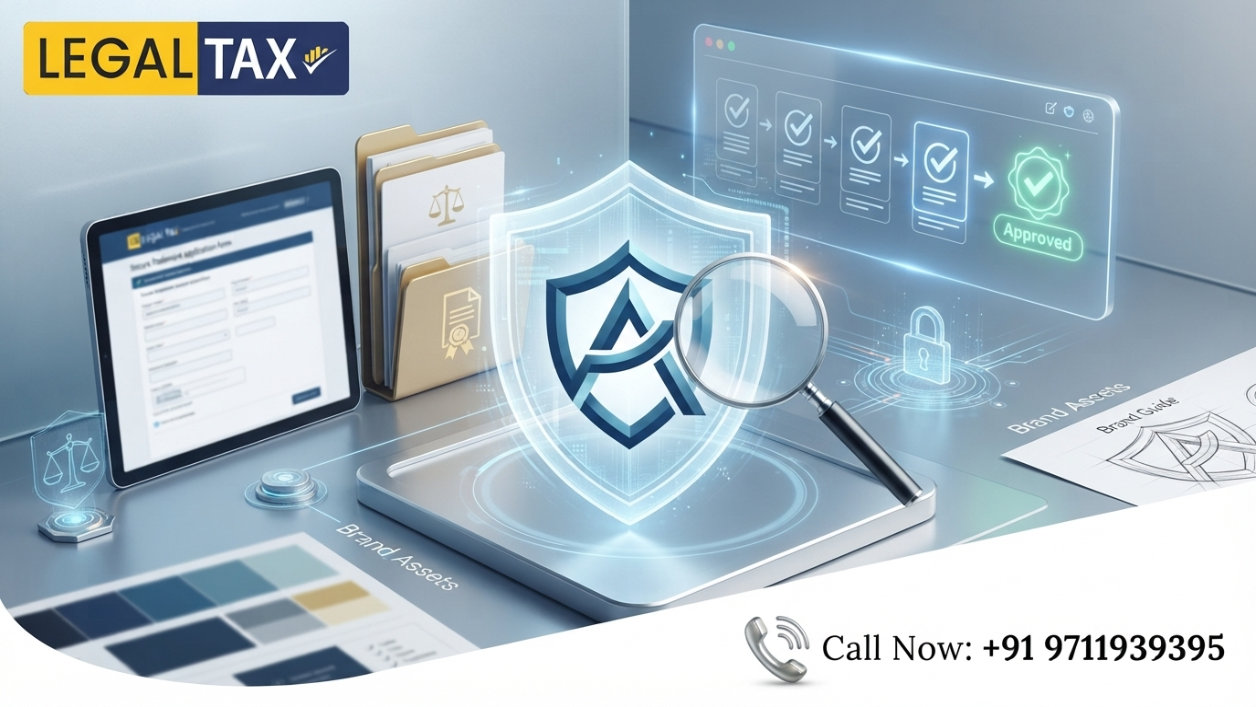
A logo trademark, also called a device mark, is a trademark consisting of a visual design element. It may include a stylised version of the brand name in a distinctive font, a graphic symbol or icon, a combination of text and graphic elements, a distinctive colour combination used as part of the design, or any other visual element that functions as an identifier of the source of goods or services.
Under the Trade Marks Act, 1999, a trademark can consist of any mark capable of being represented graphically and capable of distinguishing the goods or services of one person from those of others. A logo, by its nature, is capable of being represented graphically and, if it is distinctive, qualifies for trademark registration.
Wordmark vs Logo Mark: What Is the Difference and Do You Need Both?
Many business owners are confused about whether to register their brand name as a trademark, their logo as a trademark, or both. Understanding the difference is important for building complete brand protection.
A wordmark is a trademark consisting only of the text of the brand name, without any particular font, style, graphic, or design element. A wordmark registration protects the words themselves in any font, colour, or style. If your brand name is “SunBright,” a wordmark registration protects the words “SunBright” regardless of how they are written or displayed.
A logo mark (device mark) is a trademark consisting of the specific visual design of the logo, including the graphic elements, the stylised font if used, the layout, and the colour combination. A logo mark registration protects the specific visual design as registered.
The difference in scope matters. A wordmark protects the name broadly but not a specific visual design. A logo mark protects the specific design but not necessarily the words in a different font or design.
For comprehensive brand protection, most businesses should register both: the wordmark (protecting the brand name in text) and the logo mark (protecting the specific visual design). These are separate trademark applications with separate government fees, but together they provide much stronger protection than either alone.
What Makes a Logo Registrable as a Trademark?
Not every logo can be registered as a trademark. For a logo to be registrable, it must meet the following requirements under the Trade Marks Act, 1999.
Distinctiveness
The logo must be capable of distinguishing the applicant’s goods or services from those of others. A logo that is purely decorative, generic, or commonly used in the trade for the relevant goods or services will not qualify for registration without evidence that it has acquired distinctiveness through use.
Logos that are highly creative, inventive, or unique in their design are considered inherently distinctive and are the easiest to register. Logos that use common design elements (basic geometric shapes, simple lines, standard fonts) may face objections on grounds of lack of distinctiveness.
Not Deceptive or Misleading
A logo that would mislead the public about the nature, quality, or origin of the goods or services cannot be registered. For example, a logo incorporating a geographical name in a way that falsely suggests the goods come from that place would be refused.
Not Identical or Confusingly Similar to an Earlier Mark
If an identical or confusingly similar logo is already registered or pending in the same class of goods or services, the application will be refused. This is why a trademark search before filing is essential.
Not Containing Prohibited Elements
Logos containing national flags, government emblems, official hallmarks, or symbols of international organisations cannot be registered. Logos containing obscene or scandalous matter are also excluded.
Capable of Graphic Representation
The logo must be representable graphically, meaning it can be depicted in the trademark application in a way that is clear, precise, and self-contained. In practice, logos submitted as high-resolution image files in the trademark application meet this requirement.
Should You Register Your Logo in Colour or Black and White?
This is one of the most frequently asked questions in logo trademark registration, and the answer significantly affects the scope of your protection.
Black and White Registration
Registering a logo in black and white (without claiming any specific colour) gives broader protection. A black and white logo registration covers the logo in any colour combination, because colour is not a claimed element of the registered mark. This means the registration protects the design itself regardless of the colours in which it is used or reproduced.
Colour Registration
Registering a logo in colour means that colour becomes a claimed element of the mark. The registration protects the logo in the specific colour combination shown in the application. A competitor using the same design in different colours may argue that their mark is not confusingly similar to yours because the colour is different.
Which Is Better?
For most businesses, registering the logo in black and white provides broader protection and is the recommended approach. If colour is a distinctive and central element of the logo’s identity (for example, a logo where the specific colour combination is what makes it recognisable and distinctive), a colour registration may additionally be worth considering.
Many businesses register the logo twice: once in black and white for broad design protection and once in the specific colour combination for colour protection. These are separate applications with separate fees but together provide the most complete coverage.
Step-by-Step: How to Trademark a Logo in India
Step 1: Finalise Your Logo Design
Before filing a trademark application, your logo should be in its final form. Significant changes to the logo after registration will require a new application for the revised design. Minor stylistic refinements are acceptable, but changes that alter the overall visual impression of the logo would require fresh registration.
Ensure your logo is available in a high-resolution digital format (preferably JPEG or PNG at 300 DPI or higher) suitable for submission with the trademark application.
Step 2: Conduct a Comprehensive Trademark Search
Before filing, a thorough trademark search must be conducted in the IP India database to check for existing registered or pending trademarks that are identical or confusingly similar to your logo. The search should cover not just identical logo designs but visually similar marks, marks with similar overall commercial impressions, and marks that use similar graphic elements in the same class of goods or services.
A trademark search before filing is not just advisable, it is essential. Skipping the search and filing without knowing what earlier marks exist risks objection or rejection based on similarity to an earlier mark, which wastes filing fees and time and delays protection.
Legal Tax conducts comprehensive trademark searches for every client before filing. We provide a written search report and our assessment of the registrability of your logo before you commit to filing.
Step 3: Identify the Correct Nice Classification Class
Trademark registration in India is class-specific under the Nice Classification system, which divides all goods and services into 45 classes. Your logo trademark must be registered in the class or classes covering the goods or services your business provides.
For example, a restaurant brand should register in Class 43 (food and beverage services). A clothing brand should register in Class 25 (clothing, footwear, headgear). A software company should register in Class 42 (software and technology services). A cosmetics brand should register in Class 3 (cosmetics and cleaning substances).
Step 4: Determine the Correct Applicant Category
The government filing fee for trademark registration depends on the applicant category. Individuals, startups registered with DPIIT, and MSMEs registered under Udyam pay a lower fee of Rs. 4,500 per class per mark for online filing. Companies and other large entities pay Rs. 9,000 per class per mark for online filing.
Ensure you have the correct documentation to support your claimed category. For MSME fee eligibility, you need a valid Udyam Registration Certificate. For startup fee eligibility, you need a DPIIT recognition certificate.
Step 5: Prepare and File the Trademark Application
The trademark application for a logo mark requires the applicant’s full legal name and address, the logo image in the prescribed format, the class or classes of goods or services covered, the specification of goods or services (a precise description of what the registration covers), the date of first use in India if the logo is already in use commercially or a declaration of intention to use if it has not yet been used, and a power of attorney authorising the trademark agent to file and prosecute the application on the applicant’s behalf.
The application is filed online through the IP India e-filing portal at ipindiaonline.gov.in. On successful filing, an application number is generated immediately and the filing date is secured. From the date of filing, you can use the TM symbol next to your logo.
Legal Tax prepares and files every trademark application with careful attention to the specification of goods and services, the quality of the logo image submitted, and the accuracy of all applicant details, minimising the risk of formal deficiencies that could delay examination.
Step 6: Examination by the Trade Marks Registry
The Trade Marks Registry examines the application, typically within 3 to 6 months of filing. The examiner reviews the application for compliance with the Trade Marks Act and Rules, distinctiveness of the logo, conflict with any earlier registered or pending marks, and accuracy of the goods and services specification.
If the examiner finds any objection, an examination report is issued. Common objections for logo marks include visual similarity to an earlier registered mark, inclusion of a non-distinctive device or descriptive element, and technical deficiencies in the logo image submitted.
Step 7: Respond to the Examination Report
If an examination report is issued, the applicant must file a written response within the time prescribed in the report, typically 30 days from the date of the report, extendable on application. The response must address every objection raised and present legal arguments, evidence, and precedents supporting acceptance of the application.
For logo trademark applications, objection responses frequently involve comparative analysis showing why the applicant’s logo is visually distinct from earlier marks, arguments about the distinctiveness of specific design elements, and evidence of use and recognition in the market if the logo has been in use before filing.
Legal Tax prepares comprehensive objection responses that address every point raised by the examiner with legal precision. Our objection response success rate reflects years of experience handling logo trademark objections across all classes.
Step 8: Hearing (If Required)
If the examiner is not satisfied with the written response, a hearing is scheduled at the Trade Marks Registry. The applicant or their authorised agent presents oral arguments in support of the application before the examining officer.
Legal Tax represents applicants at Trade Marks Registry hearings for logo trademark applications, presenting the strongest possible case for acceptance of the mark.
Step 9: Publication in the Trademark Journal
If the application is accepted after examination (or after successful response to objections and hearing), the logo trademark is published in the weekly Trademark Journal. Publication gives notice to third parties and opens a 4-month opposition window during which any person who believes the mark conflicts with their rights can file an opposition.
Legal Tax monitors the Trademark Journal after publication and immediately notifies clients if any opposition is filed against their logo trademark.
Step 10: Registration and Certificate
If no opposition is filed during the 4-month window, or if any opposition is resolved in the applicant’s favour, the Trade Marks Registry issues a registration certificate in the applicant’s name. The logo trademark is registered for 10 years from the date of filing and can be renewed indefinitely for further 10-year periods.
After registration, the applicant can use the R symbol in a circle next to the registered logo on all commercial materials.
Government Fees for Logo Trademark Registration (2026)
| Applicant Category | Online Filing Fee (per class, per mark) | Physical Filing Fee (per class, per mark) |
|---|---|---|
| Individual / Startup / MSME | Rs. 4,500 | Rs. 5,000 |
| Company / Large Entity | Rs. 9,000 | Rs. 10,000 |
| Renewal (all categories) | Rs. 9,000 (online) | Rs. 10,000 (physical) |
Note that if you are filing both a wordmark and a logo mark, these are two separate trademark applications with separate government fees for each. If you are filing in multiple classes, a separate fee applies for each class.
Legal Tax professional fees for logo trademark registration are transparent and competitive. Call +91 9711939395 for a complete fee quote covering government fees and professional fees for your specific logo trademark application.
Timeline for Logo Trademark Registration in India
| Stage | Typical Timeframe |
|---|---|
| Filing and acknowledgement | Same day (online filing) |
| Examination report | 3 to 6 months from filing |
| Response to examination report | 1 to 2 months |
| Hearing (if required) | 2 to 4 months after response |
| Publication in Trademark Journal | 1 to 3 months after acceptance |
| Opposition period | 4 months from publication |
| Registration certificate | 1 to 2 months after opposition period |
| Total (no objection, no opposition) | 12 to 18 months |
| Total (with objection and hearing) | 18 to 36 months |
Common Mistakes in Logo Trademark Registration
Not conducting a trademark search before filing. Filing a logo trademark application without a prior search risks objection based on an earlier similar mark. A comprehensive search before filing is always essential.
Submitting a low-resolution or poor-quality logo image. The Trade Marks Registry requires the logo image to be clear, precise, and suitable for reproduction. A low-quality image can result in a formal objection and delay. Always submit a high-resolution version of your logo.
Filing in the wrong class. Filing your logo trademark in an incorrect class provides no protection for your actual goods or services. Filing in an incomplete set of classes leaves part of your business unprotected. Legal Tax conducts a careful class analysis for every client before filing.
Registering only the logo and not the wordmark. A logo registration protects the specific visual design. It does not necessarily protect the brand name in a different font or design. For complete brand protection, register both the wordmark and the logo mark.
Filing a logo that is not yet finalised. If the logo design changes significantly after registration, a new application will be needed for the revised design. Ensure your logo is in its final form before filing.
Not acting on the examination report within the deadline. The Trade Marks Registry sets a specific deadline for responding to examination reports. Missing this deadline can result in the application being treated as abandoned. Legal Tax tracks every deadline and prepares responses well before the due date.
Assuming registration in one class is sufficient when the business operates across multiple classes. A logo registered in Class 43 (food services) does not protect you if a competitor uses a similar logo to sell packaged food products in Class 30. File in all relevant classes from the outset.
Protecting Your Logo After Registration
Registration is the beginning of logo trademark protection, not the end. After registration, the trademark owner must actively use the logo in connection with the registered goods or services (non-use for 5 continuous years can be grounds for cancellation), monitor the Trademark Journal for new applications that conflict with the registered logo and file oppositions where necessary, renew the registration every 10 years before the renewal deadline, and take prompt action against infringers by sending cease and desist notices, filing infringement suits, and reporting infringing listings on e-commerce platforms.

How Legal Tax Can Help You Trademark Your Logo
Legal Tax is a complete business and legal services firm serving businesses across India. Our trademark team handles every aspect of logo trademark registration with the expertise, attention to detail, and client communication that the process requires.
We conduct a comprehensive trademark search before filing, advise on class selection and filing strategy, prepare and file the application with a high-quality logo image, respond to examination reports and objections with legally sound arguments, represent clients at Trade Marks Registry hearings, monitor the Trademark Journal during the opposition period, and handle all post-registration services.
Our fees are transparent with no hidden charges. Our communication is proactive. And our experience across all 45 trademark classes and all categories of logo trademarks means you get the right advice from the start.
Frequently Asked Questions
Can I trademark a logo that contains my name or initials? Yes. Logos containing names, initials, or personal identifiers are registrable as trademarks, provided the overall design is distinctive and does not conflict with an earlier registered mark. If the name in the logo is a very common surname, there may be distinctiveness concerns, which a trademark attorney can advise on before filing.
Can I trademark a logo that uses a common symbol or shape? Common symbols, basic geometric shapes, and widely used graphic elements are generally not registrable on their own because they lack distinctiveness. However, a logo that combines common elements in a unique and distinctive way may still be registrable as a whole, even if individual elements are common. The overall visual impression of the logo is what is assessed for distinctiveness.
Can I trademark a logo that is similar to an existing trademark in a different industry? It depends on whether the earlier mark is well-known and whether the goods or services are related. For ordinary marks, registration in a different class for genuinely unrelated goods or services is possible if there is no risk of consumer confusion. For well-known marks (marks with significant reputation across industries), the protection may extend beyond the registered classes. A trademark search and professional advice before filing is essential to assess this.
What happens if I change my logo after registering it as a trademark? Minor modifications to a registered logo may still fall within the scope of the registration if the overall visual impression remains the same. However, significant changes to the design, including changes to graphic elements, fonts, or layout that alter the overall impression, would require a fresh trademark application for the revised logo. Legal Tax advises clients on whether a logo change requires a new application.
Can I trademark a logo that I did not design myself? Yes, provided you own the intellectual property rights in the logo. If the logo was designed by a freelance designer or a design agency, you should ensure that the design contract includes an assignment of all intellectual property rights in the logo to you. Without such an assignment, the designer may retain copyright in the logo even after you have paid for it. Legal Tax drafts IP assignment clauses and agreements for logo design engagements.
Is copyright protection for my logo sufficient without trademark registration? No. Copyright and trademark protection serve different purposes and should not be treated as alternatives. Copyright in a logo arises automatically upon creation and protects the artistic work from being copied. However, copyright does not give you the exclusive right to use the logo as a brand identifier in commerce, does not prevent a third party from creating a similar-looking logo independently, and does not give you the right to stop a competitor from using a confusingly similar logo on competing goods or services. Trademark registration provides these specific commercial protections that copyright does not.
Conclusion
Your logo is one of the most valuable identifiers of your business. It represents everything your brand stands for, and customers use it to recognise and trust your products and services. Registering your logo as a trademark is the legal step that transforms a design asset into a protected business right.
The process requires professional guidance: a proper trademark search, correct class selection, a well-prepared application with a high-quality logo image, timely and effective responses to any objections, and diligent monitoring after registration. Attempting the process without qualified help risks rejection, wasted fees, and gaps in protection.
Legal Tax handles every aspect of logo trademark registration for businesses across Dwarka, Delhi NCR, and all of India. From the initial search to the registration certificate and beyond, our trademark professionals protect the logo you have built your brand around.
Register your logo trademark today. Protect your visual identity. Build a brand that competitors cannot legally copy.
Get Started With Logo Trademark Registration
🟡 Legal Tax provides complete logo trademark registration, search, objection response, hearing representation, renewal, and all IP and business services for businesses across India.
Trademark and IP Services
👉 Trademark Registration 👉 Trademark Objection Reply 👉 Trademark Opposition 👉 Trademark Renewal 👉 Trademark Assignment 👉 Patent Registration 👉 Copyright Registration 👉 Design Registration
Business Registration and Compliance
👉 Private Limited Company Registration 👉 LLP Registration 👉 GST Registration and Filing 👉 Startup India Registration 👉 MSME / Udyam Registration 👉 Income Tax Filing 👉 One Person Company Registration
IT and Digital Services
👉 Website Development 👉 SEO Services 👉 Social Media Marketing 👉 Lead Generation
Call Now: +91 9711939395 Free Consultation: Monday to Saturday, 9 AM to 6 PM

Anjali is a Digital Marketing Expert at LegalTax.in who builds websites that rank and convert. She specializes in SEO-driven web development, helping people find the right legal help online.
Our Clients