Views: 10
Types of Logo Design, choosing the right type of logo design for your brand is one of the most important decisions you will make as a business owner. Your logo is not just a pretty picture. It is the visual foundation of your entire brand identity. It appears on your products, your website, your social media, your packaging, your invoices, and every single customer touchpoint. Getting it right from the beginning saves you time, money, and the painful experience of a costly rebrand later.
In India, thousands of new businesses launch every single day. From street-level retail shops in Lucknow to funded technology startups in Bengaluru, from homegrown food brands in Punjab to D2C fashion labels in Mumbai, every business needs a logo that communicates what it stands for. But with so many types of logo design available, how do you know which one is right for your brand?
This complete guide walks you through every major type of logo design, explains when and why to use each one, helps you understand how to choose the right logo for your specific business, and covers the legal steps you must take to protect your logo once it is finalized. Whether you are starting fresh or reconsidering your existing visual identity, this is the only guide you need.
Table of Contents
- 1 Why Choosing the Right Type of Logo Matters
- 2 The 7 Main Types of Logo Design Explained
- 3 How to Choose the Right Type of Logo for Your Brand
- 4 The Legal Steps You Must Take After Finalizing Your Logo
- 5 Common Mistakes to Avoid When Choosing a Logo Type
- 6 FAQs
- 7 Conclusion: Your Logo Type Is a Strategic Brand Decision
Why Choosing the Right Type of Logo Matters
Before exploring the different types of logo design, it is worth understanding why this choice matters so deeply. Many business owners treat the logo type as a purely aesthetic decision, but it is actually a strategic one.
The type of logo you choose determines how recognizable your brand becomes over time, how well your logo scales across different media and sizes, how effectively it communicates your brand values to your target audience, and how easily it can be protected as a trademark.
A wordmark logo and an emblem logo, for example, communicate very different things to a customer even if both are for the same type of business. A tech startup using an emblem logo may feel traditional and stiff. A heritage jewelry brand using a minimal abstract mark may feel disconnected from its legacy. The fit between your logo type and your brand positioning is what creates a cohesive, powerful identity.
Additionally, once your logo is designed and finalized, registering it as a trademark is essential. Your logo is your intellectual property, and without legal protection, any competitor can copy or imitate it. For complete guidance on trademark registration in India, OnlineTrademark India offers professional assistance to help businesses secure their brand assets quickly and efficiently.
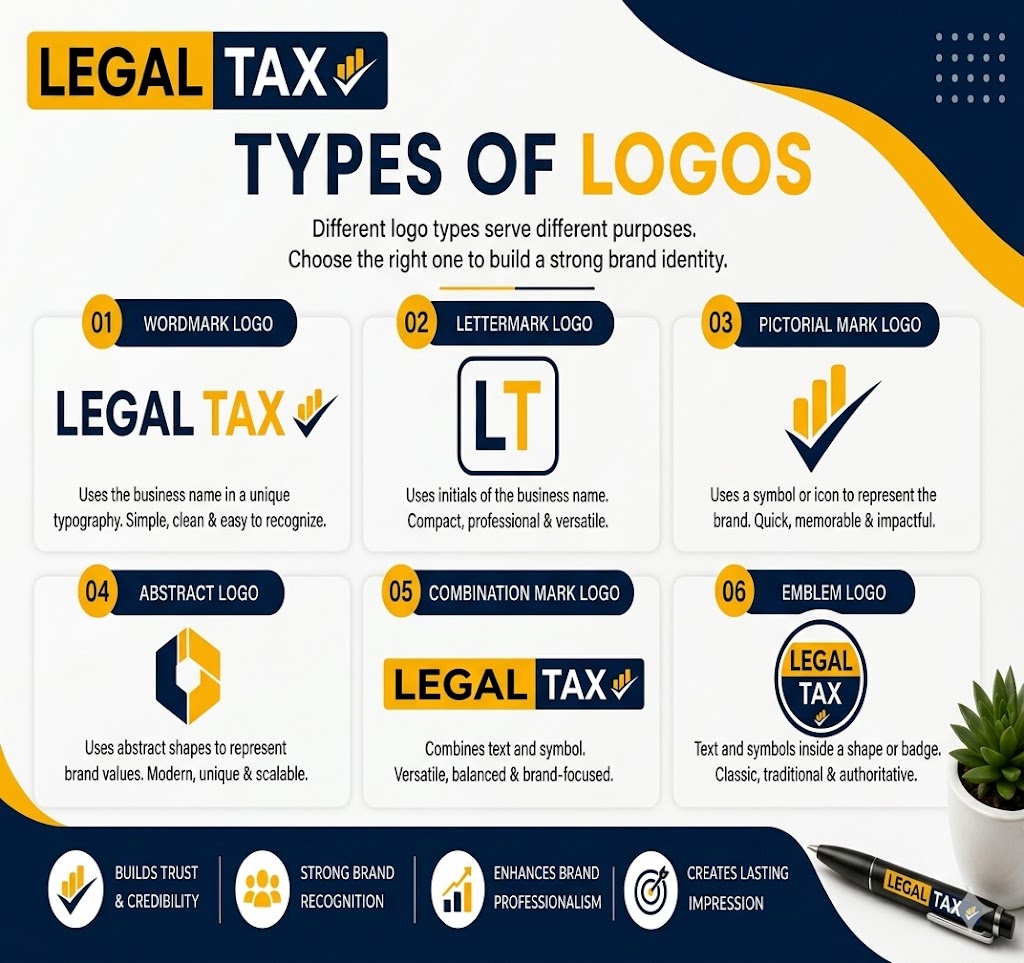
The 7 Main Types of Logo Design Explained
Wordmark Logo
A wordmark logo, also called a logotype, consists entirely of the business name written in a distinctive typographic style. There is no symbol, no icon, and no illustration. The name itself is the logo.
What Makes a Wordmark Effective
The power of a wordmark lies entirely in the uniqueness and memorability of the typography. The font, the letter spacing, the weight, and sometimes custom letter modifications all work together to create a visual identity that is immediately associated with the brand.
When to Use a Wordmark Logo
Wordmarks work best when the business name itself is short, distinctive, and memorable. If your brand name is one or two words and carries strong meaning or recall potential, a wordmark can be an extraordinarily powerful choice.
Wordmarks also work well for businesses where the name itself is the primary selling point, such as founder-led brands, professional services firms, and businesses where the name carries personal reputation or heritage value.
Industries Where Wordmarks Are Common in India
Law firms, consulting practices, financial advisory businesses, and premium retail brands in India frequently use wordmarks. The clean, text-forward approach communicates expertise and confidence without relying on visual metaphors.
Legal Consideration for Wordmarks
When registering a wordmark as a trademark, you are protecting the specific stylistic representation of the name as well as the name itself. Understanding the distinction between a device mark and a word mark registration is important for Indian businesses. LegalIP.in provides detailed guidance on different types of trademark applications and what protection each type offers.
Lettermark Logo
A lettermark logo uses only the initials or abbreviation of the business name rather than the full name. When a company name is long, complex, or difficult to render visually as a full wordmark, initials offer a cleaner and more scalable solution.
When to Use a Lettermark Logo
Lettermarks are ideal when your business name has three or more words, when the abbreviation has already gained recognition in your market, when the full name is difficult to pronounce or remember for your target audience, or when you want a highly compact and versatile mark for use across small spaces like app icons, embroidery, or stamps.
Design Considerations for Lettermarks
Because a lettermark is so minimal, the typography must do all the heavy lifting. The font choice, weight, letter spacing, and any custom modifications to the letters must communicate the brand personality clearly. A lettermark for a law firm should feel authoritative and precise. A lettermark for a creative agency should feel expressive and modern.
Trademark Registration for Lettermarks
Registering a lettermark as a trademark protects the specific stylized version of the initials. Note that if another business already has a similar abbreviation registered in the same category, your application may face opposition. Always conduct a trademark search before finalizing your lettermark. Professional search and registration services are available at OnlineTrademark India.
Pictorial Mark Logo
A pictorial mark logo, also called a brand mark or logo symbol, is a graphic-based logo that uses a single recognizable image or icon to represent the brand with no text included.
The Power and Risk of Pictorial Marks
The main advantage of a pictorial mark is that it transcends language. A powerful icon can communicate across cultures, languages, and literacy levels, which makes it particularly valuable for Indian brands operating in multilingual markets or targeting global audiences.
However, pictorial marks carry significant risk for new businesses. Without accompanying text, a new brand’s icon means nothing to someone who has never encountered the brand before. Recognition must be built over time through consistent and repeated exposure. This is why pictorial marks are typically most effective for established brands that have already built strong name recognition.
When to Use a Pictorial Mark
Use a pictorial mark only when your brand name is already well known among your target audience, when you are operating at a scale where brand exposure is high and consistent, or when you are deliberately positioning the brand for icon-level recognition as a long-term goal.
Choosing the Right Symbol
The image chosen for a pictorial mark must be original, distinctive, and free of existing trademark conflicts. It should also be culturally appropriate for your target market. In India, certain symbols carry deep religious or cultural significance and using them carelessly can damage your brand reputation or attract legal challenges.
For guidance on how intellectual property law in India applies to symbols and graphic elements used in logos, LegalIP.in is an excellent resource for business owners navigating these considerations.
Abstract Logo Mark
An abstract logo mark is similar to a pictorial mark in that it uses a graphic symbol rather than text. However, instead of a recognizable real-world image, it uses a completely abstract geometric shape or visual form to represent the brand.
Why Abstract Marks Are Powerful
Abstract marks give brands tremendous creative freedom. Because they do not depict a literal object, they can be designed to convey any concept, emotion, or brand value through shape, color, and form alone. They are also much easier to protect through trademark registration because the abstract design is inherently unique and not shared with any other visual category.
When to Use an Abstract Mark
Abstract marks work particularly well for technology companies, financial services brands, consulting firms, and any business that wants a modern, forward-looking identity that is not limited by a literal visual metaphor.
They are also useful for businesses that operate across multiple product or service categories, where a literal symbol would be too limiting or too specific.
Design Quality Is Critical
Because an abstract mark carries no literal meaning, the quality of the design itself must be exceptional. Poorly executed abstract marks look like random shapes and create no brand equity. Invest in a skilled designer who understands how to encode brand meaning into abstract visual forms.
Combination Mark Logo
A combination mark is a logo that pairs a symbol or icon with the business name in text form. The text and the symbol can be arranged side by side, stacked vertically, or integrated into a single unified design.
Why Combination Marks Are the Most Popular Choice
Combination marks are by far the most popular type of logo for new and growing businesses in India, and for good reason. They give you the best of both worlds. The text component ensures immediate recognition and readability even for first-time brand encounters. The symbol component builds visual recognition over time and gives you a standalone icon to use in spaces where the full logo does not fit.
Over time, as your brand grows, you can gradually transition to using just the symbol in contexts where it has become recognizable, while continuing to use the full combination mark in new markets or contexts where brand recognition is still being built.
Flexibility Across Applications
A combination mark is also the most flexible logo type for practical applications. The text and symbol can be rearranged for different layouts. The symbol alone can be used as a social media profile picture, a favicon, or an embroidery patch. The full combination can be used on letterheads, signage, and packaging.
Trademark Registration for Combination Marks
When you file a trademark application for a combination mark in India, you are protecting the overall composite design. It is advisable to also file separate applications for the wordmark and the device mark independently, providing layered protection for your brand assets. For expert advice on multi-component trademark strategy, OnlineTrademark India provides comprehensive legal assistance tailored to Indian businesses.
Emblem Logo
An emblem logo integrates text within or around a symbol, badge, seal, or crest shape. The text and the graphic element are inseparable and form a single unified design.
The Heritage and Authority of Emblems
Emblems project a strong sense of tradition, authority, heritage, and institutional credibility. They are widely used by government bodies, educational institutions, sports teams, legal organizations, and traditional businesses across India.
For businesses that want to communicate a sense of history, trustworthiness, and established reputation, an emblem logo can be an extremely powerful choice even for relatively new businesses when designed carefully.
Limitations of Emblem Logos
The main limitation of an emblem is its reduced scalability compared to simpler logo types. Because emblems contain a lot of detail, they can become difficult to read at very small sizes. This is a significant concern in the digital age where logos must work well at tiny sizes on mobile screens, favicons, and app icons.
Modern emblem designs for digital-first businesses address this by creating simplified secondary versions of the emblem for small-scale use while retaining the full emblem for larger applications.
Industries Where Emblems Work Well in India
Educational institutions, legal services firms, government-adjacent businesses, traditional manufacturing companies, premium food and beverage brands, and sports organizations in India frequently use emblem-style logos to great effect.
Mascot Logo
A mascot logo features an illustrated character that represents the brand. The mascot becomes the face and personality of the business and serves as a visual spokesperson in all brand communications.
When Mascots Work
Mascots are particularly powerful for brands targeting families, children, or young consumers. They work well in food service, retail, sports, entertainment, and education sectors. Mascots make brands feel approachable, friendly, and memorable in a way that no other logo type can match.
In India, mascot-based branding has a long and successful history. Some of the most beloved Indian brand characters have become cultural icons that transcend generations.
Design and Legal Considerations for Mascots
A mascot is a complex illustration and requires a skilled character designer. The mascot must have a consistent style guide so it can be drawn and reproduced correctly across all applications and by different illustrators over time.
Because a mascot is an original artistic work, it is automatically protected under copyright law in India from the moment of creation. However, registering it as a trademark provides much stronger commercial protection. Understanding the interaction between copyright protection and trademark registration for mascot characters is important. LegalIP.in offers detailed guidance on protecting illustrated brand characters under Indian intellectual property law.
How to Choose the Right Type of Logo for Your Brand
Now that you understand all seven major types of logo design, the question is how to decide which one is right for your specific business. Here is a structured approach to making this decision.
Consider Your Brand Name
If your business name is short, memorable, and distinctive, a wordmark or combination mark may work perfectly. If the name is long or complex, a lettermark or combination mark with a strong symbol may serve you better. If the name is already well known, you have the freedom to consider a pictorial mark as well.
Consider Your Industry and Target Audience
Different industries carry different visual expectations. Technology businesses tend toward clean, minimal marks. Traditional or heritage businesses lean toward emblems or detailed combination marks. Businesses targeting young consumers might benefit from mascots. Professional services firms typically use wordmarks or lettermarks.
Understanding what your target audience expects visually and where you want to position relative to those expectations is a critical input into your logo type decision.
Consider Your Growth Plans
If you plan to expand into international markets or across multiple product categories, an abstract mark or a flexible combination mark will serve you better than a highly specific pictorial mark. If you are building a local or regional brand with deep community roots, an emblem or mascot might be more appropriate.
Consider Your Applications
Think about where your logo will appear most frequently. If it needs to work on small mobile screens, app icons, and social media thumbnails, simplicity is essential. If it primarily appears on signage, packaging, and print materials, you have more room for complexity.
The Legal Steps You Must Take After Finalizing Your Logo
Choosing the right type of logo and getting it professionally designed is only the beginning. Once your logo is finalized, there are essential legal steps you must take to protect it.
Conduct a Trademark Search
Before finalizing any logo design, conduct a thorough trademark search to ensure that no similar mark is already registered in your industry category. This protects you from unintentionally infringing on an existing trademark and from investing in a design you may be forced to change later.
Register Your Logo as a Trademark
Trademark registration gives you exclusive rights to use your logo for your specific goods and services in India. It creates a legal presumption of ownership and gives you the right to take legal action against infringers. The registration process involves filing an application with the Trademark Registry, examination, publication, and if unopposed, registration.
For professional guidance and end-to-end assistance with trademark registration for your logo in India, visit OnlineTrademark India.
Understand Copyright Ownership
As discussed earlier, when you commission a logo from a designer, ensure you have a written agreement that transfers all copyright in the design to your business. Without this, the designer technically retains copyright even after you pay for the work.
For help understanding and drafting IP assignment agreements, copyright transfer clauses, and other intellectual property matters related to your brand assets, LegalIP.in is the right resource for Indian businesses.
Maintain GST and Tax Compliance on Design Expenses
Logo design services attract 18 percent GST in India. Ensure you receive a proper GST invoice from your designer or agency so you can claim input tax credit if you are a registered GST taxpayer. Logo design expenses are also generally deductible as business expenses under Indian income tax law.
For all tax-related questions about branding expenses, professional service fees, and business compliance, LegalTax.in provides expert guidance that helps Indian businesses manage their finances correctly from the start.
Common Mistakes to Avoid When Choosing a Logo Type
Choosing a Logo Type Based Only on Aesthetics
Many business owners fall in love with a design style without considering whether it is strategically right for their brand. Always evaluate logo type decisions against your brand strategy, target audience, and long-term growth plans.
Copying Competitor Logos
In competitive Indian markets, some businesses intentionally design logos that closely resemble successful competitors, thinking it will help them ride on established recognition. This is both ethically wrong and legally dangerous. Trademark infringement can result in expensive legal disputes and forced rebranding.
Ignoring Scalability
A logo that looks beautiful at a large size but becomes unreadable at small sizes is a serious design failure. Always test your logo at multiple scales before approving the final design.
Not Consulting a Legal Professional Before Launch
Many Indian businesses launch their brand, print thousands of units of packaging, and invest heavily in brand-building before discovering that their logo infringes on an existing trademark. This mistake can be catastrophically expensive. Always conduct a proper trademark search and consult a professional before going public with your logo.
FAQs
1: Which logo type is best for a new business?
The best logo type depends on your business goals and brand identity. Startups often choose combination logos because they include both text and visual elements.
2: How do I choose the right logo for my brand?
Choose a logo based on your target audience, industry, brand values, business personality, and long-term branding goals.
3: What is the difference between a wordmark and a brandmark logo?
A wordmark logo focuses on the company name using typography, while a brandmark logo uses a symbol or icon without text.
4: Are minimalist logos better for modern brands?
Minimalist logos are popular because they are clean, memorable, versatile, and work well across digital and print platforms.
5: Can I redesign my business logo later?
Yes, many businesses redesign or refresh their logos over time to match changing trends, brand growth, or new market positioning.
Conclusion: Your Logo Type Is a Strategic Brand Decision
Choosing the right type of logo design for your brand is not just a creative exercise. It is a strategic business decision with long-term financial and legal implications. The seven types of logos, wordmark, lettermark, pictorial mark, abstract mark, combination mark, emblem, and mascot, each serve different brand needs and work better in different contexts.
Take the time to understand your brand positioning, your target audience, your growth ambitions, and your industry landscape before deciding on a logo type. Work with a skilled designer who understands brand strategy, not just visual aesthetics. And once your logo is finalized, protect it immediately through trademark registration and proper IP agreements.
For tax and business compliance guidance related to your branding investment, visit LegalTax.in. For trademark registration of your logo in India, visit OnlineTrademark India. For copyright protection, IP assignment agreements, and broader intellectual property guidance for your brand, visit LegalIP.in.
You can contact us on +919711939395
Your logo is the single most visible asset your brand will ever have. Choose its type wisely, design it professionally, and protect it legally. That is the foundation of a brand built to last.

I’m Aryan Yadav, passionate about SEO and Digital Marketing with a strong interest in helping businesses grow online. I enjoy learning new strategies, exploring digital trends, and creating ideas that deliver value. I believe in continuous growth, creativity, and building meaningful results through smart work and dedication.
Our Clients