Views: 22
Table of Contents
- 1 Introduction
- 2 Overview of the Three Structures
- 3 Formation Requirements
- 4 Governance Structure
- 5 Tax Exemptions and Approvals
- 6 Ongoing Compliance Requirements
- 7 Suitability by Organisation Type and Scale
- 8 Conversion Between Structures
- 9 Frequently Asked Questions
- 10 Conclusion
- 11 Get Expert Support for Not-for-Profit Organisation Registration
Introduction
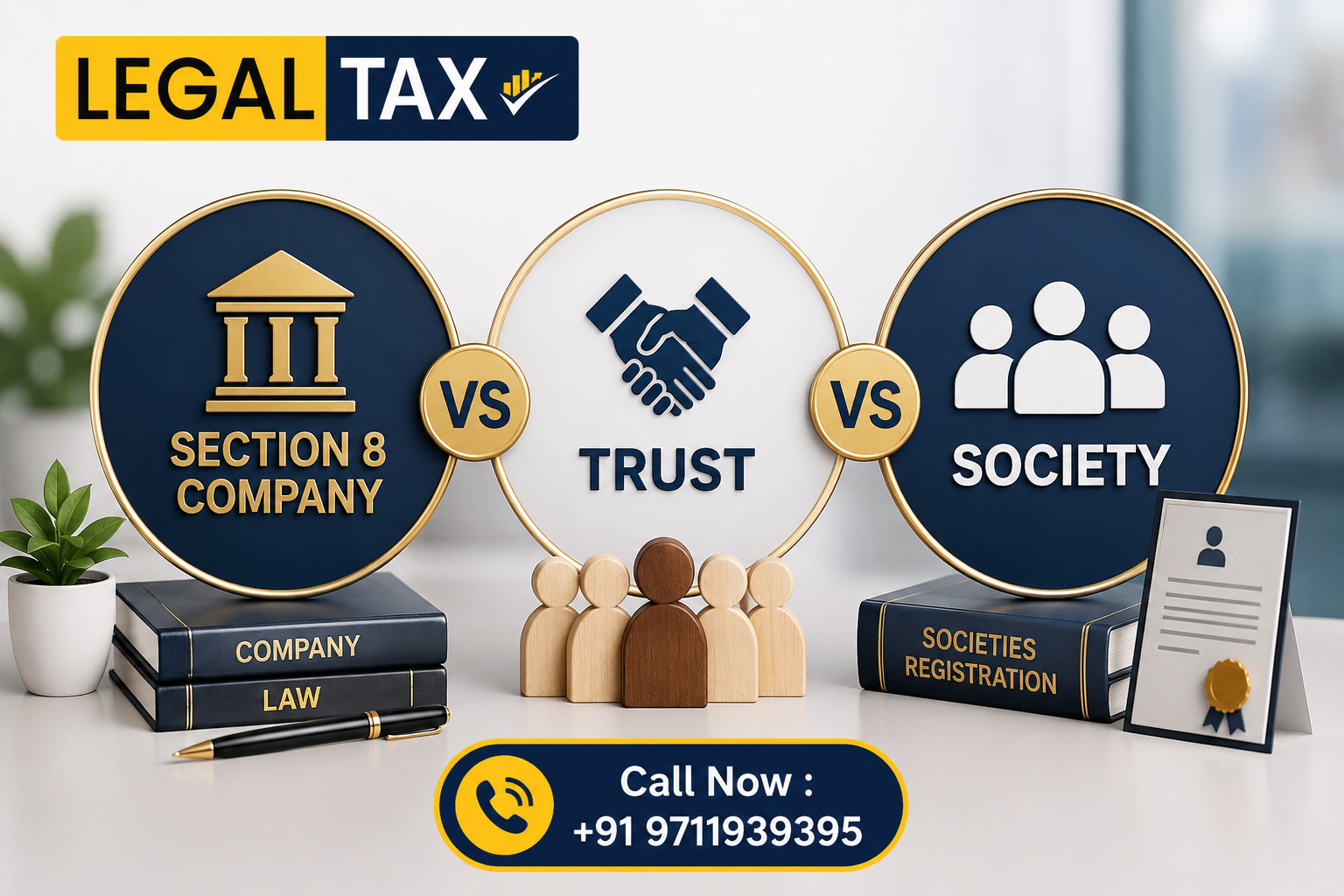
Individuals and groups in India looking to formally establish an organisation for charitable, religious, educational, social welfare, or other not-for-profit purposes are faced with a choice among three distinct legal structures: a Section 8 Company under the Companies Act, 2013, a Trust under the relevant state Trusts Act or, for public charitable trusts, general principles of trust law, and a Society under the Societies Registration Act, 1860 as adopted or amended by various states.
Each of these structures has been used in India for decades to house everything from small community welfare groups to large national NGOs, educational institutions, religious organisations, and research foundations. Yet the three structures differ significantly in their governance framework, registration process, regulatory oversight, ease of obtaining tax exemptions and foreign funding approvals, and suitability for different scales and types of activity.
Choosing the wrong structure at the outset is not always fatal, since conversion between structures is possible in some cases, but it often results in avoidable complications, particularly when an organisation later seeks tax exemptions, foreign contributions, or wishes to operate across multiple states. Understanding the distinguishing features of each structure before registration helps founders choose the structure that best fits their organisation’s intended scale, governance preferences, and funding plans.
This guide compares Section 8 Companies, Trusts, and Societies across the dimensions most relevant to founders deciding which structure to register.
For registration of any of these structures, Legal Tax provides complete registration and compliance support for not-for-profit organisations across India.
Overview of the Three Structures
Section 8 Company
A Section 8 Company is a company registered under Section 8 of the Companies Act, 2013, formed for promoting commerce, art, science, sports, education, research, social welfare, religion, charity, protection of the environment, or similar objects, with the condition that any profits or income are applied only towards promoting these objects and no dividend is distributed to its members. A Section 8 Company is registered with the Ministry of Corporate Affairs and is regulated as a company, subject to the provisions of the Companies Act applicable to it.
Trust
A Trust is an arrangement under which property is transferred by a settlor to trustees, who hold and manage that property for the benefit of specified beneficiaries or for a charitable purpose, governed by a Trust Deed. Public charitable trusts, which are the relevant form for most not-for-profit purposes, are registered with the office of the Charity Commissioner or Sub-Registrar depending on the state, and are governed by the applicable state-level trusts legislation, general principles of trust law, and, where relevant, the Indian Trusts Act, 1882 for certain aspects, though that Act primarily addresses private trusts.
Society
A Society is an association of persons formed for a charitable, literary, scientific, or similar purpose, registered under the Societies Registration Act, 1860, or the corresponding state legislation in states that have enacted their own society registration laws. A Society is governed by a Memorandum of Association and Rules and Regulations, and is managed by a governing body or managing committee elected or appointed in accordance with those rules.
Formation Requirements
Section 8 Company
A Section 8 Company requires a minimum of two directors for a private limited structure or three for a public limited structure (Section 8 Companies can be incorporated as either), and a minimum of two members for a private company or seven for a public company. Incorporation is conducted through the Ministry of Corporate Affairs portal, similar to the incorporation process for other companies, but with an additional requirement to obtain a licence under Section 8 confirming that the company’s objects and proposed activities meet the conditions for Section 8 status, along with a Memorandum of Association and Articles of Association reflecting the not-for-profit objects and the restriction on distribution of profits.
Trust
A Trust is formed by executing a Trust Deed, which sets out the objects of the trust, the trust property, the names of the trustees, and the rules governing the trust’s administration. The Trust Deed is typically executed on appropriate stamp paper and registered with the Sub-Registrar of Assurances or the relevant Charity Commissioner’s office depending on the state. A Trust requires a minimum of two trustees in most states, though specific requirements vary by state legislation.
Society
A Society is formed by a memorandum of association signed by a minimum number of persons, typically seven, who form the governing body, along with rules and regulations governing the society’s management. Registration is conducted with the Registrar of Societies in the relevant state, and the requirements, including the minimum number of members and specific documentation, vary by state since societies registration is governed by state-level adoption and amendment of the central Act.
Comparing Formation Complexity
Section 8 Company incorporation is the most procedurally structured of the three, involving the Ministry of Corporate Affairs’ standard incorporation process plus the Section 8 licence requirement, and generally takes longer and involves higher costs than Trust or Society registration. Trust registration is comparatively straightforward in most states, primarily involving the Trust Deed and its registration. Society registration complexity varies significantly by state, with some states having relatively simple processes and others having more involved requirements, including verification of the proposed members and objects.
Governance Structure
Section 8 Company: Board of Directors
A Section 8 Company is governed by a Board of Directors, similar to any other company, with directors having defined duties and responsibilities under the Companies Act. The governance framework is the most formalised of the three structures, with statutory requirements regarding board meetings, resolutions, and director responsibilities that mirror, with some modifications, the requirements applicable to other companies.
Trust: Board of Trustees
A Trust is governed by its trustees, whose powers, responsibilities, and the process for appointment, removal, and replacement of trustees are set out in the Trust Deed. Once a Trust is established, the Trust Deed is generally considered difficult to amend in many respects, since the trust property has been dedicated to the stated objects, and significant changes to the trust’s objects or structure may require approval from the Charity Commissioner or a court in some circumstances, depending on the state and the nature of the proposed change.
Society: Governing Body or Managing Committee
A Society is governed by a governing body or managing committee, whose composition and the process for election or appointment of its members is set out in the society’s rules and regulations. Societies are generally expected to function as membership-based organisations with periodic general body meetings and elections to the governing body, providing a more democratic governance structure compared to a Trust, where trustees are typically appointed rather than elected and the founding trustees often have significant ongoing influence.
Which Governance Structure Suits Which Organisation
Organisations that anticipate a broad membership base with periodic elections to leadership positions, such as professional associations, alumni associations, or community organisations, often find the Society structure’s governance framework a natural fit. Organisations established by a smaller group of founders who wish to retain more direct control over the organisation’s direction, particularly where significant personal assets or a specific vision is being dedicated to the organisation’s purpose, often find the Trust structure’s framework, with trustees rather than an elected body, more suitable. Organisations seeking the most formalised governance framework, with clear statutory duties for directors and a structure that mirrors corporate governance standards, often find the Section 8 Company structure appropriate, particularly where the organisation expects to engage with institutional funders, government bodies, or international donors who are more familiar with and reassured by company-style governance.
Tax Exemptions and Approvals
Income Tax Exemption (Section 12A/12AB Registration)
All three structures, Section 8 Companies, Trusts, and Societies, can apply for registration under Section 12AB of the Income Tax Act (which has replaced the earlier Section 12A registration framework), which provides exemption from income tax on income applied towards the organisation’s charitable or religious purposes, subject to compliance with the conditions prescribed under the Income Tax Act. None of the three structures has an inherent advantage over the others in obtaining this registration; the eligibility criteria relate to the nature of the organisation’s objects and activities rather than the specific legal structure chosen.
80G Approval for Donor Tax Benefits
Similarly, approval under Section 80G of the Income Tax Act, which allows donors to claim a tax deduction for donations made to the organisation, is available to all three structures, subject to meeting the prescribed conditions. This approval is significant for organisations that rely on donations from individuals or corporates seeking tax benefits for their contributions.
FCRA Registration for Foreign Contributions
Organisations seeking to receive foreign contributions or donations must obtain registration or prior permission under the Foreign Contribution (Regulation) Act, 2010 (FCRA). All three structures are eligible to apply for FCRA registration, subject to meeting the eligibility criteria, which include a minimum period of existence and a track record of activities before the organisation can apply. The specific structure chosen does not determine FCRA eligibility, though the organisation’s governance documentation and financial records, which are generally more standardised for Section 8 Companies due to the Companies Act framework, can sometimes be more straightforward to present during the FCRA application process.
CSR Funding Eligibility
Companies seeking to fulfil their Corporate Social Responsibility obligations under the Companies Act often prefer to channel CSR funds to implementing organisations that are registered under specific frameworks and have a track record of compliance. While Section 8 Companies, Trusts, and Societies can all be eligible recipients of CSR funding subject to meeting the prescribed conditions, some corporates, particularly larger ones with more risk-averse CSR compliance processes, express a preference for Section 8 Companies due to the perceived robustness of the regulatory framework governing them, though this is a matter of practice and corporate preference rather than a legal requirement favouring one structure.
Ongoing Compliance Requirements
Section 8 Company Compliance
A Section 8 Company is subject to the compliance requirements applicable to companies under the Companies Act, including holding board meetings and an annual general meeting, maintaining statutory registers, filing annual financial statements and annual returns with the Registrar of Companies, and undergoing a statutory audit regardless of the organisation’s size or turnover. This represents the most extensive ongoing compliance burden of the three structures.
Trust Compliance
The ongoing compliance requirements for a Trust depend significantly on the state in which it is registered and the requirements of the relevant Charity Commissioner’s office, which can include filing annual accounts and reports with the Charity Commissioner. Compared to a Section 8 Company, the compliance framework for Trusts is generally less standardised across India, varying by state, and in many states involves less frequent or less detailed filing requirements with the registering authority, though the Trust remains subject to the Income Tax Act’s compliance requirements applicable to all three structures once it has obtained 12AB registration.
Society Compliance
Societies are generally required to file annual lists of their managing committee members with the Registrar of Societies, and depending on the state, may have additional filing requirements. Like Trusts, the specific compliance framework varies by state since societies registration is state-administered, and the overall compliance burden with the registering authority is generally lighter than that of a Section 8 Company, though again subject to the Income Tax Act’s requirements once registered under that framework.
Compliance Comparison Summary
| Aspect | Section 8 Company | Trust | Society |
|---|---|---|---|
| Registering Authority | Ministry of Corporate Affairs | Charity Commissioner/Sub-Registrar (state-level) | Registrar of Societies (state-level) |
| Governance Body | Board of Directors | Trustees | Governing Body/Managing Committee |
| Statutory Audit | Mandatory regardless of size | Per state and Income Tax requirements | Per state and Income Tax requirements |
| Annual Filings with Registering Authority | Annual returns and financial statements with RoC | Varies by state | Annual list of managing committee, varies by state |
| Amendment of Objects/Governing Document | Through MCA process, more structured | Often requires Charity Commissioner or court approval | Through amendment of MoA/rules per state process |
| 12AB/80G/FCRA Eligibility | Eligible | Eligible | Eligible |
Suitability by Organisation Type and Scale
Small, Locally Focused Community Organisations
For small organisations operating within a local community, such as a neighbourhood welfare association, a small educational support group, or a local religious institution, a Society or a Trust is generally more proportionate to the organisation’s scale, given the lighter compliance framework with the registering authority compared to a Section 8 Company. Between a Society and a Trust for such organisations, a Society’s more membership-based governance structure may suit organisations where community participation in leadership is valued, while a Trust may suit organisations centred around a specific founder’s vision or where specific property is being dedicated to the organisation’s purpose.
Educational Institutions
Educational institutions in India have historically been established as Societies, Trusts, or, increasingly, Section 8 Companies, with the choice often influenced by the specific regulatory requirements of the education sector body that will recognise or affiliate the institution, which can have its own preferences or requirements regarding the legal structure of the managing entity. Founders of educational institutions should verify the structure preferences or requirements of the relevant education regulatory authority for the type of institution being established before finalising the legal structure.
Organisations Seeking Significant Institutional or International Funding
Organisations that anticipate working with international donors, large corporate CSR programs, or government grant programs that involve due diligence on the organisation’s governance and compliance framework often find that a Section 8 Company’s more standardised, company-style governance and compliance framework is more readily understood and accepted by such funders, even though Trusts and Societies remain legally eligible for the same funding in principle.
Organisations Where a Small Group Wants to Retain Long-Term Control
Founders who want to establish an organisation around a specific charitable vision and retain a structure where they, or their designated successors, continue to guide the organisation over the long term, without the organisation evolving into a broader membership-based body with elected leadership, often find the Trust structure’s framework, where trustees are appointed according to the Trust Deed rather than elected by a general membership, aligns more closely with this intention.
Membership-Based Professional or Alumni Associations
Organisations whose core purpose involves a membership of individuals who elect leadership periodically, such as professional bodies, alumni associations, or sports and cultural associations, often find the Society structure’s governance framework, built around a general body and an elected managing committee, the most natural fit for how the organisation is intended to function.
Conversion Between Structures
Is Conversion Possible
Conversion from one of these structures to another is possible in certain circumstances but is generally a more involved process than converting between commercial business structures such as a Partnership Firm and an LLP, given the different regulatory frameworks, the charitable dedication of assets involved in Trusts in particular, and the need for approvals from the relevant registering authorities and, in some cases, the Income Tax Department for continuity of exemptions.
Practical Implications
Given the complexity of conversion, founders should treat the initial choice of structure as a decision that the organisation will likely operate under for a substantial period, and should weigh the considerations in this guide carefully at the outset rather than planning to register quickly under one structure with the intention of converting later if it does not suit the organisation’s needs.
Frequently Asked Questions
What is the main difference between a Section 8 Company, Trust, and Society?
A Section 8 Company, Trust, and Society are all non-profit legal structures in India, but they differ in governance, regulatory requirements, and operational flexibility. A Section 8 Company is incorporated under the Companies Act, 2013 and is known for its structured governance and credibility. A Trust is generally established through a trust deed and is managed by trustees, making it suitable for charitable and family-oriented activities.
Which legal structure offers the highest level of credibility?
A Section 8 Company is generally considered the most credible structure among the three. It is subject to stricter regulatory oversight, transparent governance standards, and detailed compliance requirements. Because of these factors, government agencies, corporate donors, international organizations, and funding institutions often prefer working with Section 8 Companies.
Which structure is easiest to establish and manage?
A Trust is often considered the easiest and quickest structure to establish, as it usually requires a trust deed and fewer ongoing compliance obligations. Societies involve registration procedures and periodic governance requirements, while Section 8 Companies require incorporation procedures, board management, and annual compliance filings.
Which structure is suitable for long-term growth and expansion?
For organizations planning significant growth, national operations, or partnerships with government bodies and large donors, a Section 8 Company is often the most suitable choice. Its formal governance structure, legal recognition, and operational transparency make expansion easier.
Which legal structure should an NGO or non-profit organization choose?
The choice depends on the organization’s goals, funding strategy, governance preferences, and future plans. A Trust may be ideal for family-led charitable activities and simple philanthropic initiatives. A Society is often suitable for membership-based organizations focused on social, cultural, educational, or community development activities.
Conclusion
Section 8 Companies, Trusts, and Societies each provide a legally recognised framework for not-for-profit activity in India, and each is eligible for the income tax exemptions, donor benefits, and foreign contribution registrations that most charitable organisations ultimately seek. The meaningful differences between the three structures lie not in which one provides access to these benefits, since all three do, but in their governance frameworks, the formality and cost of registration and ongoing compliance, the flexibility to amend the organisation’s governing documents over time, and how the structure is perceived by different categories of funders and institutional partners.
A small, locally focused organisation with modest compliance capacity is generally better served by a Trust or a Society, with the choice between the two depending on whether a founder-led trustee structure or a membership-based elected governance structure better fits the organisation’s intended character. An organisation anticipating significant institutional funding, international donors, or a scale of operations that benefits from a more formalised governance and compliance framework is generally better served by a Section 8 Company, provided the founders are prepared for the more extensive compliance obligations that come with it.
Define your organisation’s intended scale, governance style, and funding sources before choosing a structure. Recognise that conversion between structures later is complex, so choose carefully at the outset. And remember that 12AB, 80G, and FCRA eligibility depend on your organisation’s objects and compliance, not on which of these three structures you select.
Get Expert Support for Not-for-Profit Organisation Registration
🟡 Legal Tax provides complete registration and compliance support for Section 8 Companies, Trusts, and Societies, along with related approvals including 12AB, 80G, and CSR-1 registration.
👉 Private Limited Company Registration 👉 LLP Registration 👉 Startup Registration 👉 MSME Registration 👉 GST Registration and Filing 👉 Income Tax Return 👉 Legal Documentation and Drafting
🟡 IT and Digital Services
👉 Website Development 👉 SEO Services 👉 Branding Services 👉 Logo Design
📞 Call Now: +91 9711939395 🕐 Free Consultation: Monday to Saturday, 9 AM to 6 PM

Anjali is a Digital Marketing Expert at LegalTax.in who builds websites that rank and convert. She specializes in SEO-driven web development, helping people find the right legal help online.
Our Clients