Views: 24
Table of Contents
- 1 Introduction
- 2 What Is Trademark Class 1?
- 3 What Does Trademark Class 1 Include?
- 4 What Does Trademark Class 1 Exclude?
- 5 Common Products and Their Correct Class
- 6 Why Trademark Registration in Class 1 Matters for Chemical Businesses
- 7 The Trademark Registration Process for Class 1 in India
- 8 Multi-Class Filing Strategy for Chemical Businesses
- 9 Frequently Asked Questions
- 10 Conclusion
- 11 Get Expert Trademark Registration and IP Protection Services
Introduction
When a business applies to register a trademark in India, it does not register that trademark in the abstract. It registers it in relation to specific goods or services, organised according to an internationally standardised classification system known as the Nice Classification. The Nice Classification divides all goods and services into 45 classes — Classes 1 through 34 cover goods, and Classes 35 through 45 cover services. Every trademark application must specify the class or classes within which the mark is being registered, and the protection granted by the registration extends only to the goods and services specified within those classes.
Class 1 is the first and in many ways the most technically complex of the 45 classes. It covers chemical products used in industry, science, and technology — a broad and economically significant category that encompasses the raw materials and functional substances on which modern manufacturing, agriculture, construction, and research depend. Businesses that manufacture, trade, import, or export chemical products need to understand Class 1 thoroughly before applying for trademark protection, because an incorrectly classified application, or an application that fails to capture the full scope of the business’s goods, can result in a registration that does not adequately protect the brand.
India is a major producer and exporter of chemicals, agrochemicals, specialty chemicals, and related products. The chemical industry is one of the largest industrial sectors in the Indian economy, encompassing bulk chemicals, petrochemicals, dyes and pigments, agrochemicals, specialty chemicals, and pharmaceuticals. For businesses operating in this sector, trademark protection under Class 1 is not a formality — it is a critical component of brand protection strategy that determines whether the investment in building a brand in the chemical sector is legally defensible.
This guide provides a complete explanation of Trademark Class 1 in the Indian trademark framework — what it covers, what it excludes, how to correctly classify chemical products, how the registration process works, and why prompt registration matters for businesses in the chemical sector. For complete trademark registration, brand protection, and IP advisory services, the team at LegalIP.in works with businesses across all industries and product categories.
What Is Trademark Class 1?
The Official Definition
Under the Nice Classification system adopted by India’s Trade Marks Registry, Class 1 is officially described as covering:
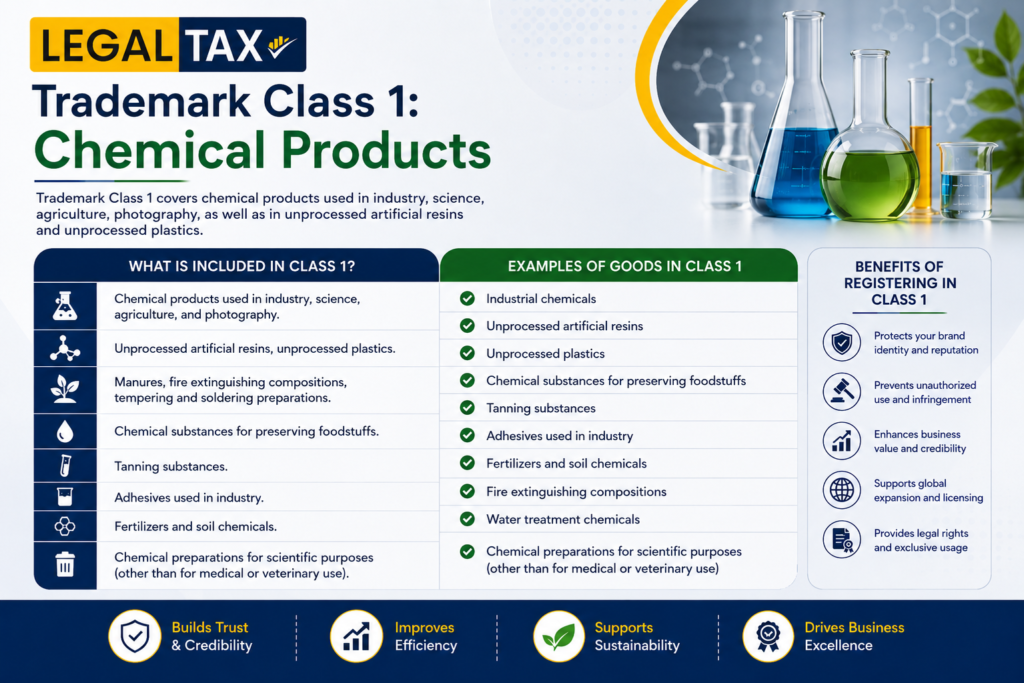
Chemicals for use in industry, science, photography, as well as in agriculture, horticulture and forestry; unprocessed artificial resins, unprocessed plastics; fire extinguishing compositions; tempering and soldering preparations; substances for tanning animal skins and hides; adhesives for use in industry; putties and other paste fillers; compost, manures, fertilisers; biological preparations for use in industry and science.
This official heading is a summary, not an exhaustive list. The actual scope of Class 1 is determined by the full list of goods included in the class as published by the World Intellectual Property Organisation and adopted by the Indian Trade Marks Registry, along with the class notes that clarify the basis for inclusion and exclusion.
The Governing Principle of Class 1
The governing principle of Class 1 is that it covers chemical substances and preparations used as inputs in industrial, agricultural, scientific, and technological processes — not chemical products intended for direct consumer use in their final form. This distinction between industrial/intermediate use and final consumer use is central to understanding where Class 1 begins and where it ends, and where goods from Class 1 overlap with or give way to goods in other classes.
What Does Trademark Class 1 Include?
The scope of Class 1 is broad. The following categories represent the main areas covered.
Industrial Chemicals and Chemical Raw Materials
Acids and bases used in industrial processes — sulfuric acid, hydrochloric acid, caustic soda, and similar industrial chemicals. Chemical salts used in manufacturing, treatment, and processing operations. Solvents for industrial use. Chemical reagents for industrial and laboratory applications. Oxidising agents, reducing agents, catalysts, and chemical intermediates used in manufacturing processes.
This category forms the core of Class 1 and covers the bulk chemical products that serve as inputs to other industries. A company that produces or trades industrial acids, alkalis, or chemical raw materials for industrial customers would file under Class 1.
Agricultural Chemicals
Fertilisers — whether inorganic mineral fertilisers such as urea, diammonium phosphate, and potassium chloride, or organic fertilisers such as bone meal and blood meal. Soil conditioners, soil amendments, and plant nutrition products intended for agricultural use. Compost and composting preparations. Micronutrient preparations for agricultural application.
Note that pesticides, herbicides, insecticides, and fungicides are excluded from Class 1 and are instead covered under Class 5, which covers pharmaceutical and veterinary preparations and sanitary preparations. This is a common point of confusion for businesses in the agrochemical sector, and it is addressed in detail in the exclusions section below.
Adhesives for Industrial Use
Industrial adhesives — epoxy adhesives, cyanoacrylate adhesives, polyurethane adhesives, structural adhesives — intended for use in manufacturing, construction, and industrial assembly processes. The key qualifier is that these are adhesives for industrial use, not adhesives for household or office use. Household adhesives fall under Class 16. Industrial adhesive tapes fall under Class 17.
Unprocessed Artificial Resins and Unprocessed Plastics
Synthetic resins in their unprocessed form — polyethylene, polypropylene, polystyrene, polyvinyl chloride, and other polymer materials before they are processed into finished goods. This covers the raw polymer materials used as inputs in plastics manufacturing. Processed plastics, plastic semi-manufactures, and plastic articles fall under other classes depending on their nature and use.
Fire Extinguishing Compositions
Chemical compositions used in fire extinguishing systems — not the extinguisher devices themselves, which would be classified under other classes covering apparatus, but the chemical agents used in fire suppression. Dry powder formulations, foam concentrates, and chemical suppressants used in fire extinguishing systems fall here.
Tempering and Soldering Preparations
Chemical preparations used in metal working — tempering preparations used to harden or condition metals, soldering fluxes and preparations used to facilitate the joining of metals, brazing preparations, and similar metalworking chemical products.
Tanning Substances
Chemical preparations used in the tanning of animal hides and skins — chromium salts, vegetable tannins, synthetic tanning agents, and auxiliary chemicals used in the leather manufacturing process.
Putties and Paste Fillers for Industrial Use
Industrial putties and paste fillers used in construction, manufacturing, and surface preparation — not decorative fillers or consumer products. Glazing putty, industrial sealing compounds, and similar paste preparations for professional industrial use.
Biological and Biochemical Preparations for Industry and Science
Enzymes for industrial use — enzymes used in food processing, textile processing, paper manufacturing, and other industrial applications. Biological preparations used in research and science — culture media, reagents, and biological materials used in laboratory and scientific contexts. Microorganism preparations used in industrial fermentation or biological processing. Biocontrol agents used in agriculture for crop protection through biological rather than chemical means.
Photography Chemicals
Chemical substances and preparations for photographic use — developing agents, fixing agents, toners, sensitising preparations, and other photographic chemicals. With the decline of traditional film photography, this subcategory is less commercially prominent than it once was, but it remains formally within Class 1.
Water Treatment Chemicals
Chemicals used for the treatment and purification of water — flocculants, coagulants, pH adjustment chemicals, biocides for water treatment, anti-scaling preparations, and corrosion inhibitors used in water treatment systems and industrial cooling systems.
Chemical Preparations for Scientific Research
Laboratory chemicals, analytical reagents, chromatography media, calibration standards, and chemical preparations used as inputs in scientific research and analytical processes. These are distinguished from pharmaceutical or diagnostic products by their use context — they are used in research and analysis, not in treating or diagnosing disease.
What Does Trademark Class 1 Exclude?
Understanding what Class 1 does not cover is equally important for correct trademark classification. The most significant exclusions are as follows.
Pesticides, Herbicides, and Insecticides — Class 5
This is the most commercially significant exclusion for businesses in the agrochemical sector. Despite being chemical products used in agriculture, pesticides, herbicides, insecticides, fungicides, rodenticides, and similar biocidal crop protection products are classified under Class 5, not Class 1. Class 5 covers pharmaceutical, veterinary, and sanitary preparations as well as substances used for destroying vermin and insects. An agrochemical company that manufactures both fertilisers (Class 1) and pesticides (Class 5) must file trademark applications in both classes to protect its brand across its full product range.
Pharmaceutical Products — Class 5
Chemical compounds intended for pharmaceutical use — active pharmaceutical ingredients, drug formulations, and medicinal preparations — are covered under Class 5, not Class 1. Even though APIs are chemical substances, their intended use in treating, preventing, or diagnosing disease places them in Class 5. Pharmaceutical companies must register their trademarks in Class 5 for their drug products.
Paints, Varnishes, and Coatings — Class 2
Paints, lacquers, varnishes, preservatives against rust and against deterioration of wood, and colorants are covered under Class 2. Chemical companies that produce coating products for industrial or decorative use should register in Class 2, not Class 1, for those products.
Cleaning and Washing Preparations — Class 3
Detergents, cleaning preparations, bleaching preparations, and polishing preparations for household or industrial cleaning use fall under Class 3, not Class 1. An industrial cleaning chemical company should register in Class 3 for its cleaning products, even though the products are chemicals.
Lubricants and Fuels — Class 4
Petroleum products, fuels, lubricants, and industrial oils and greases are covered under Class 4. Chemical companies involved in lubricant formulation or fuel additive production need to assess carefully whether their products fall under Class 1 (additives and chemical inputs) or Class 4 (the finished lubricant or fuel product).
Plastics in Semi-Manufactured Forms — Class 17
While unprocessed plastics fall under Class 1, plastics in semi-manufactured forms — plastic sheets, plastic tubes, plastic pipes, and similar semi-manufactured plastic materials — fall under Class 17, which covers rubber, gutta-percha, gum, asbestos, mica and goods made from these materials.
Adhesives for Household or Stationery Use — Class 16
Adhesives and glues for household, office, and stationery use fall under Class 16. Only adhesives for industrial use belong in Class 1. A company that makes both industrial adhesives and consumer adhesive products may need to register in both Class 1 and Class 16.
Explosives — Class 13
Explosive compositions, pyrotechnic products, and fireworks fall under Class 13, not Class 1, even though they involve chemical formulations.
Common Products and Their Correct Class
| Product | Correct Class |
|---|---|
| Urea fertiliser | Class 1 |
| Diammonium phosphate | Class 1 |
| Soil conditioner | Class 1 |
| Industrial sulfuric acid | Class 1 |
| Epoxy adhesive for industrial use | Class 1 |
| Unprocessed polyethylene resin | Class 1 |
| Water treatment flocculant | Class 1 |
| Industrial enzyme | Class 1 |
| Pesticide / insecticide | Class 5 |
| Herbicide / weedicide | Class 5 |
| Pharmaceutical active ingredient | Class 5 |
| Industrial paint or coating | Class 2 |
| Industrial cleaning chemical | Class 3 |
| Lubricating oil | Class 4 |
| Household glue or adhesive | Class 16 |
| Plastic sheeting (semi-manufactured) | Class 17 |
Why Trademark Registration in Class 1 Matters for Chemical Businesses
Brand Protection in a High-Value Sector
The Indian chemical industry is one of the most competitive industrial sectors, with thousands of manufacturers, traders, and importers competing across product categories. A brand in the chemical sector represents significant investment in product development, quality, customer relationships, and market reputation. Trademark registration in Class 1 gives the brand owner the exclusive right to use the registered mark for the specified goods, and the legal standing to take action against infringers, counterfeiters, or companies that adopt confusingly similar marks.
Without trademark registration, a chemical company that has built a reputation for its brand has limited legal recourse if a competitor adopts a similar mark for similar products. Common law passing off remedies are available but are harder to establish and enforce than the rights that flow from a registered trademark.
Preventing Counterfeiting and Substitution
Counterfeit chemicals and agrochemicals are a serious commercial and safety problem in the Indian market. Fake fertilisers, adulterated industrial chemicals, and counterfeit specialty chemicals cause financial loss to genuine brand owners and in some cases safety or quality failures for customers and end users. A registered trademark is the foundation of enforcement action — whether through civil suits, criminal complaints, or border enforcement measures — against those who produce or trade in counterfeit products bearing a copied mark.
Export Market Access and International Brand Protection
India is a significant exporter of chemicals, dyes, specialty chemicals, and agrochemicals to markets in the United States, Europe, and Asia. Building an export business on a brand that is not registered in the relevant trademark classes in the destination markets is a strategic risk. The Nice Classification is used in over 150 countries. Registering in Class 1 in India under the Madrid Protocol or through direct national applications in key export markets is essential for international brand protection. A Class 1 registration in India also supports priority claims in foreign applications filed within six months of the Indian application date.
Licensing and Commercial Agreements
Many chemical businesses operate licensing arrangements — licensing a formulation, a brand, or a production process to a contract manufacturer or distributor. A registered trademark is a licensable asset. Licensing agreements, distribution agreements, and franchising arrangements for chemical products are more commercially robust and legally enforceable when built on a registered trademark foundation. Investors, acquirers, and financial institutions also place greater value on brands that are protected by registration.
GeM Portal and Government Procurement
Indian government procurement through the GeM portal increasingly involves chemical products — industrial chemicals, cleaning agents, water treatment chemicals, and specialty products procured by government departments, PSUs, and defence establishments. GeM portal listings and government supply contracts are more credible and defensible when the supplying business has registered trademark protection for its brand. Certification and registration credentials are assessed as part of supplier qualification in government procurement.
The Trademark Registration Process for Class 1 in India
Step 1: Trademark Search
Before filing, a thorough search of the Trade Marks Registry database must be conducted to identify any identical or confusingly similar marks already registered or applied for in Class 1 for similar goods. The search should cover phonetic similarities, visual similarities, and conceptual similarities, not just exact matches. A clearance search reduces the risk of rejection on relative grounds and reduces the risk of opposition proceedings after filing.
Step 2: Preparing the Application
The trademark application must specify the mark to be registered (word mark, logo, combined mark, or other mark type), the class (Class 1), and a clear specification of the goods within Class 1 for which protection is sought. The goods specification must be precise and accurate — it should cover all the products the business actually makes or trades, described in terms consistent with the Nice Classification. An overly broad specification risks objection from the examiner; an overly narrow specification fails to protect the full range of the business’s products.
Step 3: Filing the Application
The application is filed with the Trade Marks Registry through the IP India online portal. On filing, the Registry assigns an application number. The application date is important because it establishes the priority date of the trademark — the date from which the applicant’s rights are counted.
Government filing fees apply per class per application. A single-class application filed by a small enterprise or startup attracts a concessional fee. Applications covering multiple classes require a separate fee for each class.
Step 4: Examination
The Registry examines the application for compliance with formal requirements and substantive grounds. The examiner issues an examination report specifying any objections — whether absolute grounds objections (the mark is descriptive, generic, or otherwise unregistrable) or relative grounds objections (the mark conflicts with an earlier registered mark). The applicant must respond to the examination report within the prescribed time, addressing each objection with arguments, evidence, or amendments to the specification as appropriate.
Step 5: Publication in the Trade Marks Journal
If the examination report objections are resolved, the application is accepted and published in the Trade Marks Journal. Publication opens a four-month opposition window during which any third party may file an opposition to the registration. If no opposition is filed, or if opposition proceedings are resolved in the applicant’s favour, the mark proceeds to registration.
Step 6: Certificate of Registration
Upon completion of the opposition period without successful challenge, the Trade Marks Registry issues the Certificate of Registration. The registration is valid for ten years from the date of application and is renewable indefinitely in ten-year cycles on payment of the renewal fee.
Multi-Class Filing Strategy for Chemical Businesses
Many businesses in the chemical sector need trademark protection across multiple classes because their product range spans goods that fall into different classes. A company that manufactures fertilisers and soil conditioners (Class 1), pesticides and herbicides (Class 5), and cleaning agents for agricultural equipment (Class 3) needs registrations in all three classes to protect its brand across its full product range.
A multi-class filing strategy should be developed based on a complete mapping of the business’s current product range and foreseeable product extensions. Filing in too few classes leaves the brand exposed in product categories the business actually operates in or plans to enter. Filing in classes where the business has no genuine intent to use the mark can raise issues of non-use in future enforcement or renewal proceedings.
Frequently Asked Questions
1. What is Trademark Class 1?
Trademark Class 1 covers chemical products used in industry, science, photography, agriculture, horticulture, and forestry. It also includes chemicals used in manufacturing processes, fertilizers, fire extinguishing compositions, and certain industrial raw materials. Businesses dealing with such products should register their trademarks under Class 1 to protect their brand identity.
2. Which products are included in Trademark Class 1?
Trademark Class 1 includes industrial chemicals, fertilizers, chemical additives, unprocessed artificial resins, fire extinguishing compounds, tempering preparations, chemical substances used in scientific research, and various chemicals used in agriculture and manufacturing industries.
3. Why is Trademark Class 1 registration important?
Trademark registration under Class 1 provides legal protection for brands associated with chemical products. It prevents competitors from using similar trademarks, helps build brand recognition, and grants exclusive rights to use the mark for covered goods.
4. Who should apply for Trademark Class 1?
Manufacturers, suppliers, exporters, importers, and distributors of chemical products, fertilizers, industrial compounds, laboratory chemicals, and agricultural chemicals should consider registering their trademarks under Class 1 to secure their brand rights.
5. Are fertilizers covered under Trademark Class 1?
Yes, fertilizers are one of the key categories included in Trademark Class 1. Businesses manufacturing or selling fertilizers can seek trademark protection under this class to safeguard their brand name and market presence.
6. Can a business register a trademark in multiple classes?
Yes, if a business deals with products or services that fall under different trademark classes, it can apply for registration in multiple classes. This ensures broader legal protection across all relevant business activities and product categories.
7. What products are not covered under Trademark Class 1?
Trademark Class 1 does not cover finished pharmaceutical products, paints, cleaning preparations, or cosmetics. These products fall under other trademark classes such as Class 5, Class 2, Class 3, and others depending on the nature of the goods. Businesses should carefully identify the correct class before filing a trademark application.
8. How can I register a trademark under Class 1 in India?
To register a trademark under Class 1, an applicant must conduct a trademark search, prepare the application with the appropriate class details, submit the application to the Trademark Registry, and respond to any objections if raised. Once approved and published without opposition, the trademark is registered and protected under the Trade Marks Act, 1999.
Conclusion
Trademark Class 1 is the foundational class for brand protection in the chemical sector — covering the industrial, agricultural, scientific, and technological chemical products that are central to India’s manufacturing and agricultural economy. For businesses operating in this space, understanding the scope of Class 1, correctly identifying which of their products fall within it and which fall in adjacent classes, and filing comprehensive trademark applications that cover their full product range is not an optional compliance exercise. It is the legal foundation on which brand value in the chemical sector is built and defended.
The Indian chemical industry is competitive, and the consequences of inadequate brand protection — copycat products, trademark infringement, counterfeiting, and market confusion — are commercially and reputationally damaging. A registered trademark in Class 1, filed promptly and maintained through renewal, gives a chemical business the legal tools to protect what it has built.
The trademark registration process in India is portal-based, the fees are manageable, and the protection granted is strong. What creates problems for businesses is not the process but the delay — waiting until a competitor has adopted a similar mark before taking action. The right time to register a trademark is before it becomes valuable enough for someone else to copy.
Map your products to the correct classes. Conduct a clearance search. File promptly. Respond to examination reports. Maintain the registration through renewal. Build your brand on a registered foundation.
Get Expert Trademark Registration and IP Protection Services
🟡 LegalIP.in provides complete trademark registration, IP advisory, opposition response, renewal, and brand protection services for businesses across all industries and product categories.
👉 Trademark Registration 👉 Patent Registration 👉 Copyright Registration 👉 Design Registration
🟡 LegalTax.in provides complete business registration, compliance, and legal documentation services.
👉 Legal Documentation and Drafting 👉 GST Registration and Filing 👉 Income Tax Return 👉 Private Limited Company Registration 👉 LLP Registration 👉 Partnership Firm Registration 👉 MSME and Udyam Registration 👉 Import Export Code Registration 👉 Startup Registration 👉 GeM Registration
🟡 IT and Digital Services
👉 Website Development 👉 SEO Services 👉 Social Media Marketing 👉 Logo Design 👉 Google and Facebook Ads 👉 Branding Services
📞 Call Now: +91 9711939395 🕐 Free Consultation: Monday to Saturday, 9 AM to 6 PM

I’m Aryan Yadav, passionate about SEO and Digital Marketing with a strong interest in helping businesses grow online. I enjoy learning new strategies, exploring digital trends, and creating ideas that deliver value. I believe in continuous growth, creativity, and building meaningful results through smart work and dedication.
Our Clients