Views: 137
Table of Contents
- 1 Quick Summary
- 2 📌 What Is ISO 14001?
- 3 ⚠️ Why ISO 14001 Certification Matters for Your Organisation
- 4 🌍 The High Level Structure (HLS) — How ISO 14001 Is Organised
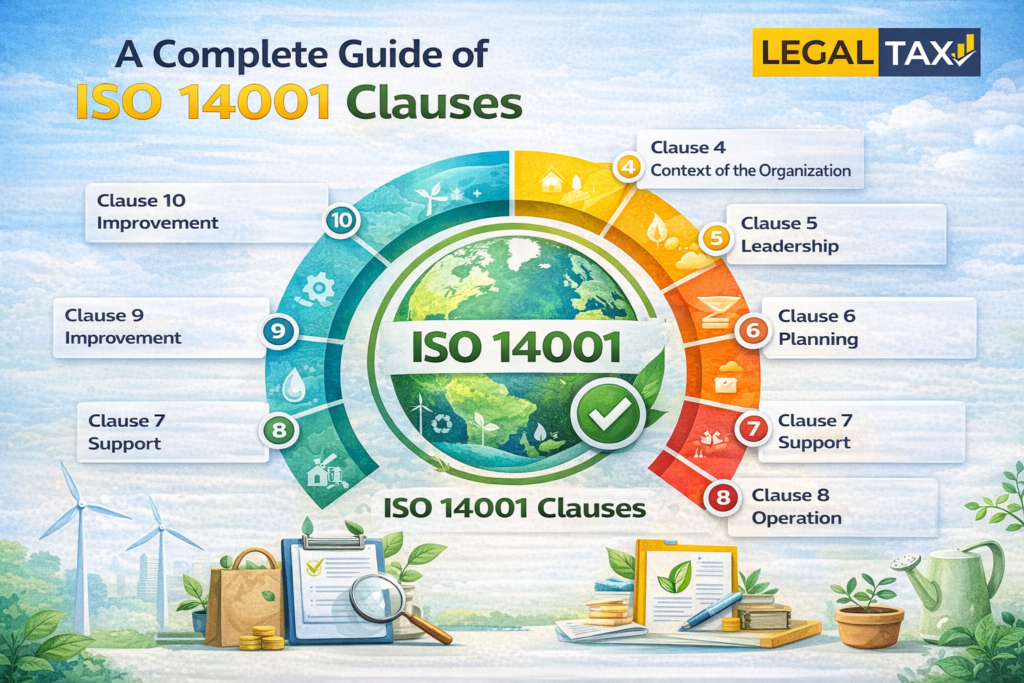
- 5 📦 Complete Guide to All 10 ISO 14001 Clauses
- 6 Clause 4 — Context of the Organisation
- 7 Clause 5 — Leadership
- 8 Clause 6 — Planning
- 9 Clause 7 — Support
- 10 Clause 8 — Operation
- 11 Clause 9 — Performance Evaluation
- 12 Clause 10 — Improvement
- 13 🔄 How All 10 Clauses Connect — The PDCA Cycle
- 14 📋 ISO 14001 Clause-Wise Audit Checklist
- 15 🚫 Most Common Non-Conformities in ISO 14001 Audits
- 16 📋 ISO 14001 Certification Process in India
- 17 💰 ISO 14001 Certification Fees in India
- 18 🌟 How LegalTax.in Helps with ISO 14001 Certification
- 19 ❓ Frequently Asked Questions (FAQs)
- 20 🎯 Who Needs This Guide Right Now?
- 21 ✅ Final Recommendation
- 22 Need Help With ISO Certifications?
Quick Summary
ISO 14001:2015 is the world’s leading Environmental Management System (EMS) standard — structured into 10 clauses following the universally adopted High Level Structure (HLS).
Here is what every organisation implementing ISO 14001 must know:
- 📋 10 clauses total — Clauses 1–3 are introductory; Clauses 4–10 contain all auditable requirements
- 🎯 PDCA framework — all requirements follow the Plan-Do-Check-Act cycle
- 🌿 Environmental focus — the standard requires identification of environmental aspects, impacts and compliance obligations
- 🔒 Leadership commitment — top management involvement is a mandatory and auditable requirement
- ⚠️ Risk-based thinking — risks and opportunities must be identified and addressed in every clause
- ✅ LegalTax.in provides expert ISO 14001 gap assessment, documentation support and certification assistance — Call 📞 9711939395
📌 What Is ISO 14001?
ISO 14001 is an internationally recognised standard for Environmental Management Systems (EMS) — published by the International Organization for Standardization (ISO). It provides a framework for organisations to manage their environmental responsibilities in a systematic way — reducing environmental impact, ensuring legal compliance and demonstrating environmental commitment to customers, regulators and stakeholders.
The current version — ISO 14001:2015 — was published in September 2015 and replaced ISO 14001:2004. It is applicable to any organisation, regardless of size, sector or geography — from small businesses to multinational corporations, from manufacturing plants to service companies.
ISO 14001 follows the High Level Structure (HLS) — also called Annex SL — which is a common framework shared by all modern ISO management system standards including ISO 9001 (Quality), ISO 45001 (Occupational Health and Safety) and ISO 27001 (Information Security). This makes it easy to integrate ISO 14001 with other management system certifications.
The simple rule: ISO 14001 does not prescribe specific environmental performance targets — it requires an organisation to set its own targets, build a system to achieve them, monitor performance and continuously improve.
⚠️ Why ISO 14001 Certification Matters for Your Organisation
ISO 14001 certification is not merely a compliance document — it is a strategic tool that delivers measurable benefits.
Legal and Regulatory Compliance
ISO 14001 requires organisations to identify all applicable environmental legal requirements — laws, regulations, permits and other obligations — and maintain compliance. This dramatically reduces the risk of regulatory penalties, notices and enforcement action.
Business and Commercial Advantages
Many large corporates, government tenders and international buyers require their supply chain partners to hold ISO 14001 certification. Certification opens access to contracts and markets that would otherwise be unavailable.
Operational Cost Reduction
A properly implemented EMS identifies waste, energy inefficiency and resource overuse — translating environmental improvements directly into operational cost savings. Organisations regularly report reductions in energy costs, water costs and waste disposal costs after ISO 14001 implementation.
Reputational and Stakeholder Benefits
ISO 14001 certification demonstrates a credible, independently verified commitment to environmental management — valued by customers, investors, communities and regulators.
Risk Management
ISO 14001 requires organisations to proactively identify environmental risks — risks of pollution incidents, regulatory non-compliance and environmental damage — and put controls in place before incidents occur.
🌍 The High Level Structure (HLS) — How ISO 14001 Is Organised
Clauses 1 to 3 — Non-Auditable Introductory Clauses
Clause 1 — Scope: Defines what the standard covers and to what types of organisations it applies.
Clause 2 — Normative References: Lists reference documents applicable to ISO 14001 (in the case of ISO 14001:2015, there are no normative references — all terms are defined in the standard itself).
Clause 3 — Terms and Definitions: Defines all key terms used in the standard — including Environmental Aspect, Environmental Impact, Environmental Management System, Environmental Policy, Environmental Objective, Legal Requirements and other core terminology.
Clauses 1 to 3 are not audited — they provide context and terminology only. All audit requirements are contained in Clauses 4 to 10.
Clauses 4 to 10 — The Auditable Requirements
These seven clauses contain all the requirements an organisation must meet to achieve and maintain ISO 14001 certification:
| Clause | Title | PDCA Phase |
|---|---|---|
| Clause 4 | Context of the Organisation | Plan |
| Clause 5 | Leadership | Plan |
| Clause 6 | Planning | Plan |
| Clause 7 | Support | Do |
| Clause 8 | Operation | Do |
| Clause 9 | Performance Evaluation | Check |
| Clause 10 | Improvement | Act |
📦 Complete Guide to All 10 ISO 14001 Clauses
Clause 4 — Context of the Organisation
Overview
Clause 4 is the foundation of the entire Environmental Management System. It requires the organisation to understand its environment — both internal and external — before designing and implementing any other part of the EMS. An EMS designed without understanding the organisation’s context is unlikely to be effective, relevant or sustainable.
Clause 4.1 — Understanding the Organisation and Its Context
What the standard requires:
The organisation must determine the external and internal issues that are relevant to its purpose and that affect its ability to achieve the intended outcomes of its EMS.
External issues to consider:
- Environmental conditions — climate, geography, air, water, land, natural resources in the organisation’s area of operation
- External cultural, social, political, legal, regulatory, financial and economic conditions
- Conditions related to the external environment including biodiversity, ecosystems and climate change
- Obligations of external interested parties — customers, regulators, local communities
Internal issues to consider:
- The organisation’s activities, products and services and the environmental conditions they create or influence
- The organisation’s values, culture, capabilities and capacity
- Information systems and decision-making flows
- Standards and guidelines already adopted by the organisation
Practical implementation tips:
Conduct a structured context analysis — often called a SWOT (Strengths, Weaknesses, Opportunities, Threats) or PESTLE (Political, Economic, Social, Technological, Legal, Environmental) analysis focused specifically on environmental relevance. Document the findings and review them at planned intervals.
Common audit findings in this clause:
- Context analysis exists but is too generic — not specific to the organisation’s actual environmental situation
- Context analysis conducted once during certification and never reviewed or updated
- Environmental conditions in the organisation’s geographic area not considered
Clause 4.2 — Understanding the Needs and Expectations of Interested Parties
What the standard requires:
The organisation must identify the interested parties (stakeholders) relevant to its EMS and determine their relevant needs and expectations — including any that become compliance obligations.
Interested parties typically include:
- Regulatory authorities — pollution control boards, environmental agencies, local government
- Customers and clients — particularly those with environmental supply chain requirements
- Employees and workers
- Local communities near the organisation’s facilities
- Non-governmental organisations (NGOs) and environmental groups
- Investors and shareholders
- Industry associations and trade bodies
- Insurers
Needs and expectations to identify:
- Legal and regulatory requirements applicable to the organisation
- Customer environmental requirements, codes of conduct or contractual obligations
- Community concerns about pollution, noise, odour, traffic or other environmental impacts
- Industry sector environmental standards or commitments
Practical implementation tips:
Create a documented register of interested parties — listing each stakeholder, their relevance to the EMS, their key needs and expectations and whether any of those needs and expectations represent compliance obligations. Review the register at least annually.
Common audit findings in this clause:
- Interested parties list is incomplete — missing key regulators or significant community stakeholders
- Needs and expectations listed but not evaluated for whether they constitute compliance obligations
- No process for updating the interested parties register when stakeholder situations change
Clause 4.3 — Determining the Scope of the Environmental Management System
What the standard requires:
The organisation must determine the boundaries and applicability of the EMS — defining what is included and what is excluded.
Factors to consider when defining scope:
- External and internal issues identified in Clause 4.1
- Compliance obligations identified in Clause 4.2
- The organisation’s organisational units, functions and physical boundaries
- The organisation’s activities, products and services
- The organisation’s authority and ability to exercise control and influence
Key principle: The scope must be documented and available to interested parties. An organisation cannot exclude activities, products or services from the scope in order to avoid difficult environmental aspects — the scope definition must be honest and representative.
Practical implementation tips:
Write the scope statement clearly — specifying which sites, which activities, which products and services are included. If certain activities or locations are excluded — document the rationale. Display the scope certificate on your premises and website.
Clause 4.4 — Environmental Management System
What the standard requires:
The organisation must establish, implement, maintain and continually improve an EMS in accordance with all requirements of ISO 14001:2015.
This clause is brief — it simply requires that the EMS as a whole is established and maintained. All the detailed requirements of what that EMS must contain are in the clauses that follow.
Clause 5 — Leadership
Overview
ISO 14001:2015 significantly strengthened the leadership requirements compared to previous versions. The 2015 revision made it explicit that top management must be personally accountable for the EMS — not just delegate it to an Environment Manager and move on. This is a deliberately auditable requirement — auditors will seek evidence of genuine top management engagement.
Clause 5.1 — Leadership and Commitment
What the standard requires:
Top management must demonstrate leadership and commitment with respect to the EMS. Specifically, top management must:
- Take accountability for the effectiveness of the EMS
- Ensure the environmental policy and environmental objectives are established and compatible with the strategic direction of the organisation
- Ensure integration of EMS requirements into business processes
- Ensure that resources needed for the EMS are available
- Communicate the importance of effective environmental management and of conforming to EMS requirements
- Ensure the EMS achieves its intended outcomes
- Direct persons to contribute to the effectiveness of the EMS
- Promote continual improvement
- Support other relevant management roles to demonstrate leadership in their areas
Practical implementation tips:
Top management commitment should be evidenced in multiple ways — not just through signing an environmental policy. Evidence includes: attendance at management review meetings, visible communication to employees about environmental goals, allocation of budget and resources to environmental initiatives, personal involvement in setting environmental objectives and measurable targets.
Common audit findings in this clause:
- Environmental policy signed by top management but no other evidence of personal engagement
- EMS managed entirely by a single Environment Officer with no visible top management involvement
- Resources for EMS implementation (training, monitoring equipment, waste management) not allocated by management
Clause 5.2 — Environmental Policy
What the standard requires:
Top management must establish, implement and maintain an environmental policy that:
- Is appropriate to the purpose and context of the organisation, including the nature, scale and environmental impacts of its activities, products and services
- Provides a framework for setting environmental objectives
- Includes a commitment to the protection of the environment, including prevention of pollution and other specific commitments relevant to the context of the organisation (e.g. sustainable resource use, climate change mitigation, biodiversity protection)
- Includes a commitment to fulfil compliance obligations
- Includes a commitment to continual improvement of the EMS to enhance environmental performance
Additional requirements:
- The policy must be documented
- The policy must be communicated within the organisation
- The policy must be available to interested parties
- The policy must be maintained and reviewed for continued suitability
Practical implementation tips:
The environmental policy should be concise and meaningful — not a generic statement. It should specifically reference the organisation’s key environmental aspects and reflect its genuine environmental commitments. Post it in all facilities, include it in new employee induction and publish it on the company website.
Common audit findings in this clause:
- Policy is entirely generic — could apply to any organisation in any industry
- Policy not communicated to employees — staff unaware of its content
- Policy not reviewed since the previous certification cycle
- Commitments in the policy not reflected in actual objectives and programmes
Clause 5.3 — Organisational Roles, Responsibilities and Authorities
What the standard requires:
Top management must assign and communicate responsibilities and authorities for relevant roles within the EMS — specifically ensuring that:
- Responsibility and authority is assigned for ensuring the EMS conforms to ISO 14001:2015 requirements
- Responsibility and authority is assigned for reporting on the performance of the EMS to top management
Practical implementation tips:
Create a clear documented organisational structure for the EMS — showing who is responsible for what. This typically includes an Environment Management Representative (or equivalent), departmental environmental champions, and clear escalation paths. Ensure job descriptions reflect environmental responsibilities where relevant.
Clause 6 — Planning
Overview
Clause 6 is where the real substance of environmental management lives. It requires the organisation to systematically identify what environmental risks and opportunities are present, understand what legal and other obligations apply, set meaningful objectives and plan how to achieve them. This is the heart of the Plan phase in the PDCA cycle.
Clause 6.1 — Actions to Address Risks and Opportunities
Clause 6.1.1 — General
When planning the EMS, the organisation must consider the context (Clause 4.1), interested parties (Clause 4.2), the scope (Clause 4.3) and determine the risks and opportunities that need to be addressed — to give assurance that the EMS can achieve its intended outcomes, prevent or reduce undesired effects, and achieve continual improvement.
Clause 6.1.2 — Environmental Aspects
This is one of the most critical requirements of the entire standard.
The organisation must identify the environmental aspects of its activities, products and services — and determine which of those aspects have or can have significant environmental impacts.
Environmental aspect = an element of an organisation’s activities, products or services that interacts or can interact with the environment (e.g. emission of exhaust gases from a vehicle fleet)
Environmental impact = a change to the environment — whether adverse or beneficial — wholly or partially resulting from an organisation’s environmental aspects (e.g. contribution to air pollution and greenhouse gas emissions)
The organisation must consider:
- Aspects under normal operating conditions
- Aspects under abnormal conditions — start-up, shutdown, maintenance
- Aspects under reasonably foreseeable emergency situations
The organisation must also consider life cycle perspective — considering the environmental aspects of its products and services throughout their life cycle, from raw material acquisition through to end of life disposal.
Determining significance: The organisation must apply criteria to determine which environmental aspects are significant. Criteria typically include magnitude of impact, probability of occurrence, severity, reversibility, legal significance and stakeholder concern. The criteria and determination methodology must be documented.
Significant environmental aspects must be considered in establishing, implementing and maintaining the EMS.
Common audit findings in this clause:
- Environmental aspects register is incomplete — missing aspects from support activities (offices, vehicles, business travel)
- Significance determination methodology not documented or inconsistently applied
- Life cycle perspective not considered in aspect identification
- Aspects register not reviewed after changes to operations or activities
Clause 6.1.3 — Compliance Obligations
The organisation must:
- Identify and have access to all compliance obligations — legal requirements and other requirements applicable to its environmental aspects
- Determine how these obligations apply to the organisation
- Take these obligations into account in establishing, implementing and maintaining the EMS
Compliance obligations include:
- Environmental laws and regulations — national, state and local level
- Environmental permits, licences and consents
- Agreements with regulatory authorities
- Contractual obligations with customers or suppliers that have environmental implications
- Industry sector guidelines and codes of practice the organisation has committed to follow
- Voluntary principles or programmes the organisation has adopted
Practical implementation tips:
Maintain a Legal Register — a documented list of all applicable environmental laws, regulations and permits, with regular review to capture new legislation and regulatory changes. In India, key environmental legislation includes the Environment Protection Act 1986, the Water (Prevention and Control of Pollution) Act 1974, the Air (Prevention and Control of Pollution) Act 1981, the Hazardous Waste (Management, Handling and Transboundary Movement) Rules 2016, and the E-Waste (Management) Rules 2022.
Clause 6.1.4 — Planning Action
The organisation must plan to take actions to address its significant environmental aspects, compliance obligations and the risks and opportunities identified in Clause 6.1.1. These actions must be integrated into the EMS processes (Clause 7, 8) and their effectiveness evaluated (Clause 9).
Clause 6.2 — Environmental Objectives and Planning to Achieve Them
Clause 6.2.1 — Environmental Objectives
The organisation must establish environmental objectives at relevant functions, levels and processes — taking into account significant environmental aspects, compliance obligations and risks and opportunities.
Environmental objectives must be:
- Consistent with the environmental policy
- Measurable (if practicable)
- Monitored
- Communicated
- Updated as appropriate
Clause 6.2.2 — Planning Actions to Achieve Environmental Objectives
For each environmental objective, the organisation must plan:
- What will be done
- What resources will be required
- Who will be responsible
- When the objective will be completed
- How results will be evaluated
Practical implementation tips:
Environmental objectives must be SMART — Specific, Measurable, Achievable, Relevant and Time-bound. Avoid vague objectives like “reduce our environmental impact.” Use specific targets: “Reduce total energy consumption by 15% compared to the 2024 baseline by December 2026.” Assign a specific owner for each objective and review progress at management reviews.
Common audit findings in this clause:
- Objectives not linked to significant environmental aspects identified in Clause 6.1.2
- Objectives not measurable — stated as intentions rather than quantified targets
- No action plans with timelines, resources and responsibilities assigned
- Objectives not reviewed or updated from the previous certification cycle
Clause 7 — Support
Overview
Clause 7 covers the resources, competence, awareness, communication and documentation needed to operate and maintain the EMS effectively. It is the enabler — ensuring the organisation has what it needs to implement the plans made in Clause 6.
Clause 7.1 — Resources
What the standard requires:
The organisation must determine and provide the resources needed for the establishment, implementation, maintenance and continual improvement of the EMS. Resources include human resources, financial resources, infrastructure, technology and knowledge.
Practical implementation tips:
Resources for the EMS should be formally allocated — included in budgets, reflected in staffing plans and documented in management review outputs. The EMS cannot function on goodwill alone — it needs committed time, budget and capability.
Clause 7.2 — Competence
What the standard requires:
The organisation must:
- Determine the necessary competence of persons doing work under its control that affects its environmental performance and its ability to fulfil compliance obligations
- Ensure that persons are competent on the basis of appropriate education, training or experience
- Take action to acquire the necessary competence and evaluate the effectiveness of actions taken
- Retain documented information as evidence of competence
Practical implementation tips:
Maintain a competence matrix — showing the environmental competence requirements for each relevant role and the evidence of how each individual meets those requirements. Records of training, qualifications and experience must be maintained. For roles with specific legal requirements (e.g. hazardous waste handlers, emission testers), ensure qualifications are current and valid.
Clause 7.3 — Awareness
What the standard requires:
Persons doing work under the organisation’s control must be aware of:
- The environmental policy
- The significant environmental aspects and related actual or potential environmental impacts associated with their work
- Their contribution to the effectiveness of the EMS, including the benefits of enhanced environmental performance
- The implications of not conforming with EMS requirements, including not fulfilling compliance obligations
Practical implementation tips:
General environmental awareness must be built into employee induction and refreshed regularly through toolbox talks, notice boards, internal communications and team meetings. Awareness must be role-specific — a production operator needs to be aware of the environmental aspects of their specific work area, not just the corporate environmental policy in the abstract.
Clause 7.4 — Communication
Clause 7.4.1 — General
The organisation must establish, implement and maintain a process for internal and external communications relevant to the EMS — covering what will be communicated, when, to whom, how and who will communicate.
Clause 7.4.2 — Internal Communication
The organisation must communicate internally on matters relevant to the EMS — including changes to the EMS, environmental performance results, environmental incidents and near-misses, and upcoming compliance requirements.
Clause 7.4.3 — External Communication
The organisation must communicate externally on matters relevant to its EMS in accordance with its compliance obligations and as required. The organisation must decide whether to proactively communicate its environmental performance externally.
Common audit findings in this clause:
- No documented communication procedure
- External communications not managed — individual employees responding to regulatory or media queries without authorisation or tracking
- Internal communication about environmental performance is one-way only — top-down announcements with no mechanism for workers to raise environmental concerns
Clause 7.5 — Documented Information
Clause 7.5.1 — General
The organisation’s EMS must include documented information required by the standard (mandatory documented information) and documented information determined by the organisation as necessary for the effectiveness of the EMS.
Mandatory documented information under ISO 14001:2015:
- Scope of the EMS (Clause 4.3)
- Environmental policy (Clause 5.2)
- Environmental aspects and impacts register, including significant environmental aspects (Clause 6.1.2)
- Compliance obligations (Clause 6.1.3)
- Evidence of environmental objectives and plans (Clause 6.2)
- Evidence of competence (Clause 7.2)
- Monitoring, measurement, analysis and evaluation results (Clause 9.1)
- Calibration records for monitoring equipment (Clause 9.1)
- Evidence of internal audits (Clause 9.2)
- Evidence of management review (Clause 9.3)
- Evidence of non-conformities and corrective actions (Clause 10.2)
Clause 7.5.2 — Creating and Updating
Documented information must be appropriately identified, formatted, reviewed and approved.
Clause 7.5.3 — Control of Documented Information
The organisation must control documented information — ensuring it is available and suitable for use where and when needed, and adequately protected. Documented information of external origin must be identified and controlled.
Practical implementation tips:
Establish a document control procedure — covering creation, review, approval, version control, distribution, access and disposal of documented information. Use version numbers and review dates on all controlled documents. Ensure obsolete documents are removed from active use.
Clause 8 — Operation
Overview
Clause 8 is the Do phase of the PDCA cycle — it addresses how the organisation plans, controls and manages the operational activities that have significant environmental aspects or relate to compliance obligations.
Clause 8.1 — Operational Planning and Control
What the standard requires:
The organisation must plan, implement, control, maintain and review the processes needed to meet EMS requirements and to implement the actions identified in Clause 6 — including:
- Establishing operating criteria for the processes
- Implementing control of the processes in accordance with the operating criteria
- Keeping documented information to the extent necessary to have confidence that processes have been carried out as planned
Life cycle perspective in operations:
The organisation must consider the life cycle perspective and establish controls to ensure that its environmental requirements are addressed in the design and development of products and services, and communicated to contractors, outsourced processes, product and service providers.
Practical implementation tips:
Operational controls may take many forms — Standard Operating Procedures (SOPs) for processes with significant environmental aspects, engineering controls (containment, filtration, treatment), administrative controls (purchase specifications requiring environmental compliance from suppliers), and training requirements for operators.
Common audit findings in this clause:
- Operational controls exist on paper but not followed in practice — gap between documented procedures and actual behaviour
- No environmental requirements communicated to contractors working on site
- Life cycle perspective not considered — no environmental requirements in design process or procurement specifications
Clause 8.2 — Emergency Preparedness and Response
What the standard requires:
The organisation must:
- Prepare for potential emergency situations that can have an environmental impact
- Respond to actual emergency situations
- Take action to prevent or mitigate adverse environmental impacts from emergency situations
- Periodically test its emergency response procedures where practicable
- Periodically review and revise its procedures — especially after emergency situations
- Provide relevant information and training related to emergency preparedness to relevant interested parties including persons working under the organisation’s control
Types of environmental emergencies to consider:
- Chemical or fuel spills — reaching soil, drains, waterways
- Fire with environmental release of combustion products, contaminated firefighting water
- Flood events causing release of stored chemicals or waste
- Equipment failure causing abnormal emissions or discharges
- Accidental release of refrigerants or other hazardous substances
Practical implementation tips:
Maintain a documented emergency response plan specific to the environmental risks at each site — including spill response kits, emergency contacts, evacuation procedures, notification requirements to regulators and methods for containing and cleaning up environmental releases. Conduct drills at least annually and document the outcomes.
Common audit findings in this clause:
- Emergency response plan is generic — not specific to the actual environmental hazards at the site
- Spill kits present but staff not trained in their use
- Emergency response plan not tested or drilled
- Regulatory notification requirements not included in the emergency response plan
Clause 9 — Performance Evaluation
Overview
Clause 9 is the Check phase of the PDCA cycle. It requires the organisation to monitor, measure and evaluate its environmental performance — and to assess the effectiveness of its EMS through internal audit and management review.
Clause 9.1 — Monitoring, Measurement, Analysis and Evaluation
Clause 9.1.1 — General
The organisation must monitor, measure, analyse and evaluate its environmental performance. It must determine:
- What needs to be monitored and measured — including operational controls, progress toward objectives, compliance with obligations
- The methods for monitoring, measurement, analysis and evaluation to ensure valid results
- The criteria against which the organisation will evaluate its environmental performance, and the indicators to be used
- When monitoring and measuring shall be performed
- When results shall be analysed and evaluated
- Who shall analyse and evaluate the results
Clause 9.1.2 — Evaluation of Compliance
The organisation must establish, implement and maintain a process for evaluating the fulfilment of its compliance obligations — maintaining documented evidence of compliance evaluation results and knowing its compliance status.
Practical implementation tips:
Create a compliance evaluation calendar — scheduling regular checks against each identified legal requirement and compliance obligation. Use inspection checklists, monitoring records and permit condition registers. Document the evidence that compliance is being maintained. Address any compliance gaps immediately as potential non-conformities under Clause 10.2.
Common audit findings in this clause:
- Monitoring data collected but not analysed or used to make decisions
- Compliance evaluation conducted only at certification time — not as an ongoing process
- Calibration of monitoring equipment not maintained — records out of date
- Environmental performance data not communicated to management or compared against objectives
Clause 9.2 — Internal Audit
Clause 9.2.1 — General
The organisation must conduct internal audits at planned intervals to assess whether the EMS conforms to ISO 14001 requirements, the organisation’s own requirements, and is effectively implemented and maintained.
Clause 9.2.2 — Internal Audit Programme
The organisation must establish, implement and maintain an internal audit programme — covering frequency, methods, responsibilities, planning requirements and reporting. The audit programme must take into account the environmental importance of the processes concerned, changes affecting the organisation and the results of previous audits.
Practical implementation tips:
Internal auditors must be competent and objective — they should not audit their own work. Develop an annual audit programme covering all clauses of ISO 14001 and all significant aspects and compliance obligations over the audit cycle. Document audit findings, including any non-conformities, and ensure corrective actions are tracked through to completion. Internal audit findings feed directly into management review.
Common audit findings in this clause:
- Internal audits conducted but no findings recorded — implying a superficial audit process
- Same person auditing their own area — lack of independence
- Audit programme not risk-based — all areas audited with the same frequency regardless of significance
- Non-conformities from previous internal audits not closed out before the certification audit
Clause 9.3 — Management Review
What the standard requires:
Top management must review the organisation’s EMS at planned intervals to ensure its continuing suitability, adequacy and effectiveness.
Inputs to management review must include:
- Status of actions from previous management reviews
- Changes in external and internal issues relevant to the EMS
- Changes in needs and expectations of interested parties, including compliance obligations
- The extent to which environmental objectives have been achieved
- Information on the organisation’s environmental performance — non-conformities, corrective actions, monitoring and measurement results, audit results, compliance evaluation results
- Adequacy of resources
- Relevant communication from interested parties, including complaints
- Opportunities for continual improvement
Outputs from management review must include:
- Conclusions on the continuing suitability, adequacy and effectiveness of the EMS
- Decisions related to continual improvement opportunities
- Decisions related to any need for changes to the EMS, including resources
- Actions if environmental objectives have not been achieved
- Implications for the strategic direction of the organisation
Practical implementation tips:
Management reviews should be genuine strategic discussions — not rubber-stamp meetings that sign off pre-prepared reports. Document the agenda, attendance, all inputs reviewed, all decisions made and all actions assigned with owners and deadlines. Management review outputs must be retained as documented information.
Common audit findings in this clause:
- Management review held but attendance by actual top management is minimal or absent
- Management review outputs are vague — no specific decisions, actions or accountability
- Review does not address all required inputs — particularly compliance status and progress against objectives
- Actions from previous management reviews not tracked or completed
Clause 10 — Improvement
Overview
Clause 10 is the Act phase of the PDCA cycle. It requires the organisation to respond to non-conformities, take corrective action and drive continual improvement in the EMS and in environmental performance.
Clause 10.1 — General
The organisation must determine opportunities for improvement and implement necessary actions to achieve the intended outcomes of its EMS.
Clause 10.2 — Nonconformity and Corrective Action
What the standard requires:
When a nonconformity occurs, the organisation must:
- React to the nonconformity — take action to control and correct it, and deal with the consequences including mitigating adverse environmental impacts
- Evaluate the need for action to eliminate the root causes of the nonconformity — so it does not recur or occur elsewhere — through reviewing the nonconformity, determining its causes and determining if similar nonconformities exist or could occur
- Implement any action needed
- Review the effectiveness of corrective action taken
- Make changes to the EMS if necessary
Nonconformities and corrective actions must be retained as documented information.
Practical implementation tips:
A robust corrective action process distinguishes between correction (fixing the immediate problem) and corrective action (eliminating the root cause to prevent recurrence). Use root cause analysis tools — such as 5-Why analysis or Fishbone (Ishikawa) diagrams — to identify genuine causes rather than symptoms. Track all corrective actions to completion and verify their effectiveness.
Common audit findings in this clause:
- Corrections made but no root cause analysis conducted
- Same or similar nonconformities recurring — indicating corrective actions are not addressing root causes
- Corrective action records not maintained or not linked back to the original nonconformity
- No system for capturing near-misses and minor issues before they become nonconformities
Clause 10.3 — Continual Improvement
What the standard requires:
The organisation must continually improve the suitability, adequacy and effectiveness of the EMS — to enhance environmental performance.
Practical implementation tips:
Continual improvement should be driven by data — monitoring results, audit findings, management review outputs, employee suggestions and industry benchmarking. Document improvement initiatives and their results. Improvement does not mean the organisation must improve every single environmental metric every year — it means the organisation must have a systematic process for identifying improvement opportunities and implementing them over time.
🔄 How All 10 Clauses Connect — The PDCA Cycle
The logic of ISO 14001 follows the universally recognised Plan-Do-Check-Act (PDCA) cycle:
| PDCA Phase | ISO 14001 Clauses | What Happens |
|---|---|---|
| PLAN | Clauses 4, 5, 6 | Understand context → Set policy → Identify aspects and risks → Set objectives and plans |
| DO | Clauses 7, 8 | Provide resources and support → Implement operational controls and emergency preparedness |
| CHECK | Clause 9 | Monitor performance → Conduct internal audits → Conduct management review |
| ACT | Clause 10 | Correct nonconformities → Drive continual improvement |
No clause operates in isolation — they form an integrated system. Clause 6 planning is meaningless without the operational controls of Clause 8. Clause 9 monitoring only adds value if Clause 10 corrective action responds to what is found.
📋 ISO 14001 Clause-Wise Audit Checklist
| Clause | Key Audit Questions |
|---|---|
| 4.1 | Is there a documented context analysis? Is it reviewed periodically? |
| 4.2 | Is there an interested parties register? Are compliance obligations identified? |
| 4.3 | Is the scope defined, documented and available? |
| 5.1 | Is there evidence of top management engagement beyond signing the policy? |
| 5.2 | Is the policy current, communicated and publicly available? |
| 5.3 | Are EMS roles and responsibilities documented and communicated? |
| 6.1.2 | Is there a complete environmental aspects and impacts register? How is significance determined? |
| 6.1.3 | Is there a legal register? Is it current? Are compliance obligations reviewed? |
| 6.2 | Are environmental objectives SMART? Do they have action plans with owners and deadlines? |
| 7.1 | Have adequate resources been allocated for the EMS? |
| 7.2 | Is there a competence matrix? Are training records maintained? |
| 7.3 | Are employees aware of significant aspects, policy and their EMS responsibilities? |
| 7.4 | Is there a communication procedure? Are external communications managed? |
| 7.5 | Is documented information controlled? Are mandatory records maintained? |
| 8.1 | Are operational controls in place for significant aspects? Are contractors included? |
| 8.2 | Is there an emergency response plan? Has it been tested? |
| 9.1 | Is environmental performance being monitored? Are compliance evaluations conducted? |
| 9.2 | Is there an internal audit programme? Are findings and corrective actions documented? |
| 9.3 | Are management reviews conducted with all required inputs and documented outputs? |
| 10.2 | Are nonconformities recorded? Is root cause analysis conducted? Are corrective actions tracked? |
| 10.3 | Is there evidence of continual improvement over time? |
🚫 Most Common Non-Conformities in ISO 14001 Audits
❌ Incomplete environmental aspects and impacts register (Clause 6.1.2) The most frequently cited non-conformity — aspects register missing activities from support functions, offices, vehicle fleets or supply chain. Significance criteria not documented or inconsistently applied.
❌ Legal register not current (Clause 6.1.3) Legal register created at certification and never updated — missing new regulations, revised permit conditions or new compliance obligations.
❌ Environmental objectives not measurable or not linked to significant aspects (Clause 6.2) Objectives stated as intentions rather than quantified targets, or not connected to the significant aspects identified in the aspects register.
❌ Top management not demonstrably involved (Clause 5.1) Policy signed but no other evidence of top management engagement — no attendance at management reviews, no allocation of resources, no visible communication on environmental goals.
❌ Compliance evaluation not conducted as an ongoing process (Clause 9.1.2) Compliance evaluation done at audit time only — no regular, scheduled process for checking compliance with each regulatory requirement throughout the year.
❌ Corrective actions addressing symptoms rather than root causes (Clause 10.2) Same nonconformities recurring because corrections are made without root cause analysis — problems fixed superficially without addressing underlying systemic causes.
❌ Emergency response plan not site-specific or not tested (Clause 8.2) Generic emergency plans not tailored to the actual chemical, waste or operational hazards at the site. Plans in place but no drills conducted.
❌ Monitoring data collected but not analysed (Clause 9.1) Environmental monitoring records maintained but data not analysed for trends, not compared against objectives and not reported to management.
📋 ISO 14001 Certification Process in India
Step 1 — Gap Assessment
Before beginning implementation — conduct a gap assessment to understand the current state of environmental management against ISO 14001:2015 requirements. The gap assessment identifies:
- Which requirements are already met
- Which requirements are partially met
- Which requirements are not yet addressed
LegalTax.in conducts a comprehensive ISO 14001 gap assessment — producing a prioritised action plan for closing all identified gaps. Call 9711939395.
Step 2 — EMS Documentation Development
Develop all required documented information — including the environmental policy, environmental aspects and impacts register, legal register, environmental objectives and action plans, operational procedures, emergency response plan and all mandatory records.
Step 3 — Implementation
Implement the EMS across all relevant functions and locations. This includes training employees, establishing operational controls, beginning monitoring activities, managing compliance obligations and operating the corrective action process.
Step 4 — Internal Audit
Conduct a full internal audit of the implemented EMS against all ISO 14001:2015 requirements. Address all nonconformities identified in the internal audit before the certification audit.
Step 5 — Management Review
Conduct a management review following the internal audit — reviewing all required inputs and generating documented outputs including any actions required before the certification audit.
Step 6 — Certification Audit (Stage 1)
The certification body conducts a Stage 1 audit — a documentation review and readiness assessment to confirm the organisation is ready for the Stage 2 audit.
Step 7 — Certification Audit (Stage 2)
The certification body conducts a Stage 2 audit — an on-site assessment verifying that the EMS is effectively implemented and maintained in accordance with ISO 14001:2015. Stage 2 results in a finding of conformity (certification recommended) or nonconformity (corrective action required before certification).
Step 8 — Certification and Certificate Issuance
On successful completion of Stage 2 — the certification body issues an ISO 14001:2015 certificate valid for 3 years, subject to annual surveillance audits.
Total timeline: 3 to 9 months from gap assessment to certification — depending on the organisation’s size, complexity and starting position.
💰 ISO 14001 Certification Fees in India
Certification Body Audit Fees
| Organisation Size | Approximate Audit Fee Range |
|---|---|
| Micro/Small (up to 50 employees) | ₹25,000 to ₹60,000 |
| Medium (50 to 250 employees) | ₹60,000 to ₹1,50,000 |
| Large (250+ employees) | ₹1,50,000 to ₹5,00,000+ |
| Multi-site organisations | Custom quote — depends on number of sites |
Professional Implementation and Consulting Fees — LegalTax.in
| Service | Fee |
|---|---|
| ISO 14001 Gap Assessment | ₹10,000 to ₹30,000 |
| EMS Documentation Development | ₹25,000 to ₹75,000 |
| Implementation Support and Training | ₹20,000 to ₹60,000 |
| Internal Audit Conduct | ₹15,000 to ₹40,000 |
| Certification Audit Support | ₹15,000 to ₹30,000 |
| Complete ISO 14001 Certification Package | ₹60,000 to ₹1,80,000 |
Total Cost Example
Medium manufacturing company, single site, ISO 14001 certification:
- Certification body fees: ₹80,000 to ₹1,20,000
- LegalTax.in implementation and support: ₹60,000 to ₹1,20,000
- Total: ₹1,40,000 to ₹2,40,000
📞 Call 9711939395 for a specific quote for your ISO 14001 certification.
🌟 How LegalTax.in Helps with ISO 14001 Certification
LegalTax.in provides complete, expert ISO 14001 certification support — from initial gap assessment and documentation development through implementation, internal audit and certification.
What LegalTax.in Does
Free Initial ISO 14001 Consultation LegalTax.in provides a free initial consultation — understanding your organisation’s activities, identifying key environmental aspects and advising on the overall certification approach. No obligation, no upfront cost.
📞 Call 9711939395 to book your free ISO 14001 consultation.
Comprehensive Gap Assessment LegalTax.in conducts a thorough gap assessment against all ISO 14001:2015 clauses — producing a clear, prioritised action plan that shows exactly what needs to be done to achieve certification.
Full EMS Documentation Development LegalTax.in develops all mandatory and recommended EMS documentation — environmental policy, aspects and impacts register, legal register, objectives and action plans, operational procedures, emergency response plan and all required records templates.
Implementation Training and Support LegalTax.in provides training for all relevant staff — from top management briefings on ISO 14001 leadership requirements to operational training for workers managing significant environmental aspects.
Legal Register Development and Maintenance LegalTax.in develops a comprehensive legal register covering all applicable Indian environmental legislation — and provides ongoing maintenance to keep it current as regulations change.
Internal Audit Services LegalTax.in conducts objective, technically competent internal audits — identifying genuine nonconformities and improvement opportunities before the certification body arrives.
Certification Audit Support LegalTax.in provides on-site support during the certification audit — ensuring your team is confident in responding to auditor questions and that any minor nonconformities are addressed effectively.
Surveillance Audit Support LegalTax.in supports annual surveillance audits — helping maintain certification through ongoing compliance, continual improvement and timely responses to surveillance findings.
Integrated Management System Development LegalTax.in develops integrated management systems combining ISO 14001 (Environment), ISO 9001 (Quality) and ISO 45001 (Occupational Health and Safety) — maximising efficiency and minimising duplication.
LegalTax.in ISO 14001 Services and Pricing
| Service | Details |
|---|---|
| Free Initial Consultation | Call 9711939395 |
| Gap Assessment | ₹10,000 to ₹30,000 |
| Full Documentation Development | ₹25,000 to ₹75,000 |
| Implementation Support and Training | ₹20,000 to ₹60,000 |
| Internal Audit | ₹15,000 to ₹40,000 |
| Certification Audit Support | ₹15,000 to ₹30,000 |
| Complete ISO 14001 Package | ₹60,000 to ₹1,80,000 |
| Integrated IMS (14001 + 9001 + 45001) | Custom quote |
| Ongoing Compliance Support | Annual retainer — custom quote |
📞 9711939395 🌐 legaltax.in
Get Your Free ISO 14001 Consultation from LegalTax.in →
❓ Frequently Asked Questions (FAQs)
Q1. How many clauses are there in ISO 14001?
ISO 14001:2015 has 10 clauses in total. Clauses 1 to 3 are introductory (Scope, Normative References and Terms and Definitions) and are not audited. All auditable requirements are contained in Clauses 4 to 10 — Context, Leadership, Planning, Support, Operation, Performance Evaluation and Improvement.
Q2. Which clause of ISO 14001 deals with environmental aspects and impacts?
Environmental aspects and impacts are addressed in Clause 6.1.2 — which falls under Clause 6 (Planning). This clause requires the organisation to identify all environmental aspects of its activities, products and services, determine their associated environmental impacts and evaluate which aspects are significant. The environmental aspects register is one of the most critical documents in the EMS. LegalTax.in assists in developing a comprehensive aspects register. Call 9711939395.
Q3. Is ISO 14001 certification mandatory in India?
ISO 14001 certification is not legally mandatory under Indian law for most organisations. However it is increasingly required by large corporates and government agencies as a supply chain and tender condition — making it commercially mandatory for businesses seeking those contracts. Certain industry sectors and export markets may have specific requirements. LegalTax.in advises on whether ISO 14001 is needed for your specific situation. Call 9711939395.
Q4. How long does ISO 14001 certification take in India?
From the start of implementation to receipt of the certificate — ISO 14001 certification typically takes 3 to 9 months, depending on the organisation’s size, complexity and starting position. Organisations that already have environmental management practices in place will typically certify more quickly. LegalTax.in’s structured approach minimises unnecessary delays. Call 9711939395.
Q5. What is the difference between Clause 8.1 and Clause 8.2 in ISO 14001?
Clause 8.1 (Operational Planning and Control) addresses the day-to-day operational controls for managing significant environmental aspects — standard operating procedures, engineering controls, procurement requirements and contractor management. Clause 8.2 (Emergency Preparedness and Response) specifically addresses what happens when things go wrong — abnormal situations and emergencies such as spills, fires, equipment failures or extreme weather events that could cause environmental damage. Both are part of the Do phase of the PDCA cycle but address normal operations and emergency situations respectively.
Q6. What documented information is mandatory under ISO 14001:2015?
The mandatory documented information under ISO 14001:2015 includes: the scope of the EMS (Clause 4.3); the environmental policy (Clause 5.2); the environmental aspects and impacts register including significant aspects (Clause 6.1.2); compliance obligations (Clause 6.1.3); environmental objectives and action plans (Clause 6.2); evidence of competence (Clause 7.2); monitoring and measurement results (Clause 9.1); compliance evaluation results (Clause 9.1.2); internal audit programme and results (Clause 9.2); management review outputs (Clause 9.3); and records of nonconformities and corrective actions (Clause 10.2). LegalTax.in develops all mandatory documented information as part of the certification package.
Q7. Can ISO 14001 be integrated with ISO 9001 and ISO 45001?
Yes — ISO 14001:2015, ISO 9001:2015 and ISO 45001:2018 all follow the same High Level Structure (HLS) with identical clause numbering for common requirements. This makes integration straightforward — many procedures, records and audit processes can be shared across all three standards. LegalTax.in designs and implements integrated management systems combining all three — delivering significant cost and efficiency savings compared to separate implementations. Call 9711939395.
Q8. What is the validity period of an ISO 14001 certificate in India?
An ISO 14001:2015 certificate is valid for 3 years from the date of issue. During this period, the certification body conducts annual surveillance audits (in Year 1 and Year 2) to verify ongoing conformity. At the end of the 3-year cycle, a recertification audit is conducted to renew the certificate for another 3 years. LegalTax.in provides ongoing support through surveillance and recertification audits to ensure uninterrupted certification status.
🎯 Who Needs This Guide Right Now?
If you are implementing ISO 14001 for the first time → Use this guide to understand what each clause requires and call LegalTax.in at 9711939395 for a free gap assessment to understand where you stand and what needs to be done.
If you have received nonconformities in a recent audit → Review the relevant clause requirements in this guide and call LegalTax.in at 9711939395 for expert support in developing effective root cause analyses and corrective actions.
If you are preparing for a surveillance or recertification audit → Use the clause-wise audit checklist in this guide as a self-assessment tool and call LegalTax.in for pre-audit support.
If you are an internal auditor planning your audit programme → Use this guide to understand the intent behind each clause requirement and develop meaningful audit questions that go beyond surface compliance.
If you are a top manager being asked to demonstrate ISO 14001 leadership → Review Clause 5 and the management review requirements in Clause 9.3 — understanding what auditors will be looking for as evidence of genuine top management commitment.
If you want to integrate ISO 14001 with ISO 9001 or ISO 45001 → LegalTax.in designs integrated management systems that maximise shared processes and documentation across all three standards. Call 9711939395.
✅ Final Recommendation
ISO 14001:2015 — with its 10 clauses following the Plan-Do-Check-Act cycle — provides a rigorous, internationally recognised framework for managing environmental performance in any organisation.
Understanding each clause in depth — not just as a checklist requirement but as a genuine management principle — is the difference between an EMS that delivers real environmental and business benefits and one that exists only on paper to satisfy certification audits.
The most important steps when implementing ISO 14001:
- 📋 Begin with a genuine context analysis — understand your environmental situation before designing your EMS
- 🌿 Build a comprehensive, site-specific environmental aspects and impacts register — this is the foundation everything else depends on
- 🔍 Develop and maintain a current legal register — compliance is non-negotiable
- 🎯 Set SMART environmental objectives linked to your significant aspects — vague commitments deliver nothing
- 👥 Secure genuine top management commitment — visible, evidenced and ongoing
- 📊 Monitor performance and act on what you find — data without action is waste
- 🔄 Drive continual improvement — the EMS should get better every year, not just maintain the status quo
LegalTax.in provides India’s most expert and comprehensive ISO 14001 certification support — from initial gap assessment and full EMS documentation development through implementation, internal audit, certification audit support and ongoing surveillance.
For any organisation — from a small business seeking certification for the first time to a large enterprise managing an integrated management system across multiple sites — LegalTax.in has the expertise to deliver conforming, effective and commercially valuable ISO 14001 certification.
Your first consultation is completely free.
📞 9711939395 🌐 legaltax.in
Get Your Free ISO 14001 Consultation from LegalTax.in →
Need Help With ISO Certifications?
🟡 Legal Tax provide complete ISO Certifications, trademark registration, trademark search, multi-class filing strategy, and IP advisory services for businesses across all sectors in India.
IP Protection Services
👉 Trademark Registration 👉 Patent Registration 👉 Copyright Registration 👉 Design Registration
Business Registration and Compliance Services
👉 GST Registration and Filing 👉 Private Limited Company Registration 👉 LLP Registration 👉 MSME / Udyam Registration 👉 Startup India Registration
Call Now: +91 9711939395 Email: info@legaltax.in Free Consultation: Monday to Saturday, 9 AM to 6 PM

I’m Aryan Yadav, passionate about SEO and Digital Marketing with a strong interest in helping businesses grow online. I enjoy learning new strategies, exploring digital trends, and creating ideas that deliver value. I believe in continuous growth, creativity, and building meaningful results through smart work and dedication.
Our Clients