Views: 8
Table of Contents
Introduction
When someone in India decides to start a business on their own — a shop, a freelance practice, a small trading operation, a home-based service — the most natural and instinctive structure they reach for is the sole proprietorship. No partners to consult, no board to approve decisions, no complex registration process to navigate. You decide, you act, you earn, you are responsible.
The sole proprietorship is the oldest and most widely used business structure in India. From the corner kirana store to the independent consultant billing lakhs every month, from the local tailor to the digital freelancer serving international clients — the sole proprietorship accommodates an extraordinary range of business activity with minimal structural overhead.
But simplicity at the formation stage does not mean simplicity at every stage. A sole proprietorship that grows, takes on employees, enters contracts, borrows money, or faces legal disputes will encounter the structural limitations of this form — sometimes in ways that are costly, inconvenient, or damaging.
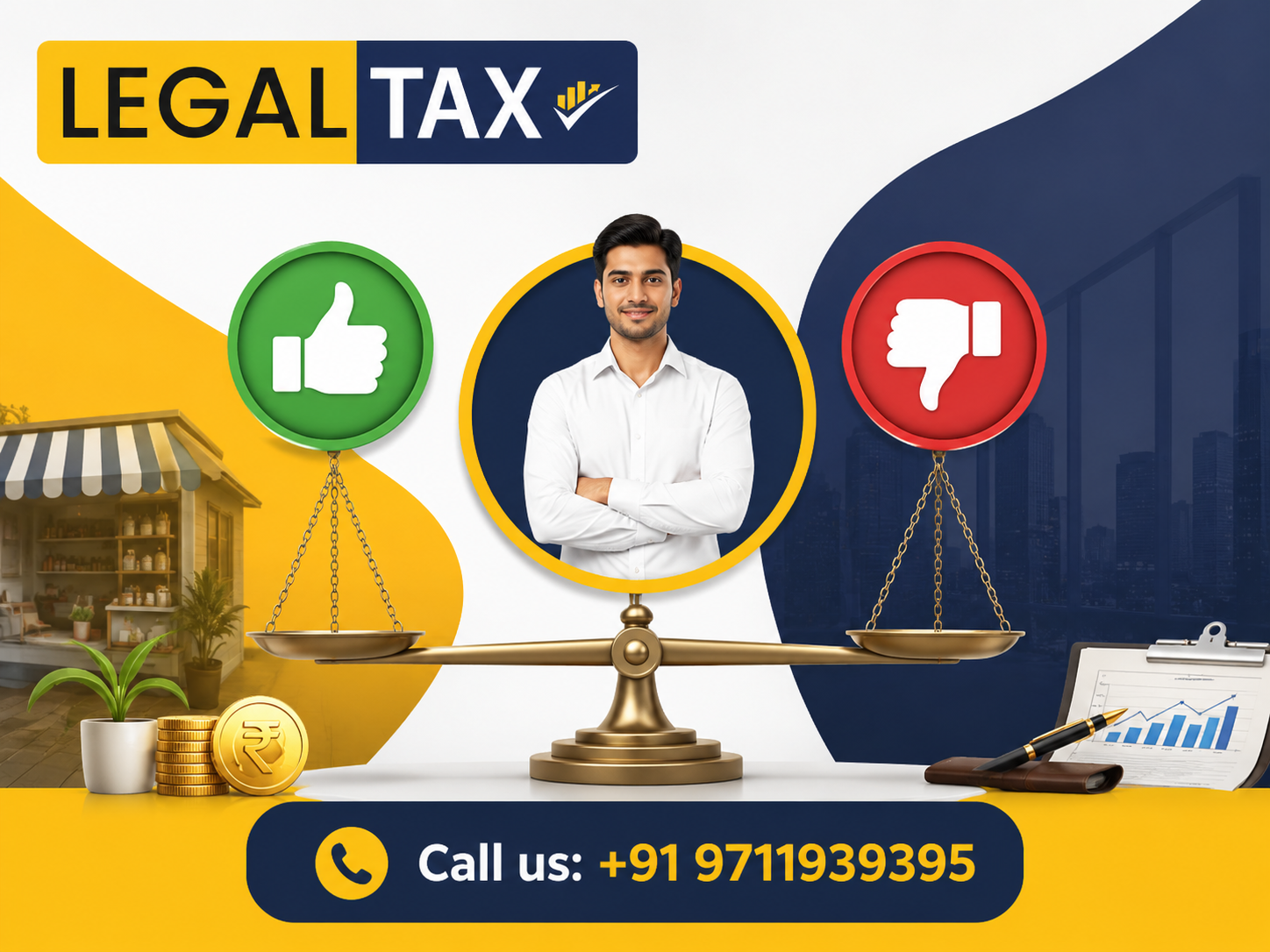
This guide is written for individuals who are evaluating the sole proprietorship as their business structure — or who are already operating as sole proprietors and want to understand the full picture of what their structure means for their business, their finances, and their personal liability. We cover the genuine advantages and the real disadvantages, without glossing over either side.
What Is a Sole Proprietorship?
A sole proprietorship is a business owned and operated by a single individual — the proprietor — who is personally and solely responsible for all aspects of the business. There is no legal separation between the proprietor as an individual and the business as an entity. The business is not incorporated, not registered as a company or LLP, and has no existence independent of its owner.
In India, there is no single central registration that formally constitutes a sole proprietorship. The business comes into existence simply by the proprietor commencing business activity. Various registrations — GST registration, Shops and Establishments registration, MSME (Udyam) registration, trade licence — may be obtained depending on the nature and scale of the business, but none of these create a separate legal entity. They are operational registrations, not entity creation.
This distinction — the absence of a separate legal identity — is the central structural fact of the sole proprietorship, and it is the source of both its most significant advantages and its most significant disadvantages.
Advantages of Sole Proprietorship
1. Easiest and Cheapest to Start
A sole proprietorship requires no formal registration to begin operating. There is no incorporation process, no filing with the Registrar of Companies, no partnership deed, no minimum capital requirement. A person can decide today to start a business and begin operating tomorrow.
The cost of starting is limited to whatever operational registrations are required for the specific business — a GST registration if turnover warrants it, a trade licence if the local municipality requires it, a Udyam registration if MSME benefits are desired. These are low-cost, often online processes that can be completed in days.
For someone testing a business idea, starting a side income stream, or entering business for the first time, the zero friction of the sole proprietorship formation is a genuine and significant advantage.
2. Complete Control and Decision-Making Freedom
In a sole proprietorship, every decision belongs to the proprietor. Pricing, suppliers, staff, working hours, product range, business direction, expansion plans — all are made by one person, without needing to consult partners, obtain board approval, or hold meetings.
This speed of decision-making is a real competitive advantage in many business contexts. A sole proprietor can respond to market changes, customer requests, and opportunities faster than a structure that requires collective decision-making. The proprietor does not need to explain or justify decisions to co-owners or investors.
For individuals who have a clear business vision and the capability to execute it, this autonomy is one of the most valued features of the sole proprietorship.
3. All Profits Belong to the Proprietor
In a partnership, profits are shared among partners. In a company, profits are distributed as dividends — with tax implications and regulatory requirements. In a sole proprietorship, every rupee of profit after taxes belongs entirely to the proprietor.
There is no obligation to share profits, no negotiation about profit ratios, no minority shareholder whose interests must be considered. The financial rewards of the business flow entirely to the one person who built it.
4. Simple Taxation
A sole proprietorship is not taxed as a separate entity. The business income is treated as the personal income of the proprietor and is taxed under the individual income tax slabs. The proprietor files a single Income Tax Return (ITR) that includes both personal income and business income.
This means there is no corporate tax, no dividend distribution tax, and no need for separate tax filings for the business. The tax structure is as simple as it gets. For proprietors in lower income brackets — particularly those whose total income including business profits falls below the higher tax slabs — this simplicity is a genuine advantage.
5. Minimal Compliance Burden
A sole proprietorship has no mandatory annual filings with the Registrar of Companies, no requirement to maintain audited accounts (unless turnover crosses the tax audit threshold under the Income Tax Act), no board meetings to hold, and no annual returns to file.
The compliance obligations are limited to: filing an annual Income Tax Return, GST compliance if registered, and any sector-specific regulatory requirements. Compared to the compliance burden of a private limited company or LLP, the sole proprietorship is dramatically simpler to maintain year on year.
6. Easy to Close Down
Winding up a sole proprietorship requires no formal legal process. If the proprietor decides to stop operations — because the business has failed, because they are moving on to something else, or because they are retiring — they simply stop doing business. Operational registrations like GST can be cancelled, trade licences surrendered, and the business ceases to exist.
There is no dissolution procedure, no court approval, no liquidation process. This ease of exit reduces the risk of starting — the cost of failure, in structural terms, is very low.
7. Privacy of Financial Information
A sole proprietorship has no obligation to publicly disclose its financial statements. Unlike a private limited company — whose annual filings are publicly accessible on the MCA portal — a sole proprietor’s finances are private. Customers, competitors, and the general public have no access to the business’s revenue, profit, or financial position.
For many proprietors, this privacy is a genuine advantage — particularly in competitive markets where financial disclosure could disadvantage the business.
8. Direct Relationship With Customers and Business
Because the proprietor is the business, there is typically a direct, personal relationship between the owner and the customers. The proprietor knows their customers, understands their needs, and can provide a level of personalised service that larger, more structured businesses often cannot.
This personal touch is a competitive strength for many sole proprietorships — particularly in service businesses, retail, and professional services.
Disadvantages of Sole Proprietorship
1. Unlimited Personal Liability — The Most Significant Risk
This is the defining limitation of the sole proprietorship — and it cannot be overstated.
Because there is no legal separation between the proprietor and the business, the proprietor is personally liable for every debt and obligation of the business. If the business takes a loan and cannot repay it, the lender can recover the amount from the proprietor’s personal assets — savings, investments, property, vehicle — everything.
If the business is sued — by a customer, a supplier, an employee, a third party injured by a business activity — the legal and financial consequences fall on the proprietor personally. There is no corporate shield, no limited liability protection.
For a small business with modest transactions and limited exposure, this risk may feel theoretical. For a business that borrows significantly, handles large contracts, or operates in a sector where liability claims are common, unlimited personal liability is an existential risk. One lawsuit, one large debt default, one unforeseen liability can destroy not just the business but the proprietor’s entire personal financial situation.
2. Limited Access to Capital
Raising capital is structurally difficult for a sole proprietorship. The business cannot issue shares. It cannot bring in equity investors. Venture capital, angel investment, and private equity are simply not available to a sole proprietorship structure — investors require equity stakes in a legal entity, which a sole proprietorship cannot provide.
Borrowing is also more constrained. Banks and NBFCs lending to sole proprietors are effectively lending to an individual — the credit assessment is based on the proprietor’s personal creditworthiness and assets, not on the business as a standalone entity. The amounts available, the terms, and the conditions are typically less favourable than what a company or LLP with audited financial statements and a track record can access.
For a business that needs to scale — to hire significantly, invest in infrastructure, expand to new markets — the capital constraints of the sole proprietorship are a serious structural limitation.
3. Business Continuity Depends on One Person
A sole proprietorship has no continuity independent of its owner. If the proprietor becomes seriously ill, is incapacitated, or dies, the business effectively ceases to exist. There is no succession mechanism built into the structure, no co-owner to step in, no board to manage continuity.
This lack of perpetual succession creates vulnerability — for the business, for its employees, for its customers, and for the proprietor’s family. A business that has been built over years can effectively end overnight with no structural mechanism to preserve it.
In contrast, a company or LLP has perpetual succession — the death or departure of a director or partner does not end the entity’s existence.
4. Difficulty in Scaling
The sole proprietorship structure, with its single decision-maker and capital constraints, is inherently difficult to scale beyond a certain point. As a business grows, it needs more capital, more management bandwidth, more institutional credibility, and more operational structure — none of which the sole proprietorship provides easily.
Hiring senior employees becomes harder when the business has no institutional structure to offer. Large clients and corporate customers often prefer to contract with companies or LLPs that have defined governance and accountability structures. Government tenders and large procurement contracts frequently require the bidder to be a registered company.
The very features that make the sole proprietorship easy to start — informality, simplicity, single-person ownership — become limiting factors as the business grows.
5. Workload and Burnout Risk
The sole proprietor carries the entire business alone. Sales, operations, finance, administration, customer service, compliance — all of it. There is no partner to share the load, no co-director to take over during illness or absence.
This concentration of responsibility creates a significant personal burden. Many sole proprietors report that the business becomes consuming — always on, always dependent on the proprietor’s time and energy. Vacations are difficult. Illness is disruptive. Burnout is a real and common outcome for sole proprietors who do not manage their personal capacity carefully.
6. Lower Credibility With Large Clients and Institutions
A sole proprietorship, by its informal structure, may be perceived as less credible or less stable than a registered company or LLP — particularly by large corporate clients, government agencies, banks, and institutional partners.
This perception affects the ability to win large contracts, access institutional credit, and build partnerships with larger organisations. A private limited company, with its formal governance structure, audited accounts, and MCA registration, signals a level of institutional seriousness that a sole proprietorship structurally cannot match.
For businesses that primarily serve individual consumers, this is rarely a problem. For businesses that seek corporate or institutional clients, it is a real competitive disadvantage.
7. No Separation of Personal and Business Finances
Because the proprietor and the business are legally the same person, many sole proprietors — particularly early on — mix personal and business finances. Business expenses paid from personal accounts, personal expenses paid from business accounts, unclear records of what is business income and what is personal.
This mixing creates problems at multiple levels: tax compliance becomes complicated, financial analysis of the business is difficult, and in any dispute or audit, the absence of clear financial separation creates vulnerability.
Even though there is no legal requirement to maintain separate accounts, sole proprietors who are serious about their businesses should maintain strict separation — a dedicated business bank account, separate records, and clear bookkeeping.
8. Limited Talent Attraction
Senior professionals and experienced employees often prefer to work for companies with formal structures, defined HR policies, ESOPs, and institutional stability. Attracting top talent to a sole proprietorship is harder — both because the business may not be able to offer competitive compensation structures, and because the informality of the structure may raise concerns about job security.
For a sole proprietorship that grows to the point of needing senior management, the structural limitation becomes a talent limitation as well.
When Does a Sole Proprietorship Make Sense?
Given the advantages and disadvantages above, a sole proprietorship is well suited to:
📋 Individuals starting their first business and testing a concept before committing to a formal structure 📋 Freelancers and independent professionals — consultants, designers, writers, coaches — whose liability exposure is limited 📋 Small retail and trading businesses serving individual consumers in a local market 📋 Home-based businesses with modest capital requirements 📋 Businesses where the owner intends to remain the sole operator with no plans for significant scaling
A sole proprietorship is not well suited to:
📋 Businesses with significant borrowing or financial exposure 📋 Businesses in sectors where liability claims are common — manufacturing, food service, healthcare, construction 📋 Businesses that intend to raise external capital or bring in co-investors 📋 Businesses that aspire to serve large corporate or institutional clients 📋 Businesses that intend to scale significantly, hire senior staff, or expand across geographies
When to Convert From Sole Proprietorship to a Company or LLP
Many businesses start as sole proprietorships and outgrow the structure. The right time to consider conversion is when:
📋 Turnover crosses a level where unlimited personal liability becomes a real risk 📋 The business needs to raise capital from investors 📋 Large clients or contracts require a formal company structure 📋 The business needs to bring in partners or co-owners 📋 The proprietor wants to build a business that can survive independently of them 📋 The business is taking on employees at a scale that requires institutional HR structure
Conversion from a sole proprietorship to a private limited company or LLP is a straightforward process — assets, contracts, and registrations can be transferred to the new entity. The earlier this transition is made when the signals are present, the smoother it tends to be.
FAQs
What is a sole proprietorship in India?
A sole proprietorship is a business structure owned and managed by one individual where the owner and the business are legally considered the same entity. It is one of the simplest forms of business in India.
What are the main advantages of a sole proprietorship?
The major advantages include easy setup, low registration cost, full control over business decisions, fewer legal compliances, and direct ownership of profits by the proprietor.
What is the biggest disadvantage of a sole proprietorship?
The biggest disadvantage is unlimited liability, meaning the owner is personally responsible for all business debts and losses, and personal assets may be used to repay liabilities.
What happens to the business if the proprietor dies or becomes unable to operate?
A sole proprietorship may not continue automatically after the proprietor’s death or incapacity because the business depends entirely on the owner.
Is sole proprietorship suitable for large businesses?
Generally, sole proprietorship is more suitable for small businesses. Large businesses often prefer LLPs or private limited companies for better funding opportunities, legal protection, and scalability.
Conclusion
The sole proprietorship is the most accessible business structure in India — easy to start, simple to run, inexpensive to maintain, and quick to close. For millions of Indian entrepreneurs, it is the right structure for where they are in their business journey.
But ease of entry should not be confused with freedom from risk. The unlimited personal liability of a sole proprietorship is a structural feature that carries real consequences as a business grows. The capital constraints, succession limitations, and credibility challenges are not problems that discipline or hard work can overcome — they are baked into the structure itself.
The right question to ask is not whether a sole proprietorship is good or bad in the abstract — it is whether it is the right structure for your specific business, at this specific stage, given your specific goals and risk profile. Many businesses are well served by starting as sole proprietorships. Fewer are well served by remaining sole proprietorships indefinitely.
Start where you are. Understand what you have. And structure your business to support where you want to go.
Need Help Choosing the Right Business Structure?
🟡 LegalTax.in helps individuals and entrepreneurs evaluate the right business structure — sole proprietorship, LLP, or private limited company — and handles complete registration and compliance support across India.
👉 Private Limited Company Registration 👉 LLP Registration 👉 GST Registration and Filing 👉 MSME / Udyam Registration 👉 Income Tax Filing 👉 Startup India Registration
🟡 Protect Your Business Brand 👉 Trademark Registration at LegalIP.in 👉 Patent Registration at LegalIP.in 👉 Copyright Registration at LegalIP.in 👉 Design Registration at LegalIP.in
📞 Call Now: +91 9711939395 🕐 Free Consultation: Monday to Saturday, 9 AM to 6 PM

Anjali is a Digital Marketing Expert at LegalTax.in who builds websites that rank and convert. She specializes in SEO-driven web development, helping people find the right legal help online.
Our Clients