Views: 12
Table of Contents
- 1 Introduction
- 2 What Is Copyright and What Does It Protect?
- 3 Who Owns the Copyright?
- 4 Why Register Copyright if It Arises Automatically?
- 5 What Cannot Be Registered as Copyright?
- 6 Step-by-Step Copyright Registration Process in India 2026
- 7 Copyright Registration Fee in India 2026
- 8 How Long Does Copyright Registration Take?
- 9 Duration of Copyright Protection in India
- 10 Copyright Registration for Software in India
- 11 Copyright vs Trademark vs Patent: Understanding the Difference
- 12 Benefits of Copyright Registration: A Summary
- 13 Common Mistakes in Copyright Registration
- 14 Frequently Asked Questions
- 15 Conclusion
- 16 Need Help With Copyright Registration and IP Protection?
Introduction
Every time a writer completes a novel, a musician records a song, a software developer writes code, a filmmaker produces a video, or a graphic designer creates an original artwork, something valuable is created. That creation is not just a product or a file. It is an intellectual work that belongs to its creator from the moment it comes into existence.
India’s copyright law recognises this ownership automatically. Under the Copyright Act, 1957, copyright in an original work arises the moment the work is created in a tangible form. There is no registration requirement for copyright to exist. The author of an original literary, artistic, musical, dramatic, or cinematographic work owns the copyright in that work from the moment of creation, without any formality.
But automatic ownership and provable ownership are two different things. When a copyright dispute arises, when someone copies your work and you need to take legal action, when a publisher or investor asks for proof of ownership, or when you want to license your work commercially, the question that matters is not whether you own the copyright but whether you can prove it. That is where copyright registration becomes practically essential.
Copyright registration in India creates an official, time-stamped, government record of the copyright claim. It is not mandatory. But it is the most reliable evidence of ownership available to a copyright holder, and it significantly strengthens the legal position in any dispute or enforcement action.
In 2026, copyright registration in India is administered by the Copyright Office under the Department for Promotion of Industry and Internal Trade (DPIIT), and applications are filed online through the Copyright Office portal. The process has been largely digitalised, making it more accessible than ever for individual creators, businesses, and institutions.
This guide explains everything about copyright registration in India in 2026, covering what can be registered, who can apply, the step-by-step application process, the cost, the timeline, the benefits, and the common mistakes to avoid.
What Is Copyright and What Does It Protect?
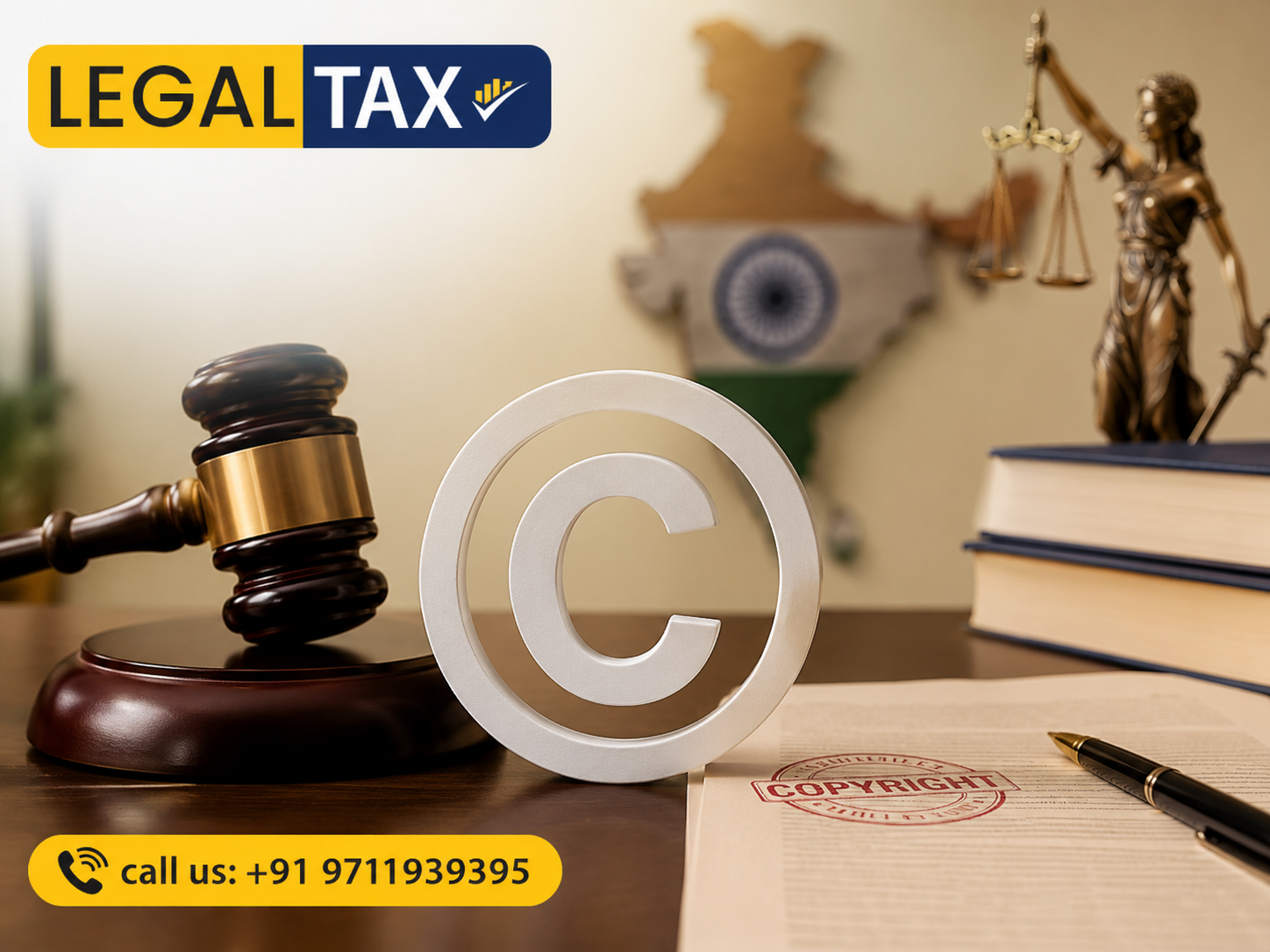
Copyright is a form of intellectual property protection that gives the creator of an original work exclusive rights over how that work is used, reproduced, distributed, adapted, and communicated to the public.
Under the Copyright Act, 1957, copyright protection extends to the following categories of works:
📋 Literary works: Novels, short stories, poems, essays, articles, blogs, textbooks, instruction manuals, computer programs, tables, and compilations 📋 Musical works: Musical compositions including the notes and any accompanying lyrics 📋 Artistic works: Paintings, drawings, sculptures, engravings, photographs, maps, charts, plans, logos, and works of artistic craftsmanship 📋 Dramatic works: Scripts for plays, screenplays, choreographic works, and entertainment shows 📋 Cinematographic films: Motion pictures, documentaries, short films, web series, and other audiovisual works 📋 Sound recordings: Recorded music, podcasts, audiobooks, and other audio works independent of the musical composition
Copyright protection covers the expression of an idea, not the idea itself. The idea of writing a detective story is not protectable. The specific words, plot, characters, and narrative of a particular detective story are protectable. This distinction between idea and expression is fundamental to copyright law.
Who Owns the Copyright?
Understanding who owns the copyright is important before applying for registration.
📋 Author of the work: In most cases, the person who creates the work is its first owner. A writer owns their novel. A photographer owns their photograph. A software developer owns the code they write independently.
📋 Employer in employment cases: If a work is created by an employee in the course of their employment, the employer is the first owner of the copyright in that work, unless there is a contract to the contrary. A content writer employed by a company does not own the articles they write as part of their job.
📋 Commissioner in commissioned works: For certain categories of works, including photographs, paintings, portraits, and engravings commissioned and paid for by a person, the person who commissions and pays for the work is the first owner.
📋 Producer for cinematographic films and sound recordings: The producer of a film or sound recording is the first owner of the copyright in those works.
📋 Government works: Works made or published by or under the direction or control of the government are owned by the government.
Why Register Copyright if It Arises Automatically?
This is the most frequently asked question about copyright registration in India. If copyright arises automatically at creation, why go through the effort and expense of registration?
The answer lies in the practical realities of enforcement and dispute resolution.
Registration Creates Prima Facie Evidence of Ownership
📋 A copyright registration certificate is a government record that establishes the registered owner as the prima facie owner of the work from the date of registration. 📋 In a copyright infringement dispute, the registered owner does not need to independently prove ownership. The certificate itself is evidence. The burden shifts to the infringer to challenge the registration. 📋 Without registration, the creator must establish ownership through other means, such as drafts, timestamps, publication records, and witness testimony, which is more difficult and uncertain.
Registration Establishes the Creation Date
📋 The registration application records the date of creation of the work and the date of application. 📋 This timestamp is crucial when two parties claim ownership of the same or similar work. The party with the earlier registration date has a stronger legal position.
Registration Enables Stronger Legal Remedies
📋 In copyright infringement proceedings before Indian courts, a registered copyright holder is in a stronger procedural position than an unregistered one. 📋 Courts are more readily inclined to grant interim injunctions, search and seizure orders, and other urgent reliefs to registered copyright holders.
Registration Supports Commercial Exploitation
📋 Publishers, producers, investors, streaming platforms, and licensees routinely ask for proof of copyright ownership before entering into agreements. 📋 A copyright registration certificate is the clearest and most accepted proof of ownership for commercial purposes. 📋 Licensing and assignment agreements for registered copyrights are more straightforward to document and enforce.
Registration Deters Infringement
📋 A publicly accessible copyright registration record signals to potential infringers that the work is owned and registered, creating a deterrent effect.
What Cannot Be Registered as Copyright?
Not everything can be registered under the Copyright Act. The following are not protectable by copyright:
📋 Ideas, concepts, and facts: Copyright protects expression, not ideas. The concept of a mobile banking app is not protectable. The specific code, design, and content of a particular app are protectable. 📋 Titles, names, slogans, and short phrases: These are generally not protectable by copyright. They may be protectable as trademarks. 📋 Works that lack originality: A work must be original, in the sense that it is independently created by the author and involves at least a minimal degree of creativity. A simple alphabetical list of names is not original enough for copyright. 📋 Works in the public domain: Works whose copyright has expired are in the public domain and cannot be re-registered. 📋 Government works in certain categories: Certain government documents are in the public domain.
Step-by-Step Copyright Registration Process in India 2026
Step 1: Create an Account on the Copyright Office Portal
Copyright registration applications in India are filed online through the Copyright Office portal at copyright.gov.in.
📋 Visit copyright.gov.in and create a new user account 📋 Register with a valid email address and mobile number 📋 Verify the account through the OTP sent to the registered email and mobile number 📋 Log in to the portal with the created credentials
Step 2: Prepare the Application
Before beginning the application, prepare the following:
📋 Title of the work 📋 Category of the work, literary, artistic, musical, dramatic, cinematographic, or sound recording 📋 Year and country of first publication, if the work has been published 📋 Nature of the work, a brief description 📋 Details of the applicant, name, address, nationality 📋 Details of the author, if different from the applicant 📋 Statement of ownership, whether the applicant is the author, assignee, or exclusive licensee 📋 Copies of the work to be deposited with the application
Step 3: File the Application Online
📋 Log in to the copyright.gov.in portal 📋 Select the appropriate form based on the category of work
Form IV is the standard application form used for copyright registration of all categories of works in India. There is one form for all work types.
📋 Fill in the application form with all required details 📋 Upload the copy of the work, the deposit copy, in the prescribed digital format 📋 For published works: upload the published version 📋 For unpublished works: upload the manuscript, file, or work in its current form 📋 Upload the No Objection Certificate (NOC) from the author if the applicant is not the author 📋 Upload the assignment deed or licence agreement if the applicant is an assignee or exclusive licensee 📋 Pay the prescribed application fee online
Step 4: Mandatory 30-Day Waiting Period
After the application is filed, the Copyright Office mandates a 30-day waiting period before proceeding with examination. This waiting period is provided to allow any third party who has an objection to the registration to file a notice of objection with the Copyright Office.
📋 During this 30-day period, the Copyright Office publishes the application details in the Copyright Journal 📋 If no objection is received within 30 days, the application proceeds to examination 📋 If an objection is received, both parties are given an opportunity to be heard before the Copyright Office decides whether to proceed with registration
Step 5: Examination by the Copyright Office
After the 30-day waiting period, the application is examined by the Copyright Office.
📋 The examiner reviews the application for completeness and compliance with the Copyright Act and Rules 📋 If the examiner has any queries or requires additional information or documents, a letter of discrepancy is issued to the applicant 📋 The applicant must respond to the discrepancy letter within the prescribed time 📋 If the response is satisfactory, the application proceeds to registration
Step 6: Issuance of Registration Certificate
Once the examination is complete and the Copyright Office is satisfied that the application is in order, the copyright registration certificate is issued.
📋 The certificate is issued in the name of the registered owner 📋 It records the title of the work, the category, the date of creation, the date of registration, and the registration number 📋 The certificate is available for download from the Copyright Office portal 📋 The copyright registration number can be cited in legal proceedings, licensing agreements, and commercial documentation
Copyright Registration Fee in India 2026
The government fee for copyright registration in India is modest and varies by the category of work.
Literary, Dramatic, Musical, and Artistic Works
📋 For published works: Rs. 500 per work 📋 For unpublished works: Rs. 500 per work
Cinematographic Films
📋 Rs. 5,000 per work
Sound Recordings
📋 Rs. 2,000 per work
Software and Computer Programs (classified as literary works)
📋 Rs. 500 per work
These are the government fees payable to the Copyright Office. Professional fees for a copyright attorney or agent assisting with the application add to the total cost.
Professional Fees:
📋 For straightforward literary, artistic, or musical works: Rs. 2,000 to Rs. 8,000 📋 For software copyright registration: Rs. 5,000 to Rs. 15,000 📋 For cinematographic films with complex ownership structures: Rs. 10,000 to Rs. 30,000
Total estimated cost per registration:
📋 Literary, artistic, musical works (with professional assistance): Rs. 2,500 to Rs. 8,500 📋 Software: Rs. 5,500 to Rs. 15,500 📋 Cinematographic films: Rs. 15,000 to Rs. 35,000
Copyright registration is one of the most affordable forms of intellectual property registration available in India.
How Long Does Copyright Registration Take?
The timeline for copyright registration in India in 2026 depends on whether objections are filed and how quickly the examination proceeds.
📋 Without objection or discrepancy: Approximately 2 to 4 months from application to certificate. This includes the mandatory 30-day waiting period plus examination and processing time. 📋 With discrepancy letter: Add 1 to 2 months for the response and re-examination process. 📋 With third-party objection: Add 3 to 6 months for the hearing and resolution process.
For applicants who need a faster registration, the Copyright Office has in practice been processing applications within shorter timelines in 2026 compared to earlier years, reflecting improvements in the online system and reduced backlog.
Duration of Copyright Protection in India
Copyright protection in India lasts for the following periods under the Copyright Act, 1957:
Literary, Dramatic, Musical, and Artistic Works
📋 Lifetime of the author plus 60 years from the beginning of the calendar year following the year of death of the author 📋 For works with multiple authors, the 60-year period runs from the death of the last surviving author
Cinematographic Films
📋 60 years from the beginning of the calendar year following the year of publication
Sound Recordings
📋 60 years from the beginning of the calendar year following the year of publication
Government Works
📋 60 years from the beginning of the calendar year following the year of publication
Anonymous and Pseudonymous Works
📋 60 years from the beginning of the calendar year following the year of publication
After the copyright term expires, the work enters the public domain and can be freely used by anyone without permission.
Copyright Registration for Software in India
Software copyright registration deserves special attention because it is increasingly important for Indian technology businesses, startups, and developers.
📋 Computer programs, including source code and object code, are classified as literary works under the Copyright Act and are eligible for copyright registration 📋 The registration process is the same as for other literary works, using Form IV with a fee of Rs. 500 📋 The applicant must deposit a copy of the source code with the application. For proprietary software, the Copyright Office allows deposit of a partial source code (typically the first 25 and last 25 pages) to protect trade secrets while still providing evidence of the work 📋 Software copyright registration is particularly important for Indian software companies that license their products to clients, as it provides a strong legal basis for enforcing licence terms and preventing unauthorised copying
Copyright vs Trademark vs Patent: Understanding the Difference
Many creators and businesses are unsure which form of intellectual property protection is appropriate for their work.
Copyright protects original creative expression. It arises automatically and can be registered for a modest fee. It protects the specific creative expression of an idea, not the idea itself. Duration is the lifetime of the author plus 60 years.
Trademark protects brand identifiers, including names, logos, and slogans that distinguish the goods or services of one business from another. It requires registration and renewal every 10 years. It protects commercial identity, not creative expression.
Patent protects inventions, including novel and non-obvious technical innovations in any field of technology. It requires registration and is valid for 20 years. It protects the functional innovation, not the creative expression.
A creator or business may need more than one form of protection for different aspects of their work. A software company may need copyright registration for its code, trademark registration for its product name and logo, and patent registration for any novel technical processes the software implements.
Benefits of Copyright Registration: A Summary
📋 Prima facie evidence of ownership in legal proceedings and disputes 📋 Government record with a timestamped certificate establishing the creation and registration date 📋 Stronger enforcement rights in infringement proceedings before courts and the Copyright Board 📋 Eligibility for stronger interim remedies including injunctions and Anton Piller orders 📋 Commercial credibility with publishers, producers, investors, streaming platforms, and licensees 📋 Licensing and assignment documentation is cleaner and more enforceable 📋 Deterrent to infringers through the public record of registered ownership 📋 Border protection through Customs notifications for registered works, preventing import of infringing copies
Common Mistakes in Copyright Registration
Registering the title rather than the work: Copyright does not protect titles. The registration covers the work itself, not its name. Many applicants mistakenly believe that registering a title is the primary purpose of copyright registration.
Not depositing an adequate copy of the work: The deposit copy submitted with the application must be a complete and accurate copy of the work being registered. Submitting an incomplete or modified version can affect the scope of protection.
Incorrect identification of the copyright owner: Registering in the author’s name when the employer is the actual first owner, or vice versa, creates a mismatch that weakens the registration in disputes.
Not obtaining NOC from the author: When the applicant is not the author, a No Objection Certificate from the author is required. Missing this document leads to discrepancy letters and delays.
Not registering multiple works separately: Each work must be registered separately with a separate fee. Attempting to register a collection of works under a single application is only possible in specific circumstances.
Waiting too long after publication: While there is no strict deadline for copyright registration, registering promptly after creation or publication ensures that the registration is in place before any infringement occurs.
Frequently Asked Questions
Is copyright registration mandatory in India?
No, copyright registration is not mandatory because copyright protection generally arises automatically when an original work is created. However, registration provides official evidence of ownership and can be highly beneficial in legal disputes and enforcement actions.
Who can apply for copyright registration?
Authors, artists, musicians, software developers, photographers, filmmakers, publishers, companies, and other creators or owners of original works can apply for copyright registration. Applications may be filed by the owner directly or through an authorized representative.
Can software be copyrighted in India?
Yes, computer software and source code are generally protected as literary works under Indian copyright law. Copyright registration can help software developers establish ownership and protect against unauthorized reproduction or distribution.
What happens if someone copies my copyrighted work?
The copyright owner may take legal action against unauthorized use, reproduction, distribution, publication, or adaptation of the protected work. Available remedies may include injunctions, damages, compensation, and other relief provided under copyright law.
Can copyright ownership be transferred or licensed?
Yes, copyright owners can assign, sell, transfer, or license their rights to other individuals or organizations through legally valid agreements. Such arrangements allow creators to commercially exploit their works while retaining or transferring specified rights.
Conclusion
Copyright registration in India in 2026 is affordable, accessible, and online. The government fee is as low as Rs. 500 for most categories of works. The process is straightforward for individual creators and businesses alike. The benefits, particularly the evidentiary value of the registration certificate and the stronger enforcement position it provides, are disproportionately large relative to the modest cost of registration.
Every original work of creative expression that has commercial value deserves to be registered. Writers, musicians, filmmakers, graphic designers, software developers, content creators, and businesses that produce original creative content should treat copyright registration as a routine part of their intellectual property strategy, not as an optional formality.
The copyright arises the moment you create. The protection is complete the moment you register.
Create. Register. Protect.
Need Help With Copyright Registration and IP Protection?
🟡 Legal Tax provides complete copyright registration, trademark registration, patent filing, and design registration services for individual creators, startups, and businesses across all sectors in India.
👉 Copyright Registration at LegalIP.in 👉 Trademark Registration 👉 Patent Registration 👉 Design Registration 👉 Trademark Objection Reply 👉 Trademark Renewal
🟡 Also Need Business Registration or Compliance Support? 👉 Private Limited Company Registration 👉 Startup India Registration 👉 GST Registration and Filing 👉 MSME / Udyam Registration
🟡 Need IT or Digital Support for Your Business? 👉 Website Development 👉 SEO Services 👉 Social Media Marketing 👉 Lead Generation
📞 Call Now: +91 9711939395 ✉️ Email: info@legaltax.in 🕐 Free Consultation: Monday to Saturday, 9 AM to 6 PM

Adv. Manish Kashyap is an IPR Law Expert with 10+ years of professional experience in Intellectual Property Rights. He specializes in matters related to Trademark, Copyright, Patent, and other IPR-related legal services, helping individuals and businesses protect and manage their intellectual property effectively.
Our Clients