Views: 35
Table of Contents
- 1 Quick Summary
- 2 📌 What Is ISO Certification?
- 3 🏛️ Why NGOs Need ISO Certification
- 4 📜 Which ISO Standard Is Most Relevant for NGOs?
- 5 🔍 ISO 9001:2015 — Quality Management System Explained
- 6 👥 Other ISO Standards Applicable to NGOs
- 7 🔒 Who Can Apply — Types of NGOs Eligible
- 8 💰 Benefits of ISO Certification for NGOs
- 9 📋 Step by Step Process for ISO Certification for NGO
- 10 📄 Documents Required for ISO Certification for NGO
- 11 💰 Cost of ISO Certification for NGO in India
- 12 🏛️ ISO Certification Bodies in India — How to Choose
- 13 🔄 Internal Audit and Management Review
- 14 🔁 Surveillance Audits and Recertification
- 15 ⚖️ ISO Certification vs NGO Registration — Key Differences
- 16 💰 ISO Certification and Government Grants / CSR Funding
- 17 🌍 ISO Certification and FCRA — Is There a Connection?
- 18 🚫 Common Mistakes in ISO Certification for NGOs
- 19 🌟 How Legal Tax Helps NGOs Get ISO Certified
- 20 💰 Cost Breakdown: ISO Certification for NGO
- 21 ❓ Frequently Asked Questions (FAQs)
- 22 🎯 Who Needs This Guide Right Now?
- 23 ✅ Final Recommendation
- 24 🟡 Need Help With ISO Certification or Business Compliance?
Quick Summary
ISO Certification for NGO is a formal recognition that your organisation follows internationally accepted standards of quality management, governance and operational efficiency.
Here is what you need to know upfront:
- ⚖️ Definition — ISO Certification confirms that your NGO’s processes, governance and service delivery meet international quality standards
- 🔒 Most Relevant Standard — ISO 9001:2015 (Quality Management System) is the most widely applicable ISO standard for NGOs
- 💰 Cost — Certification body fees range from ₹15,000 to ₹50,000+ depending on NGO size; Legal Tax consultation starts at ₹499
- 📋 Timeline — Typically 2–4 months from documentation to certification
- 🚨 Who can apply — Trusts, Societies, Section 8 Companies, Foundations, NGOs of all sizes
- ✅ Legal Tax helps NGOs with ISO documentation, gap analysis, audit preparation and complete certification support — starting at ₹499
Whether you are a small community NGO or a large national foundation — this guide explains ISO certification for NGOs completely.
📌 What Is ISO Certification?
ISO stands for the International Organization for Standardization — an independent, non-governmental international body headquartered in Geneva, Switzerland, that develops and publishes international standards across virtually every industry and sector.
An ISO certification is a formal confirmation — issued by an accredited third-party certification body — that your organisation’s management systems, processes and operations conform to the requirements of a specific ISO standard.
ISO certification is not a one-time stamp of approval. It is a living certification — requiring ongoing compliance, internal audits, and periodic surveillance and recertification audits by the certification body.
For NGOs, ISO certification is a powerful signal of:
- Credibility — that your organisation operates with structured, accountable processes
- Transparency — that your governance and programme management follow documented, auditable systems
- Accountability — that you measure your performance against defined objectives and continuously improve
The core purpose of ISO Certification for NGO: To demonstrate to donors, government bodies, CSR funders, beneficiaries and the public that your organisation operates to the highest international standards of quality, governance and accountability.
🏛️ Why NGOs Need ISO Certification
The Indian NGO sector has grown enormously — with over 3 million NGOs registered across the country. In this crowded landscape, ISO certification provides a critical competitive advantage and builds trust with key stakeholders.
Here is why ISO certification matters for NGOs today:
🏆 Donor Credibility Institutional donors — both Indian and international — increasingly require evidence of robust organisational systems before releasing funds. ISO 9001 certification provides this assurance at an internationally recognised level.
💼 CSR Funding Access Companies disbursing CSR funds under Section 135 of the Companies Act 2013 prefer to partner with NGOs that have demonstrable governance credentials. ISO certification is a strong differentiator in CSR partner selection.
🏛️ Government Grants and Contracts Several central and state government grant schemes explicitly prefer or require ISO certified implementing partners. ISO certification strengthens your eligibility for government funding.
🌍 FCRA and International Funding NGOs receiving foreign contributions under FCRA are subject to increased scrutiny. ISO certification demonstrates robust governance and financial management systems — reducing regulatory risk.
📈 Operational Efficiency The ISO certification process itself forces your NGO to document processes, eliminate redundancy, define roles and measure outcomes — resulting in real operational improvement regardless of the certificate.
👥 Staff and Volunteer Accountability Documented processes and clear role definitions — required under ISO 9001 — improve staff accountability and reduce dependence on key individuals.
🤝 Partnership Opportunities Corporates, international NGOs and multilateral organisations prefer implementing partners with ISO certification — as it reduces due diligence burden on their side.
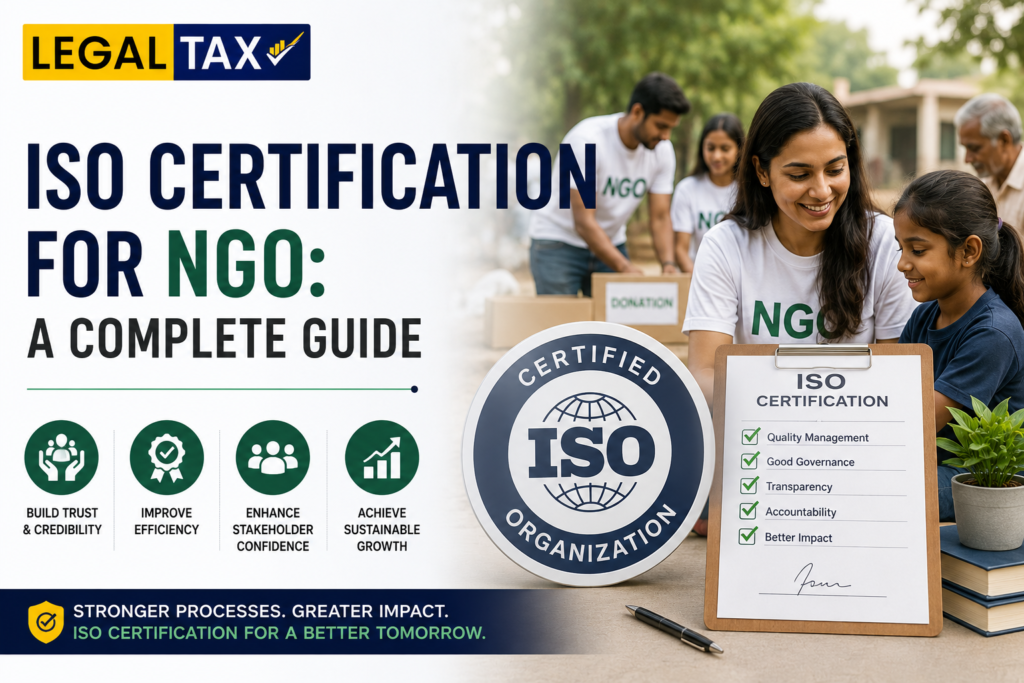
📜 Which ISO Standard Is Most Relevant for NGOs?
There are hundreds of ISO standards covering different sectors and functions. For NGOs, the following are most commonly applicable:
| ISO Standard | What It Covers | Relevance for NGOs |
|---|---|---|
| ISO 9001:2015 | Quality Management System | Most widely applicable — covers processes, governance, service delivery |
| ISO 14001:2015 | Environmental Management System | Relevant for environment-focused NGOs |
| ISO 45001:2018 | Occupational Health and Safety | Relevant for NGOs with field staff in hazardous conditions |
| ISO 27001:2022 | Information Security Management | Relevant for NGOs handling sensitive beneficiary data |
| ISO 26000 | Social Responsibility Guidance | Guidance standard — not certifiable, but useful reference |
| ISO 50001:2018 | Energy Management | Relevant for NGOs with significant energy use |
For most NGOs, ISO 9001:2015 is the primary and most valuable certification to pursue.
ISO 9001:2015 is sector-neutral — it applies to any organisation, including non-profits and NGOs — and its requirements directly address the governance, process and accountability gaps that commonly affect the NGO sector.
🔍 ISO 9001:2015 — Quality Management System Explained
ISO 9001:2015 is the world’s most widely adopted quality management standard — with over 1 million organisations certified globally across all sectors.
It is based on seven Quality Management Principles:
- Customer Focus — For NGOs, “customers” are beneficiaries, donors and community stakeholders. Their needs must drive programme design and delivery.
- Leadership — Top management must demonstrate commitment to the QMS and set the direction, values and culture of the organisation.
- Engagement of People — Staff and volunteers at all levels must be engaged, competent and empowered to contribute to quality outcomes.
- Process Approach — Activities and resources must be managed as processes with defined inputs, outputs, responsibilities and performance indicators.
- Improvement — Continuous improvement of processes, outcomes and the QMS itself is a core requirement.
- Evidence-Based Decision Making — Decisions must be based on analysis of data and information — not intuition alone.
- Relationship Management — Relationships with donors, partners, government and beneficiaries must be systematically managed.
Key Requirements of ISO 9001:2015 for NGOs
Context of the Organisation The NGO must define its internal and external context — who are the relevant stakeholders, what are their needs and expectations, what is the scope of the QMS.
Leadership and Commitment The Board / Governing Body and Executive Director must demonstrate active commitment to the QMS — not delegate it entirely to a quality manager.
Planning Risks and opportunities must be identified and addressed. Quality objectives must be set — with measurable targets, timelines and responsibility.
Support Resources — human, financial, infrastructure, knowledge — must be adequate and properly managed. Competence of staff must be assessed and training provided where needed.
Operation Programme design, implementation, monitoring and evaluation processes must be documented and followed consistently.
Performance Evaluation Internal audits must be conducted. Management reviews must be held. Customer satisfaction — beneficiary, donor and partner feedback — must be measured.
Improvement Nonconformities must be identified, corrected and the root cause addressed. Continual improvement actions must be planned and implemented.
👥 Other ISO Standards Applicable to NGOs
ISO 14001:2015 — Environmental Management System
Relevant for NGOs working in environment, conservation, sustainable development, climate change and natural resource management. Demonstrates that your organisation manages its own environmental impact and integrates environmental considerations into programme design.
ISO 45001:2018 — Occupational Health and Safety
Relevant for NGOs with field staff working in hazardous environments — disaster relief, conflict zones, remote rural areas, construction and rehabilitation projects. Demonstrates that worker safety is systematically managed.
ISO 27001:2022 — Information Security Management
Relevant for NGOs handling sensitive personal data of beneficiaries — health data, financial data, identity documents. Also relevant for NGOs using digital platforms for programme delivery. Demonstrates robust data protection and cybersecurity systems.
ISO 26000 — Social Responsibility
This is a guidance document — not a certifiable standard. However, it provides a valuable framework for NGOs to assess their social responsibility practices across governance, human rights, labour practices, environment, fair operating practices, consumer issues and community involvement.
🔒 Who Can Apply — Types of NGOs Eligible
All types of legally registered NGOs in India are eligible to apply for ISO certification:
| Type of NGO | Registration | Eligible for ISO |
|---|---|---|
| Trust | Indian Trusts Act / state trust laws | ✅ Yes |
| Society | Societies Registration Act 1860 | ✅ Yes |
| Section 8 Company | Companies Act 2013 | ✅ Yes |
| Charitable Company | Companies Act 2013 | ✅ Yes |
| Foundation | Trust or Section 8 | ✅ Yes |
| Community Based Organisation | State laws | ✅ Yes |
| Religious Trust (with charitable activities) | Trust laws | ✅ Yes |
Size does not matter. ISO 9001:2015 is equally applicable to a small 5-person NGO running a single programme and a large 500-person multi-state NGO implementing complex development projects. The standard is scalable — the depth of documentation and systems is proportionate to the organisation’s size and complexity.
💰 Benefits of ISO Certification for NGOs
For Donors and Funders
ISO 9001 certification signals that your NGO has:
- Documented programme processes with clear accountability
- Measurable objectives and performance monitoring
- A formal system for identifying and addressing problems
- Continuous improvement mechanisms built into operations
This dramatically reduces the due diligence burden on donors — and increases confidence in your organisation’s ability to deliver results and account for funds.
For Government and FCRA
ISO certification demonstrates the robust governance and financial management systems that government grant agencies and FCRA regulators look for. It is particularly valuable for NGOs that have faced scrutiny or are seeking renewal of FCRA registration.
For CSR Funding
The Companies Act 2013 requires companies to conduct due diligence on NGO implementing partners before releasing CSR funds. ISO certification is the most internationally recognised shortcut through this due diligence process.
For Beneficiaries
ISO certification means that your beneficiaries receive services through consistent, documented processes — with formal mechanisms for feedback and complaint redressal built in.
For Internal Management
The ISO certification process forces an honest assessment of your current systems — what is working, what is not, what is undocumented and dependent on individual knowledge. The resulting documentation and process improvements have real operational value beyond the certificate.
📋 Step by Step Process for ISO Certification for NGO
Step 1: Consultation and Gap Analysis
Book a ₹499 Legal Tax consultation. An ISO specialist will:
- Understand your NGO’s structure, programmes, size and governance
- Identify which ISO standard(s) are most relevant
- Conduct a gap analysis — comparing your current systems against ISO 9001:2015 requirements
- Prepare a roadmap for closing the gaps and achieving certification
Gap analysis is the most important first step. It tells you exactly what work needs to be done — preventing surprises during the certification audit.
Step 2: Documentation Preparation
ISO 9001:2015 requires a documented Quality Management System. Legal Tax assists in preparing:
- Quality Manual — overall description of your QMS scope, policies and how it applies to your NGO
- Quality Policy — top management’s commitment to quality, signed by the Executive Director / Chairperson
- Quality Objectives — measurable targets for the current year, with timelines and responsibility
- Process Documents — documented procedures for all key processes: programme design, implementation, monitoring, financial management, HR, procurement
- Work Instructions — step-by-step operational instructions for specific tasks
- Forms and Records — standard formats for capturing data, decisions and evidence
Step 3: Implementation
Documentation alone is not sufficient. The systems must actually be implemented and followed by your team. This involves:
- Training all staff on the QMS requirements and their individual responsibilities
- Rolling out documented processes across all departments and programmes
- Establishing the internal audit programme
- Setting up the management review process
- Beginning to capture records and evidence as required by the standard
Implementation period: Typically 1–3 months depending on the size and complexity of the NGO.
Step 4: Internal Audit
Before the certification body audit, an internal audit must be conducted — reviewing all processes against ISO 9001:2015 requirements.
Legal Tax conducts internal audits for NGO clients — identifying nonconformities and recommending corrective actions before the external audit.
Step 5: Management Review
The top management — Board / Governing Body and Executive Director — must conduct a formal Management Review — reviewing:
- Results of internal audits
- Customer / beneficiary feedback
- Process performance and quality objectives progress
- Risks and opportunities
- Resource adequacy
- Decisions and action items for improvement
The Management Review must be formally minuted and documented.
Step 6: Select and Engage Certification Body
A certification body (CB) is an accredited third-party organisation that conducts the certification audit. In India, certification bodies are accredited by the Quality Council of India (QCI) through the National Accreditation Board for Certification Bodies (NABCB).
Legal Tax helps clients identify and engage the right certification body — based on accreditation, cost, reputation and sector experience.
Step 7: Stage 1 Audit (Document Review)
The certification body conducts a Stage 1 Audit — reviewing your documentation and assessing whether your NGO is ready for the Stage 2 audit. The auditor reviews:
- Scope of the QMS
- Quality Manual and documented procedures
- Evidence that implementation has begun
- Suitability of the audit plan for Stage 2
Any major gaps identified in Stage 1 must be addressed before Stage 2 is scheduled.
Step 8: Stage 2 Audit (Certification Audit)
The Stage 2 Audit is the main certification audit — where the auditor visits your NGO (or conducts a remote audit for smaller organisations) and assesses:
- Actual implementation of the QMS in practice
- Evidence of records and compliance with documented processes
- Interviews with staff at all levels
- Review of internal audit and management review records
- Assessment against all clauses of ISO 9001:2015
The auditor identifies any nonconformities — deviations from the standard’s requirements. Nonconformities are classified as:
- Major Nonconformity — a systematic failure that must be corrected before certification is granted
- Minor Nonconformity — a specific lapse that must be addressed within a defined timeframe
- Observation / Opportunity for Improvement — not a nonconformity, but a recommendation for improvement
Step 9: Corrective Action and Certification Decision
Where nonconformities are found, you must submit a corrective action plan — explaining how each nonconformity will be addressed and prevented from recurring. Legal Tax prepares corrective action responses on behalf of clients.
Once the certification body is satisfied, the Certification Decision is made and the ISO 9001:2015 Certificate is issued.
Step 10: Receive ISO Certificate
The ISO 9001:2015 Certificate is issued — valid for 3 years, subject to annual surveillance audits.
The certificate confirms:
- Your NGO’s name and registration details
- The scope of certification
- The ISO standard certified to
- The certification body’s name and accreditation details
- Validity period
📄 Documents Required for ISO Certification for NGO
Organisational Documents
- 📋 Registration certificate of the NGO (Trust deed / Society registration / Certificate of Incorporation)
- 📄 PAN card and TAN of the NGO
- 📊 Latest audited financial statements
- 👥 List of Governing Body / Board members with designations
- 📋 Organogram / organisation structure chart
- 📝 List of ongoing programmes and projects with brief descriptions
QMS Documents (Prepared During Process)
- 📘 Quality Manual
- 📋 Quality Policy (signed by top management)
- 🎯 Quality Objectives document
- 📝 Process documents for all key functions
- 📋 Risk and opportunity register
- 📝 Stakeholder analysis and needs assessment
- 📋 Internal audit plan and reports
- 📝 Management Review minutes
- 📊 Corrective action records
- 📋 Training records and competency assessments
- 📝 Supplier / vendor evaluation records
- 📊 Beneficiary feedback and complaints records
- 📋 Programme monitoring and evaluation records
Financial and HR Documents
- 📊 Bank statements and financial management procedures
- 📋 HR policies — recruitment, leave, performance appraisal
- 📝 Procurement policy
- 📋 Asset register
Legal Tax provides complete templates and formats for all QMS documentation — customised for your NGO’s specific programmes and structure.
💰 Cost of ISO Certification for NGO in India
Certification Body Fees
| NGO Size | Stage 1 + Stage 2 Audit Fee (Approx.) |
|---|---|
| Small NGO (up to 10 staff) | ₹15,000 to ₹25,000 |
| Medium NGO (11–50 staff) | ₹25,000 to ₹40,000 |
| Large NGO (50+ staff, multiple locations) | ₹40,000 to ₹1,00,000+ |
Certification body fees vary by accreditation body, auditor rates and travel costs. Remote audits are cheaper than on-site audits.
Annual Surveillance Audit Fees
Approximately 50–60% of the initial certification audit fee per year.
Legal Tax Professional Fees
| Service | Price |
|---|---|
| Initial Consultation + Gap Analysis | ₹499 onwards |
| QMS Documentation Package | ₹9,999 onwards |
| Implementation Support and Training | ₹7,999 onwards |
| Internal Audit | ₹4,999 onwards |
| Certification Body Selection and Coordination | ₹2,999 onwards |
| Corrective Action Response Preparation | ₹3,999 onwards |
| Complete ISO Certification Package | ₹19,999 onwards |
| Annual Surveillance Audit Support | ₹4,999 per year |
Book Your ISO Certification Consultation with Legal Tax → | 📞 +91 9711939395
🏛️ ISO Certification Bodies in India — How to Choose
Choosing the right certification body is critical. The certification body must be:
NABCB Accredited Only ISO certificates issued by NABCB (National Accreditation Board for Certification Bodies) accredited certification bodies are internationally recognised and accepted by institutional donors, government agencies and CSR departments.
Do not accept ISO certificates from non-accredited certification bodies — they have no international validity and will not be accepted by serious funders.
Check the NABCB Directory The NABCB maintains a public directory of accredited certification bodies at nabcb.qci.org.in. Legal Tax verifies the accreditation status of certification bodies before recommending them to clients.
Sector Experience A certification body with experience in the NGO / development sector will have auditors who understand the specific context of NGO operations — programme delivery, community engagement, donor compliance — and can conduct a more meaningful audit.
Fee and Timeline Fees and audit timelines vary significantly between certification bodies. Legal Tax helps clients obtain competitive quotes and select the most cost-effective accredited option.
🔄 Internal Audit and Management Review
Internal Audit
ISO 9001:2015 requires your NGO to conduct internal audits at planned intervals — to verify that the QMS is effectively implemented and maintained.
Internal audits must be:
- Conducted by trained internal auditors (or external consultants like Legal Tax)
- Based on a documented internal audit programme — covering all processes and clauses of the standard over a defined cycle
- Reported formally — with nonconformities and observations documented
- Followed up — with corrective actions implemented and verified
Legal Tax trains NGO staff as internal auditors — building in-house capacity for long-term QMS sustainability.
Management Review
ISO 9001:2015 requires top management to conduct a formal Management Review at planned intervals — typically annually, but more frequently for NGOs in their first year of certification.
Management Review agenda must cover:
- Status of actions from previous reviews
- Changes in internal and external context
- Audit results — internal and external
- Customer / beneficiary satisfaction and feedback
- Process performance and quality objectives status
- Nonconformities and corrective actions
- Risks and opportunities
- Adequacy of resources
- Opportunities for improvement
Management Review must be formally documented with decisions and action items clearly recorded.
🔁 Surveillance Audits and Recertification
Annual Surveillance Audits
Once certified, your NGO is subject to annual surveillance audits by the certification body — typically in Year 1 and Year 2 of the 3-year certification cycle.
Surveillance audits are less comprehensive than the initial certification audit — they focus on:
- Whether the QMS is being maintained
- Progress on corrective actions from previous audits
- Status of quality objectives
- Internal audit and management review records
- Any changes to the organisation or its processes
Legal Tax supports NGO clients through annual surveillance audits — reviewing documentation, conducting a pre-audit check and preparing the team.
Recertification Audit
At the end of the 3-year certification cycle, a full Recertification Audit is conducted — similar in scope to the initial certification audit. Successful recertification extends the certificate for another 3 years.
⚖️ ISO Certification vs NGO Registration — Key Differences
| Factor | NGO Registration | ISO Certification |
|---|---|---|
| What it is | Legal existence as a Trust / Society / Section 8 Company | Recognition of quality management systems |
| Issuing authority | Registrar of Societies / Sub-Registrar / MCA | Accredited private certification body |
| Mandatory | Yes — to legally exist and operate | No — voluntary, but increasingly expected by donors |
| Validity | Permanent (with annual compliance) | 3 years (with annual surveillance) |
| Purpose | Legal identity and tax exemption | Credibility, donor confidence, operational quality |
| Required for FCRA | Yes — basic NGO registration required | Not mandatory but strengthens application |
| Required for CSR funds | Yes — Section 8 or Society registration preferred | Increasingly expected by CSR departments |
| Cost | Low — state registration fees | Moderate — certification body fees + consultant fees |
ISO certification complements NGO registration — it does not replace it. Your NGO must be legally registered before applying for ISO certification.
💰 ISO Certification and Government Grants / CSR Funding
Government Grants
Several central government ministries and departments — including Ministry of Women and Child Development, Ministry of Social Justice and Empowerment, Ministry of Health and Family Welfare — have begun explicitly preferring ISO certified NGO implementing partners.
State government grant programmes increasingly reflect the same preference — particularly for large-value contracts and long-term partnerships.
ISO 9001 certification demonstrates to government grant agencies that your organisation has:
- Documented processes for fund utilisation and reporting
- Internal audit mechanisms
- Accountability systems for programme delivery
CSR Funding Under Section 135
The Companies Act 2013 mandates that companies with turnover above ₹1,000 crore, net worth above ₹500 crore or net profit above ₹5 crore must spend 2% of average net profit on CSR activities.
CSR departments are required to conduct due diligence on implementing NGOs. ISO 9001 certification dramatically simplifies this due diligence — the certificate is internationally recognised evidence of robust systems.
Many large corporate CSR departments now maintain preferred NGO partner lists — and ISO certification is a common criterion for inclusion. Legal Tax advises NGO clients on ISO certification as part of a broader CSR funding strategy.
🌍 ISO Certification and FCRA — Is There a Connection?
The Foreign Contribution (Regulation) Act 2010 (FCRA) governs receipt of foreign contributions by Indian NGOs. FCRA registration and its annual compliance are mandatory for NGOs receiving international funding.
ISO certification does not replace FCRA registration — both are required independently.
However, ISO certification is increasingly relevant in the FCRA context for two reasons:
1. FCRA Renewal Credibility The Ministry of Home Affairs scrutinises FCRA renewal applications carefully — particularly in the current regulatory environment. ISO 9001 certification demonstrates the governance and financial management systems that MHA looks for.
2. Foreign Donor Due Diligence International donors — bilateral agencies, foundations, UN agencies — conduct their own due diligence on Indian NGO partners. ISO 9001 certification is recognised and valued by international donors as evidence of robust organisational systems.
Legal Tax advises NGO clients on the relationship between ISO certification, FCRA compliance, and international donor requirements — providing comprehensive regulatory support across all these areas.
🚫 Common Mistakes in ISO Certification for NGOs
❌ Treating ISO Certification as a Paper Exercise
The most damaging mistake. Getting the certificate without actually implementing the systems. Auditors identify this immediately — and even if the certificate is obtained, it provides no operational value and creates no genuine donor confidence.
❌ Choosing a Non-Accredited Certification Body
Many unaccredited certification bodies offer ISO certificates cheaply. These certificates are not internationally recognised and will not be accepted by institutional donors, FCRA authorities or government grant agencies. Always verify NABCB accreditation.
❌ Documenting Ideal Processes Instead of Actual Processes
Documentation must reflect what your NGO actually does — not what it aspires to do. Auditors interview staff. If staff don’t follow the documented processes — because the documents describe an ideal rather than the reality — nonconformities will be found.
❌ Leadership Not Taking Ownership
ISO 9001:2015 explicitly requires top management commitment. A Quality Manager cannot drive ISO certification alone. The Executive Director and Board must be engaged — attending management reviews, signing the quality policy and visibly championing the QMS.
❌ Not Preparing for Internal Audit Before External Audit
Many NGOs skip or conduct a superficial internal audit before the certification audit. The internal audit is your dress rehearsal. Nonconformities found internally can be corrected before the auditor arrives. Nonconformities found by the auditor require formal corrective action and can delay certification.
❌ Not Maintaining the System After Certification
ISO certification is not a destination — it is a journey. NGOs that file away the certificate and stop maintaining the QMS fail their surveillance audits in Year 1 or Year 2. The ongoing investment in maintaining the system is what delivers long-term donor confidence and operational improvement.
❌ Incorrect Scope Definition
Defining too narrow a scope — excluding key programmes or functions — limits the value of the certificate. Defining too broad a scope — including activities you cannot demonstrate compliance for — creates audit risk. Legal Tax helps clients define the scope correctly from the start.
🌟 How Legal Tax Helps NGOs Get ISO Certified
Legal Tax provides complete ISO certification support for NGOs — from initial consultation to receiving the certificate and maintaining it through surveillance audits.
Gap Analysis and Readiness Assessment
A comprehensive assessment of your current systems against ISO 9001:2015 requirements — identifying exactly what needs to be done before certification can be achieved.
📞 Call us: +91 9711939395 | 🌐 legaltax.in
QMS Documentation
Complete preparation of all required QMS documents — Quality Manual, Quality Policy, Quality Objectives, Process Documents, Forms and Records — customised for your NGO’s specific programmes, governance structure and scale.
Implementation Support
Hands-on support during implementation — staff training, process rollout, system setup and coaching for your team.
Internal Audit
Conducting the formal internal audit required before the certification body audit — identifying and helping correct nonconformities before the external auditor arrives.
Management Review Facilitation
Facilitating the mandatory Management Review — preparing the agenda, supporting data collection and drafting the formal Management Review minutes.
Certification Body Selection and Coordination
Identifying the right NABCB-accredited certification body for your NGO — obtaining quotes, managing the audit scheduling and coordinating the audit logistics.
Corrective Action Response
Preparing and submitting corrective action responses to any nonconformities identified during the Stage 1 or Stage 2 audit.
Annual Surveillance Audit Support
Ongoing support through the annual surveillance audits — pre-audit preparation, documentation review and team coaching.
💰 Cost Breakdown: ISO Certification for NGO
| Service | With Legal Tax | Without Professional Support |
|---|---|---|
| Initial consultation + gap analysis | ₹499 onwards | DIY — risk of wrong approach |
| QMS documentation | ₹9,999 onwards | ₹20,000–₹50,000 (freelance consultant) |
| Implementation support | ₹7,999 onwards | ₹15,000–₹40,000 |
| Internal audit | ₹4,999 onwards | ₹10,000–₹25,000 |
| Certification body fee (small NGO) | ₹15,000–₹25,000 (direct) | ₹15,000–₹25,000 |
| Corrective action support | ₹3,999 onwards | ₹5,000–₹15,000 |
| Complete Package (Legal Tax fees only) | ₹19,999 onwards | ₹50,000–₹1,30,000 |
Certification body fees are payable directly to the certification body — not to Legal Tax.
Book Your ISO Certification Consultation with Legal Tax → | 📞 +91 9711939395
❓ Frequently Asked Questions (FAQs)
Q1. Is ISO certification mandatory for NGOs in India?
No — ISO certification is voluntary for NGOs. However, it is increasingly expected or preferred by institutional donors, CSR departments, government grant agencies and international funders. Many NGOs find that ISO certification opens doors to funding that was previously inaccessible.
Q2. How long does ISO 9001 certification take for an NGO?
From initial consultation to receiving the certificate, the typical timeline is 2–4 months for a small to medium NGO with reasonable existing systems. Larger NGOs with complex structures and multiple locations may take 4–6 months. Legal Tax provides a realistic timeline estimate after the initial gap analysis.
Q3. Can a small NGO with 5–10 staff get ISO certified?
Absolutely. ISO 9001:2015 is scalable — it applies to organisations of any size. The documentation and systems required are proportionate to the size and complexity of the organisation. Legal Tax has helped NGOs of all sizes — from 5-person community organisations to large national foundations — achieve ISO certification.
Q4. What is the difference between ISO 9001 and other ISO standards?
ISO 9001:2015 is the general Quality Management System standard — applicable to any organisation. Other ISO standards are sector-specific or function-specific — ISO 14001 for environmental management, ISO 45001 for occupational health and safety, ISO 27001 for information security. Many NGOs certify to ISO 9001 first and then add other standards relevant to their programmes.
Q5. Does ISO certification help with FCRA renewal?
While ISO certification is not a formal requirement for FCRA registration or renewal, it demonstrates the governance and financial management systems that the Ministry of Home Affairs looks for in FCRA renewal applications. For NGOs that have faced scrutiny or are renewing FCRA after a period of suspension, ISO certification can be a significant positive factor.
Q6. How much does ISO certification cost for a small NGO?
For a small NGO (up to 10 staff), the total cost is typically ₹35,000 to ₹60,000 — including Legal Tax professional fees (₹19,999 onwards) and certification body fees (₹15,000–₹25,000). This is a one-time investment valid for 3 years, with annual surveillance audit costs of approximately ₹10,000–₹15,000 per year thereafter.
Q7. Can ISO certification be done remotely?
Yes — Legal Tax provides complete remote support for ISO certification. Documentation, training, internal audit facilitation and corrective action support are all available remotely. Many certification bodies also offer remote Stage 1 and Stage 2 audits — particularly for smaller NGOs. Legal Tax advises on the most cost-effective audit modality for your NGO.
Q8. What happens if my NGO fails the certification audit?
If major nonconformities are found during the Stage 2 audit, the certification body will not issue the certificate until the nonconformities are resolved. You will be given time to implement corrective actions and provide evidence. In most cases, this does not require a full re-audit — the auditor reviews the corrective action evidence remotely. Legal Tax prepares all corrective action responses and supports clients through this process.
🎯 Who Needs This Guide Right Now?
If you are an NGO seeking institutional or international donor funding → ISO 9001 certification is your strongest credibility signal. Book a ₹499 Legal Tax consultation and begin the certification process today.
If your NGO is applying for government grants or CSR funding → ISO certification is increasingly a differentiator in grant selection. Contact Legal Tax on +91 9711939395 for an immediate consultation.
If your NGO is preparing for FCRA renewal → ISO certification strengthens your governance credentials with MHA. Legal Tax advises on both ISO certification and FCRA compliance.
If your NGO has received an ISO certification rejection or surveillance audit failure → Legal Tax prepares corrective action responses and supports remediation. Contact us immediately.
If you are a corporate CSR manager evaluating NGO partners → Legal Tax can help you identify and verify ISO certified NGO partners — and support NGO partners through the certification process.
✅ Final Recommendation
ISO Certification for NGOs is no longer a luxury — it is a strategic necessity for any organisation serious about accessing institutional funding, building donor trust and improving operational effectiveness.
If you are seeking ISO certification for your NGO:
Start with a gap analysis. Understand where you are today against where ISO 9001 requires you to be. Build a realistic plan. Invest in genuine implementation — not just documentation. Choose an accredited certification body. And maintain your systems after certification — because the value of ISO is in the ongoing system, not the certificate.
If you are already ISO certified and facing a surveillance audit:
Maintain your systems continuously — not just in the weeks before the audit. Legal Tax provides ongoing support through the 3-year certification cycle.
In both situations — Legal Tax provides:
- ✅ Confidential ISO consultation starting at ₹499
- ✅ Gap analysis and certification roadmap
- ✅ Complete QMS documentation — customised for your NGO
- ✅ Staff training and implementation support
- ✅ Internal audit and management review facilitation
- ✅ Certification body selection and coordination
- ✅ Corrective action response preparation
- ✅ Annual surveillance audit support
- ✅ Hindi and English support throughout
Your NGO’s credibility is its most valuable asset. ISO certification helps you demonstrate it to the world.
Book Your ISO Certification Consultation with Legal Tax →
📞 Call / WhatsApp: +91 9711939395
🟡 Need Help With ISO Certification or Business Compliance?
Legal Tax provides complete ISO certification support, business registration, tax filing and IP protection services for NGOs, businesses and founders across all sectors in India.
IP Protection Services
👉 Trademark Registration
👉 Trademark Objection Reply
👉 Design Registration
👉 Patent Registration
👉 Copyright Registration
Business Registration and Tax Services
👉 GST Registration and Filing
👉 Income Tax Filing
👉 Private Limited Company Registration
👉 LLP Registration
👉 MSME / Udyam Registration
👉 Startup India Registration
IT and Digital Services
👉 Website Development
👉 SEO Services
👉 Social Media Marketing
👉 Lead Generation
📞 Call Now: +91 9711939395
📧 Email: info@legaltax.in
🕐 Free Consultation: Monday to Saturday, 9 AM to 6 PM

I’m Aryan Yadav, passionate about SEO and Digital Marketing with a strong interest in helping businesses grow online. I enjoy learning new strategies, exploring digital trends, and creating ideas that deliver value. I believe in continuous growth, creativity, and building meaningful results through smart work and dedication.
Our Clients