Views: 6
Table of Contents
- 1 Introduction
- 2 Why Convert an LLP to a Private Limited Company?
- 3 Eligibility Criteria for Conversion
- 4 Step-by-Step Process for Converting an LLP to a Private Limited Company
- 5 Documents Required for LLP to Private Limited Company Conversion
- 6 Tax Implications of LLP to Private Limited Company Conversion
- 7 Common Mistakes in the LLP to Private Limited Company Conversion Process
- 8 Frequently Asked Questions
- 9 Conclusion
- 10 Need Help With LLP Conversion or Company Registration?
Introduction
As a business grows, its founders often find that the structure they chose at incorporation no longer serves their evolving needs. The Limited Liability Partnership (LLP) is a popular choice for early-stage businesses and professional service firms in India, offering flexibility, limited liability, and relatively light compliance requirements. However, as businesses scale, seek external investment, plan for employee stock option plans (ESOPs), or prepare for institutional funding rounds, the Private Limited Company structure becomes far more suitable.
The conversion of an LLP to a Private Limited Company is a recognised legal process under Indian law. It allows a business to retain continuity while changing its legal form to one that is better aligned with the requirements of institutional investors, venture capital funds, and the broader corporate ecosystem.
In India, the conversion of an LLP into a Private Limited Company is governed by the Companies Act, 2013, the Limited Liability Partnership Act, 2008, and the Companies (Incorporation) Rules, 2014. The process involves specific eligibility conditions, regulatory filings with the Ministry of Corporate Affairs, and the transfer of assets, liabilities, and registrations from the LLP to the newly incorporated company.
This guide provides a complete, practical walkthrough of how to convert an LLP to a Private Limited Company in India in 2026, covering the eligibility criteria, the step-by-step process, the documents required, the tax implications, and the common mistakes that derail or delay the conversion.
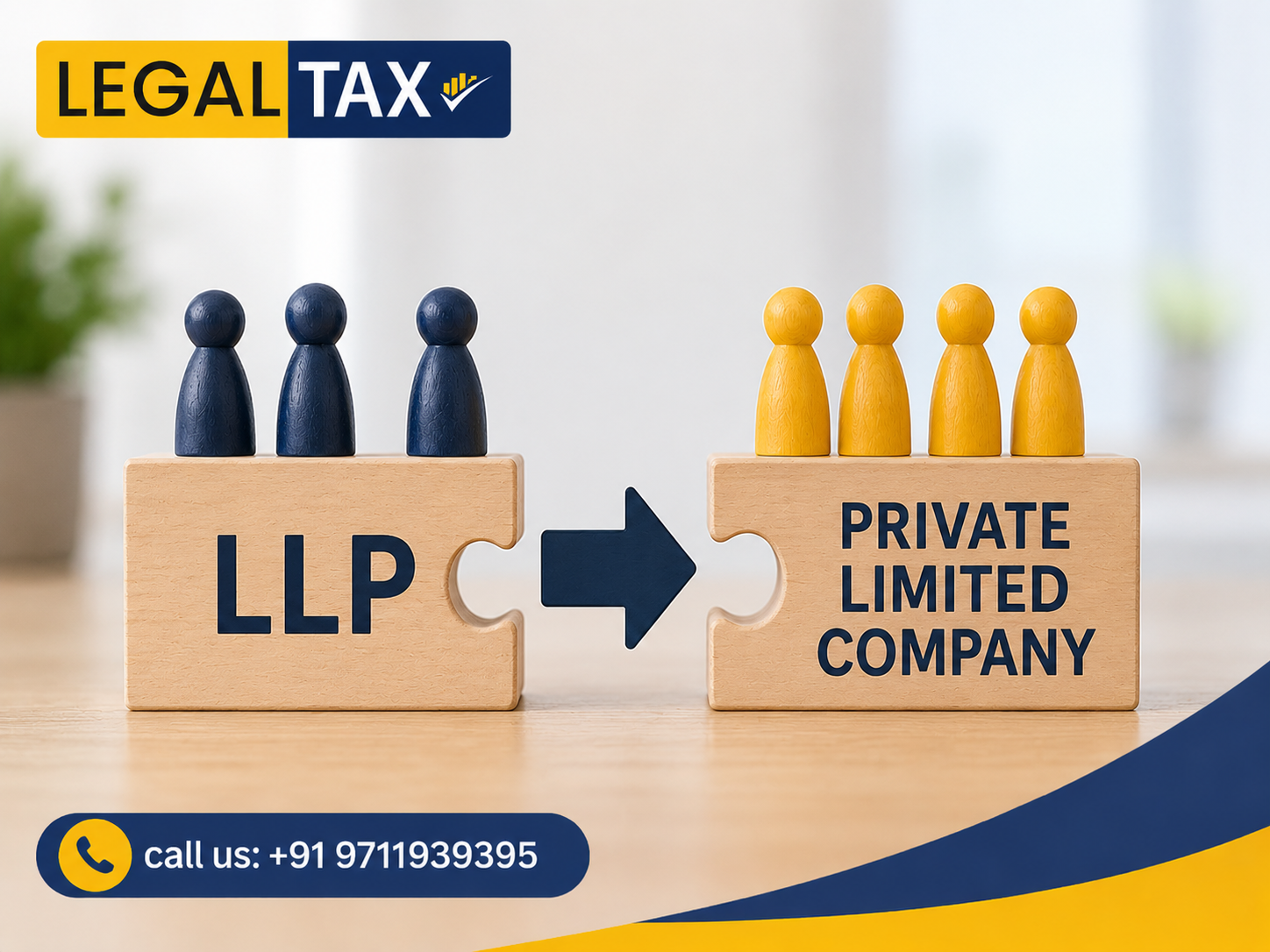
Why Convert an LLP to a Private Limited Company?
Before addressing the process, it is worth understanding the reasons that drive this conversion. The most common reasons include:
1. Attracting External Investment
Institutional investors, angel investors, and venture capital funds overwhelmingly prefer to invest in Private Limited Companies. The equity structure of a company — with defined share classes, preference shares, anti-dilution rights, and board representation mechanisms — is far more compatible with the investment instruments used in funding rounds. LLPs do not have share capital in the traditional sense and cannot issue equity shares, preference shares, or convertible instruments in the manner expected by investors.
2. ESOPs for Employees
Employee Stock Option Plans (ESOPs) are one of the most powerful tools for talent retention in growing businesses. Under Indian law, ESOPs can only be issued by companies. LLPs cannot create ESOPs. Businesses that want to offer equity-linked compensation to employees must operate as companies.
3. Enhanced Credibility and Perception
Private Limited Companies are generally perceived as more credible and established than LLPs by clients, vendors, banks, and partners — particularly in sectors such as technology, finance, and enterprise services. The designation “Private Limited” carries a level of institutional recognition that “LLP” does not always command.
4. Access to Certain Regulatory Approvals
Certain regulatory approvals, licences, and government scheme benefits are available only to companies. For instance, the startup recognition programme under DPIIT and certain Ministry of Finance schemes have eligibility criteria that favour or require company structure.
5. Preparing for an IPO or Acquisition
Any business that has a long-term ambition of listing on a stock exchange or being acquired by a listed company must, at some point, be structured as a company. The conversion from LLP to Private Limited Company is an early step on that path.
Eligibility Criteria for Conversion
Not every LLP is immediately eligible to convert to a Private Limited Company. The following conditions must be satisfied:
- The LLP must have at least two partners at the time of conversion (who will become the first directors and shareholders of the company)
- The LLP must have filed all outstanding annual returns and statements of accounts with the Ministry of Corporate Affairs up to the date of conversion. An LLP with pending filings cannot initiate the conversion process
- There must be no subsisting security interest (charge or mortgage) on the property of the LLP at the time of conversion, unless the secured creditor consents to the conversion
- All partners of the LLP must consent to the conversion
- The LLP must not be a partner in another LLP at the time of conversion (i.e., the converting LLP itself should not be holding a partnership interest in another LLP)
- The LLP must not have been wound up, dissolved, or struck off
Step-by-Step Process for Converting an LLP to a Private Limited Company
Step 1: Obtain Digital Signature Certificates (DSCs) for Proposed Directors
Before any filings can be made with the MCA, each proposed director of the new company must hold a valid Digital Signature Certificate (DSC):
- A Class 3 DSC is required for MCA filings
- DSCs are typically issued by authorised certifying authorities and are valid for 2 years
- If any proposed director already holds a valid DSC, a fresh one is not required
Step 2: Obtain Director Identification Numbers (DINs) for Proposed Directors
Each proposed director must hold a Director Identification Number (DIN):
- DIN is a unique identification number allotted by the MCA to every individual who is or intends to be a director of a company
- If the partners of the LLP do not already hold DINs (they may hold DPINs as LLP designated partners, which are separate), they must apply for DINs
- DIN applications are filed through Form DIR-3 on the MCA21 portal
Step 3: Apply for Name Approval
The proposed name of the new Private Limited Company must be approved by the MCA before the company can be incorporated:
- The name reservation application is filed through the RUN (Reserve Unique Name) facility on the MCA21 portal
- The proposed name must comply with the Companies Act, 2013 naming guidelines — it must not be identical or too similar to an existing company or LLP name, a registered trademark, or a prohibited name
- The name of the new company may incorporate the name of the existing LLP, but this is not mandatory
- Name approval is valid for 20 days within which the incorporation application must be filed
Step 4: Draft the Memorandum and Articles of Association
The new Private Limited Company must have a Memorandum of Association (MOA) and Articles of Association (AOA):
- The MOA defines the objects, scope, and capital structure of the company
- The AOA defines the internal governance rules of the company
- These documents must be carefully drafted to reflect the business activities of the LLP and the governance structure intended for the company
- If external investors are anticipated, the AOA should be structured to accommodate the governance rights and protective provisions that investors typically expect
Step 5: File Form URC-1 (Application for Conversion)
The core filing for the conversion is Form URC-1, filed on the MCA21 portal under the Companies (Incorporation) Rules, 2014:
- Form URC-1 is the application by an LLP for registration as a company
- The form requires details of the LLP, its partners, its assets and liabilities, and the proposed structure of the new company
- The following documents must be attached to Form URC-1:
• A list of the names, addresses, and occupations of all partners of the LLP
• A list of the persons who are to be the first directors of the company
• A statement of the assets and liabilities of the LLP as of a date not earlier than 30 days before filing
• Written consent of all partners to the conversion
• A declaration by two or more partners that no partner has been adjudicated insolvent or has applied for adjudication as insolvent, that no partner has been convicted of an offence involving moral turpitude, and that all obligations of the LLP have been accounted for in the statement of assets and liabilities
• Proof that the LLP is not a partner in any other LLP - Form URC-1 must be digitally signed by the designated partners of the LLP and certified by a practising Company Secretary or Chartered Accountant
Step 6: File SPICe+ (Simplified Proforma for Incorporating a Company Electronically Plus)
Alongside Form URC-1, the company must be incorporated through the SPICe+ filing:
- SPICe+ is the comprehensive company incorporation form on the MCA21 portal
- The SPICe+ filing includes the incorporation application, the DIN application for proposed directors (if not already allotted), the PAN and TAN applications for the new company, and optionally, applications for GST registration, Employees’ State Insurance (ESIC) registration, and Employees’ Provident Fund Organisation (EPFO) registration
- The MOA and AOA are attached to the SPICe+ filing as linked forms
- The SPICe+ filing is the single window for the entire incorporation process
Step 7: MCA Processing and Certificate of Incorporation
After receipt of Form URC-1 and SPICe+, the Registrar of Companies (ROC) reviews the application:
- If the application is complete and in order, the ROC issues the Certificate of Incorporation of the new Private Limited Company
- The Certificate of Incorporation confirms that the company has been registered and specifies the Corporate Identity Number (CIN) of the company
- Upon issue of the Certificate of Incorporation, the conversion is legally effective — the LLP ceases to exist as a separate entity and the Private Limited Company comes into existence
Step 8: File Form URC-2 (Notice of Conversion in Newspaper)
After receiving the Certificate of Incorporation, the new company must publish a notice of the conversion in two newspapers:
- One notice must be published in a newspaper circulating in the district where the registered office of the company is situated
- One of the two newspapers must be in English and one in the vernacular language of the district
- After publication, the company must file Form URC-2 with the ROC, attaching copies of the newspaper publications
- Form URC-2 must be filed within 21 days of the issue of the Certificate of Incorporation
Step 9: Update Registrations and Licences
After the conversion, the new company must update all its registrations and licences to reflect its new legal identity:
- GST Registration: The LLP’s GST registration must be cancelled and a new GST registration obtained in the name of the Private Limited Company (unless the GST registration was already applied for through SPICe+)
- PAN and TAN: The company receives new PAN and TAN through the SPICe+ filing. The LLP’s PAN and TAN are no longer valid
- Bank Accounts: New bank accounts must be opened in the name of the Private Limited Company. The LLP’s bank accounts must be closed or transferred
- Import Export Code (IEC): If the LLP held an IEC, a new IEC must be obtained in the name of the company
- MSME/Udyam Registration: If registered, the MSME registration must be updated or re-registered in the company’s name
- Intellectual Property: Trademarks, copyrights, patents, and designs registered in the name of the LLP must be assigned to or re-registered in the name of the company
- Contracts and Agreements: All material contracts entered into by the LLP should be novated or assigned to the new company wherever required by their terms
Step 10: Wind Up and Strike Off the LLP
Following the conversion, the LLP ceases to exist. However, the formal closure of the LLP must be managed:
- The LLP must file its final returns and financial statements with the MCA up to the date of conversion
- The LLP must apply for strike off or voluntary winding up as appropriate under the LLP Act, 2008
- The DPIN of the designated partners is not automatically cancelled — it remains valid for future use
Documents Required for LLP to Private Limited Company Conversion
From the LLP
- LLP Agreement (registered copy)
- Certificate of Incorporation of the LLP
- LLP PAN card
- All annual returns and financial statements filed with the MCA
- Statement of assets and liabilities as of a date not more than 30 days before the filing date
- Written consent of all partners to the conversion
- Declaration by designated partners regarding solvency, no convictions, and no outstanding obligations
- Proof that the LLP is not a partner in another LLP
For the New Company
- Proposed MOA and AOA
- Identity and address proof of all proposed directors and shareholders
- DIN of all proposed directors (or completed DIR-3 applications)
- DSC of all proposed directors
- Proof of registered office address (ownership document or rent agreement plus NOC from owner)
- Name approval letter from the MCA (via RUN)
For Form URC-2 (Post-Incorporation)
- Copies of newspaper publications of conversion notice (English and vernacular)
Tax Implications of LLP to Private Limited Company Conversion
The tax treatment of the conversion is a critical consideration that requires specific attention:
Section 47(xiiib) of the Income Tax Act, 1961
Under Section 47(xiiib), the conversion of an LLP into a company is not treated as a transfer for capital gains tax purposes, provided the following conditions are satisfied:
- All assets and liabilities of the LLP immediately before the conversion become the assets and liabilities of the company
- All partners of the LLP immediately before the conversion become shareholders of the company in the same proportion in which their capital accounts stood at the time of conversion
- The partners do not receive any consideration or benefit other than shares in the company
- The aggregate shareholding of the erstwhile partners in the company is not less than 50% of the total voting power and this does not reduce to below 50% for a period of 5 years from the date of conversion
- The erstwhile partners do not receive any consideration or benefit, directly or indirectly, in any form during the 5-year period other than as shareholders
If these conditions are met, no capital gains tax arises on the conversion. If any condition is breached — for example, if the erstwhile partners dilute below 50% within 5 years — the capital gains exemption is reversed and the tax becomes payable.
GST on Transfer of Assets
The transfer of assets from the LLP to the company as part of the conversion may attract GST implications depending on the nature of the assets. Professional advice is strongly recommended to assess and manage GST exposure at the time of conversion.
Stamp Duty
The transfer of immovable property (if any) from the LLP to the company in the course of conversion may attract stamp duty under applicable state laws. This cost should be factored into the conversion planning.
Common Mistakes in the LLP to Private Limited Company Conversion Process
Not clearing LLP filing arrears before initiating conversion: The conversion process cannot proceed if the LLP has outstanding annual returns or financial statements. All arrears must be cleared before applying, which can involve filing penalties. Businesses that have neglected LLP compliance will face delays at this stage.
Not accounting for the 5-year lock-in for capital gains exemption: The Section 47(xiiib) exemption comes with a 5-year condition on the erstwhile partners’ shareholding. If an investor acquisition or secondary sale is planned that would dilute founding partners below 50%, this condition must be carefully monitored and tax advice sought before proceeding.
Failing to novate material contracts: Contracts entered into by the LLP are contracts of the LLP as a legal entity. When the LLP ceases to exist, those contracts do not automatically transfer to the company. Material contracts — with clients, vendors, landlords, and financiers — must be novated (transferred with the counterparty’s consent) to the new company. Failure to do this creates contractual uncertainty and potential defaults.
Delay in cancelling the LLP’s GST registration: After conversion, the LLP’s GST registration must be formally cancelled. Continuing to invoice on the LLP’s GST number after the conversion is a serious compliance failure. The timeline for GST registration update must be planned in advance.
Not updating bank mandates and authorised signatories: Once the LLP is converted, its bank accounts become invalid in their existing form. New company bank accounts must be opened promptly and the LLP accounts closed or transferred. Operating on LLP bank accounts after conversion creates both legal and practical complications.
Incorrect shareholding structure on conversion: The shareholding of the new company must reflect the partners’ capital account proportions at the time of conversion. Errors in this allocation can affect the Section 47(xiiib) exemption and create disputes between founders.
Not filing Form URC-2 within 21 days: The newspaper publication and Form URC-2 filing is a post-incorporation requirement with a hard 21-day deadline. This step is frequently overlooked in the relief of obtaining the Certificate of Incorporation. Missing this deadline attracts additional fees and regulatory exposure.
Frequently Asked Questions
1. Can an LLP be converted into a Private Limited Company in India?
Yes, an LLP can be converted into a Private Limited Company in India subject to compliance with the Companies Act, 2013 and other applicable regulations. The conversion allows businesses to benefit from a corporate structure, easier fundraising opportunities, greater investor confidence, and improved scalability.
2. What are the eligibility requirements for converting an LLP into a Private Limited Company?
To convert an LLP into a Private Limited Company, the LLP should have at least two partners who can become shareholders and directors of the company. The LLP must have obtained consent from all partners for the conversion.
3. What documents are required for LLP to Private Limited Company conversion?
The conversion process typically requires documents such as the LLP incorporation certificate, LLP agreement, PAN card of the LLP, address proof of the registered office, identity and address proofs of partners/directors, consent letters, latest financial statements, and declarations required under the Companies Act.
6. What are the advantages of converting an LLP into a Private Limited Company?
Converting to a Private Limited Company can provide several benefits, including easier access to equity funding, the ability to issue shares to investors, improved credibility among customers and financial institutions, better opportunities for business expansion, and a structured corporate governance framework.
7. How long does it take to convert an LLP into a Private Limited Company?
The timeline for conversion depends on document readiness, regulatory approvals, and ROC processing times. In most cases, the process can be completed within a few weeks if all documents are correctly prepared and submitted.
Conclusion
Converting an LLP to a Private Limited Company in India is a structured legal and regulatory process that involves multiple filings, eligibility conditions, and post-conversion compliance obligations. The process is well-defined under the Companies Act, 2013 and the Companies (Incorporation) Rules, 2014, and when executed correctly, it provides a seamless transition of the business from one legal form to another without triggering adverse tax consequences.
The most important considerations are ensuring the LLP’s compliance record is clean before initiating conversion, structuring the shareholding of the new company correctly to preserve the capital gains tax exemption, novating material contracts to the new entity, and managing the GST and other regulatory transitions promptly after incorporation.
For growing businesses that are approaching external funding, considering ESOPs, or simply seeking a structure better suited to their scale and ambitions, the conversion to a Private Limited Company is a sound and often necessary step.
Plan the conversion well in advance. Clear all LLP compliance arrears. Get the tax structuring right from day one. And build your company on a foundation of legal and regulatory compliance.
Need Help With LLP Conversion or Company Registration?
🟡 Legal Tax provides complete support for LLP to Private Limited Company conversion, director appointments, company compliance, annual filings, and all MCA related matters for businesses across India.
👉 Private Limited Company Registration
👉 LLP Registration
👉 GST Registration and Filing
👉 MSME / Udyam Registration
👉 Income Tax Filing
👉 Partnership Firm Registration
🟡 IT Services
👉 Web Development
👉 Custom Website Development
👉 E-commerce Website Development
👉 SEO Service
👉 Digital Marketing
👉 Social Media Marketing
🟡 Protect Your Business Brand
👉 Trademark Registration
👉 Copyright Registration
👉 Design Registration
👉 Patent Registration
📞 Call Now: +91 9711939395
✉️ Email: info@legaltax.in
🕐 Free Consultation: Monday to Saturday, 9 AM to 6 PM

Anjali is a Digital Marketing Expert at LegalTax.in who builds websites that rank and convert. She specializes in SEO-driven web development, helping people find the right legal help online.
Our Clients