Views: 3
Table of Contents
- 1 Introduction
- 2 What is DPIIT Recognition Under Startup India?
- 3 Who is Eligible for Startup India Registration in 2026?
- 4 What are the Benefits of DPIIT Recognition?
- 5 The Complete Process for Startup India Registration in 2026
- 6 Government Fees for Startup India Registration
- 7 What Happens After DPIIT Recognition?
- 8 Startup India Registration vs. MSME Registration: Key Differences
- 9 Common Mistakes in Startup India Registration
- 10 Startup India and Intellectual Property: A Critical Connection
- 11 FAQs
- 12 Conclusion
- 13 Register Your Startup with Expert Business Specialists
Introduction
India has one of the largest and fastest-growing startup ecosystems in the world. With over 100 unicorns and tens of thousands of DPIIT-recognised startups across every sector, the country has built a regulatory and policy infrastructure specifically designed to support early-stage businesses — reducing compliance burdens, enabling access to funding, and providing tax and intellectual property benefits that are not available to ordinary businesses.
At the centre of this infrastructure is the Startup India initiative, launched by the Government of India in January 2016 and administered by the Department for Promotion of Industry and Internal Trade (DPIIT). DPIIT recognition under the Startup India scheme is the gateway to a comprehensive package of benefits — tax exemptions, relaxed compliance requirements, self-certification under labour and environmental laws, fast-track patent and trademark examination, and eligibility for government procurement and funding schemes.
But despite the significance of DPIIT recognition, many eligible startups either do not apply, apply incorrectly, or apply after they have already missed the eligibility window. And many founders are uncertain about what the recognition actually confers and what conditions must continue to be met to retain it.
This guide provides a complete, practical explanation of Startup India registration in 2026 — who is eligible, what the benefits are, what the process involves, what documents are required, and what pitfalls to avoid.
For complete Startup India registration support from experienced business registration specialists, the team at LegalTax.in handles DPIIT recognition applications for startups across all sectors and business structures.
What is DPIIT Recognition Under Startup India?
DPIIT recognition is the formal acknowledgment by the Department for Promotion of Industry and Internal Trade that a particular entity qualifies as a startup for the purposes of the Startup India scheme. Recognition is granted on the basis of an application filed through the Startup India portal and results in the issuance of a DPIIT Recognition Certificate — a document that is required to access every benefit available under the scheme.
DPIIT recognition is not a separate business registration. It is an additional certification layered on top of an existing business registration (company, LLP, or partnership firm). The entity must be validly incorporated or registered before applying for DPIIT recognition.
Recognition once granted remains valid as long as the entity continues to meet the eligibility criteria. If the entity ceases to meet the criteria — for example, because it exceeds the turnover threshold or because it is no longer an innovation-driven business — it is no longer eligible for the benefits associated with recognition.
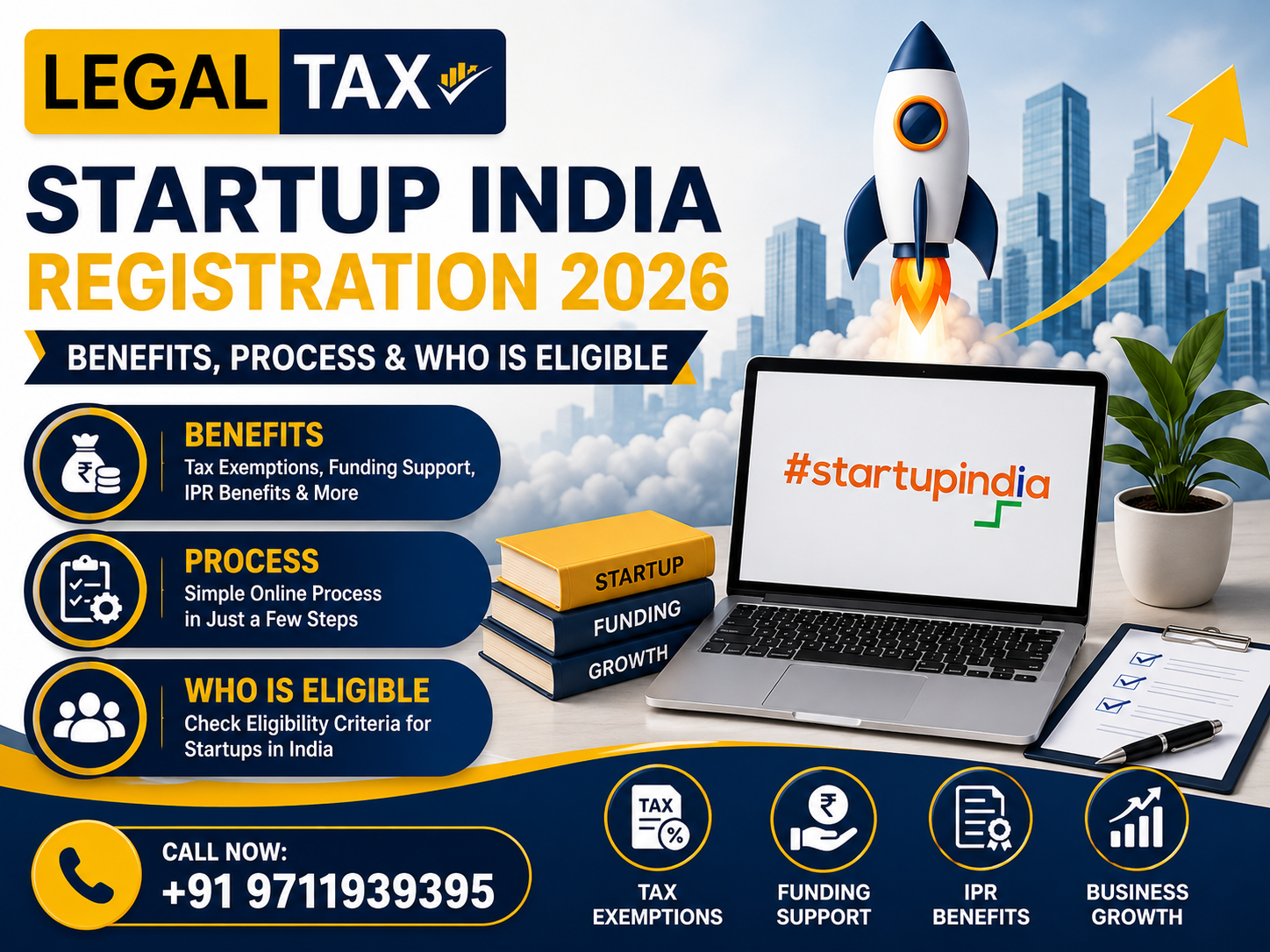
Who is Eligible for Startup India Registration in 2026?
The eligibility criteria for DPIIT recognition under the Startup India scheme are defined in the DPIIT notification and have been updated several times since the scheme’s launch. As of 2026, the eligibility criteria are:
Criterion 1: Type of Entity
The entity must be incorporated or registered in India as one of the following:
✅ Private Limited Company under the Companies Act, 2013 ✅ Limited Liability Partnership (LLP) under the Limited Liability Partnership Act, 2008 ✅ Registered Partnership Firm under the Indian Partnership Act, 1932
Sole proprietorships, Hindu Undivided Families (HUFs), and public limited companies do not qualify for DPIIT recognition under the Startup India scheme.
Criterion 2: Age of the Entity
The entity must not have completed 10 years from the date of its incorporation or registration. Once an entity is more than 10 years old from its date of incorporation, it is no longer eligible for DPIIT recognition regardless of its size or nature of business.
Criterion 3: Annual Turnover
The entity’s annual turnover must not have exceeded Rs. 100 crore in any financial year since incorporation. If the entity’s turnover has exceeded Rs. 100 crore in any prior year, it is no longer eligible for DPIIT recognition.
Criterion 4: Original Entity — Not a Restructured Business
The entity must not have been formed by splitting up or reconstructing an existing business. DPIIT recognition is available only to genuinely new businesses, not to restructured or reorganised versions of established companies.
Criterion 5: Innovation, Scalability, and Employment or Wealth Creation
This is the substantive criterion that distinguishes startups from ordinary small businesses. The entity must be working towards:
🚀 Innovation, development, or improvement of products, processes, or services, OR 🚀 A scalable business model with a high potential of employment generation or wealth creation
This criterion requires the entity to demonstrate that it is not merely carrying on a traditional business in an established sector but is building something genuinely innovative, technology-enabled, or scalable. The nature of the business and its approach to innovation are assessed at the time of the application.
What are the Benefits of DPIIT Recognition?
DPIIT recognition unlocks a substantial package of benefits across tax, compliance, intellectual property, funding, and government procurement. Understanding these benefits in detail — and knowing which require separate applications beyond recognition itself — is essential for founders to extract full value from the scheme.
Benefit 1: Income Tax Exemption Under Section 80-IAC
DPIIT-recognised startups can apply for a 100% income tax exemption on profits for any 3 consecutive assessment years out of the first 10 years from the date of incorporation.
Key conditions:
📋 The startup must be incorporated as a private limited company or LLP (partnership firms are not eligible for this exemption) 📋 The startup must be incorporated on or after 1 April 2016 📋 The startup must obtain a separate certificate of eligibility from the Inter-Ministerial Board (IMB) — DPIIT recognition alone is not sufficient for this tax exemption; the IMB certification must also be obtained 📋 The startup’s total turnover must not exceed Rs. 100 crore in the year for which the exemption is claimed
This is one of the most valuable financial benefits available to eligible startups and can result in substantial tax savings during the growth phase when profits are first being generated.
Benefit 2: Exemption from Angel Tax — Section 56(2)(viib)
One of the most significant and practically impactful benefits for funded startups is the exemption from angel tax under Section 56(2)(viib) of the Income Tax Act.
Under this provision, when a closely held company receives consideration for the issue of shares in excess of the fair market value of those shares, the excess amount is treated as income and taxed in the hands of the company. This provision — commonly called “angel tax” — created significant problems for startups receiving early-stage funding, where investor valuations often exceed the book value or formula-based fair market value of the shares.
DPIIT-recognised startups are exempt from angel tax under Section 56(2)(viib), provided:
📋 The aggregate amount of paid-up share capital and share premium after the issue does not exceed Rs. 25 crore (with certain categories of investors excluded from this limit) 📋 The startup has not invested in specified assets such as land, buildings other than used for business, loans and advances, capital contributions, shares, securities, and motor vehicles above specified limits
This exemption removes a major structural tax disadvantage that previously deterred early-stage investment in Indian startups.
Benefit 3: Tax Exemption on Long-Term Capital Gains — Section 54GB
Under Section 54GB of the Income Tax Act, an individual or HUF who invests long-term capital gains from the sale of a residential property into equity shares of a DPIIT-recognised startup can claim exemption from capital gains tax on those gains.
This provision was designed to channel personal wealth into the startup ecosystem by making investment in eligible startups tax-efficient for individual investors. The startup must use the invested amount for the purposes of its business within the prescribed time period.
Benefit 4: Fast-Track Patent Examination with 80% Fee Rebate
DPIIT-recognised startups receive two significant advantages in patent prosecution before the Indian Patent Office:
🔬 80% rebate on government patent filing fees — Startups pay the same concessional government fee rates as individual inventors, which are approximately 80% lower than the fees applicable to large companies
🔬 Eligibility for Expedited Examination (Form 18A) — Startups can request expedited examination of their patent applications, significantly reducing the wait for the First Examination Report compared to standard examination timelines
These benefits make patent protection substantially more accessible and affordable for innovation-driven startups. The patent filing specialists at LegalIP.in handle complete patent prosecution for DPIIT-recognised startups at the applicable concessional fee rates.
Benefit 5: Fast-Track Trademark Examination
DPIIT-recognised startups receive priority processing of trademark registration applications. Trademark applications filed by DPIIT-recognised startups are processed on an expedited basis — significantly reducing the time from application to examination report compared to standard processing timelines.
Given that trademark registration is a fundamental brand protection step for any business, this benefit can materially accelerate the timeline for securing trademark rights. Trademark registration services for startups are available at LegalIP.in, LegalTax.in, and OnlineTrademark India.
Benefit 6: Self-Certification Under Labour Laws
DPIIT-recognised startups can self-certify compliance with 9 labour laws for a period of 3 to 5 years from the date of incorporation:
📋 The Building and Other Constructions Workers’ (Regulation of Employment and Conditions of Service) Act, 1996 📋 The Inter-State Migrant Workmen (Regulation of Employment and Conditions of Service) Act, 1979 📋 The Payment of Gratuity Act, 1972 📋 The Contract Labour (Regulation and Abolition) Act, 1970 📋 The Employees’ Provident Funds and Miscellaneous Provisions Act, 1952 📋 The Employees’ State Insurance Act, 1948 📋 The Industrial Disputes Act, 1947 📋 The Trade Unions Act, 1926 📋 The Maternity Benefit Act, 1961
Self-certification means startups are not subject to routine inspections under these laws during the self-certification period, reducing the compliance burden on early-stage businesses that are focused on growth.
Benefit 7: Self-Certification Under Environmental Laws
DPIIT-recognised startups operating in 36 specified categories (white category industries as defined by the Central Pollution Control Board) can self-certify compliance with 3 environmental laws for a period of 3 years from the date of incorporation:
📋 The Water (Prevention and Control of Pollution) Act, 1974 📋 The Water (Prevention and Control of Pollution) Cess Act, 1977 📋 The Air (Prevention and Control of Pollution) Act, 1981
Benefit 8: Simplified Winding Up
DPIIT-recognised startups incorporated as private limited companies can wind up their business within 90 days under the Insolvency and Bankruptcy Code, 2016 — compared to the significantly longer process applicable to non-startup companies. This benefit reduces the risk and cost associated with winding up a startup that does not succeed.
Benefit 9: Government Procurement Benefits
DPIIT-recognised startups are eligible to participate in government procurement tenders on relaxed terms:
🏛 Exemption from prior experience requirements — Startups are exempt from prior turnover and experience requirements that typically exclude new businesses from government contracts 🏛 Exemption from earnest money deposit (EMD) — Startups are not required to pay the earnest money deposit that is typically mandatory for bidders in government tenders 🏛 Listing on the Government e-Marketplace (GeM) — DPIIT-recognised startups can list their products and services on the GeM portal, which is the government’s online procurement platform
These benefits open up government procurement as a significant early revenue channel for eligible startups.
Benefit 10: Access to Fund of Funds
The Government of India established the Fund of Funds for Startups (FFS) with a corpus of Rs. 10,000 crore, managed through SIDBI (Small Industries Development Bank of India). The Fund of Funds does not invest directly in startups but invests in SEBI-registered Alternative Investment Funds (AIFs) that, in turn, invest in DPIIT-recognised startups.
DPIIT recognition is a prerequisite for startups seeking investment from AIFs that have received commitments from the Fund of Funds.
Benefit 11: Startup India Hub and Mentorship Network
DPIIT-recognised startups gain access to the Startup India Hub — an online platform that provides:
📋 Connections to mentors, incubators, accelerators, and investors 📋 Access to knowledge resources, webinars, and learning programmes 📋 Networking opportunities within the startup ecosystem 📋 Information about government schemes, grants, and funding programmes
The Complete Process for Startup India Registration in 2026
Step 1: Incorporate Your Business Entity
DPIIT recognition can only be granted to an entity that is already incorporated or registered. If you have not yet incorporated your business, the first step is to complete the incorporation process.
The most common and recommended structure for startups seeking DPIIT recognition is a Private Limited Company, because:
📋 It offers limited liability protection to founders 📋 It is the structure most familiar to institutional investors and VCs 📋 It is eligible for the full range of tax benefits under the Startup India scheme, including the Section 80-IAC income tax exemption 📋 Equity can be issued to investors, employees (through ESOPs), and advisors with legal clarity
The company registration specialists at LegalTax.in handle complete private limited company incorporation including name reservation, MCA filings, PAN, TAN, and GST registration.
For businesses where equity sharing is not required and a simpler structure is preferred, an LLP is also eligible for the full range of Startup India benefits, including the Section 80-IAC tax exemption. LLP registration is available at LegalTax.in.
Step 2: Register on the Startup India Portal
Go to the Startup India portal at startupindia.gov.in and create an account for your entity. The registration requires the entity’s incorporation details, contact information, and a valid email address and mobile number for OTP verification.
Step 3: Complete the DPIIT Recognition Application
After registering on the portal, complete the DPIIT recognition application. The application requires the following information and documents:
Entity Information 📄 Name of the entity 📄 Date of incorporation 📄 PAN of the entity 📄 Corporate Identity Number (CIN) for companies or LLPIN for LLPs 📄 Registered address 📄 Contact details of the authorised representative
Details of Founders and Directors 📄 Names, designations, and shareholding of all founders and directors 📄 PAN of each founder and director
Nature of Business 📄 Industry sector 📄 Brief description of the startup’s product, service, or technology 📄 Description of the innovative aspect of the business and how it meets the innovation criterion 📄 Stage of development (idea stage, prototype, revenue stage, scaling)
Supporting Documents 📄 Certificate of Incorporation or Registration Certificate 📄 Memorandum of Association (MOA) and Articles of Association (AOA) for companies, or LLP Agreement for LLPs 📄 Board Resolution authorising the application (for companies) 📄 Any patents, trademarks, or other IP registrations (if applicable) 📄 Awards, recognition, or media coverage (if applicable and supportive of the innovation claim)
Step 4: Self-Certification of Eligibility
As part of the application, the authorised representative of the entity must self-certify that the entity meets all the eligibility criteria for DPIIT recognition — including the entity type, age, turnover, and innovation criteria. The self-certification is made under penalty of the recognition being revoked if any of the certified facts are found to be false.
Step 5: Submission and Processing
After the application is submitted, it is reviewed by DPIIT. In most straightforward cases, DPIIT recognition is granted within 2 to 3 working days of a complete application being submitted. The recognition certificate is issued electronically through the Startup India portal.
If DPIIT requires clarification or additional information about the nature of the startup’s innovation, they may request supplementary information before granting recognition.
Step 6: Apply for Additional Benefits (Where Separate Applications Are Required)
DPIIT recognition is the foundation, but some benefits require separate applications beyond recognition itself:
📋 Section 80-IAC income tax exemption requires a separate application to the Inter-Ministerial Board (IMB) with detailed information about the startup’s innovation and business model
📋 Patent fee rebate and expedited examination require filing the patent application through the Indian Patent Office and selecting the applicable concessional fee category
📋 GeM portal listing requires a separate registration on the Government e-Marketplace at gem.gov.in
The Startup India registration specialists at LegalTax.in guide founders through both the DPIIT recognition application and the subsequent steps for accessing each specific benefit.
Government Fees for Startup India Registration
One of the most entrepreneur-friendly aspects of the DPIIT recognition process is that there is no government fee for filing the DPIIT recognition application. The recognition is granted free of charge through the Startup India portal.
The costs associated with Startup India registration are therefore primarily:
💰 Incorporation costs (if the entity is not yet incorporated): Rs. 6,000 to Rs. 15,000 in government fees for private limited company incorporation, plus professional fees
💰 Professional fees for DPIIT recognition application preparation: Rs. 3,000 to Rs. 10,000 depending on complexity of the innovation description
The LegalTax.in startup registration team offers complete Startup India recognition packages covering both incorporation (if required) and DPIIT recognition application.
What Happens After DPIIT Recognition?
Receive the Recognition Certificate The DPIIT recognition certificate is issued in digital form through the Startup India portal. Download and preserve the certificate — it must be submitted as proof of startup status to access every benefit under the scheme.
Update IP Filings If you are filing or intending to file patents or trademarks, ensure that the DPIIT recognition certificate is referenced in all IP filings to access the applicable concessional fee rates and expedited processing.
Apply for IMB Certification (for Section 80-IAC tax exemption) If you intend to claim the income tax exemption under Section 80-IAC, begin preparing the IMB application as early as possible. The IMB application requires detailed information about the startup’s technology, innovation, and business model, and involves a more thorough review than the DPIIT recognition application.
Register on GeM If government procurement is a relevant revenue channel for your startup, register on the Government e-Marketplace promptly after receiving DPIIT recognition.
Maintain Eligibility DPIIT recognition is valid as long as the entity continues to meet the eligibility criteria. Monitor turnover (Rs. 100 crore limit) and age (10-year limit from incorporation) to ensure continued eligibility. If the entity ceases to meet the criteria, it should proactively manage its status under the scheme.
Startup India Registration vs. MSME Registration: Key Differences
Many founders are confused about whether to register as a startup under DPIIT or as an MSME under the MSMED Act, or both. The two registrations are distinct and serve different purposes:
| DPIIT Recognition (Startup India) | MSME Registration (Udyam) | |
|---|---|---|
| Governing body | DPIIT, Ministry of Commerce | Ministry of MSME |
| Eligibility | Innovation-driven businesses | Manufacturing and service businesses by investment/turnover |
| Age limit | 10 years from incorporation | No age limit |
| Turnover limit | Rs. 100 crore | Rs. 250 crore (medium enterprise) |
| Primary benefits | Tax exemptions, IP fee concessions, angel tax exemption | Priority sector lending, government scheme eligibility, procurement preferences |
| Fee | Free | Free |
Many startups are eligible for both DPIIT recognition and MSME (Udyam) registration, and applying for both is strongly recommended — they serve complementary purposes and there is no conflict between holding both registrations. MSME registration is available at LegalTax.in.
Common Mistakes in Startup India Registration
Applying After the 10-Year Window Has Passed DPIIT recognition is only available to entities within 10 years of incorporation. Many founders discover the Startup India scheme years after incorporation and find they have already missed the eligibility window. Apply as early as possible — ideally within the first year of incorporation.
Inadequate Description of Innovation The innovation criterion is the most frequently poorly addressed part of the DPIIT recognition application. A vague or generic description of the business — “we provide technology solutions for businesses” — does not demonstrate the kind of genuine innovation, scalability, or novel approach that the scheme is designed to support. The description should specifically articulate what is new, what problem is being solved, how the approach is different from existing solutions, and why the business model is scalable.
Applying as a Sole Proprietorship Sole proprietorships are not eligible for DPIIT recognition. Founders operating as sole proprietors who wish to access Startup India benefits must first incorporate as a private limited company or LLP.
Not Applying for IMB Certification Separately DPIIT recognition alone does not confer the Section 80-IAC income tax exemption. Many startup founders assume that recognition automatically triggers all tax benefits — and then discover when filing taxes that they have not obtained the separate IMB certification required for the income tax exemption. The IMB application must be filed and approved independently.
Not Linking DPIIT Recognition to IP Filings Patent and trademark applications filed without referencing the DPIIT recognition certificate may not automatically receive the applicable concessional fee rates or expedited processing. The recognition certificate must be submitted with IP filings to access these benefits.
Startup India and Intellectual Property: A Critical Connection
For innovation-driven startups, DPIIT recognition and intellectual property protection are inseparably linked. The concessional IP fee rates and expedited examination timelines available to recognised startups can substantially reduce the cost and timeline of building an IP portfolio — one of the most important assets for attracting investment and establishing competitive advantage.
The most impactful IP benefits for DPIIT-recognised startups:
🔬 Patents — 80% fee rebate on government filing fees and eligibility for expedited examination. For a startup filing 5 patents over its first 5 years, the government fee savings alone can amount to Rs. 80,000 to Rs. 1,50,000. The patent filing specialists at LegalIP.in handle complete patent prosecution for startups.
🔖 Trademarks — Priority processing of trademark applications. Building brand protection faster at the startup stage, before competitors or trademark squatters can file conflicting marks, is a significant strategic advantage. Trademark registration for startups at LegalIP.in and LegalTax.in.
🎨 Design Registration — Protecting the visual identity of startup products. The design registration specialists at LegalIP.in handle design filing for startups across all product categories.
FAQs
What is Startup India Registration?
Startup India Registration is DPIIT recognition granted by the Government of India to eligible startups under the Startup India initiative. It helps startups access tax benefits, funding support, compliance relaxations, and intellectual property incentives.
Who is eligible for Startup India Registration in 2026?
Eligible entities generally include Private Limited Companies, LLPs, registered partnership firms, and certain cooperative societies that are innovative, scalable, and within the prescribed turnover and age limits.
Is Startup India Registration free?
Yes. The government does not usually charge any official fee for DPIIT startup recognition. However, legal professionals or consultants may charge service fees for assistance.
Can foreign founders apply for Startup India recognition?
Yes. Foreign nationals or NRIs may apply if they legally incorporate an eligible business entity in India and comply with FEMA and company law requirements.
How long does Startup India registration take?
Most DPIIT applications are processed within a few working days to a few weeks depending on document verification and application quality.
Conclusion
DPIIT recognition under the Startup India scheme is one of the most valuable and underutilised regulatory tools available to early-stage businesses in India. For eligible founders, applying for recognition as early as possible — ideally within the first year of incorporation — maximises the window during which all benefits can be accessed and ensures that IP filings, tax planning, and government procurement strategies are built on the foundation that recognition enables.
The recognition process itself is straightforward and free of government charge. The complexity lies in understanding which benefits require additional steps beyond recognition, how to correctly describe the innovation basis of the business in the application, and how to integrate DPIIT recognition into a broader IP and business strategy.
For founders building genuinely innovative, scalable businesses in India, DPIIT recognition is not a bureaucratic formality. It is a strategic asset that reduces costs, accelerates IP protection, unlocks tax benefits, and opens doors to funding and government procurement that would otherwise remain closed.
Build something genuinely new. Register it correctly. Protect it completely.
Register Your Startup with Expert Business Specialists
🟡 LegalTax.in provides complete Startup India registration support — including entity incorporation, DPIIT recognition application, IMB certification guidance, and access to the full suite of startup benefits.
👉 Startup India Registration at LegalTax.in 👉 Private Limited Company Registration 👉 LLP Registration 👉 MSME Registration 👉 GST Registration
🟡 Protect Your Startup’s IP 👉 Patent Registration at LegalIP.in 👉 Trademark Registration at LegalIP.in 👉 Design Registration at LegalIP.in 👉 Copyright Registration at LegalIP.in
🟡 Also Protect Your Brand 👉 LegalTax.in Trademark Registration 👉 OnlineTrademark India
📞 Call Now: +91 9711939395 📧 Email: info@legaltax.in 🕐 Free Consultation: Monday to Saturday, 9 AM to 6 PM

Anjali is a Digital Marketing Expert at LegalTax.in who builds websites that rank and convert. She specializes in SEO-driven web development, helping people find the right legal help online.
Our Clients