Views: 41
Table of Contents
- 1 Introduction
- 2 The ™ Symbol: Trademark Claimed, Not Registered
- 3 The ® Symbol: Registered Trademark
- 4 The © Symbol: Copyright
- 5 Comparing the Three Symbols: A Practical Summary
- 6 The ™ and ® Symbols in Brand Style Guides
- 7 Frequently Asked Questions
- 8 Conclusion
- 9 Get Expert Trademark and Copyright Registration Support
Introduction
Three symbols appear constantly on products, packaging, websites, logos, and creative works across India and internationally: ™, ®, and ©. Most people recognise these symbols instinctively as markers of some form of intellectual property protection, but the precise legal meaning of each, when each can be used, and what the consequences of using them incorrectly are, is less widely understood.
The distinction matters practically. Using the ® symbol on a mark that has not been registered as a trademark is a criminal offence under Indian law. Using the ™ symbol on a mark for which no application has been filed offers no legal protection and may give a false sense of security. Failing to use the © symbol on original creative work does not extinguish copyright, but its absence affects how the work is perceived and can complicate enforcement.
For businesses building a brand, for content creators protecting their work, and for anyone who puts any of these symbols on any product, packaging, or publication, understanding the correct legal basis for using each symbol is fundamental to both compliance and effective IP protection.
This guide explains the legal meaning of each symbol under Indian law, the precise conditions under which each can be used, the consequences of incorrect use, and the practical situations in which each symbol is most relevant for businesses and individuals.
For trademark registration, copyright registration, and complete IP protection services, Legal Tax provides comprehensive intellectual property registration and advisory services for businesses and creators across India.
The ™ Symbol: Trademark Claimed, Not Registered
What the ™ Symbol Means
The ™ symbol, read as “trademark,” is used to indicate that the person or business using it is claiming trademark rights in the mark to which it is applied, whether a brand name, a logo, a slogan, or another distinctive identifier. The ™ symbol does not indicate that the mark has been registered with the Trade Marks Registry. It indicates only that the user is asserting a claim of trademark ownership, whether based on actual use of the mark in trade or on a pending trademark application.
When You Can Use the ™ Symbol in India
The ™ symbol can be used in the following situations:
After a trademark application has been filed with the Trade Marks Registry but before the registration certificate has been issued. This is the most common and legally appropriate use of the ™ symbol in India, signalling that the mark is the subject of a pending trademark application.
When a mark has been used in trade for a period of time and the user is asserting common law trademark rights based on that use, even without having filed an application. While this use is not prohibited by Indian trademark law, it offers limited practical protection compared to a filed application or registration.
In any situation where a party wishes to signal trademark intent without having yet obtained registration, such as during a soft launch of a brand before the registration process is complete.
What the ™ Symbol Does Not Do
Using the ™ symbol does not confer any additional legal rights beyond those that exist based on actual use or a pending application. It is not a substitute for trademark registration and does not provide the exclusive statutory rights, the legal presumption of ownership, or the full enforcement mechanisms that registration provides.
A business that has been using the ™ symbol for years on an unregistered mark is in a weaker legal position than one that filed for registration early, because the statutory protections of the Trade Marks Act, 1999 are available fully only to the registered proprietor of a mark. The ™ symbol without an underlying application or registration is essentially a declaration of intent rather than a statement of legal right.
The ™ Symbol and Pending Applications
Once a trademark application is filed with the Trade Marks Registry, the applicant is the most legitimate user of the ™ symbol, because the filing establishes a priority date for the mark and puts the Registry’s database on notice of the claim. Using ™ during the pendency of the application, until the registration certificate is issued, is the standard practice in India and internationally.
The ® Symbol: Registered Trademark
What the ® Symbol Means
The ® symbol, read as “registered,” is used exclusively to indicate that the mark to which it is applied has been registered as a trademark with the relevant trademark authority. In India, this means the mark has been registered with the Trade Marks Registry under the Trade Marks Act, 1999, and a registration certificate has been issued to the registered proprietor.
The ® symbol is a statement of fact: it asserts that the mark is registered. Because it is a factual statement, using it when the mark is not in fact registered is a misrepresentation, and under Indian law it is more than a civil matter.
When You Can Use the ® Symbol in India
The ® symbol can only be used after the trademark registration certificate has been received from the Trade Marks Registry. The conditions for legitimate use of ® in India are:
The mark must be registered under the Trade Marks Act, 1999 with the Trade Marks Registry.
The registration must be currently in force, meaning it has not expired without renewal, been cancelled, or been removed from the Register.
The ® symbol must be applied to the mark in connection with the specific goods or services for which the mark is registered. Using ® in connection with goods or services outside the registered class or classes is not appropriate, because the registration does not cover those goods or services.
What Happens If You Use ® Without Registration
Section 107 of the Trade Marks Act, 1999 makes it a criminal offence to falsely represent a mark as registered when it is not. A person who applies the ® symbol to a mark that is not registered, or who uses ® in connection with goods or services not covered by the registration, is committing an offence that can attract imprisonment of up to three years, a fine, or both.
This is one of the most commonly misunderstood areas of trademark compliance in India. Many businesses, particularly those familiar with practices in other jurisdictions, apply ® to a mark as soon as an application is filed, treating it as equivalent to the ™ symbol. Under Indian law, this is incorrect and potentially criminal. The ® symbol must wait for the registration certificate.
The ® Symbol and International Trademark Registration
For businesses that hold trademark registrations in other countries through the Madrid Protocol or direct national applications, the ® symbol can be used in those countries where the registration has been granted. However, using ® in India based only on a foreign registration, without a corresponding Indian registration or a Madrid Protocol designation accepted by the Indian Trade Marks Registry, is not appropriate for Indian use of the mark.
After Registration: Displaying ® Correctly
Once a trademark is registered and the registration certificate is received, the ® symbol should be applied to the mark consistently wherever it appears, on product packaging, labels, websites, marketing materials, and business stationery. Consistent use of ® signals to the market that the mark is protected, can deter potential infringers who might otherwise assume the mark is unprotected, and reinforces the registered proprietor’s public claim to the mark.
The © Symbol: Copyright
What the © Symbol Means
The © symbol, read as “copyright,” indicates that the work to which it is applied is protected by copyright and that the person or entity named alongside the symbol is asserting copyright ownership. Unlike the ® symbol, which relates to a registration, the © symbol does not by itself indicate that the copyright has been registered with any authority.
Copyright Arises Automatically in India
Under the Copyright Act, 1957, copyright in an original literary, artistic, musical, dramatic, or cinematographic work arises automatically at the moment of creation, without any requirement to register the work or to display the © symbol. This is a fundamental principle of copyright law in India and internationally, adopted under the Berne Convention to which India is a signatory.
The © symbol is therefore a notice rather than a registration marker. Displaying © indicates to the world that the creator is asserting copyright ownership, but its absence does not mean the work is not protected by copyright. A poem written in a notebook, a logo designed on a computer, a photograph taken on a phone, and a software program written by a developer are all automatically protected by copyright from the moment of their creation, whether or not © is displayed.
When to Use the © Symbol
The © symbol can be used by the copyright owner on any original work from the moment of creation. The standard format for a copyright notice is the © symbol, followed by the name of the copyright owner, followed by the year of first publication or creation: © LegalTax.in 2026, for example.
The © symbol is appropriately used on:
Original written content including articles, blog posts, books, manuals, and marketing copy.
Original artistic works including logos, illustrations, photographs, and graphic designs.
Original software code and applications.
Original musical compositions and sound recordings.
Original audiovisual works including videos, films, and animations.
Original website content, including both the written content and the underlying code.
Why Display © Even If Copyright Is Automatic
If copyright arises automatically without registration or notice, why display the © symbol at all? There are several practical reasons:
The © notice informs the public and potential users that the work is protected and that the copyright owner expects their rights to be respected. Many accidental or opportunistic infringers are deterred by a clearly displayed copyright notice.
The © notice identifies the copyright owner, making it easier for potential licensees or users who want to seek permission to contact the right person.
In some jurisdictions outside India, the presence of a copyright notice can affect the remedies available to the copyright owner in infringement proceedings.
For works published online, where copying is technically easy, a visible © symbol creates an explicit signal that the content is not freely available for reuse.
Copyright Registration in India
While copyright registration is not required for copyright to subsist, the Copyright Act, 1957 provides a voluntary registration system maintained by the Copyright Office under the Ministry of Commerce and Industry. Registration creates a public record of the copyright claim and provides the registered owner with a certificate that can be useful as prima facie evidence of ownership in infringement proceedings.
Copyright registration is particularly recommended for commercially significant works, works where ownership disputes are foreseeable, and software products and databases where the investment in creation is substantial. The © symbol does not indicate that the copyright is registered; a separate statement such as “Registered with the Copyright Office” would be needed to communicate that the work is registered.
Comparing the Three Symbols: A Practical Summary
The Key Differences
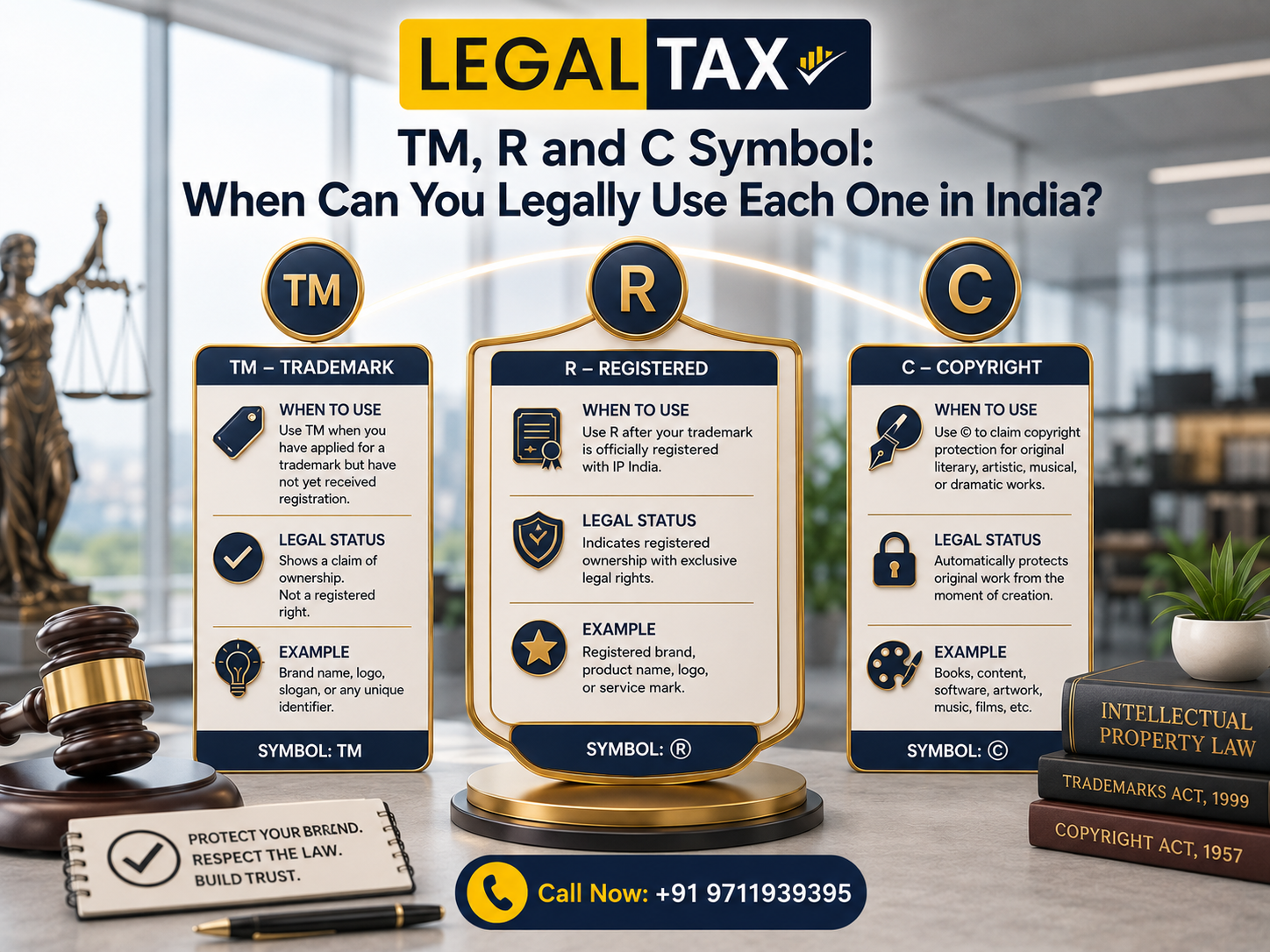
The ™ symbol requires no registration and can be used by anyone asserting a trademark claim, whether based on actual use or a pending application. It carries no statutory weight beyond signalling intent.
The ® symbol requires a valid, current trademark registration under the Trade Marks Act, 1999 and can only be used after the registration certificate has been received. Using it without registration is a criminal offence under Section 107 of the Act.
The © symbol requires no registration and arises automatically with the creation of an original work. It can be used by any copyright owner on any original work from the moment of creation without any filing or formal process.
The Most Common Mistakes
Using ® immediately after filing a trademark application, before the registration certificate is received. The correct symbol during the application period is ™, not ®.
Not using any symbol on original creative work, under the mistaken belief that copyright only exists if it is registered or the © symbol is displayed. Copyright exists automatically, but displaying © is good practice regardless.
Using ™ on a mark for which no application has been filed and treating this as equivalent to trademark protection. The ™ symbol without an underlying application or registration provides no statutory protection; the application is what creates the legal protection.
Using ® for goods or services that are outside the class or classes covered by the registration, effectively misrepresenting the scope of the trademark’s protection.
Practical Guidance by Stage of Brand Development
For a brand that has just been conceived and is about to be launched, with no trademark application yet filed: use no trademark symbol until the application is filed. Displaying ™ on an as-yet-unfiled mark is a minor point, but filing the application as early as possible is the priority.
For a brand with a trademark application pending and a registration certificate not yet received: use ™ on all brand materials, packaging, and marketing.
For a brand with a trademark registration certificate received: switch from ™ to ® on all materials where the mark is used in connection with the registered goods or services.
For any original creative work including website content, marketing copy, designs, and software: display © with the copyright owner’s name and year on all original works from creation.
The ™ and ® Symbols in Brand Style Guides
Consistent Application Across Brand Materials
Larger businesses typically address the use of ™ and ® in their brand style guides, specifying which marks are registered (and therefore carry ®), which are pending (carrying ™), and where on each asset type the symbol should appear. Maintaining a current record of trademark registration status across all marks used by the business is important for ensuring that symbols are applied correctly and updated when registrations are received or when new applications are filed.
Updating from ™ to ® After Registration
When a trademark registration certificate is received, the business should systematically update all uses of the mark from ™ to ®, including product packaging, website, marketing materials, and business stationery. This update is important not only for legal accuracy but because ® signals to competitors, distributors, and the market that the mark is now formally registered and carries the full weight of the Trade Marks Act’s protections.
Frequently Asked Questions
Can I use the ® symbol on a trademark registered in the United States but not in India? No. The ® symbol indicates registration with the Trade Marks Registry of the country where it is being used. Using ® in India based only on a US registration, without a corresponding Indian registration or accepted Madrid Protocol designation in India, is not legally correct for Indian use and could attract the consequences of Section 107 of the Trade Marks Act for false representation of registration.
Does displaying © on my website content prevent others from copying it? The © notice signals that the content is copyright protected and deters some copying, but it does not technically prevent copying in a digital environment. If someone copies copyright-protected content despite the © notice, the copyright owner has the right to take legal action for infringement. The © notice strengthens the owner’s position in such proceedings by making it clear that the copier had notice of the copyright claim.
My trademark application was filed two years ago and is still pending. Can I switch to ® now? No. The ® symbol can only be used after the registration certificate has been received. If the application is still pending, the appropriate symbol is ™ regardless of how long the application has been pending. The registration certificate is the trigger for switching from ™ to ®, not the filing date or any intermediate stage in the examination process.
Is there any symbol for a registered design or a patent? There are no universally standardised symbols for design registration or patent protection comparable to ™, ®, and © for trademarks and copyright. Some businesses use the word “Patented” or “Patent Pending” alongside products protected by a granted patent or a pending patent application respectively, though the specific rules around such statements vary. The ™, ®, and © symbols are specific to trademark and copyright and should not be used to indicate design or patent protection.
What is the correct position for the ® or ™ symbol relative to the brand name or logo? There is no legally prescribed position under the Trade Marks Act, but the conventional and widely recognised practice is to place the symbol as a superscript at the upper right of the mark, immediately after the text or the edge of the logo device. This placement is consistently recognised internationally as indicating the trademark status of the mark and is the format most readily understood by consumers and market participants.
Conclusion
The three symbols ™, ®, and © each communicate a specific and distinct legal status, and using them correctly is both a legal obligation and a practical tool for asserting and communicating intellectual property rights.
The ™ symbol signals a trademark claim, appropriate from the filing of an application. The ® symbol signals a registered trademark, available only after a registration certificate is received, and its misuse is a criminal offence. The © symbol signals copyright ownership in an original work, which arises automatically at creation and can be displayed from that moment without any registration.
For businesses building a brand, the practical sequence is clear: file the trademark application, use ™ during pendency, obtain the registration certificate, and switch to ®. For creators and businesses producing original content, © should appear on all original works from the moment they are created or published.
File your trademark application before your brand launches. Use ™ the moment the application is filed. Switch to ® the moment the registration certificate is received. Display © on all original creative work from creation. And never use ® without a valid registration certificate in hand.
Get Expert Trademark and Copyright Registration Support
🟡 Legal Tax provides business registration and compliance services for businesses protecting their brand alongside their legal and tax compliance.
👉 Private Limited Company Registration 👉 LLP Registration 👉 Startup Registration 👉 MSME Registration 👉 GST Registration and Filing 👉 Legal Documentation and Drafting
🟡 IT and Digital Services
👉 Website Development 👉 SEO Services 👉 Branding Services 👉 Logo Design
📞 Call Now: +91 9711939395 🕐 Free Consultation: Monday to Saturday, 9 AM to 6 PM

Adv. Manish Kashyap is an IPR Law Expert with 10+ years of professional experience in Intellectual Property Rights. He specializes in matters related to Trademark, Copyright, Patent, and other IPR-related legal services, helping individuals and businesses protect and manage their intellectual property effectively.
Our Clients