Views: 43
Table of Contents
- 1 Quick Summary
- 2 📌 What Is a Trademark Class in India?
- 3 ⚠️ Why Choosing the Right Trademark Class Matters
- 4 🌍 The Nice Classification System — How It Works
- 5 📦 Complete Trademark Class List — Classes 1 to 34 (Products)
- 6 🛎️ Complete Trademark Class List — Classes 35 to 45 (Services)
- 7 🎯 How to Identify the Right Trademark Class for Your Business
- 8 📋 Multi-Class Trademark Filing in India
- 9 🔄 Trademark Class vs Trademark Category — Key Difference
- 10 🏆 Most Popular Trademark Classes Filed in India
- 11 📋 Trademark Filing Process in India
- 12 💰 Trademark Class Fees in India
- 13 🚫 Common Mistakes in Trademark Class Selection
- 14 🌟 How LegalTax.in Helps with Trademark Registration
- 15 ❓ Frequently Asked Questions (FAQs)
- 16 🎯 Who Needs This Guide Right Now?
- 17 ✅ Final Recommendation
- 18 Need Help With Trademark Services?
Quick Summary
India follows the Nice Classification system — an internationally recognised system dividing all goods and services into 45 trademark classes — Classes 1 to 34 for products and Classes 35 to 45 for services.
Here is what every business owner must know:
- 📋 45 classes total — 34 product classes and 11 service classes
- 🎯 Choose correctly — filing in the wrong class means your trademark does not protect your actual business
- 💰 One fee per class — each class requires a separate filing fee
- 🔒 Multi-class filing — you can file in multiple classes in one application
- ⚠️ Wrong class = no protection — a trademark registered in Class 25 (clothing) does not protect you in Class 35 (retail services)
- ✅ LegalTax.in provides expert trademark class identification and complete registration — Call 📞 9711939395
📌 What Is a Trademark Class in India?
A trademark class is a category under which goods or services are grouped for the purpose of trademark registration. When you apply to register a trademark in India — you must specify which class or classes of goods or services your trademark will cover.
India follows the Nice Classification — an international system maintained by the World Intellectual Property Organization (WIPO) and adopted by trademark offices in over 150 countries including India’s Trade Marks Registry.
The Nice Classification divides all possible goods and services into 45 classes:
- Classes 1 to 34 — cover all types of physical products and goods
- Classes 35 to 45 — cover all types of services
Your trademark registration protects your brand only within the class or classes you register in. A competitor can legally use a similar mark in a completely different class — which is why choosing the right class (or classes) is one of the most critical decisions in trademark registration.
The simple rule: Your trademark protects your brand in the specific class where your products or services fall. If you sell in multiple categories — you need multiple classes.
⚠️ Why Choosing the Right Trademark Class Matters
Selecting the correct trademark class is not a technicality — it is the foundation of meaningful trademark protection.
Protection Is Class-Specific
A trademark registered in Class 30 (tea and coffee) does not protect you if someone uses your brand name for clothing (Class 25) or restaurants (Class 43). Your protection exists only within the registered class.
Wrong Class Means Wasted Money
Filing in the wrong class means:
- Your trademark is registered but does not protect your actual business
- A competitor can use your brand name for your actual products or services
- You paid registration fees for protection that does not apply to you
- You need to file again in the correct class — paying again
Enforcement Depends on Correct Class
When you take legal action for trademark infringement — you must show the infringing party is using a similar mark in the same or similar class. If your registration is in the wrong class — enforcement action is significantly weakened.
Class Selection Affects Opposition Proceedings
Where another party opposes your trademark application — the classes you have registered in determine the scope of your protection argument. Correct class selection strengthens your position in opposition and infringement proceedings.
🌍 The Nice Classification System — How It Works
History and Background
The Nice Classification — formally the International Classification of Goods and Services for the Purposes of the Registration of Marks — was established by the Nice Agreement of 1957. India adopted the Nice Classification through the Trade Marks Act 1999 — replacing the older classification system used under the previous Trade and Merchandise Marks Act 1958.
Structure of the Nice Classification
The Nice Classification is updated periodically — the current edition is the 12th Edition, which applies to all applications filed from January 1, 2023. It consists of:
- Class headings — a brief description of each class’s general scope
- Explanatory notes — clarifying the scope of each class and its boundaries with adjacent classes
- Alphabetical list of goods and services — searchable index showing which class each specific item falls in
How India’s Trade Marks Registry Uses Nice Classification
The Trade Marks Registry of India — headquartered in Mumbai with offices in Delhi, Kolkata, Chennai and Ahmedabad — uses the Nice Classification for all trademark applications filed under the Trade Marks Act 1999.
When filing a trademark application in India:
- You specify one or more classes
- You provide a description of the specific goods or services within that class
- You pay the prescribed fee for each class
- The Registry examines whether your application conflicts with existing registrations in the same class
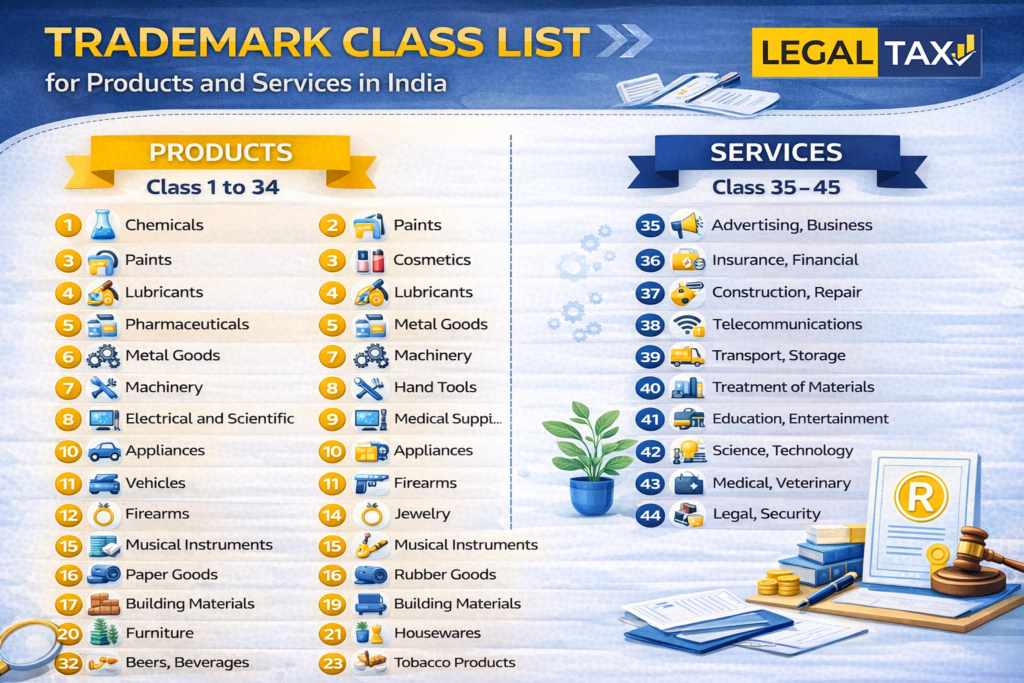
📦 Complete Trademark Class List — Classes 1 to 34 (Products)
Class 1 — Chemicals
Scope: Chemicals for use in industry, science, photography, agriculture, horticulture and forestry. Unprocessed artificial resins. Unprocessed plastics. Fire extinguishing compositions. Tempering and soldering preparations. Chemical substances for preserving foodstuffs. Tanning substances. Adhesives for industrial use.
Examples of businesses filing in Class 1: Chemical manufacturers, fertiliser companies, adhesive manufacturers, industrial chemical suppliers, laboratory reagent suppliers, photographic chemical companies.
Key products: Industrial chemicals, chemical compounds, fertilisers, adhesives, unprocessed resins, fire extinguishing chemicals, food preservatives.
Class 2 — Paints and Coatings
Scope: Paints, varnishes, lacquers. Preservatives against rust and against deterioration of wood. Colorants and dyestuffs. Inks for printing. Raw natural resins. Metals in foil and powder form for use in painting, decorating, printing and art.
Examples of businesses filing in Class 2: Paint manufacturers, varnish companies, ink manufacturers, dye companies, wood treatment product manufacturers.
Key products: Paints, varnishes, lacquers, inks, dyes, colorants, metal foils for art, rust prevention coatings.
Class 3 — Cosmetics and Cleaning Preparations
Scope: Non-medicated cosmetics and toiletry preparations. Non-medicated dentifrices. Perfumery, essential oils. Bleaching preparations and other substances for laundry use. Cleaning, polishing, scouring and abrasive preparations.
Examples of businesses filing in Class 3: Cosmetics brands, skincare companies, haircare brands, perfume houses, cleaning product manufacturers, toothpaste brands.
Key products: Shampoos, conditioners, face creams, lipsticks, perfumes, deodorants, toothpaste, soaps, detergents, cleaning products, polishes.
Class 4 — Industrial Oils and Fuels
Scope: Industrial oils and greases. Lubricants. Dust absorbing, wetting and binding compositions. Fuels and illuminants. Candles and wicks for lighting.
Examples of businesses filing in Class 4: Lubricant manufacturers, fuel companies, industrial oil suppliers, candle manufacturers.
Key products: Machine oils, lubricating greases, petroleum fuels, diesel, kerosene, candles, industrial waxes.
Class 5 — Pharmaceuticals
Scope: Pharmaceutical, medical and veterinary preparations. Sanitary preparations for medical purposes. Dietetic food and substances adapted for medical or veterinary use. Food for babies. Dietary supplements for humans and animals. Plasters, materials for dressings. Material for stopping teeth, dental wax. Disinfectants. Preparations for destroying vermin. Fungicides, herbicides.
Examples of businesses filing in Class 5: Pharmaceutical companies, nutraceutical brands, baby food companies, veterinary medicine suppliers, pest control product manufacturers, disinfectant brands.
Key products: Medicines, tablets, capsules, syrups, vitamins, supplements, baby food, bandages, disinfectants, pesticides, antiseptics.
Class 6 — Metal Goods
Scope: Common metals and their alloys, ores. Metal building and construction materials. Transportable buildings of metal. Non-electric cables and wires of common metal. Small items of metal hardware. Metal containers for storage or transport. Safes.
Examples of businesses filing in Class 6: Metal manufacturers, hardware suppliers, construction material companies, safe manufacturers, metal container producers.
Key products: Metal pipes, wires, bolts, nuts, screws, metal doors, metal containers, safes, metal building materials, steel products.
Class 7 — Machinery
Scope: Machines, machine tools, power-operated tools. Motors and engines (except for land vehicles). Machine coupling and transmission components (except for land vehicles). Agricultural implements other than hand-operated hand tools. Incubators for eggs. Automatic vending machines.
Examples of businesses filing in Class 7: Industrial machinery manufacturers, power tool companies, agricultural equipment manufacturers, motor manufacturers, vending machine suppliers.
Key products: Industrial machines, power tools, motors, engines, agricultural machinery, generators, pumps, compressors.
Class 8 — Hand Tools
Scope: Hand tools and implements, hand-operated. Cutlery. Side arms, except firearms. Razors.
Examples of businesses filing in Class 8: Hand tool manufacturers, cutlery brands, razor companies, knife manufacturers.
Key products: Hammers, screwdrivers, spanners, knives, forks, spoons, scissors, razors, hand saws.
Class 9 — Electronic and Scientific Equipment
Scope: Scientific, research, navigation, surveying, photographic, cinematographic, audiovisual, optical, weighing, measuring, signalling, detecting, testing, inspecting, life-saving and teaching apparatus and instruments. Apparatus and instruments for conducting, switching, transforming, accumulating, regulating or controlling the distribution or use of electricity. Computer hardware and peripherals. Data recording carriers. Smartphones. Software. Electric or electronic apparatus and instruments.
Examples of businesses filing in Class 9: Technology companies, smartphone brands, software companies, electronics manufacturers, camera brands, app developers, computer hardware companies.
Key products: Smartphones, computers, laptops, tablets, software, apps, cameras, headphones, smartwatches, computer peripherals, scientific instruments, electronic components, batteries, USB drives, spectacles.
Class 9 is one of the most commonly filed classes in India — covering all technology products and software.
Class 10 — Medical Devices
Scope: Surgical, medical, dental and veterinary apparatus and instruments. Artificial limbs, eyes and teeth. Orthopaedic articles. Suture materials. Therapeutic and assistive devices adapted for persons with disabilities. Massage apparatus. Apparatus, devices and articles for nursing infants. Sexual activity apparatus, devices and articles.
Examples of businesses filing in Class 10: Medical device companies, dental equipment manufacturers, orthopaedic product companies, diagnostic device manufacturers.
Key products: Surgical instruments, stethoscopes, blood pressure monitors, dental drills, wheelchairs, hearing aids, contact lenses, baby feeding bottles, medical implants.
Class 11 — Lighting and Heating Equipment
Scope: Apparatus and installations for lighting, heating, cooling, steam generating, cooking, drying, ventilating, water supply and sanitary purposes.
Examples of businesses filing in Class 11: Lighting brands, air conditioning manufacturers, water purifier companies, kitchen appliance brands, geysers and water heater brands.
Key products: LED lights, lamps, air conditioners, refrigerators, water purifiers, geysers, ovens, microwaves, fans, air purifiers, sanitary fittings.
Class 12 — Vehicles
Scope: Vehicles. Apparatus for locomotion by land, air or water.
Examples of businesses filing in Class 12: Automobile manufacturers, two-wheeler brands, bicycle companies, aircraft manufacturers.
Key products: Cars, motorcycles, scooters, bicycles, trucks, buses, boats, aircraft, vehicle parts and components.
Class 13 — Firearms
Scope: Firearms. Ammunition and projectiles. Explosives. Fireworks.
Examples of businesses filing in Class 13: Firearm manufacturers, ammunition companies, fireworks manufacturers.
Key products: Guns, rifles, bullets, explosives, fireworks, pyrotechnic products.
Class 14 — Jewellery and Watches
Scope: Precious metals and their alloys. Jewellery, precious and semi-precious stones. Horological and chronometric instruments.
Examples of businesses filing in Class 14: Jewellery brands, watch manufacturers, precious stone dealers, gold and silver jewellery companies.
Key products: Gold jewellery, diamond jewellery, silver jewellery, watches, clocks, precious stones, pearls.
Class 15 — Musical Instruments
Scope: Musical instruments. Music stands and stands for musical instruments. Conducting batons.
Examples of businesses filing in Class 15: Musical instrument manufacturers, music equipment brands.
Key products: Guitars, pianos, violins, tabla, harmoniums, drums, synthesizers, music stands.
Class 16 — Paper and Printed Matter
Scope: Paper and cardboard. Printed matter. Bookbinding material. Photographs. Stationery and office requisites, except furniture. Adhesives for stationery or household purposes. Drawing materials and materials for artists. Paintbrushes. Instructional and teaching materials. Plastic sheets, films and bags for wrapping and packaging. Printers’ type and clichés.
Examples of businesses filing in Class 16: Stationery brands, publishing companies, printing companies, packaging material manufacturers, art supply brands.
Key products: Notebooks, pens, pencils, books, magazines, newspapers, envelopes, packaging materials, art supplies, calendars, greeting cards.
Class 17 — Rubber and Plastic Goods
Scope: Raw and semi-worked rubber, gutta-percha, gum, asbestos, mica and substitutes for all these materials. Goods made of these materials not included in other classes. Plastics and resins in extruded form for use in manufacture. Packing, stopping and insulating materials. Flexible hoses and tubes.
Examples of businesses filing in Class 17: Rubber product manufacturers, plastic goods companies, insulation material suppliers, hose and pipe manufacturers.
Key products: Rubber sheets, gaskets, seals, insulating tapes, plastic hoses, rubber tubes, packaging foams.
Class 18 — Leather Goods
Scope: Leather and imitations of leather. Animal skins and hides. Luggage and carrying bags. Umbrellas and parasols. Walking sticks. Whips, harness and saddlery. Collars, leashes and clothing for animals.
Examples of businesses filing in Class 18: Leather goods brands, luggage companies, bag manufacturers, umbrella brands.
Key products: Leather bags, wallets, purses, suitcases, handbags, backpacks, belts, umbrellas, travel bags, pet accessories.
Class 19 — Building Materials
Scope: Building and construction materials, not of metal. Non-metallic rigid pipes for building. Asphalt, pitch, tar and bitumen. Non-metallic transportable buildings. Monuments, not of metal.
Examples of businesses filing in Class 19: Construction material companies, cement brands, tile manufacturers, glass companies, building material suppliers.
Key products: Cement, bricks, tiles, glass, wood panels, pipes (non-metal), roofing materials, flooring materials.
Class 20 — Furniture
Scope: Furniture, mirrors, picture frames. Containers of plastic, not included in other classes. Unworked or semi-worked bone, horn, whalebone or mother-of-pearl. Shells. Meerschaum. Yellow amber.
Examples of businesses filing in Class 20: Furniture manufacturers, mirror brands, home décor companies, mattress brands, storage solution companies.
Key products: Chairs, tables, beds, wardrobes, sofas, mirrors, picture frames, plastic storage containers, pillows, mattresses.
Class 21 — Household Utensils
Scope: Household or kitchen utensils and containers. Cookware and tableware, except forks, knives and spoons. Combs and sponges. Brushes, except paintbrushes. Brush-making materials. Articles for cleaning purposes. Unworked or semi-worked glass, except building glass. Glassware, porcelain and earthenware.
Examples of businesses filing in Class 21: Kitchenware brands, glassware companies, brush manufacturers, cookware brands.
Key products: Pots, pans, plates, cups, glasses, bowls, combs, brushes, brooms, dustpans, kitchen utensils, storage containers.
Class 22 — Ropes and Fibres
Scope: Ropes and twine. Nets. Tents, tarpaulins and awnings. Sails. Sacks for the transport and storage of materials in bulk. Padding, cushioning and stuffing materials. Raw fibrous textile materials and substitutes therefor.
Examples of businesses filing in Class 22: Rope manufacturers, net manufacturers, tent companies, fibre suppliers.
Key products: Ropes, nets, tarpaulins, tents, sacking, cotton fibre, jute fibre, padding materials.
Class 23 — Yarns and Threads
Scope: Yarns and threads for textile use.
Examples of businesses filing in Class 23: Yarn manufacturers, thread suppliers, textile raw material companies.
Key products: Cotton yarn, wool yarn, silk thread, synthetic thread, embroidery thread, sewing thread.
Class 24 — Fabrics and Textiles
Scope: Textiles and substitutes for textiles. Household linen. Curtains of textile or plastic.
Examples of businesses filing in Class 24: Textile manufacturers, fabric brands, bed linen companies, curtain brands.
Key products: Cotton fabric, silk fabric, synthetic fabric, bed sheets, pillow covers, curtains, table linen, towels.
Class 25 — Clothing and Footwear
Scope: Clothing, footwear, headgear.
Examples of businesses filing in Class 25: Fashion brands, clothing manufacturers, footwear companies, sportswear brands.
Key products: T-shirts, shirts, trousers, dresses, sarees, kurtas, shoes, sandals, boots, caps, hats, socks, underwear, sportswear.
Class 25 is one of the most commonly filed classes in India — covering all types of clothing and footwear.
Class 26 — Lace and Embroidery
Scope: Lace, braid and embroidery, and other passementerie. Buttons, hooks and eyes, pins and needles. Artificial flowers. Hair decorations. False hair.
Examples of businesses filing in Class 26: Embroidery suppliers, button manufacturers, artificial flower companies, hair accessory brands.
Key products: Lace, embroidery, buttons, zippers, pins, needles, artificial flowers, hair clips, hair bands.
Class 27 — Carpets and Floor Coverings
Scope: Carpets, rugs, mats and matting, linoleum and other materials for covering existing floors. Wall hangings, not of textile.
Examples of businesses filing in Class 27: Carpet manufacturers, rug brands, flooring companies, mat suppliers.
Key products: Carpets, rugs, doormats, floor mats, linoleum, yoga mats, wall hangings.
Class 28 — Games and Sporting Goods
Scope: Games, toys and playthings. Video game apparatus. Gymnastic and sporting articles. Decorations for Christmas trees.
Examples of businesses filing in Class 28: Toy brands, sports equipment companies, gaming companies, fitness equipment manufacturers.
Key products: Cricket bats, footballs, chess sets, board games, video games, gym equipment, bicycles (sporting), toys, dolls, Christmas decorations.
Class 29 — Meat and Processed Foods
Scope: Meat, fish, poultry and game. Meat extracts. Preserved, frozen, dried and cooked fruits and vegetables. Jellies, jams, compotes. Eggs. Milk, cheese, butter, yogurt and other milk products. Oils and fats for food.
Examples of businesses filing in Class 29: Food brands, dairy companies, processed food manufacturers, edible oil companies.
Key products: Meat products, fish products, dairy products, milk, cheese, butter, ghee, edible oils, preserved vegetables, fruit juices, jams.
Class 30 — Staple Foods
Scope: Coffee, tea, cocoa and artificial coffee. Rice, pasta and noodles. Tapioca and sago. Flour and preparations made from cereals. Bread, pastries and confectionery. Chocolate. Ice cream, sorbets and other edible ices. Sugar, honey, treacle. Yeast, baking-powder. Salt, seasonings, spices, preserved herbs. Vinegar, sauces and other condiments. Ice.
Examples of businesses filing in Class 30: FMCG food brands, tea and coffee companies, spice brands, bakery brands, confectionery companies.
Key products: Tea, coffee, rice, wheat flour, bread, biscuits, chocolates, ice cream, sugar, salt, spices, sauces, noodles, pasta, condiments.
Class 30 is one of the most commonly filed classes in India — covering most packaged food and beverage products.
Class 31 — Agricultural Products
Scope: Raw and unprocessed agricultural, aquacultural, horticultural and forestry products. Raw and unprocessed grains and seeds. Fresh fruits and vegetables, fresh herbs. Natural plants and flowers. Bulbs, seedlings and seeds for planting. Live animals. Foodstuffs and beverages for animals. Malt.
Examples of businesses filing in Class 31: Agricultural companies, seed companies, fresh produce brands, plant nurseries, animal feed companies.
Key products: Fresh fruits, fresh vegetables, seeds, seedlings, live plants, animal feed, raw grains, flowers.
Class 32 — Beers and Non-Alcoholic Beverages
Scope: Beers. Non-alcoholic beverages. Mineral and aerated waters. Fruit beverages and fruit juices. Syrups and other non-alcoholic preparations for making beverages.
Examples of businesses filing in Class 32: Soft drink brands, mineral water companies, fruit juice brands, beer manufacturers, energy drink companies.
Key products: Beer, soft drinks, mineral water, packaged drinking water, fruit juices, energy drinks, syrups, squashes, mocktails.
Class 33 — Alcoholic Beverages
Scope: Alcoholic beverages, except beers. Alcoholic preparations for making beverages.
Examples of businesses filing in Class 33: Liquor brands, wine companies, spirits manufacturers, whisky brands.
Key products: Whisky, rum, vodka, gin, wine, brandy, cocktail mixes, alcoholic beverages.
Class 34 — Tobacco Products
Scope: Tobacco and tobacco substitutes. Cigarettes and cigars. Electronic cigarettes and oral vaporisers for smokers. Smokers’ articles. Matches.
Examples of businesses filing in Class 34: Tobacco companies, cigarette brands, e-cigarette companies, match manufacturers.
Key products: Cigarettes, cigars, tobacco, e-cigarettes, vaping products, matches, lighters, tobacco pipes.
🛎️ Complete Trademark Class List — Classes 35 to 45 (Services)
Class 35 — Advertising and Business Services
Scope: Advertising. Business management, organization and administration. Office functions. Retail and wholesale services for specified goods.
Examples of businesses filing in Class 35: Advertising agencies, marketing companies, retail stores, e-commerce platforms, business consultancies, HR companies, recruitment firms, accounting firms.
Key services: Advertising services, marketing services, business management, retail services, e-commerce services, recruitment, HR management, accounting, business consulting, market research, office administration.
Class 35 is one of the most commonly filed classes in India — covering advertising, marketing and all types of retail and business services.
Class 36 — Financial Services
Scope: Financial, monetary and banking services. Insurance services. Real estate services.
Examples of businesses filing in Class 36: Banks, insurance companies, mutual fund companies, real estate agencies, payment gateways, fintech companies, stock brokers.
Key services: Banking, insurance, investment services, real estate services, mortgage services, payment processing, wealth management, stock broking, foreign exchange, loan services.
Class 37 — Construction and Repair Services
Scope: Construction services. Installation and repair services. Mining extraction, oil and gas drilling.
Examples of businesses filing in Class 37: Construction companies, interior designers, repair service companies, maintenance service providers.
Key services: Building construction, renovation, interior construction, equipment installation, repair services, vehicle servicing, plumbing, electrical services, painting services.
Class 38 — Telecommunications
Scope: Telecommunications services. Providing access to and leasing of access time to computer databases. Broadcasting services.
Examples of businesses filing in Class 38: Telecom operators, internet service providers, cable TV companies, broadcasting companies, OTT platforms (for broadcasting).
Key services: Mobile phone services, internet services, broadband services, TV broadcasting, radio broadcasting, satellite communications, messaging services, VoIP services.
Class 39 — Transport and Storage
Scope: Transport. Packaging and storage of goods. Travel arrangement.
Examples of businesses filing in Class 39: Logistics companies, courier services, travel agencies, airlines, shipping companies, storage companies.
Key services: Courier delivery, freight transport, warehousing, travel booking, airline services, taxi services, car rental, moving and packing, cold storage.
Class 40 — Material Treatment Services
Scope: Treatment of materials. Recycling of waste and trash. Air purification and treatment of water. Printing services. Food and drink preservation.
Examples of businesses filing in Class 40: Manufacturing service providers, printing companies, recycling companies, water treatment companies, food processing companies.
Key services: Custom manufacturing, printing services, recycling services, water purification, food processing, material treatment, engraving.
Class 41 — Education and Entertainment
Scope: Education. Providing of training. Entertainment. Sporting and cultural activities.
Examples of businesses filing in Class 41: Educational institutions, e-learning platforms, entertainment companies, sports organizations, media companies, coaching institutes.
Key services: School and college education, online education, coaching, training courses, entertainment services, sports events, gaming, film production, music production, publishing.
Class 41 is one of the most commonly filed classes in India — covering all education, coaching, training and entertainment services.
Class 42 — Scientific and Technology Services
Scope: Scientific and technological services and research and design relating thereto. Industrial analysis, industrial research and industrial design services. Quality control and authentication services. Design and development of computer hardware and software. IT services.
Examples of businesses filing in Class 42: IT service companies, software development companies, web design agencies, cloud service providers, R&D companies, quality testing labs.
Key services: Software development, web design, app development, IT consulting, cloud computing, data analytics, cybersecurity services, AI and machine learning services, research and development.
Class 42 is one of the most commonly filed classes in India — covering all IT services and technology services.
Class 43 — Food and Beverage Services
Scope: Services for providing food and drink. Temporary accommodation.
Examples of businesses filing in Class 43: Restaurants, cafes, hotels, catering companies, food delivery services, cloud kitchens.
Key services: Restaurant services, cafe services, hotel accommodation, catering, food delivery, cloud kitchen services, bar and pub services, banquet services.
Class 44 — Medical and Veterinary Services
Scope: Medical services. Veterinary services. Hygienic and beauty care for human beings or animals. Agriculture, aquaculture, horticulture and forestry services.
Examples of businesses filing in Class 44: Hospitals, clinics, dental clinics, veterinary clinics, beauty salons, spas, agricultural service providers.
Key services: Medical consultation, hospital services, dental services, veterinary services, beauty salon services, spa services, physiotherapy, agricultural advisory, horticulture services.
Class 45 — Legal and Security Services
Scope: Legal services. Security services for the physical protection of tangible property and individuals. Personal and social services rendered by others to meet the needs of individuals.
Examples of businesses filing in Class 45: Law firms, legal tech companies, security agencies, matrimonial services, social networking companies, dating apps.
Key services: Legal advisory services, law firm services, security guard services, surveillance services, matrimonial services, dating services, personal protection services, funeral services, religious services.
🎯 How to Identify the Right Trademark Class for Your Business
Identifying the correct trademark class requires a systematic approach:
Step 1 — List All Your Products and Services
Write down every product you manufacture or sell and every service you provide — be comprehensive. Include products and services you are planning to launch in the near future.
Step 2 — Use the TMCLASS Search Tool
WIPO’s TMclass database — available at tmclass.wipo.int — is the most comprehensive searchable database of goods and services. Enter each product or service in the search bar and the tool suggests the appropriate class.
India’s Trade Marks Registry also provides an online search tool at ipindiaonline.gov.in.
Step 3 — Review Class Headings and Explanatory Notes
For each candidate class — read the full class heading and explanatory notes to confirm your product or service falls within the scope. Pay particular attention to:
- Items specifically included in the class
- Items specifically excluded from the class
- Overlapping items that could fall in multiple classes
Step 4 — Check Where Your Competitors Have Filed
Search the Trade Marks Registry database for your competitors’ trademark registrations. The classes they have filed in provide useful guidance — though your specific products may require additional or different classes.
Step 5 — Consult a Trademark Expert
For businesses with multiple products, complex service offerings or brands that span multiple industries — professional trademark class advice from LegalTax.in ensures you get the right protection from Day 1. Call 9711939395.
📋 Multi-Class Trademark Filing in India
What Is Multi-Class Filing?
Under the Trade Marks Act 1999 — as amended — India now permits multi-class trademark applications. A single trademark application can cover multiple classes — simplifying the process of obtaining protection across different product and service categories.
Advantages of Multi-Class Filing
- Single application number — easier to manage and track
- Same filing date — all classes share the same priority date
- Streamlined process — one examination, one opposition period
- Cost efficient — reduced administrative overhead compared to separate filings
Fee Structure for Multi-Class Filing
Each class in a multi-class application attracts a separate class fee. There is no discount for filing multiple classes together — the fee is simply the per-class fee multiplied by the number of classes.
However — administrative and professional fees are typically lower for a single multi-class application compared to multiple separate applications.
When to File in Multiple Classes
File in multiple classes when your brand covers genuinely different categories — for example:
- A technology company selling hardware (Class 9) and providing software services (Class 42)
- A fashion brand selling clothing (Class 25) and accessories (Class 18)
- A food company selling products (Class 30) and operating restaurants (Class 43)
- An educational institution offering courses (Class 41) and selling books (Class 16)
LegalTax.in advises on the optimal multi-class filing strategy for your specific business. Call 9711939395.
🔄 Trademark Class vs Trademark Category — Key Difference
A common confusion in trademark filing:
| Aspect | Trademark Class | Trademark Category |
|---|---|---|
| What it is | One of 45 official Nice Classification divisions | Industry sector or type (e.g. food, technology, fashion) |
| Legal significance | Legally defined — determines scope of protection | Descriptive only — no legal significance |
| Used in filing | Yes — must be specified in every application | No — not used in official filing |
| Examples | Class 30, Class 42, Class 25 | Food and beverage, IT services, clothing |
The class is what matters legally. The category is just informal industry language.
🏆 Most Popular Trademark Classes Filed in India
Based on Trade Marks Registry data — these are the most frequently filed classes in India:
| Rank | Class | Sector | Why So Popular |
|---|---|---|---|
| 1 | Class 35 | Advertising and Retail | Covers all retail, e-commerce and marketing businesses |
| 2 | Class 42 | IT Services | Covers software development, web design, IT consulting |
| 3 | Class 41 | Education and Entertainment | Covers coaching, training, e-learning, entertainment |
| 4 | Class 9 | Electronics and Software | Covers smartphones, apps, software products |
| 5 | Class 25 | Clothing and Footwear | Covers all fashion brands |
| 6 | Class 30 | Food and Beverages | Covers packaged food, tea, coffee, spices |
| 7 | Class 5 | Pharmaceuticals | Covers medicines, supplements, healthcare products |
| 8 | Class 43 | Restaurants and Hotels | Covers food service, hospitality |
| 9 | Class 44 | Medical Services | Covers hospitals, clinics, beauty services |
| 10 | Class 3 | Cosmetics | Covers skincare, haircare, personal care brands |
📋 Trademark Filing Process in India
Step 1 — Trademark Search
Before filing — conduct a comprehensive trademark search to identify any conflicting existing registrations:
- Search the Trade Marks Registry database at ipindiaonline.gov.in
- Search for identical and similar marks in the same class
- Check for phonetically similar marks
- Search for marks with similar visual appearance
LegalTax.in conducts comprehensive trademark searches — covering direct conflicts, phonetically similar marks and visually similar marks — before recommending filing. Call 9711939395.
Step 2 — Identify Applicant Type
The applicant type affects the filing fee:
- Individual — single person filing
- Startup — recognized by DPIIT under Startup India
- Small enterprise — as defined under MSMED Act
- Large entity — all others including large companies
Step 3 — Prepare the Application
The trademark application requires:
- Applicant details — name, address, nationality
- Trademark representation — wordmark, logo or both
- Specification of goods or services — within the selected class(es)
- Class number(s)
- User clause — date of first use if the mark is already in use
Step 4 — File the Application
File through:
- Online — at ipindiaonline.gov.in (recommended — faster and with online payment)
- Physical filing — at the Trade Marks Registry office
Upon filing — an application number and filing date (priority date) are assigned immediately.
Step 5 — Examination
The Trade Marks Registry examines the application — typically within 3 to 12 months. The examiner checks:
- Whether the mark is distinctive and registrable
- Whether any absolute grounds for refusal apply (descriptive, generic marks)
- Whether any relative grounds for refusal apply (conflict with existing marks)
Where objections are raised — an Examination Report is issued.
Step 6 — Response to Examination Report
Where an Examination Report raises objections — the applicant has 30 days to file a response. LegalTax.in drafts legally sound responses that address all objections and maximise the chances of acceptance.
Step 7 — Publication in Trade Marks Journal
Where the application is accepted — it is published in the Trade Marks Journal. Any person can oppose the application within 4 months of publication.
Step 8 — Opposition (If Any)
Where an opposition is filed — both parties exchange pleadings and evidence. LegalTax.in handles opposition proceedings — both defending your application and filing oppositions against conflicting marks.
Step 9 — Registration and Certificate
Where there is no opposition (or opposition is decided in your favour) — the trademark is registered and a Registration Certificate is issued.
Total timeline: 18 to 36 months from filing to registration in India — though the trademark is protected from the date of filing.
💰 Trademark Class Fees in India
Official Filing Fees
| Applicant Type | Fee Per Class (e-filing) | Fee Per Class (physical filing) |
|---|---|---|
| Individual | ₹4,500 | ₹5,000 |
| Startup (DPIIT recognized) | ₹4,500 | ₹5,000 |
| Small Enterprise (MSME) | ₹4,500 | ₹5,000 |
| Large Entity | ₹9,000 | ₹10,000 |
Professional Service Fees — LegalTax.in
| Service | Fee |
|---|---|
| Trademark search and class identification | ₹2,000 to ₹5,000 |
| Trademark application filing (per class) | ₹2,000 to ₹5,000 |
| Examination report response | ₹3,000 to ₹8,000 |
| Opposition proceedings | ₹10,000 to ₹50,000 |
| Complete trademark registration (search to certificate) | ₹8,000 to ₹20,000 per class |
Total Cost Example
Individual filing in 2 classes (e.g. Class 25 and Class 35):
- Government fee: ₹4,500 × 2 = ₹9,000
- LegalTax.in service fee: ₹8,000 to ₹15,000
- Total: ₹17,000 to ₹24,000
📞 Call 9711939395 for a specific quote for your trademark registration.
🚫 Common Mistakes in Trademark Class Selection
❌ Filing only in one class when business spans multiple classes A clothing brand that also operates retail stores needs both Class 25 (clothing) and Class 35 (retail services). Filing only in Class 25 leaves the retail service aspect unprotected.
❌ Filing in an incorrect class due to superficial reading Class 9 covers software products. Class 42 covers software services. A company that both sells software (Class 9) and provides IT consulting (Class 42) needs both — filing only in Class 9 leaves services unprotected.
❌ Not filing in defensive classes for well-known brands Large brands should consider filing in related classes to prevent competitors from registering in adjacent categories. LegalTax.in advises on defensive trademark strategy.
❌ Over-broad specification of goods and services Claiming excessively broad goods and services within a class — including items you do not actually deal in — can make the application vulnerable to non-use cancellation after 5 years.
❌ Relying on one jurisdiction’s filing for global protection An Indian trademark registration protects you only in India. For international protection — file in each target country or use the Madrid System (international trademark filing). LegalTax.in handles international trademark filing.
❌ Not conducting a prior search before filing Filing without a comprehensive prior art search risks rejection based on a conflicting existing mark — wasting filing fees and months of time.
❌ Filing as the wrong applicant type Startups and MSMEs qualify for reduced fees. Filing as a large entity unnecessarily doubles or more the filing fee. LegalTax.in ensures the correct applicant type is used.
🌟 How LegalTax.in Helps with Trademark Registration
LegalTax.in provides complete, expert trademark registration services — from class identification and prior art search through filing, examination and registration.
What LegalTax.in Does
Free Initial Trademark Consultation LegalTax.in provides a free initial consultation — understanding your business, identifying the correct trademark classes and advising on the overall trademark strategy. No obligation, no upfront cost.
📞 Call 9711939395 to book your free trademark consultation.
Comprehensive Trademark Search LegalTax.in conducts a thorough prior art search — covering exact matches, phonetically similar marks, visually similar marks and marks in the same and adjacent classes — before recommending filing.
Class Identification and Strategy LegalTax.in identifies all classes applicable to your business — including classes you may not have considered — and advises on the optimal filing strategy for complete protection.
Trademark Application Drafting and Filing LegalTax.in prepares and files your trademark application — with a precisely worded specification of goods and services that provides strong protection without being vulnerable to non-use challenges.
Examination Report Response LegalTax.in drafts technically and legally sound responses to examination reports — addressing all objections with compelling arguments and maximising the chances of acceptance.
Opposition Management LegalTax.in handles opposition proceedings — both defending your application against third party oppositions and filing oppositions against conflicting marks published in the Trade Marks Journal.
Portfolio Management For businesses with multiple trademarks — LegalTax.in provides ongoing portfolio management including renewal tracking, competitive monitoring and infringement alerts.
International Trademark Filing LegalTax.in manages trademark filing in international markets — through the Madrid System (WIPO) or direct country filings in the USA, UK, EU and other key markets.
LegalTax.in Trademark Services and Pricing
| Service | Details |
|---|---|
| Free Initial Consultation | Call 9711939395 |
| Trademark Search | ₹2,000 to ₹5,000 |
| Trademark Filing (per class, individual) | ₹6,500 to ₹9,500 (govt fee + professional fee) |
| Trademark Filing (per class, large entity) | ₹11,000 to ₹14,000 (govt fee + professional fee) |
| Examination Report Response | ₹3,000 to ₹8,000 |
| Opposition Proceedings | ₹10,000 to ₹50,000 |
| International Filing (Madrid System) | Custom quote |
| Portfolio Management | Annual retainer — custom quote |
📞 9711939395 🌐 legaltax.in
Get Your Free Trademark Consultation from LegalTax.in →
❓ Frequently Asked Questions (FAQs)
Q1. How many trademark classes are there in India?
There are 45 trademark classes in India under the Nice Classification system — Classes 1 to 34 for goods (products) and Classes 35 to 45 for services. India adopted the Nice Classification under the Trade Marks Act 1999. The current applicable edition is the 12th Edition of the Nice Classification.
Q2. Can I register a trademark in multiple classes in India?
Yes — India permits multi-class trademark applications. A single application can cover multiple classes — sharing the same filing date and application number. Each additional class attracts a separate class fee. LegalTax.in advises on the right multi-class strategy for your business. Call 9711939395.
Q3. What class should a software company file in?
A software company typically needs to file in multiple classes: Class 9 — for software products (apps, programs, downloadable software); Class 42 — for IT services (software development, web design, cloud services, IT consulting); and potentially Class 35 — if the company provides business management software as a service. LegalTax.in confirms the right classes for your specific software business.
Q4. What is the trademark class for a restaurant in India?
Restaurants primarily file in Class 43 — which covers services for providing food and drink and temporary accommodation. However if the restaurant also sells packaged food products, that would additionally require Class 29 or Class 30 depending on the product type. Call LegalTax.in at 9711939395 for restaurant-specific trademark advice.
Q5. How long does trademark registration take in India?
From filing to registration — the process typically takes 18 to 36 months in India. The timeline depends on whether there are examination objections, whether an opposition is filed and the current workload at the Trade Marks Registry. However the trademark is protected from the date of filing — even before registration is complete. LegalTax.in monitors your application throughout and responds promptly to any examination reports.
Q6. What happens if I file in the wrong trademark class in India?
A trademark registered in the wrong class does not protect your actual products or services — leaving you vulnerable to infringement by competitors. The filed application cannot typically be amended to a different class — you would need to file a new application in the correct class and pay the fees again. Professional class identification by LegalTax.in before filing prevents this costly mistake. Call 9711939395.
Q7. Is an Indian trademark valid internationally?
An Indian trademark registration protects your brand only in India. For protection in other countries — you need to file separately in each country or use the Madrid System (WIPO’s international trademark filing mechanism) which allows you to file in up to 130 countries through a single international application. LegalTax.in handles both Indian and international trademark filing. Call 9711939395.
Q8. What is the difference between trademark registration and trademark use?
You can use a trademark (the ™ symbol) without registration. Registration (the ® symbol) requires formal registration with the Trade Marks Registry. Registered trademarks provide stronger legal protection — the right to sue for infringement, the ability to oppose conflicting applications and a legal presumption of validity. An unregistered mark has some common law protection but is significantly harder and more expensive to enforce.
🎯 Who Needs This Guide Right Now?
If you are launching a new product or service and want to protect your brand → Identify the correct trademark class and file immediately. The sooner you file, the earlier your priority date. Call LegalTax.in at 9711939395.
If you have been using a brand name without registering it → Someone else could register your mark before you. File now — your protection dates from the filing date, not the registration date.
If a competitor is using a name similar to yours → LegalTax.in can assess whether you have grounds for an opposition or infringement action and what trademark class issues are relevant. Call 9711939395.
If you are expanding your business into new product or service categories → You need to file in additional classes to protect your brand in the new areas. LegalTax.in reviews your existing registrations and advises on additional filings needed.
If you are targeting international markets → LegalTax.in handles Madrid System international trademark filings and direct country filings for Indian businesses expanding globally.
✅ Final Recommendation
The complete trademark class list in India — all 45 classes under the Nice Classification — is the foundation of trademark protection strategy for every business.
Getting the class selection right means your trademark genuinely protects your brand — across all the products you sell and all the services you provide.
Getting it wrong means paying registration fees for protection that does not cover your actual business — leaving you vulnerable to infringement and requiring expensive re-filing.
The most important steps when protecting your trademark:
- 📋 List every product and service your brand covers — including future plans
- 🔍 Conduct a comprehensive prior art search before filing
- 🎯 Identify all applicable classes — including classes you might not have considered
- 📝 File with a precise specification of goods and services — not too broad, not too narrow
- 🌍 Consider international filing if you operate or plan to operate in other markets
LegalTax.in provides India’s most expert and comprehensive trademark registration service — from class identification and prior art search through filing, examination, opposition and registration.
For any business — from a first-time startup protecting its brand to a large enterprise managing a multi-class trademark portfolio — LegalTax.in has the expertise to deliver complete and commercially meaningful trademark protection.
Your first consultation is completely free.
📞 9711939395 🌐 legaltax.in
Get Your Free Trademark Consultation from LegalTax.in →
Need Help With Trademark Services?
🟡 Legal Tax provide complete trademark registration, trademark search, multi-class filing strategy, and IP advisory services for businesses across all sectors in India.
IP Protection Services
👉 Trademark Registration 👉 Patent Registration 👉 Copyright Registration 👉 Design Registration
Business Registration and Compliance Services
👉 GST Registration and Filing 👉 Private Limited Company Registration 👉 LLP Registration 👉 MSME / Udyam Registration 👉 Startup India Registration
Call Now: +91 9711939395 Email: info@legaltax.in Free Consultation: Monday to Saturday, 9 AM to 6 PM

I’m Aryan Yadav, passionate about SEO and Digital Marketing with a strong interest in helping businesses grow online. I enjoy learning new strategies, exploring digital trends, and creating ideas that deliver value. I believe in continuous growth, creativity, and building meaningful results through smart work and dedication.
Our Clients