Views: 20
Table of Contents
Introduction
Every business whether it manufactures steel, processes food, builds infrastructure, writes software, or runs a hospital interacts with the natural environment in some way. It consumes energy and water. It generates waste. It produces emissions. It uses raw materials that were extracted from the earth. Some of these interactions are minor; others are significant. What separates environmentally responsible organisations from the rest is not the absence of environmental impact but the presence of a systematic framework for identifying, managing, and continually reducing that impact.
ISO 14001 is that framework. It is the internationally recognised standard for Environmental Management Systems, published by the International Organisation for Standardisation and adopted by hundreds of thousands of organisations across the world. ISO 14001 does not tell an organisation what its environmental performance must be. It tells an organisation how to build the management system that enables it to know what its environmental impacts are, to comply with applicable environmental laws and obligations, to set and pursue environmental improvement objectives, and to demonstrate its environmental credentials to customers, regulators, and stakeholders.
For Indian businesses, ISO 14001 has become increasingly significant across multiple dimensions simultaneously. Environmental regulations administered by the Central Pollution Control Board and State Pollution Control Boards are becoming stricter. Large domestic and international buyers are introducing environmental criteria into their procurement and supply chain requirements. ESG reporting and sustainability disclosures are moving from voluntary to expected, and in some cases toward mandatory. The cost of energy and raw materials makes operational efficiency which ISO 14001 systematically drives a financial as well as an environmental priority.
This guide provides a complete explanation of ISO 14001 in 2026 what the standard is, how it works in practice, what implementing it requires, what the certification process involves, and why an organisation should invest in it. For complete ISO 14001 advisory, documentation support, and Environmental Management System implementation services, the team at LegalTax.in works with businesses across all sectors and entity types.
What Is ISO 14001?
The Standard and Its History
ISO 14001 is an international standard that specifies the requirements for an Environmental Management System. The current version is ISO 14001:2015, published in September 2015. It replaced the previous version, ISO 14001:2004, which itself succeeded the original 1996 version.
The 2015 revision was significant. It aligned ISO 14001 with the High Level Structure common to all major ISO management system standards, making integration with ISO 9001, ISO 45001, and other standards far more efficient. It strengthened the requirements for leadership involvement, introduced the life cycle perspective requirement, placed greater emphasis on strategic context and interested parties, and elevated the importance of proactive environmental thinking beyond mere compliance.
The standard is developed and maintained by the ISO Technical Committee 207, Subcommittee 1, with input from national standards bodies around the world. In India, the Bureau of Indian Standards represents India in this process and publishes the Indian Standard equivalent.
What ISO 14001 Is Not
Understanding what ISO 14001 is not is as important as understanding what it is.
ISO 14001 is not a product standard. It does not certify that a product is environmentally friendly. It certifies that the organisation producing the product has a management system in place to identify and manage the environmental impacts of its operations.
ISO 14001 does not specify environmental performance targets. It does not require an organisation to achieve a particular level of energy consumption, emissions, or waste generation. It requires the organisation to set its own objectives consistent with its environmental policy and to make continual improvement toward those objectives.
ISO 14001 is not a guarantee of environmental compliance. Certification does not mean that an organisation will never violate an environmental regulation. It means that the organisation has systems in place to identify applicable requirements, monitor compliance, and address non-compliances when they occur.
ISO 14001 is not an environmental audit. It is a management system standard. Certification involves assessment of whether the management system meets the standard’s requirements, not a forensic audit of every environmental impact the organisation has ever had.
The Structure of ISO 14001:2015
ISO 14001:2015 follows the High Level Structure used by all modern ISO management system standards. This structure has ten clauses, of which clauses 4 through 10 contain the substantive requirements.
Clause 4: Context of the Organisation
This clause requires the organisation to understand the internal and external factors that are relevant to its purpose and that affect its ability to achieve the intended outcomes of its Environmental Management System. It also requires identification of interested parties those who can affect or be affected by the organisation’s environmental performance and understanding of their needs and expectations.
Practically, this means the organisation must examine its operating environment: the nature of its activities and their relationship to the surrounding natural environment, the regulatory framework it operates within, the community in which it is located, the expectations of its customers and supply chain partners, and its own internal capabilities and culture regarding environmental management.
The scope of the EMS is defined in this clause the boundaries and applicability of the Environmental Management System must be documented.
Clause 5: Leadership
ISO 14001:2015 places strong emphasis on top management involvement in environmental management. Senior leadership must demonstrate commitment to the EMS, not merely delegate it to an environmental manager. Specific leadership requirements include establishing an environmental policy, ensuring the EMS is integrated into the organisation’s business processes, and promoting a culture of environmental awareness throughout the organisation.
The environmental policy must include commitments to protecting the environment and preventing pollution, complying with compliance obligations, and continually improving the EMS.
Clause 6: Planning
This is one of the most substantive clauses in ISO 14001 and contains requirements that distinguish it most clearly from other management system standards.
Environmental aspects and impacts: The organisation must identify the aspects of its activities, products, and services that interact with the environment, evaluate which aspects have or can have significant environmental impacts, and maintain documented information about this assessment. This must cover normal operating conditions, abnormal conditions, and foreseeable emergency situations. It must also consider a life cycle perspective not just what happens within the organisation’s fence line but what happens upstream and downstream in the product or service life cycle.
Compliance obligations: The organisation must identify all legal requirements and other requirements applicable to its environmental aspects. In India, this includes consents and authorisations under the Water (Prevention and Control of Pollution) Act, the Air (Prevention and Control of Pollution) Act, the Environment Protection Act, Hazardous Waste Management Rules, E-Waste Management Rules, Plastic Waste Management Rules, and any sector-specific environmental regulations. It includes applicable standards, industry codes, and any environmental commitments made to customers or communities.
Environmental objectives: The organisation must establish environmental objectives at relevant functions and levels, consistent with its environmental policy and significant aspects. Objectives must be measurable where practicable, monitored, communicated, and updated as appropriate. Plans for achieving each objective must specify what will be done, what resources are required, who is responsible, when it will be completed, and how results will be evaluated.
Clause 7: Support
This clause covers the resources, competence, awareness, communication, and documented information necessary to support the EMS. It requires the organisation to ensure that people working under its control who affect environmental performance are competent with appropriate education, training, and experience. It requires internal and external communication planning for environmental matters. And it requires maintenance of the documented information that serves as evidence of the EMS operation and results.
Clause 8: Operation
This clause translates the planning requirements into actual operational controls. Organisations must plan, implement, control, and maintain the processes needed to manage their significant environmental aspects and to achieve their environmental objectives.
The life cycle perspective is operationalised here: environmental requirements must be considered in product and service design, communicated to suppliers and contractors, and addressed in post-delivery activities including product use and end-of-life management.
Emergency preparedness and response is also addressed in this clause, requiring the organisation to plan for potential environmental emergencies chemical spills, uncontrolled emissions, fire with environmental consequences, hazardous material releases and to maintain response procedures that are periodically tested.
Clause 9: Performance Evaluation
This clause requires the organisation to monitor, measure, analyse, and evaluate its environmental performance. Monitoring must cover the significant environmental aspects, compliance obligations, progress toward environmental objectives, and the effectiveness of operational controls.
Compliance evaluation a requirement with no equivalent in ISO 9001 must be conducted periodically to assess whether the organisation is meeting all of its compliance obligations. This is not merely a documentation exercise; it requires a substantive assessment of actual compliance status.
Internal audits of the EMS must be conducted at planned intervals to assess conformity with the standard’s requirements and the organisation’s own requirements, and to assess whether the EMS is effectively implemented and maintained.
Management review by top management must be conducted periodically, using inputs including environmental performance trends, compliance status, achievement of objectives, audit results, and communications from interested parties.
Clause 10: Improvement
This clause requires the organisation to continually improve the suitability, adequacy, and effectiveness of its EMS to enhance environmental performance. When nonconformities occur instances where requirements are not met the organisation must react to control the nonconformity, evaluate the need for root cause analysis, and implement corrective action to prevent recurrence. The organisation must also look for improvement opportunities proactively, not only react to failures.
How ISO 14001 Works in Practice
Step 1: Commitment and Scope Definition
The starting point is genuine top management commitment to implementing an EMS. Without leadership commitment, the system will not be adequately resourced, will not be integrated into business processes, and will not produce the cultural change that makes environmental management sustainable.
Once commitment is established, the scope of the EMS is defined which sites, activities, products, and services are included within the boundary of the system.
Step 2: Gap Assessment
A gap assessment compares the organisation’s current environmental management practices against the requirements of ISO 14001:2015. The assessment identifies what is already in place, what is partially in place, and what needs to be built from scratch. The output is a prioritised implementation plan.
Step 3: Environmental Aspects and Impacts Assessment
This is the most analytically demanding step. The organisation must systematically identify every activity, product, and service that interacts with the environment, and for each, assess the nature of the environmental impact, whether it is significant, and what the current controls are. This assessment is documented in an aspects and impacts register.
Aspects typically identified in manufacturing operations include raw material consumption, energy consumption, water use, air emissions from combustion and process operations, wastewater discharge, solid waste and hazardous waste generation, chemical storage and potential for spills, and noise. The register must cover normal, abnormal, and emergency scenarios.
Step 4: Compliance Obligations Register
All applicable environmental legal requirements, permit conditions, and other obligations are identified and documented. In India, this involves mapping the consents and authorisations held under pollution control legislation, identifying all conditions attached to those consents, and identifying any additional legal requirements applicable to the sector.
Step 5: Environmental Policy, Objectives, and Programmes
The environmental policy is established by top management. Environmental objectives are set based on the significant aspects identified, the compliance obligations in place, and the organisation’s strategic environmental priorities. Action programmes with specific actions, responsibilities, timelines, and resources are developed to achieve each objective.
Step 6: Documentation and Procedure Development
The documented information required by the standard is developed: the EMS scope document, environmental policy, aspects and impacts register, compliance obligations register, environmental objectives and plans, operational procedures for activities with significant aspects, emergency preparedness and response procedures, and monitoring and measurement plans.
Step 7: Implementation and Training
The system is implemented across the organisation. Personnel who work in roles that affect environmental performance are trained in the relevant procedures, the significance of their environmental aspects, and their responsibilities under the EMS. Awareness of the environmental policy and the organisation’s significant aspects is communicated throughout the workforce.
Step 8: Internal Audit
Before the external certification audit, the organisation conducts internal audits of the EMS to verify that it has been properly implemented and that it conforms to the requirements of ISO 14001:2015. Internal auditors must be competent and must audit areas other than their own.
Step 9: Management Review
Top management reviews the EMS using the inputs specified in the standard. The output of the management review includes decisions on improvement opportunities, any need for changes to the EMS, and any resource requirements.
Step 10: Certification Audit
The certification audit is conducted in two stages. Stage 1 is a documentation review the certification body reviews the EMS documentation to assess readiness for the Stage 2 audit. Stage 2 is a site-based audit during which the certification body verifies that the EMS is implemented effectively across the organisation. Audit findings are classified as major nonconformities, minor nonconformities, or observations. Major nonconformities must be resolved before the certificate is issued. Minor nonconformities are addressed through the corrective action process during the first surveillance audit cycle.
Why Use ISO 14001: The Business Case
Regulatory Compliance Assurance
India’s environmental regulatory framework is extensive and increasingly enforced. Consents under the Water Act and Air Act, authorisations under Hazardous Waste Rules, environmental clearances under the Environment Impact Assessment notification, and sector-specific standards from the Central Pollution Control Board create a complex web of obligations for industrial and commercial organisations.
An ISO 14001 EMS provides the systematic framework for identifying, tracking, and maintaining compliance with all applicable obligations. The compliance obligations register and periodic compliance evaluation requirement mean that gaps are identified and addressed before they become violations. Organisations with a functioning EMS are significantly less likely to face enforcement action, show-cause notices, or directions to shut down from pollution control authorities.
Supply Chain and Customer Requirements
Large domestic and international buyers particularly in automotive, electronics, pharmaceuticals, food, retail, and infrastructure sectors are increasingly extending their environmental requirements into their supply chains. ISO 14001 certification has become a standard requirement in supplier qualification processes for major corporations, many of whom have made public commitments on carbon neutrality, zero waste, and responsible sourcing.
For Indian manufacturers supplying to export markets in Europe and North America, ISO 14001 is frequently a contractual requirement or a strong competitive differentiator. European buyers, in particular, apply stringent sustainability criteria in procurement and favour suppliers who can demonstrate certified environmental management.
Cost Reduction Through Resource Efficiency
The process of identifying environmental aspects and setting reduction objectives systematically surfaces opportunities for energy savings, water conservation, waste reduction, and raw material efficiency that are invisible without the structured approach the standard requires. Organisations that implement ISO 14001 genuinely rather than as a documentation exercise consistently find that the operational improvements it drives deliver financial returns that more than offset the cost of implementation and certification.
Reduced energy consumption lowers electricity and fuel costs. Reduced waste generation lowers disposal costs. Reduced water consumption lowers utility costs and, in water-stressed regions, reduces operational risk. The environmental and financial benefits of resource efficiency are inseparable.
ESG Reporting and Investor Relations
Environmental, Social, and Governance (ESG) considerations are increasingly central to investment decisions, lending decisions, and business partnership assessments. ISO 14001 certification provides credible, independently verified evidence of environmental management capability that supports ESG reporting, sustainability disclosures, and responses to investor questionnaires on environmental performance.
For companies listed on Indian stock exchanges, the Business Responsibility and Sustainability Report requirements have elevated the importance of structured environmental management. ISO 14001 provides the data and the management framework that makes BRSR disclosures substantive rather than superficial.
Reputational and Community Relations Benefits
Organisations that operate near communities manufacturing plants, mining operations, construction sites, processing facilities face heightened scrutiny of their environmental performance from local residents, media, and civil society organisations. ISO 14001 certification demonstrates that the organisation takes its environmental responsibilities seriously and manages them through a structured, audited system. This provides a credible basis for community engagement and reduces the reputational risk associated with environmental incidents.
Alignment with India’s Environmental Policy Direction
India has made significant commitments on climate change, renewable energy adoption, and environmental quality improvement. The direction of Indian environmental policy reflected in increasingly stringent emission standards, water quality norms, and waste management regulations is toward greater environmental accountability for industry. Organisations that invest in ISO 14001 now are building the management capability to meet the environmental standards of tomorrow, not just today.
ISO 14001 Across Key Indian Industries
Manufacturing
For manufacturing organisations, ISO 14001 is the most directly applicable environmental management standard. The aspects of manufacturing operations energy consumption, emissions, wastewater discharge, solid and hazardous waste, chemical storage are precisely what the standard is designed to manage. ISO 14001 certification is a qualification requirement for many manufacturing sector export contracts and domestic supply agreements with large corporates.
Construction and Infrastructure
Construction projects generate significant environmental impacts: dust and noise, dewatering and water discharge, demolition waste, chemical usage, and disruption to local drainage and vegetation. ISO 14001 provides a framework for managing these impacts systematically across project sites and is increasingly required by project owners and developers as part of contractor qualification.
Information Technology
IT companies and data centres have significant energy consumption footprints and growing regulatory and customer expectations around environmental responsibility. ISO 14001 enables IT organisations to demonstrate systematic energy management, e-waste responsibility, and environmental governance all increasingly important in client procurement criteria and ESG reporting.
Chemicals and Pharmaceuticals
Chemical and pharmaceutical manufacturers face some of the most stringent environmental regulatory requirements in Indian industry. ISO 14001 is near-universal in these sectors for operations that supply to international markets, and is increasingly expected for domestic operations of scale.
Food and Agriculture
Food processing companies face environmental aspects relating to water consumption, organic effluent discharge, solid waste from processing, packaging waste, and cold chain energy use. ISO 14001 is complementary to ISO 22000 food safety certification and is increasingly required by major food retailers and export customers.
Frequently Asked Questions
1. What is ISO 14001?
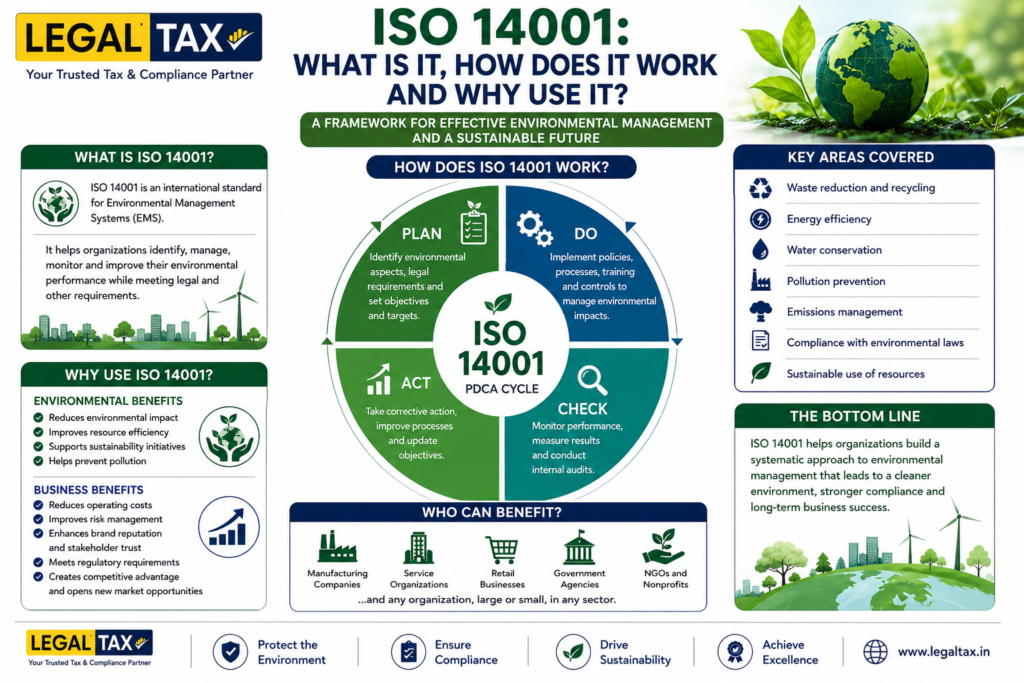
ISO 14001 is an internationally recognized standard for Environmental Management Systems (EMS). It provides a framework that helps organizations identify, manage, monitor, and improve their environmental performance. The standard enables businesses to reduce their environmental impact while meeting regulatory and sustainability requirements.
2. How does ISO 14001 work?
ISO 14001 works by helping organizations establish a systematic approach to environmental management. It requires businesses to identify environmental risks, set environmental objectives, implement controls, monitor performance, and continuously improve their processes to minimize negative environmental impacts.
3. What are the main requirements of ISO 14001?
The standard requires organizations to develop an environmental policy, identify environmental aspects and impacts, comply with applicable regulations, establish environmental objectives, implement operational controls, conduct internal audits, and review performance regularly to ensure continual improvement.
4. What are the benefits of ISO 14001 certification?
ISO 14001 certification helps organizations improve environmental performance, reduce waste and resource consumption, enhance compliance with environmental laws, strengthen brand reputation, lower operational costs, and demonstrate a commitment to sustainability to customers, investors, and stakeholders.
5. Which businesses should obtain ISO 14001 certification?
ISO 14001 is suitable for organizations of all sizes and industries. It is particularly beneficial for manufacturing companies, construction firms, logistics providers, exporters, energy companies, and businesses that want to reduce their environmental footprint and improve sustainability practices.
6. Why should a company use ISO 14001?
A company should use ISO 14001 because it provides a structured framework for managing environmental responsibilities, reducing risks, improving operational efficiency, and meeting stakeholder expectations. It also enhances business credibility and can create new opportunities in markets where environmental compliance and sustainability are important factors.
Conclusion
ISO 14001 is not a compliance burden or a piece of paper to hang on a wall. When implemented with genuine commitment, it is a management tool that delivers real environmental improvements, real cost savings, and real commercial benefits. It provides the discipline to identify what your environmental impacts are, the framework to manage them systematically, the objectives to drive continual improvement, and the independent certification to demonstrate your environmental credentials to the market.
For Indian businesses operating in an environment of tightening environmental regulation, increasing supply chain sustainability requirements, and growing investor focus on ESG performance, ISO 14001 represents a prudent and increasingly necessary investment. The organisations that implement it now building the management capability, the data systems, and the improvement culture that ISO 14001 requires will be better positioned for the environmental compliance and commercial requirements of the years ahead.
The environmental challenges facing Indian industry are real: air and water quality, energy efficiency, waste management, and carbon emissions are all areas where improvement is both necessary and achievable. ISO 14001 provides the systematic framework for that improvement to happen in an organised, measurable, and credible way.
Identify your significant environmental aspects. Build the system to manage them. Set objectives to improve. Certify to demonstrate it. Sustain and improve through the audit cycle.
Get Expert ISO 14001 Advisory and EMS Implementation Support
🟡 LegalTax.in provides complete ISO 14001 advisory, Environmental Management System documentation, implementation support, and certification preparation services for businesses across all sectors and entity types.
👉 Legal Documentation and Drafting 👉 GST Registration and Filing 👉 Income Tax Return 👉 Private Limited Company Registration 👉 LLP Registration 👉 Partnership Firm Registration 👉 MSME and Udyam Registration 👉 Import Export Code Registration 👉 Startup Registration 👉 GeM Registration
🟡For complete IP registration and brand protection services for businesses across all sectors.
👉 Trademark Registration 👉 Patent Registration 👉 Copyright Registration 👉 Design Registration
🟡 IT and Digital Services
👉 Website Development 👉 SEO Services 👉 Social Media Marketing 👉 Logo Design 👉 Google and Facebook Ads 👉 Branding Services
📞 Call Now: +91 9711939395 🕐 Free Consultation: Monday to Saturday, 9 AM to 6 PM

I’m Aryan Yadav, passionate about SEO and Digital Marketing with a strong interest in helping businesses grow online. I enjoy learning new strategies, exploring digital trends, and creating ideas that deliver value. I believe in continuous growth, creativity, and building meaningful results through smart work and dedication.
Our Clients