Views: 25
Table of Contents
- 1 Introduction
- 2 The Foundation: What Each Standard Is Trying to Achieve
- 3 Scope and Applicability
- 4 Primary Focus Areas
- 5 Understanding Context and Interested Parties
- 6 Planning Requirements: Risks, Opportunities, and Objectives
- 7 Operational Requirements
- 8 Performance Evaluation
- 9 Documentation Requirements
- 10 Key Differences: Side-by-Side Comparison
- 11 Can ISO 9001 and ISO 14001 Be Implemented Together?
- 12 Which Standard Should Your Business Pursue First?
- 13 Frequently Asked Questions
- 14 Conclusion
- 15 Get Expert ISO Certification Advisory and Compliance Support
Introduction
ISO 9001 and ISO 14001 are two of the most widely adopted management system standards in the world, and two of the most frequently confused. Both are published by the International Organisation for Standardisation. Both follow the same High Level Structure that makes them compatible and easy to integrate. Both require documentation, internal audits, management reviews, and continual improvement. Both are certified by accredited third-party certification bodies for a three-year cycle.
And yet they address fundamentally different organisational concerns, serve different stakeholder interests, and require different implementation focus areas. ISO 9001 is about delivering quality — ensuring that what you produce or provide consistently meets customer requirements. ISO 14001 is about environmental responsibility — ensuring that how you operate minimises harm to the environment and meets applicable legal obligations.
For Indian businesses evaluating which certification to pursue, or whether to pursue both simultaneously through an Integrated Management System, understanding the precise differences between these two standards is essential. The decision should be driven by your customers’ requirements, your regulatory environment, your industry sector, and your strategic priorities — not by assumptions that one is more prestigious or more difficult than the other.
This guide provides a complete, structured comparison of ISO 9001 and ISO 14001 across every significant dimension — purpose, scope, requirements, documentation, performance evaluation, interested parties, and business benefits. For complete ISO certification advisory, documentation support, and management system implementation services, the team at LegalTax.in works with businesses across all sectors and entity types.
The Foundation: What Each Standard Is Trying to Achieve
The most important difference between ISO 9001 and ISO 14001 is the fundamental objective each standard serves.
ISO 9001: The Purpose Is Customer Satisfaction Through Consistent Quality
ISO 9001:2015 is built around a single central objective: enabling an organisation to consistently provide products and services that meet customer requirements and applicable statutory and regulatory requirements, and to enhance customer satisfaction.
Every requirement in ISO 9001 — from understanding the context of the organisation to planning, operation, performance evaluation, and improvement — is ultimately oriented toward this outcome. The customer is the primary interested party. Quality is defined in terms of meeting requirements: the requirements of the customer, the requirements of the product or service specification, and the requirements of applicable regulations.
ISO 14001: The Purpose Is Environmental Performance Through Systematic Management
ISO 14001:2015 is built around a different central objective: enabling an organisation to manage its environmental responsibilities in a systematic way that contributes to the environmental pillar of sustainable development.
The primary interested party in ISO 14001 is not the customer but the environment — and by extension, regulatory bodies, communities, and society at large. Environmental performance is defined in terms of the organisation’s impacts on the natural environment: air emissions, water discharges, waste generation, energy consumption, land contamination, and use of natural resources.
Scope and Applicability
ISO 9001 Scope
ISO 9001 applies to any organisation, regardless of its type, size, or the products and services it provides. Its scope covers the processes by which an organisation designs, develops, produces, delivers, and supports its products and services. The boundary of the QMS is defined by the organisation to include all processes that affect the quality of what it provides to customers.
ISO 14001 Scope
ISO 14001 applies to any organisation that wishes to manage its environmental responsibilities, regardless of type, size, or nature. Its scope covers the activities, products, and services of the organisation that interact with the environment. The boundary of the EMS is defined to include all activities, products, and services over which the organisation has control or influence that have or could have environmental impacts.
A key scope difference is that ISO 14001 requires consideration of a life cycle perspective — meaning the organisation must consider the environmental impacts of its products and services not just in its own operations but across the full life cycle, including the acquisition of inputs, use of products by customers, and end-of-life disposal. ISO 9001 does not have an equivalent life cycle requirement, though it does require the organisation to consider externally provided processes, products, and services that affect quality.
Primary Focus Areas
ISO 9001 Primary Focus Areas
The primary operational focus areas of ISO 9001 are:
Customer focus — Understanding current and future customer needs, meeting customer requirements, and striving to exceed customer expectations.
Process approach — Managing activities as interconnected processes that function as a coherent system, with defined inputs, outputs, responsibilities, and performance criteria.
Product and service realisation — Planning, designing, developing, producing, and delivering products and services that meet specifications and customer requirements.
Nonconformity and corrective action — Identifying instances where requirements are not met, taking action to address nonconformities, and preventing recurrence.
Customer satisfaction measurement — Monitoring customer perceptions of the degree to which requirements have been met, and using this information to improve.
ISO 14001 Primary Focus Areas
The primary operational focus areas of ISO 14001 are:
Environmental aspects and impacts — Identifying the aspects of the organisation’s activities, products, and services that interact with the environment, and evaluating their environmental impacts, both actual and potential.
Compliance obligations — Identifying the legal and other requirements that apply to the organisation’s environmental aspects, and ensuring ongoing compliance.
Environmental objectives and targets — Setting measurable environmental goals related to significant environmental aspects, and planning actions to achieve them.
Operational control of significant impacts — Establishing controls, procedures, and criteria to manage activities that have or could have significant environmental impacts.
Emergency preparedness and response — Planning for and responding to potential environmental emergencies such as spills, fires, or releases of hazardous materials.
Understanding Context and Interested Parties
Both ISO 9001 and ISO 14001 require the organisation to understand its context — the internal and external factors that affect its ability to achieve its objectives — and to identify its interested parties and their requirements. However, the practical application of these requirements differs significantly between the two standards.
Context in ISO 9001
In ISO 9001, the context exercise focuses on understanding factors that affect the organisation’s ability to provide quality products and services. External factors include market conditions, competitive environment, customer preferences, regulatory requirements for products, and supplier landscape. Internal factors include operational capabilities, workforce competence, technology, and organisational culture.
The interested parties most relevant to ISO 9001 are customers (whose requirements define quality), employees (who deliver quality), suppliers and subcontractors (whose performance affects quality), and regulatory bodies (whose requirements must be met in products and services).
Context in ISO 14001
In ISO 14001, the context exercise focuses on the organisation’s relationship with the natural environment and the stakeholders affected by that relationship. External factors include the local environment (air, water, land, biodiversity), applicable environmental laws and permits, community expectations regarding environmental performance, and the environmental impacts of the supply chain.
The interested parties most relevant to ISO 14001 are regulatory and enforcement bodies (environmental agencies, pollution control boards), local communities and residents near operational facilities, environmental advocacy groups, investors with ESG screening criteria, and customers with supply chain sustainability requirements. The natural environment itself is effectively an interested party whose interests are represented through legal and regulatory frameworks.
Planning Requirements: Risks, Opportunities, and Objectives
Risk-Based Thinking in ISO 9001
ISO 9001 requires the organisation to determine risks and opportunities related to its ability to provide conforming products and services and achieve customer satisfaction. Risks in the quality context include potential failures to meet specifications, supply chain disruptions, competence gaps, and customer complaint escalations. Opportunities include new product development, process improvements, and expanded customer relationships.
Quality objectives are set for relevant functions, levels, and processes, and must be measurable, monitored, communicated, and updated as appropriate. Examples of quality objectives include customer satisfaction scores, defect rates, delivery on-time performance, and complaint resolution times.
Environmental Aspects and Objectives in ISO 14001
ISO 14001 requires the organisation to identify its environmental aspects — the elements of its activities, products, and services that interact or can interact with the environment — and to determine which aspects have or can have significant environmental impacts. This identification covers normal operating conditions, abnormal conditions, and emergency situations.
Once significant environmental aspects are identified, the organisation sets environmental objectives related to those aspects. Examples include reducing energy consumption by a defined percentage, reducing waste sent to landfill, decreasing water consumption, reducing emissions of specific pollutants, or eliminating the use of a hazardous substance.
The compliance obligation requirement in ISO 14001 has no direct equivalent in ISO 9001. ISO 14001 explicitly requires the organisation to identify all applicable legal requirements and other requirements related to its environmental aspects — permits, discharge consents, emissions limits, waste disposal regulations, and environmental reporting obligations — and to maintain compliance with them. Non-compliance with environmental legal requirements is treated as a serious nonconformity under the standard.
Operational Requirements
Operations Under ISO 9001
The operational requirements of ISO 9001 are oriented toward product and service delivery. They cover:
Planning of product and service realisation processes, including quality criteria and resource requirements. Requirements determination — understanding what the customer actually needs and ensuring those needs are captured accurately. Design and development controls for organisations that design their own products or services. Control of externally provided processes, products, and services — supplier management and incoming quality control. Production and service provision controls — ensuring that operations are carried out under controlled conditions with appropriate equipment, competent people, and monitoring. Control of nonconforming outputs — identifying and managing products or services that do not meet requirements before they reach the customer.
Operations Under ISO 14001
The operational requirements of ISO 14001 are oriented toward managing environmental impacts. They cover:
Operational planning and control of significant environmental aspects — establishing and maintaining documented procedures or criteria for operations associated with significant aspects to ensure they are carried out under specified conditions. Life cycle perspective — considering environmental controls needed in the design phase for products and services, communicating relevant environmental requirements to suppliers and contractors, and managing end-of-life considerations. Emergency preparedness and response — identifying potential environmental emergency scenarios, planning response procedures, and periodically testing those procedures.
There is no equivalent in ISO 14001 to the ISO 9001 requirements for customer communication, design and development, or control of nonconforming outputs. Equally, there is no equivalent in ISO 9001 to the ISO 14001 requirements for life cycle perspective in operations or emergency preparedness for environmental incidents.
Performance Evaluation
Performance Evaluation in ISO 9001
ISO 9001 requires monitoring, measurement, analysis, and evaluation of quality performance. Key performance evaluation requirements include:
Customer satisfaction monitoring — how the organisation determines whether customers perceive their requirements to have been met. Internal audit of the QMS — periodic assessment of whether the quality management system conforms to requirements and is effectively implemented. Management review — periodic review by top management of the QMS using inputs including customer satisfaction data, process performance, nonconformities, audit results, and external provider performance.
Specific performance indicators typically tracked under ISO 9001 include customer complaint rates, product defect or rejection rates, on-time delivery performance, customer satisfaction survey scores, supplier performance scores, and process efficiency metrics.
Performance Evaluation in ISO 14001
ISO 14001 requires monitoring, measurement, analysis, and evaluation of environmental performance. Key performance evaluation requirements include:
Monitoring of environmental aspects — measuring actual environmental performance against the criteria and objectives established for significant aspects. Compliance evaluation — periodically evaluating whether the organisation is in compliance with its legal and other environmental obligations. Internal audit of the EMS — periodic assessment of whether the environmental management system conforms to requirements and is effectively implemented. Management review — periodic review by top management using inputs including environmental performance trends, compliance status, achievement of environmental objectives, and stakeholder communications.
Specific performance indicators typically tracked under ISO 14001 include energy consumption (kWh per unit of production), water consumption, waste generation and recycling rates, greenhouse gas emissions, specific pollutant discharge levels, and number of environmental regulatory violations or incidents.
Documentation Requirements
Both standards require documented information to support the operation of the management system and to provide evidence of results achieved. The documentation requirements are broadly similar in structure but differ in content.
ISO 9001 Documentation
ISO 9001 requires documented information for the scope of the QMS, quality policy, quality objectives, and evidence of the results of the management review process. Operationally, it requires documented information to support process operation where the absence of documentation would adversely affect the organisation’s ability to ensure conforming products and services. Records required include evidence of product and service conformity, customer satisfaction monitoring results, audit programmes and results, nonconformities and corrective actions, and management review outputs.
ISO 14001 Documentation
ISO 14001 requires documented information for the scope of the EMS, environmental policy, environmental aspects and their associated impacts, compliance obligations, environmental objectives and plans, and evidence of monitoring and measurement results. It requires records of the evaluation of compliance, emergency preparedness and response procedures, internal audit results, and management review outputs.
A significant documentation difference is that ISO 14001 requires maintenance of a register of environmental aspects and impacts and a register of compliance obligations — documents with no direct equivalent in ISO 9001. These registers are central to the environmental management system and must be kept current as operations, activities, and regulatory requirements change.
Key Differences: Side-by-Side Comparison
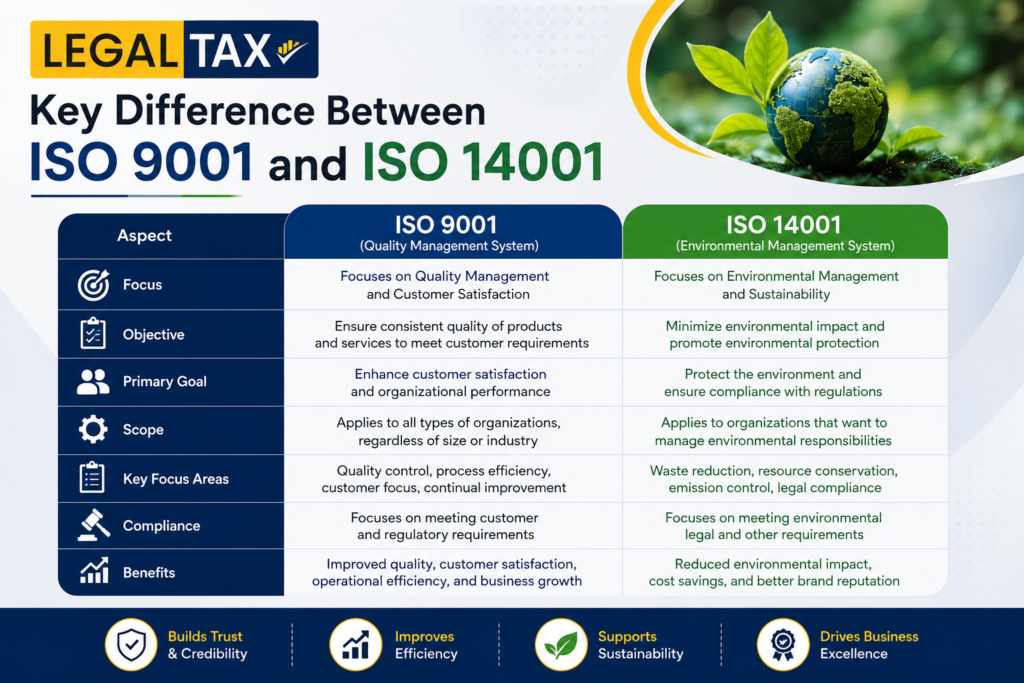
| Dimension | ISO 9001:2015 | ISO 14001:2015 |
|---|---|---|
| Primary purpose | Customer satisfaction through quality | Environmental performance and compliance |
| Primary interested party | Customer | Environment, regulators, community |
| Core focus | Product and service quality | Environmental aspects and impacts |
| Key planning input | Customer requirements and quality risks | Environmental aspects, compliance obligations |
| Unique requirement | Control of nonconforming outputs | Life cycle perspective, compliance evaluation |
| Performance measure | Customer satisfaction, defect rates | Energy, emissions, waste, water consumption |
| Legal compliance focus | Product regulatory requirements | Environmental laws and permits |
| Emergency planning | Not required | Required (environmental emergencies) |
| Supplier requirements | Quality and delivery performance | Environmental requirements in procurement |
| Certification driver | Customer and tender requirements | Regulatory, ESG, supply chain requirements |
| Most applicable sector | All sectors universally | Manufacturing, chemicals, construction, mining |
Can ISO 9001 and ISO 14001 Be Implemented Together?
Yes — and for many organisations, implementing both standards simultaneously through an Integrated Management System is the most efficient approach. Both standards follow the same High Level Structure (Annex SL), which means they share identical clause headings and a common framework for context, leadership, planning, support, operation, performance evaluation, and improvement.
In an IMS combining ISO 9001 and ISO 14001, a single management manual, a unified internal audit programme, a combined management review process, and shared documentation of context and interested parties serve both systems simultaneously. The areas that are unique to each standard — quality-specific requirements for ISO 9001 and environmental-specific requirements for ISO 14001 — are addressed in the areas of the system where they are relevant.
An integrated audit can assess compliance with both standards in a single visit from the certification body, reducing audit time, cost, and organisational disruption compared to two separate audits. Most major certification bodies offer integrated certification audits for organisations implementing multiple standards.
Which Standard Should Your Business Pursue First?
The answer to this question is determined by your business situation, not by any inherent hierarchy between the standards.
Choose ISO 9001 first if: your customers or tender requirements specify ISO 9001 as a qualification, your primary operational challenge is quality consistency and customer satisfaction, you are in a service sector where environmental impacts are minimal, or you are implementing your first formal management system and want the broadest applicable foundation.
Choose ISO 14001 first if: your operations have significant environmental impacts and you face regulatory scrutiny or community pressure, your customers in manufacturing, export, or retail supply chains have environmental requirements, you are in an industry where environmental performance is a competitive differentiator, or you are pursuing ESG reporting commitments that require evidence of environmental management.
Pursue both simultaneously if: you are in a manufacturing, chemicals, construction, or food processing sector where both quality and environmental management are expected by customers and regulators, you want to maximise efficiency by implementing both systems together from the outset, or you are responding to a tender that requires both certifications.
Frequently Asked Questions
Conclusion
ISO 9001 and ISO 14001 are complementary rather than competing standards. ISO 9001 addresses the organisation’s relationship with its customers through quality management. ISO 14001 addresses the organisation’s relationship with the natural environment through environmental management. Both are structured around the same management system framework, both require leadership commitment and systematic continuous improvement, and both deliver tangible business benefits when implemented genuinely.
For Indian businesses, the practical decision is straightforward: assess what your customers require, what your regulators expect, and what your operational risks are. If quality and customer satisfaction are the primary concerns, ISO 9001 is the starting point. If environmental performance and regulatory compliance are the driving issues, ISO 14001 comes first. If both matter — as they do for most manufacturing, food, chemical, and construction businesses — implement them together as an integrated system and obtain both certifications efficiently in a single process.
The investment is the same in both cases: leadership commitment, disciplined implementation, honest internal auditing, and a genuine culture of improvement. The returns — in customer confidence, market access, operational efficiency, and regulatory credibility — make that investment worthwhile.
Understand the difference. Identify what applies to your situation. Implement with genuine intent. Certify with an accredited body. Maintain with discipline.
Get Expert ISO Certification Advisory and Compliance Support
🟡 LegalTax.in provides complete ISO certification advisory, documentation preparation, management system implementation support, and compliance services for businesses across all sectors and entity types.
👉 Legal Documentation and Drafting 👉 GST Registration and Filing 👉 Income Tax Return 👉 Private Limited Company Registration 👉 LLP Registration 👉 Partnership Firm Registration 👉 MSME and Udyam Registration 👉 Import Export Code Registration 👉 Startup Registration 👉 GeM Registration
🟡 Complete IP registration and brand protection services for businesses across all sectors.
👉 Trademark Registration 👉 Patent Registration 👉 Copyright Registration 👉 Design Registration
🟡 IT and Digital Services
👉 Website Development 👉 SEO Services 👉 Social Media Marketing 👉 Logo Design 👉 Google and Facebook Ads 👉 Branding Services
📞 Call Now: +91 9711939395 🕐 Free Consultation: Monday to Saturday, 9 AM to 6 PM

I’m Aryan Yadav, passionate about SEO and Digital Marketing with a strong interest in helping businesses grow online. I enjoy learning new strategies, exploring digital trends, and creating ideas that deliver value. I believe in continuous growth, creativity, and building meaningful results through smart work and dedication.
Our Clients