Views: 23
Table of Contents
- 1 What Is Trademark Class 16?
- 2 What Products Fall Under Trademark Class 16?
- 3 Why Is Trademark Registration Under Class 16 Important?
- 4 Who Should Apply for Trademark Class 16?
- 5 Trademark Class 16 vs Other Classes — Key Differences
- 6 Step-by-Step Process to Register Trademark Under Class 16
- 7 Documents Required for Class 16 Trademark Registration
- 8 Government Fees for Class 16 Trademark Registration
- 9 Timeline for Trademark Registration
- 10 Common Mistakes to Avoid When Filing Under Class 16
- 11 Why Choose LegalTax.in for Your Trademark Registration?
- 12 Frequently Asked Questions (FAQs)
- 13 Conclusion
- 14 Get Expert Trademark Registration and IP Protection Services
What Is Trademark Class 16?
In India’s trademark registration system, every product and service is categorized under one of 45 internationally recognized classes — known as the Nice Classification. Trademark Class 16 is the designated category for businesses dealing in paper, cardboard, printed matter, books, stationery, office supplies, and related goods.
If your business manufactures notebooks, sells office stationery, publishes books, prints packaging material, or deals in any paper-based product — Class 16 is the trademark class you need to file under.
India’s stationery, printing, and publishing industry is massive. From school notebooks to corporate office supplies, from greeting cards to packaging boxes — thousands of brands compete in this space. Without a registered trademark, your brand name, logo, and identity are completely unprotected. A competitor can copy your brand, and you will have no legal ground to stand on.
What Products Fall Under Trademark Class 16?
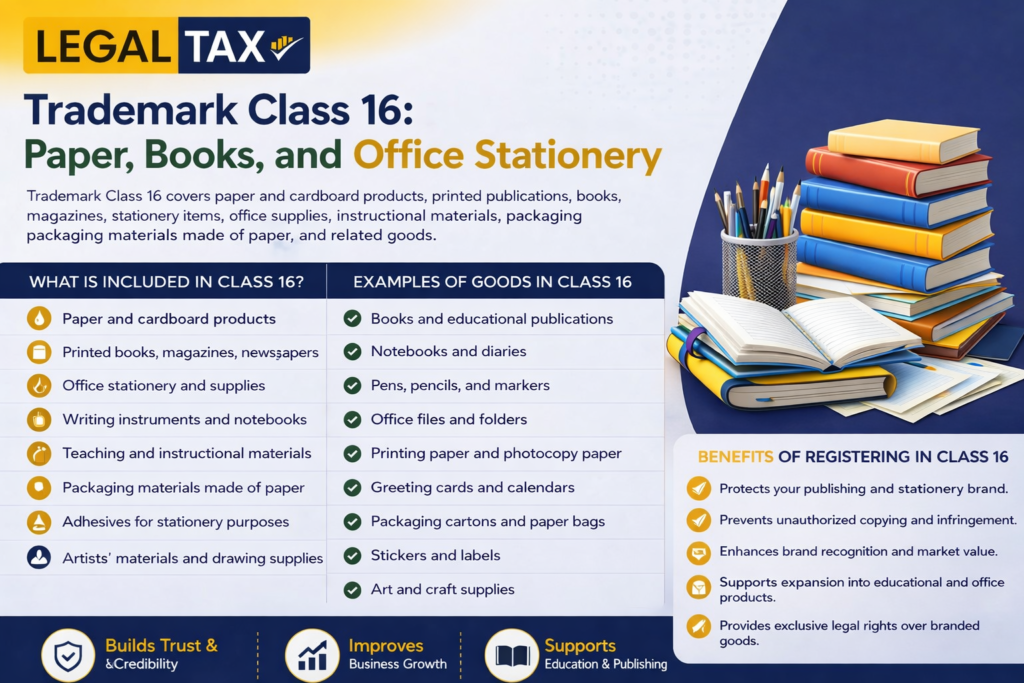
Class 16 is one of the broader trademark categories and covers a wide range of everyday products. Here is a detailed breakdown:
Paper and Cardboard Products: Printing paper, writing paper, kraft paper, tissue paper, cardboard sheets, corrugated board, packaging paper, crepe paper, and carbon paper
Printed Matter: Books, magazines, newspapers, journals, brochures, leaflets, catalogs, pamphlets, almanacs, directories, and timetables
Office Stationery: Notebooks, diaries, planners, notepads, letterheads, envelopes, files, folders, binders, index cards, and sticky notes
Writing Instruments and Accessories: Pencils, pens, erasers, sharpeners, rulers, staples, paper clips, drawing pins, and correction fluid
Bookbinding Materials: Glue for stationery purposes, adhesive tapes for stationery, gummed labels, and bookbinding cloth
Educational and Art Supplies: Drawing books, sketchbooks, graph paper, tracing paper, coloring books, and educational charts
Printing and Typewriting Materials: Printer ribbons, typewriter ribbons, duplicating stencils, and ink pads for office use
Plastic Materials for Packaging: Plastic bags and sheets used for packaging purposes fall here when they are made of materials similar to paper or cardboard
Photographs and Stationery Items: Photographs, photo albums, scrapbooks, and stamp albums
Why Is Trademark Registration Under Class 16 Important?
The Indian stationery and publishing market is growing rapidly, driven by a massive student population, a booming e-commerce sector, and an increasing demand for premium office supplies. In such a competitive environment, your brand name is your most valuable asset.
Here is why registering your trademark under Class 16 is a decision you cannot afford to delay:
Complete Brand Ownership A registered trademark gives you the exclusive right to use your brand name and logo for Class 16 products across India. No one else can legally use a name or mark that is confusingly similar to yours.
Powerful Legal Weapon Against Infringers Every year, thousands of stationery and book brands are copied in India — especially in the unorganized market. With a registered trademark, you can file a civil lawsuit, demand damages, and seek a court injunction to immediately stop the infringer.
Nationwide Recognition A trademark registered with the Indian Trademark Registry gives your brand legal standing across all Indian states simultaneously — unlike a simple copyright or a local business registration.
Essential for E-Commerce Selling Platforms like Amazon India, Flipkart, and Meesho have brand registry programs that require trademark registration. Without it, your listings can be hijacked by unauthorized sellers who copy your product images and brand name.
Franchising and Licensing Opportunities If you ever plan to expand through franchising or licensing your brand to other distributors, a registered trademark is the foundation of that arrangement. It is a legally enforceable intellectual property asset.
Stronger Business Valuation Whether you are approaching investors, applying for a business loan, or planning to sell your company — a registered trademark adds measurable value to your business as a recognized intellectual property asset.
Who Should Apply for Trademark Class 16?
You should file under Trademark Class 16 if your business operates in any of the following areas:
- Notebook and diary manufacturers
- Book publishers and self-publishers
- Printing press and offset printing businesses
- Office stationery suppliers and wholesalers
- Greeting card and invitation card makers
- Packaging material manufacturers using paper or cardboard
- Art supply companies selling sketchbooks and drawing materials
- Educational material and chart publishers
- Gift wrapping and craft paper businesses
- Online stationery stores and D2C stationery brands
- Corporate gifting companies offering stationery items
- Newspaper and magazine publishers
Even if you are a home-based business selling handmade journals or custom notebooks, your brand deserves legal protection. The size of your business does not determine whether you need a trademark — the value of your brand does.
Trademark Class 16 vs Other Classes — Key Differences
Several neighboring classes can cause confusion during filing. Here is how Class 16 stands apart:
Class 16 vs Class 9: Class 9 covers electronic goods including e-books, downloadable publications, and digital content. If your product is a physical book, it is Class 16. If it is an e-book or digital educational software, it likely falls under Class 9.
Class 16 vs Class 35: Class 35 covers business services including advertising and retail services. If you run a stationery retail store, your services fall under Class 35, while the products you sell are covered under Class 16. Many stationery businesses need both classes.
Class 16 vs Class 41: Class 41 covers education and entertainment services. If you publish books, the products fall under Class 16. But if you provide tutoring, coaching, or training services, those fall under Class 41.
Class 16 vs Class 2: Class 2 covers paints, varnishes, and inks used for industrial purposes. However, printing inks specifically used in office or stationery contexts can sometimes overlap. A trademark professional can guide you on the right classification.
Getting the class right from the beginning saves you time, money, and legal headaches. Our experts at LegalTax.in have helped thousands of clients navigate exactly these kinds of classification questions.
Step-by-Step Process to Register Trademark Under Class 16
The trademark registration process in India is governed by the Trade Marks Act, 1999 and is administered by the Controller General of Patents, Designs and Trade Marks (CGPDTM). Here is the complete process:
Step 1 — Conduct a Trademark Search Before filing, search for existing trademarks that may conflict with yours. Use the official IP India portal at ipindia.gov.in to search the database. This step is critical — filing without a search is one of the most expensive mistakes a business can make.
Step 2 — Prepare Your Application Gather all necessary documents and decide whether you are filing as an individual, startup, MSME, or large company. This determines your government fee.
Step 3 — File Form TM-A Submit your application through the IP India e-filing portal at tmrsss.ipindia.gov.in. Mention Class 16 as your chosen class and provide a clear description of the goods you wish to protect.
Step 4 — Receive Examination Report The Trademark Registry will examine your application and may raise objections related to similarity with existing marks or descriptive nature of the mark. You must file a detailed reply within 30 days of receiving the report.
Step 5 — Hearing (If Required) If the examiner is not satisfied with your written response, a hearing may be scheduled. Your trademark attorney presents arguments on your behalf.
Step 6 — Publication in the Trademark Journal Once the examiner clears your application, your trademark is published in the official Trademark Journal. This begins a 4-month opposition window during which any third party can challenge your mark.
Step 7 — Registration Certificate If no opposition is received, or if opposition is decided in your favor, the Trademark Registry issues your Registration Certificate. Your trademark is now registered and valid for 10 years from the date of filing.
Documents Required for Class 16 Trademark Registration
Keep the following documents ready before you begin the filing process:
- Clear image of your trademark — brand name, logo, or combination of both
- Identity proof of the applicant — Aadhaar card, PAN card, or passport
- Address proof — utility bill, bank statement, or rental agreement
- Business registration proof — GST certificate, shop act license, MSME registration, or company incorporation certificate
- Power of Attorney — Form TM-48, required if a trademark agent or attorney is filing on your behalf
- User Affidavit — if you claim prior use of the trademark before the date of application
- MSME or Startup India registration certificate — for availing the reduced government fee
Government Fees for Class 16 Trademark Registration
The government filing fee depends on your applicant category:
Individual, Startup, or MSME: ₹4,500 per class for online (e-filing)
Partnership Firms, LLPs, Private Limited Companies, and Large Enterprises: ₹9,000 per class for online (e-filing)
Physical filing is slightly more expensive in both categories. These are purely government charges and do not include professional fees.
At LegalTax.in, we offer complete end-to-end trademark registration services at competitive and transparent pricing. No hidden costs, no surprises.
📞 Call or WhatsApp: 9711939395
Timeline for Trademark Registration
Here is a realistic timeline you should expect:
- Application Filing: Same day (e-filing)
- Acknowledgement and TM Number: Immediately upon filing
- Examination Report: 3 to 6 months
- Response to Examination Report: Within 30 days of receipt
- Publication in Journal: 1 to 3 months after clearance
- Opposition Period: 4 months from publication date
- Registration Certificate: 6 to 12 months after opposition period
Total expected timeline: 18 to 24 months under normal circumstances
You can use the ™ symbol right from the day you file your application. The ® symbol is only permitted after receiving the official registration certificate.
Common Mistakes to Avoid When Filing Under Class 16
Using a Descriptive or Generic Name: A name like “Good Notebooks” or “Quality Paper Products” will almost certainly be rejected because it directly describes the product. Your trademark needs to be distinctive, creative, and capable of identifying your brand uniquely.
Skipping the Trademark Search: If a similar mark exists in Class 16, your application can be rejected outright or challenged by the existing registrant. Always search before you file.
Ignoring Examination Reports: Many applicants abandon their trademark simply because they do not respond to the examination report within the 30-day window. Always engage a professional who will track and respond to such communications.
Filing Under the Wrong Class: Filing a book publishing brand under Class 41 instead of Class 16, or an e-commerce stationery service under Class 16 instead of Class 35 — these are common and costly mistakes.
Not Renewing After 10 Years: A trademark lasts 10 years and must be renewed before expiry. Missing the renewal window means your mark lapses and loses its protection. LegalTax.in sends proactive renewal reminders to all our clients.
Why Choose LegalTax.in for Your Trademark Registration?
At LegalTax.in, we combine legal expertise with a client-first approach. Our team of qualified trademark attorneys and IP professionals has successfully registered trademarks for businesses across all 45 classes — from first-time entrepreneurs to established publishing houses.
Here is what sets us apart:
- Free consultation before you commit to anything
- Comprehensive trademark search to eliminate filing risks
- Complete documentation assistance and form preparation
- Expert drafting of replies to examination reports and oppositions
- Regular status updates throughout the registration process
- Renewal reminders so your trademark never lapses
- 100% online process — no need to visit any office
We understand that your brand is the result of years of hard work, creativity, and investment. Our job is to make sure it stays yours — legally, permanently, and powerfully.
Frequently Asked Questions (FAQs)
1. What is Trademark Class 16?
Trademark Class 16 covers paper products, printed publications, books, stationery, office supplies, packaging materials, and various paper-based goods used for educational, commercial, and personal purposes.
2. Which products are included in Trademark Class 16?
Class 16 includes books, notebooks, magazines, newspapers, calendars, paper, cardboard, envelopes, pens, pencils, folders, labels, stickers, and office stationery items.
3. Why should businesses register a trademark under Class 16?
Trademark registration protects your brand name and logo from unauthorized use, establishes brand identity, and provides exclusive rights for paper and stationery-related products.
4. Are books and printed publications covered under Trademark Class 16?
Yes, books, journals, magazines, brochures, catalogs, printed manuals, and other publications are covered under Class 16.
5. Does Trademark Class 16 include office stationery products?
Yes, office stationery items such as pens, pencils, markers, files, folders, staplers, notebooks, and writing materials fall under Class 16.
Conclusion
Trademark Class 16 covers a product universe that touches every home, every school, every office, and every business in India. If you are in the business of paper, stationery, books, or printed matter — your brand deserves the same legal protection that India’s biggest corporate names enjoy.
Trademark registration is not just for large companies. It is for every business that values its identity and wants to build something lasting. The process is simpler than most people think, and the protection it offers is permanent.
Do not let someone else claim what you have built. Register your trademark today with LegalTax.in — and let your brand work as hard as you do.
Get Expert Trademark Registration and IP Protection Services
🟡 For complete trademark registration, IP advisory, opposition response, renewal, and brand protection services for businesses across all industries and product categories.
👉 Trademark Registration
👉 Patent Registration
👉 Copyright Registration
👉 Design Registration
🟡 LegalTax.in provides complete business registration, compliance, and legal documentation services.
👉 Legal Documentation and Drafting
👉 GST Registration and Filing
👉 Income Tax Return
👉 Private Limited Company Registration
👉 LLP Registration
👉 Partnership Firm Registration
👉 MSME and Udyam Registration
👉 Import Export Code Registration
👉 Startup Registration
👉 GeM Registration
🟡 IT and Digital Services
👉 Website Development
👉 SEO Services
👉 Social Media Marketing
👉 Logo Design
👉 Google and Facebook Ads
👉 Branding Services
📞 Call Now: +91 9711939395
🕐 Free Consultation: Monday to Saturday, 9 AM to 6 PM

I’m Aryan Yadav, passionate about SEO and Digital Marketing with a strong interest in helping businesses grow online. I enjoy learning new strategies, exploring digital trends, and creating ideas that deliver value. I believe in continuous growth, creativity, and building meaningful results through smart work and dedication.
Our Clients