Views: 24
Table of Contents
- 1 Introduction
- 2 1. What is Trademark Class 2?
- 3 2. Complete List of Goods Covered Under Trademark Class 2
- 4 3. What is NOT Covered Under Trademark Class 2?
- 5 4. Why Should You Register a Trademark Under Class 2?
- 6 5. Who Can Apply for Trademark Class 2 Registration?
- 7 6. Documents Required for Trademark Class 2 Registration
- 8 7. Step-by-Step Trademark Registration Process in India
- 9 8. Timeline: How Long Does Trademark Class 2 Registration Take?
- 10 9. Government Fees and Cost Factors
- 11 10. Common Mistakes to Avoid
- 12 11. Practical Examples of Class 2 Trademark Registrations in India
- 13 Frequently Asked Questions (FAQs)
- 14 Conclusion
- 15 Get Expert Trademark Registration and IP Protection Services
Introduction
If you run a business that manufactures or sells paints, varnishes, lacquers, wood preservatives, colorants, or anti-corrosion products in India, one of the most important legal steps you must take is registering your brand under Trademark Class 2.
India follows the Nice Classification system, which divides all goods and services into 45 classes. Class 2 specifically covers paints and related products. Without a registered trademark in this class, any competitor can legally use a similar brand name, logo, or color scheme — and you would have little legal recourse to stop them.
This guide explains everything you need to know about Trademark Class 2 in India — what products are covered, what is excluded, how to register, what documents you need, how long it takes, and what it costs. Whether you are a small paint shop owner, a manufacturer, or a large industrial coatings company, this guide is written for you in plain language.
1. What is Trademark Class 2?
Trademark Class 2 is one of the 45 internationally recognised categories under the Nice Classification (NCL), which India adopted through the Trade Marks Act, 1999 and the Trade Marks Rules, 2017.
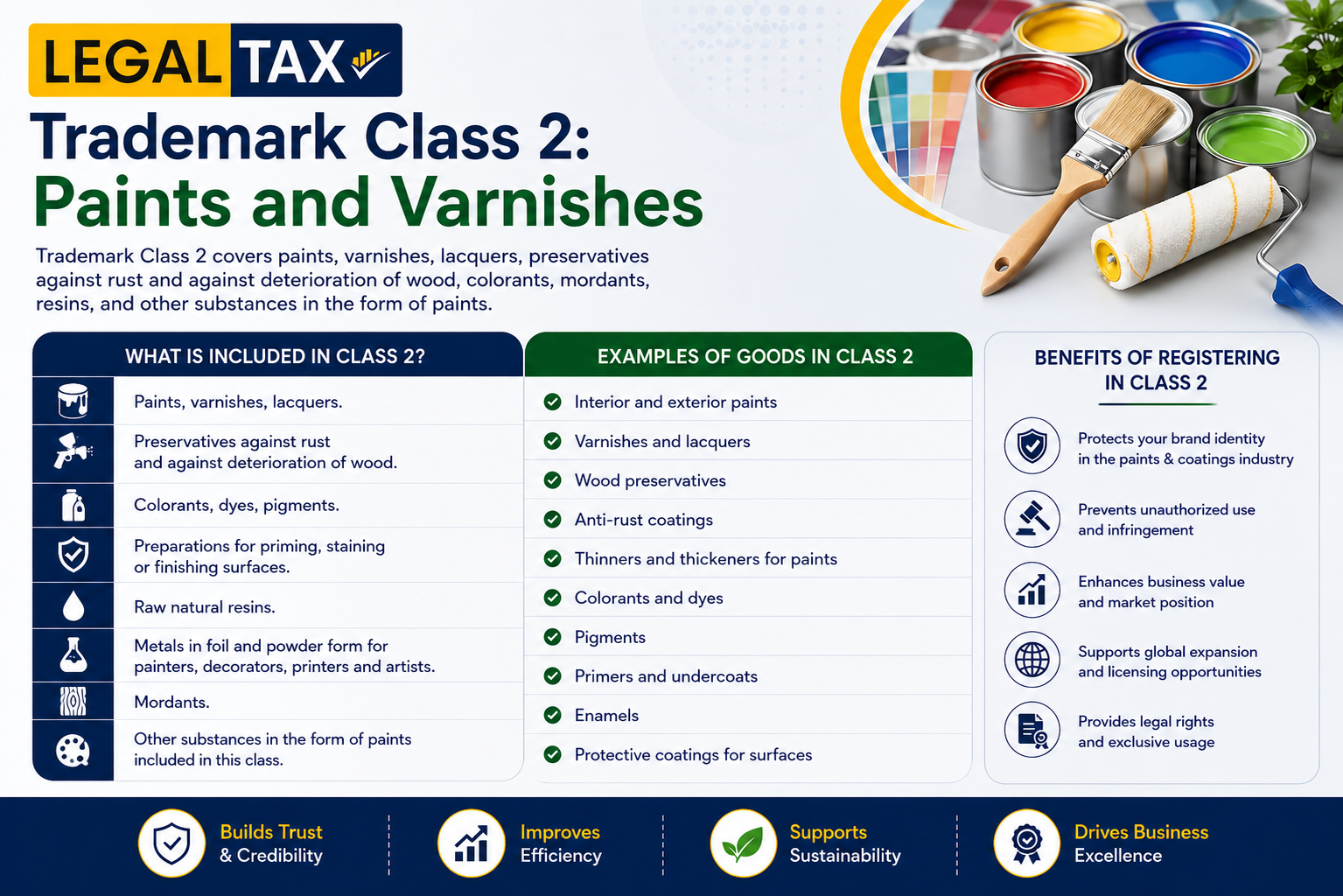
Class 2 is officially titled “Paints, Varnishes, Lacquers” and covers a broad range of products used for protection, decoration, and coloring of surfaces and materials.
In simple terms, if your business sells anything that colors, coats, preserves, or protects surfaces — whether for industrial use, home decoration, or artistic purposes — your trademark likely needs to be registered under Class 2.
The legal authority for trademark registration in India is the Office of the Controller General of Patents, Designs and Trade Marks (CGPDTM), which operates under the Ministry of Commerce and Industry.
2. Complete List of Goods Covered Under Trademark Class 2
Class 2 is broader than most people realize. It does not just cover house paints — it includes a wide range of industrial, commercial, and artistic products.
2.1 Paints and Coatings
- Paints (all types — wall paint, industrial paint, decorative paint)
- Varnishes
- Lacquers
- Enamels (used as varnishes or paints)
- Distempers
- Primers
- Undercoating for vehicle chassis
- Ceramic paints
- Anti-fouling paints
- Fireproof paints
- Bactericidal paints
- Asbestos paints
- Aluminium paints
- Lime wash and whitewash
- Wood coatings
- Badigeon (a type of surface coating)
2.2 Wood Preservation Products
- Wood preservatives
- Creosote for wood preservation
- Carbonyl (a wood preservative)
- Oils for preservation of wood
- Wood stains
- Wood mordants
2.3 Anti-Corrosion and Protective Products
- Anti-corrosive preparations
- Anti-corrosive bands
- Anti-rust oils
- Anti-rust greases
- Anti-rust preparations for preservation
- Anti-tarnishing preparations for metals
- Protective preparations for metals
2.4 Colorants and Dyes
- Colorants and dyestuffs (general)
- Aniline dyes
- Alizarine dyes
- Indigo (colorant)
- Saffron (colorant)
- Turmeric (colorant)
- Caramel (food colorant)
- Malt caramel (food colorant)
- Food dyes and food colorants
- Colorants for beer, butter, beverages, and liqueurs
- Cochineal carmine
- Cobalt oxide (colorant)
- Malt colorants
- Yellowwood (colorant)
- Soot (colorant)
- Shoe dyes
- Ink for leather and skin-dressing
- Marking ink for animals
- Dyewood extracts
- Paper for dyeing Easter eggs
- Auramine (a yellow dye)
2.5 Pigments and Metallic Powders
- Pigments
- Titanium dioxide (pigment)
- Zinc oxide (pigment)
- Carbon black (pigment)
- Lamp black (pigment)
- Silver emulsions (pigments)
- Silver paste
- Silvering powders
- Aluminium powder for painting
- Bronze powder for painting
- Metals in powder form for painters, decorators, printers, and artists
- Metal foil for painters, decorators, printers, and artists
- Bronzing lacquers
- White lead
- Red lead / minium
- Orange lead / litharge
- Sienna earth
2.6 Resins and Varnish-Related Products
- Raw natural resins
- Gum resins
- Colophony
- Copal
- Copal varnish
- Sandarac
- Mastic (natural resin)
- Gum-lac / shellac
- Canada balsam
- Sumac for varnishes
- Bitumen varnish
- Black japan (a type of varnish)
- Gamboge for painting
- Glazes (paints, lacquers)
2.7 Printing and Ink Products
- Printing ink
- Engraving ink
- Printers’ pastes (ink)
- Toner cartridges (filled, for printers and photocopiers)
- Toners (ink) for photocopiers
2.8 Paint Additives and Accessories
- Binding preparations for paints
- Siccatives (drying agents) for paints
- Thickeners for paints
- Thinners for paints
- Thinners for lacquers
- Turpentine (thinner for paints)
- Fixatives for watercolours
- Fixatives (varnishes)
- Mordants
- Repositionable paint patches
3. What is NOT Covered Under Trademark Class 2?
This is where many applicants make costly mistakes. Several related products are specifically excluded from Class 2 and fall under other classes. Filing under the wrong class means your trademark registration will not protect those products.
Products excluded from Class 2:
- Unprocessed artificial resins — These fall under Class 1 (chemical products for industrial use)
- Laundry blueing — Classified under Class 3 (cleaning and washing preparations)
- Cosmetic dyes — Also under Class 3 (cosmetics and personal care products)
- Paint boxes for school use — Classified under Class 16 (paper goods and stationery)
- Insulating paints and varnishes — These fall under Class 17 (rubber and insulating materials)
If your business deals in any of the above products, you need to file a separate trademark application under the correct class — or file a multi-class application covering both Class 2 and the relevant class.
4. Why Should You Register a Trademark Under Class 2?
Many paint and colorant manufacturers in India operate for years without a registered trademark — until the day a competitor launches a similar-looking brand and they realize they have no legal protection. Here is why registration matters:
Legal Ownership: A registered trademark gives you exclusive rights over your brand name, logo, or tagline for Class 2 goods across India.
Protection Against Infringement: If someone copies your brand, you can file a civil suit or a criminal complaint under the Trade Marks Act, 1999. Without registration, this becomes very difficult.
Brand Value and Business Growth: A registered trademark increases the value of your business. When you seek investment, partnerships, or want to franchise your brand, a registered trademark is a strong asset.
Customs Protection: With a registered trademark, you can request Indian Customs to block the import of goods that infringe your mark.
Online Protection: E-commerce platforms like Amazon India, Flipkart, and Meesho give priority to registered trademark holders when handling infringement complaints.
“Registered” Symbol (®): Once registered, you can legally use the ® symbol with your brand name. This deters imitators and signals credibility to customers.
5. Who Can Apply for Trademark Class 2 Registration?
Under the Trade Marks Act, 1999, any of the following can apply:
- Individual proprietors or sole traders
- Partnership firms
- Limited Liability Partnerships (LLPs)
- Private Limited Companies and Public Limited Companies
- Trust or societies
- Foreign nationals and foreign companies (NRIs and overseas businesses can also apply)
There is no minimum turnover or business size requirement. Even a startup or a home-based paint business can apply for trademark registration.
6. Documents Required for Trademark Class 2 Registration
The documentation required is straightforward. Here is the complete list:
For Individuals and Sole Proprietors:
- PAN card of the applicant
- Aadhaar card or any government-issued identity proof
- Address proof (electricity bill, rent agreement, etc.)
- Logo or wordmark in JPEG format (if registering a logo)
- Signed Form TM-48 (Power of Attorney, if filing through an agent or attorney)
- Date of first use of the trademark (if already in use commercially)
For Companies and LLPs:
- Certificate of Incorporation
- PAN card of the company
- Registered office address proof
- Authorization letter on company letterhead
- Logo in JPEG format
- Signed Form TM-48
For Priority Claims (Paris Convention):
- Copy of the foreign trademark application
- Certified translation if the document is not in English
Note: If you are claiming prior use of your trademark, you should also collect supporting evidence such as invoices, packaging, advertisements, or photographs showing your trademark in use before the application date.
7. Step-by-Step Trademark Registration Process in India
Step 1: Conduct a Trademark Search
Before filing, always do a trademark search on the IP India official portal (ipindia.gov.in). Search for similar marks in Class 2 to check whether any identical or deceptively similar trademark is already registered or pending.
Step 2: Prepare Your Application
Decide what you want to protect — your brand name, logo, tagline, or a combination. Prepare the mark in the required format (JPEG for logos, typed text for wordmarks). Confirm whether you are filing as an individual or entity.
Step 3: File the Application on the IP India Portal
Applications can be filed:
- Online: Through the IP India trademark portal (tmrsearch.ipindia.gov.in)
- Offline: By visiting the Trademark Registry office in Mumbai, Delhi, Chennai, Kolkata, or Ahmedabad
Fill in Form TM-A (the standard application form for new trademark registration). Mention Class 2 and provide a description of the specific goods you want covered.
Step 4: Pay the Government Fee
Pay the applicable government fee at the time of filing. The fee depends on whether you are filing as an individual/startup or as a company (details in the next section).
Step 5: Receive the Acknowledgement Number
After filing, you receive an acknowledgement number immediately. From this point, you can use the ™ (TM) symbol next to your brand name — even before registration is complete.
Step 6: Examination by the Trademark Registry
A Trademark Examiner reviews your application. The Examiner may:
- Accept the application directly
- Issue an Examination Report raising objections (absolute or relative grounds)
Step 7: Respond to Examination Report (If Applicable)
If an objection is raised, you must file a written reply within 30 days. In many cases, a hearing is also scheduled. A qualified trademark attorney can significantly improve your chances of overcoming objections.
Step 8: Publication in the Trade Marks Journal
Once accepted (either directly or after overcoming objections), your trademark is published in the Trade Marks Journal for a period of 4 months. During this window, any third party can file an opposition if they believe your mark conflicts with theirs.
Step 9: Opposition Period
If no opposition is filed within 4 months, the trademark proceeds to registration. If opposition is filed, both parties get to present their case before the Registrar.
Step 10: Certificate of Registration
If no opposition succeeds, you receive your Trademark Registration Certificate. From this point, you can use the ® symbol with your brand name. The registration is valid for 10 years and can be renewed indefinitely.
8. Timeline: How Long Does Trademark Class 2 Registration Take?
This is one of the most common questions from applicants. Here is a realistic timeline:
- Filing to Acknowledgement: Same day (for online applications)
- Examination Report: Typically within 3 to 6 months of filing
- Response to Objections (if any): 1 to 3 months depending on the complexity
- Journal Publication: After acceptance, published within 1 to 3 months
- Opposition Period: 4 months from the date of publication
- Registration Certificate: Issued within 1 to 3 months after the opposition period ends
Realistic total timeline: 12 to 24 months for a straightforward application. If there are objections or oppositions, it can take longer.
The TM symbol can be used from the date of filing. The ® symbol can only be used after the registration certificate is issued.
9. Government Fees and Cost Factors
Government Fee (as per Trade Marks Rules, 2017):
- Individuals, Startups, and Small Enterprises: ₹4,500 per class (online filing) | ₹5,000 per class (physical filing)
- Companies, LLPs, and Other Entities: ₹9,000 per class (online filing) | ₹10,000 per class (physical filing)
These fees are per class, per application. If you want to protect your brand in multiple classes, you need to pay the fee for each class separately.
Additional Cost Factors:
- Professional/Attorney Fees: If you hire a trademark attorney or legal service provider, expect additional charges ranging from ₹2,000 to ₹10,000+ depending on the service provider
- Examination Hearing Fees: If a hearing is scheduled by the Registrar, additional government fees apply
- Opposition Proceedings: If your mark is opposed, legal representation costs can increase significantly
- Renewal Fee (after 10 years): Similar to the registration fee
10. Common Mistakes to Avoid
Many applicants make avoidable mistakes that delay or derail their trademark application. Here are the most common ones:
Filing in the Wrong Class: Registering under Class 2 when your product actually falls under Class 1 or Class 3 gives you no protection for those products. Always verify the correct class before filing.
Skipping the Trademark Search: Filing without a proper search often leads to objections or oppositions from existing trademark holders. A 30-minute search can save months of legal dispute.
Using a Generic or Descriptive Name: Marks like “Best Paint” or “Quality Varnish” are difficult to register because they are descriptive. Choose a distinctive name that is unique to your brand.
Not Responding to Examination Reports: Many applicants abandon their application simply because they do not respond to the Examiner’s objections within the deadline. Always track your application status regularly.
Filing Without a Proper Specification of Goods: Vague or overly broad descriptions of goods can lead to objections. Be specific — mention exactly which goods from Class 2 you are dealing in.
11. Practical Examples of Class 2 Trademark Registrations in India
To give you a clearer picture, here are the kinds of businesses in India that register trademarks under Class 2:
Paint Manufacturers: Companies like Asian Paints, Berger Paints, Nerolac, and Dulux all hold trademark registrations under Class 2 for their brand names, logos, and taglines. But it is equally important for small and mid-size regional manufacturers to protect their brands.
Wood Treatment Companies: Businesses selling wood preservatives, stains, or coatings for furniture and construction material register under Class 2.
Food Colorant Suppliers: A company selling food-grade colorants for beverages, dairy products, or confectionery would protect their brand under Class 2 (since food colorants are specifically included in this class).
Printing Ink Manufacturers: Suppliers of printing inks, toner cartridges, and engraving ink register under Class 2.
Shoe Polish and Leather Care Brands: Products like shoe dyes and leather ink fall under Class 2.
Artists’ Supply Brands: A brand selling metallic powders, bronze powder, or foils for artists and decorators can protect its name under Class 2.
Frequently Asked Questions (FAQs)
Q1. What products are covered under Trademark Class 2 in India?
Trademark Class 2 covers paints, varnishes, lacquers, wood preservatives, colorants, mordants, raw natural resins, anti-corrosion preparations, printing inks, food colorants, metal powders and foils for artistic use, and related products. It is governed by the Nice Classification system adopted under the Trade Marks Act, 1999.
Q2. How much does it cost to register a trademark under Class 2 in India?
The government fee for trademark registration under Class 2 is ₹4,500 per class for individuals, startups, and small enterprises (online filing), and ₹9,000 per class for companies and LLPs. Professional attorney fees are additional and vary by service provider.
Q3. How long does Trademark Class 2 registration take in India?
A straightforward trademark application in Class 2 typically takes 12 to 24 months from filing to registration. If there are objections from the Examiner or third-party oppositions, the timeline can be longer. However, the TM symbol can be used from the date of filing itself.
Q4. Can a food colorant business register under Trademark Class 2?
Yes. Food dyes and food colorants are specifically listed as goods under Trademark Class 2. A company manufacturing or selling colorants for food and beverages should register its trademark under Class 2 for proper protection.
Q5. What is the difference between Class 2 and Class 3 for paint-related products?
Class 2 covers paints, varnishes, and industrial or artistic colorants. Class 3 covers cosmetic dyes, laundry blueing, and cleaning preparations. If your product is a hair dye or cosmetic colorant, it falls under Class 3. If it is an industrial paint, wood coating, or food colorant, it belongs to Class 2. Filing in the wrong class gives you no legal protection for your actual products.
Conclusion
Trademark Class 2 is a broad and important class that covers far more than just wall paints. If your business — large or small — deals in paints, varnishes, lacquers, wood preservatives, colorants, anti-corrosion products, printing inks, or related goods, registering your trademark under Class 2 is a legally smart and commercially necessary step.
The process, governed by the Trade Marks Act, 1999 and administered by the IP India office, involves a search, filing, examination, publication, and eventual registration. The entire process can take 12 to 24 months, but you can use the ™ symbol from day one.
The investment in trademark registration is small compared to the cost of dealing with brand infringement later. Do not wait until someone copies your brand — take action today.
Get Expert Trademark Registration and IP Protection Services
🟡 For complete trademark registration, IP advisory, opposition response, renewal, and brand protection services for businesses across all industries and product categories.
👉 Trademark Registration 👉 Patent Registration 👉 Copyright Registration 👉 Design Registration
🟡 LegalTax.in provides complete business registration, compliance, and legal documentation services.
👉 Legal Documentation and Drafting 👉 GST Registration and Filing 👉 Income Tax Return 👉 Private Limited Company Registration 👉 LLP Registration 👉 Partnership Firm Registration 👉 MSME and Udyam Registration 👉 Import Export Code Registration 👉 Startup Registration 👉 GeM Registration
🟡 IT and Digital Services
👉 Website Development 👉 SEO Services 👉 Social Media Marketing 👉 Logo Design 👉 Google and Facebook Ads 👉 Branding Services
📞 Call Now: +91 9711939395 🕐 Free Consultation: Monday to Saturday, 9 AM to 6 PM

I’m Aryan Yadav, passionate about SEO and Digital Marketing with a strong interest in helping businesses grow online. I enjoy learning new strategies, exploring digital trends, and creating ideas that deliver value. I believe in continuous growth, creativity, and building meaningful results through smart work and dedication.
Our Clients