Views: 15
Table of Contents
- 1 Introduction
- 2 What ISO Certification Is and How It Works
- 3 ISO 9001: Quality Management System
- 4 ISO 14001: Environmental Management System
- 5 ISO 45001: Occupational Health and Safety Management System
- 6 ISO 27001: Information Security Management System
- 7 ISO 22000: Food Safety Management System
- 8 ISO 13485: Medical Devices Quality Management System
- 9 ISO 50001: Energy Management System
- 10 ISO 37001: Anti-Bribery Management System
- 11 ISO 20000-1: IT Service Management System
- 12 ISO Certification Benefits: A Cross-Standard Summary
- 13 Comparison of Key ISO Standards
- 14 Frequently Asked Questions
- 15 Conclusion
- 16 Get Expert ISO Certification Advisory and Compliance Support
Introduction
ISO certification is one of the most widely recognised markers of quality, reliability, and operational discipline in business. For Indian companies operating in competitive domestic markets or seeking to expand internationally, ISO certification signals to customers, partners, regulators, and investors that the organisation meets globally accepted standards in a specific domain — whether that is quality management, information security, environmental responsibility, food safety, or occupational health.
The International Organisation for Standardisation, headquartered in Geneva, develops and publishes international standards that define best practices across virtually every industry and function. These standards are voluntary in origin but have become practically mandatory in many sectors and supply chains. A manufacturing unit seeking to supply to a large automotive company, a software firm bidding on international contracts, a food processing unit targeting export markets, or a hospital seeking empanelment with insurance providers will in each case encounter ISO certification as a prerequisite or a strong competitive advantage.
India has a substantial and growing ISO certification ecosystem. The Bureau of Indian Standards is the national body that represents India in the ISO framework, and a large number of accredited certification bodies operate in India to assess and certify organisations against specific ISO standards. The process of obtaining ISO certification involves a gap assessment, implementation of the relevant management system, an internal audit, and an external audit by the certification body, culminating in the issuance of a certificate that is valid for three years subject to annual surveillance audits.
This guide explains the complete landscape of ISO certification types relevant to Indian businesses in 2026, covering the most important standards, the benefits of certification for each, the sectors where each standard is most applicable, and the process for obtaining certification. For complete ISO certification advisory, documentation support, and compliance services, the team at LegalTax.in works with businesses across all sectors and entity types.
What ISO Certification Is and How It Works
Before examining specific ISO standards, it is important to understand what ISO certification represents and how the certification mechanism operates.
ISO publishes standards — documents that specify requirements, guidelines, or characteristics for processes, products, services, or management systems. When an organisation says it is ISO certified to a particular standard, it means that an independent, accredited certification body has audited the organisation and confirmed that its management systems, processes, and practices meet the requirements specified in that standard.
ISO itself does not certify organisations. Certification is carried out by third-party certification bodies that are accredited by national accreditation bodies. In India, the National Accreditation Board for Certification Bodies, operating under the Quality Council of India, accredits certification bodies that issue ISO certificates to Indian organisations.
An ISO certificate is valid for three years. During this period, the certification body conducts annual surveillance audits to verify that the certified organisation continues to comply with the standard. At the end of the three-year cycle, a recertification audit is conducted before the certificate is renewed.
The certification process for most management system standards follows a common pattern: initial gap assessment to identify what needs to be implemented or improved, documentation of the required policies and procedures, implementation of the management system, internal audit to verify readiness, Stage 1 audit by the certification body to review documentation, Stage 2 audit to verify implementation, and certificate issuance upon successful completion.
ISO 9001: Quality Management System
What It Is
ISO 9001 is the most widely adopted ISO standard in the world and the foundation of quality management. It specifies the requirements for a Quality Management System (QMS) that enables an organisation to consistently provide products and services that meet customer and regulatory requirements, and to continually improve its processes.
The current version is ISO 9001:2015, which emphasises a risk-based thinking approach, stronger leadership engagement, and a process-oriented framework. It applies to organisations of any size in any sector.
Who It Is For
ISO 9001 is relevant to virtually every type of organisation — manufacturing companies, service providers, IT firms, educational institutions, healthcare providers, construction companies, logistics operators, and government organisations. It is the default quality certification that customers and procurement bodies ask for when they want evidence of systematic quality management.
Key Benefits
Obtaining ISO 9001 certification brings a structured approach to managing processes, reducing defects and customer complaints, and continually improving operational performance. For businesses supplying to large corporates or government entities, ISO 9001 is often a mandatory qualification in tender documents. For export-oriented businesses, it signals quality credibility to international buyers. Internally, it drives process discipline, clearer roles and responsibilities, and better documentation of how the organisation operates.
Sectors Where Most Applicable
Manufacturing, engineering, IT services, construction, logistics, healthcare, education, food processing, retail, hospitality, and professional services.
ISO 14001: Environmental Management System
What It Is
ISO 14001 specifies the requirements for an Environmental Management System (EMS) that helps organisations improve their environmental performance, fulfil compliance obligations, and achieve environmental objectives. The current version is ISO 14001:2015.
The standard requires organisations to identify their environmental aspects and impacts, set environmental objectives, implement operational controls to manage significant impacts, monitor performance, and continually improve. It does not prescribe specific environmental performance targets but requires a systematic approach to managing environmental responsibilities.
Who It Is For
ISO 14001 is particularly relevant for manufacturing companies, chemical and pharmaceutical producers, construction firms, mining and natural resources companies, and any organisation with significant environmental footprint. It is increasingly required in supply chains where large buyers have made environmental performance commitments.
Key Benefits
ISO 14001 certification demonstrates environmental responsibility to regulators, customers, and the public. It helps organisations identify cost-saving opportunities through energy efficiency and waste reduction. It reduces the risk of regulatory non-compliance and associated penalties. For export-oriented businesses, particularly those supplying to European or North American markets, ISO 14001 is often a supply chain requirement. It also positions the organisation favourably for government tenders that include environmental criteria.
Sectors Where Most Applicable
Manufacturing, chemicals, pharmaceuticals, construction, mining, textiles, food processing, logistics, energy, and infrastructure.
ISO 45001: Occupational Health and Safety Management System
What It Is
ISO 45001 is the international standard for Occupational Health and Safety Management Systems (OHSMS). It replaced the earlier OHSAS 18001 standard and specifies requirements for eliminating hazards and minimising OH&S risks, taking advantage of OH&S opportunities, and addressing management system nonconformities. The standard was first published in 2018.
ISO 45001 requires organisations to identify workplace hazards, assess and control risks, establish legal and regulatory compliance frameworks for occupational health and safety, set objectives for improving safety performance, and foster a culture of worker participation in safety management.
Who It Is For
ISO 45001 is essential for organisations in high-risk industries including manufacturing, construction, mining, oil and gas, chemicals, and transportation. It is also increasingly relevant for IT companies, healthcare organisations, and service sector businesses where ergonomic and psychosocial risks must be managed.
Key Benefits
ISO 45001 certification demonstrates that an organisation takes workplace safety seriously, reducing workplace accidents, injuries, and occupational illnesses. It helps reduce legal liability, workers’ compensation costs, and regulatory penalties. For companies bidding on government contracts or large corporate supply chains, ISO 45001 is often a mandatory or strongly preferred qualification. It also improves employee morale and retention by demonstrating that the organisation values worker safety.
Sectors Where Most Applicable
Manufacturing, construction, mining, oil and gas, chemicals, transportation, logistics, healthcare, and engineering.
ISO 27001: Information Security Management System
What It Is
ISO 27001 is the international standard for Information Security Management Systems (ISMS). It specifies the requirements for establishing, implementing, maintaining, and continually improving an information security management system within the context of the organisation. The current version is ISO 27001:2022.
The standard requires organisations to identify information assets, assess information security risks, implement appropriate security controls, monitor and review the effectiveness of the ISMS, and continually improve. It covers people, processes, and technology dimensions of information security, not just technical controls.
Who It Is For
ISO 27001 is critical for IT companies, software firms, data processing organisations, financial services providers, healthcare organisations handling patient data, e-commerce businesses, cloud service providers, BPO and KPO operations, and any organisation that handles sensitive customer or business information. It is among the most rapidly growing ISO certifications globally, driven by escalating cybersecurity threats and data protection regulatory requirements.
Key Benefits
ISO 27001 certification provides assurance to customers and partners that the organisation manages information security risks systematically. It is a frequent requirement in contracts with international technology companies, financial institutions, and healthcare organisations. It reduces the risk of data breaches and the significant financial and reputational consequences that follow. In India, as data protection obligations under the Digital Personal Data Protection Act 2023 take fuller effect, having an ISO 27001-certified ISMS provides a strong foundation for regulatory compliance. For IT and software export businesses, ISO 27001 is often a prerequisite for winning contracts with international clients.
Sectors Where Most Applicable
IT and software services, BPO and KPO, financial services, healthcare and hospitals, e-commerce, cloud services, telecommunications, defence, and government.
ISO 22000: Food Safety Management System
What It Is
ISO 22000 is the international standard for Food Safety Management Systems (FSMS). It integrates the principles of Hazard Analysis and Critical Control Points (HACCP) with a broader management system framework and specifies requirements for ensuring food safety throughout the food supply chain. The current version is ISO 22000:2018.
The standard applies to all organisations in the food chain — from primary producers and processors to packaging manufacturers, distributors, retailers, and food service providers — and requires systematic identification and control of food safety hazards.
Who It Is For
ISO 22000 is essential for food manufacturers, food processing companies, agricultural producers, cold chain operators, food packaging companies, food ingredient suppliers, and food service businesses. It is increasingly required by large food retail chains, hotel and hospitality groups, and export customers as a condition of supply.
Key Benefits
ISO 22000 certification demonstrates that a food business manages food safety hazards systematically and consistently produces safe food. It reduces the risk of foodborne illness incidents and the severe reputational and legal consequences that follow. For food exporters, ISO 22000 is recognised internationally and facilitates entry into export markets that require evidence of food safety management. It aligns with FSSAI requirements in India and strengthens the organisation’s overall regulatory compliance posture.
Sectors Where Most Applicable
Food manufacturing, food processing, agriculture, cold chain logistics, food packaging, food ingredients, hospitality, catering, and food retail.
ISO 13485: Medical Devices Quality Management System
What It Is
ISO 13485 specifies requirements for a quality management system specifically applicable to organisations in the medical devices industry. It is similar in structure to ISO 9001 but contains additional requirements specific to the regulatory environment of medical devices, including requirements for sterile products, risk management, and post-market surveillance.
Who It Is For
ISO 13485 is mandatory or near-mandatory for medical device manufacturers, importers, and distributors who supply to regulated markets. In India, the Medical Devices Rules 2017 reference quality management requirements that align with ISO 13485. For companies seeking to export medical devices to Europe, the United States, Canada, or other regulated markets, ISO 13485 certification is a prerequisite.
Key Benefits
ISO 13485 certification is a fundamental market access requirement for the medical devices export business. It signals to regulators and buyers that the organisation’s quality management processes meet the specific requirements of the medical devices industry, including traceability, sterility assurance, and risk management. It provides a systematic framework for managing product quality throughout the device lifecycle and reduces the risk of regulatory action.
Sectors Where Most Applicable
Medical device manufacturing, medical device components, sterilisation services, medical device distribution, and healthcare equipment.
ISO 50001: Energy Management System
What It Is
ISO 50001 specifies requirements for establishing, implementing, maintaining, and improving an Energy Management System (EnMS) to enable organisations to follow a systematic approach to achieving continual improvement of energy performance, including energy efficiency, energy use, and energy consumption.
Who It Is For
ISO 50001 is relevant for energy-intensive industries such as manufacturing, cement, steel, chemicals, textiles, and large commercial facilities. It is also relevant for organisations with significant energy costs that want to systematically reduce consumption and associated carbon footprint.
Key Benefits
ISO 50001 certification drives measurable reductions in energy consumption and energy costs. It supports compliance with energy conservation obligations under India’s Energy Conservation Act and the PAT (Perform, Achieve and Trade) scheme for designated consumers. It demonstrates environmental and sustainability credentials to investors, customers, and regulators, and supports carbon reduction and ESG reporting commitments.
Sectors Where Most Applicable
Manufacturing, cement, steel, chemicals, textiles, automotive, large commercial facilities, data centres, and hospitality.
ISO 37001: Anti-Bribery Management System
What It Is
ISO 37001 specifies requirements for establishing, implementing, maintaining, reviewing, and improving an anti-bribery management system. It is designed to help organisations prevent, detect, and address bribery, and is applicable to organisations of all sizes in both the public and private sectors.
Who It Is For
ISO 37001 is relevant for organisations operating in sectors or geographies where bribery risk is elevated, for companies operating internationally, and for organisations seeking to demonstrate anti-corruption compliance to investors, partners, and regulators. It is increasingly relevant for Indian companies operating under the Prevention of Corruption Act and for those with international operations subject to laws such as the UK Bribery Act or the US Foreign Corrupt Practices Act.
Key Benefits
ISO 37001 certification provides evidence of systematic anti-bribery controls, reducing legal and reputational risk. It strengthens corporate governance credibility with investors and lenders. For companies operating in procurement-intensive sectors or in markets where corruption risk is a concern, it signals commitment to ethical business conduct that differentiates the organisation in competitive situations.
Sectors Where Most Applicable
Construction, infrastructure, defence, government contracting, financial services, international trading companies, and large corporate groups.
ISO 20000-1: IT Service Management System
What It Is
ISO 20000-1 is the international standard for IT Service Management (ITSM). It specifies requirements for a service management system (SMS) to plan, establish, implement, operate, monitor, review, maintain, and improve an SMS to deliver managed services. It is aligned with ITIL (IT Infrastructure Library) best practices.
Who It Is For
ISO 20000-1 is particularly relevant for IT service providers, managed service providers, software companies providing SaaS products, IT outsourcing companies, and internal IT departments of large organisations. It is frequently required by international IT service contracts, particularly with clients in Europe and North America.
Key Benefits
ISO 20000-1 certification demonstrates that an IT service provider manages its service delivery processes systematically and meets international standards for IT service management. It is a recognised differentiator in competitive IT services bids and is required by many enterprise clients as a qualification criterion. It drives improvement in service delivery quality, incident management, change management, and customer satisfaction.
Sectors Where Most Applicable
IT services, software development, BPO, managed services, cloud services, and telecommunications.
ISO Certification Benefits: A Cross-Standard Summary
While the specific benefits of each ISO standard are described above, several benefits are common across most ISO certifications and are worth summarising.
Market Access and Business Development
ISO certification opens doors that are otherwise closed. Tenders from government bodies, large corporates, and international buyers routinely require ISO certification as a minimum qualification. Without the relevant certificate, an organisation cannot even bid. With it, the organisation enters the competition on equal footing and can use the certification as a differentiator.
Customer and Partner Confidence
An ISO certificate issued by an accredited certification body is an independent, third-party verification of the organisation’s management systems. This carries more weight than self-declarations of quality or safety. Customers and business partners place more confidence in certified organisations because the certification process involves rigorous external scrutiny.
Operational Efficiency and Cost Reduction
The process of implementing an ISO management system requires the organisation to document, analyse, and improve its processes. This typically identifies inefficiencies, redundancies, and waste that were previously invisible. The resulting process improvements often deliver tangible cost savings, faster throughput, and fewer errors or rework requirements.
Regulatory Compliance Facilitation
Many ISO standards align closely with Indian and international regulatory requirements. An organisation with a well-implemented ISO 27001 ISMS is better positioned for compliance with the DPDPA. An ISO 22000-certified food manufacturer has a strong foundation for FSSAI compliance. ISO 45001 aligns with the Factories Act and other occupational safety legislation. Certification facilitates and evidences regulatory compliance rather than replacing it.
Employee Engagement and Culture
The implementation of ISO management systems, particularly when done with genuine employee participation rather than as a documentation exercise, improves employee understanding of their roles, the processes they contribute to, and the standards they are expected to meet. This clarity drives engagement and a culture of quality and continuous improvement.
Export and International Business
ISO certification is internationally recognised and accepted. For Indian businesses seeking to export or to win international contracts, ISO certification in the relevant standard is often a minimum requirement and always a credibility signal. It communicates that the Indian organisation operates to the same standards expected of suppliers anywhere in the world.
Comparison of Key ISO Standards
| ISO Standard | Focus Area | Certificate Validity | Primary Beneficiaries |
|---|---|---|---|
| ISO 9001:2015 | Quality Management | 3 years | All sectors |
| ISO 14001:2015 | Environmental Management | 3 years | Manufacturing, chemicals, construction |
| ISO 45001:2018 | Occupational Health and Safety | 3 years | Manufacturing, construction, mining |
| ISO 27001:2022 | Information Security | 3 years | IT, financial services, healthcare |
| ISO 22000:2018 | Food Safety | 3 years | Food industry, hospitality |
| ISO 13485:2016 | Medical Devices Quality | 3 years | Medical devices sector |
| ISO 50001:2018 | Energy Management | 3 years | Energy-intensive industries |
| ISO 37001:2016 | Anti-Bribery | 3 years | High-risk sectors, international business |
| ISO 20000-1:2018 | IT Service Management | 3 years | IT services, BPO, managed services |
Frequently Asked Questions
1. What are the most common types of ISO certifications in India?
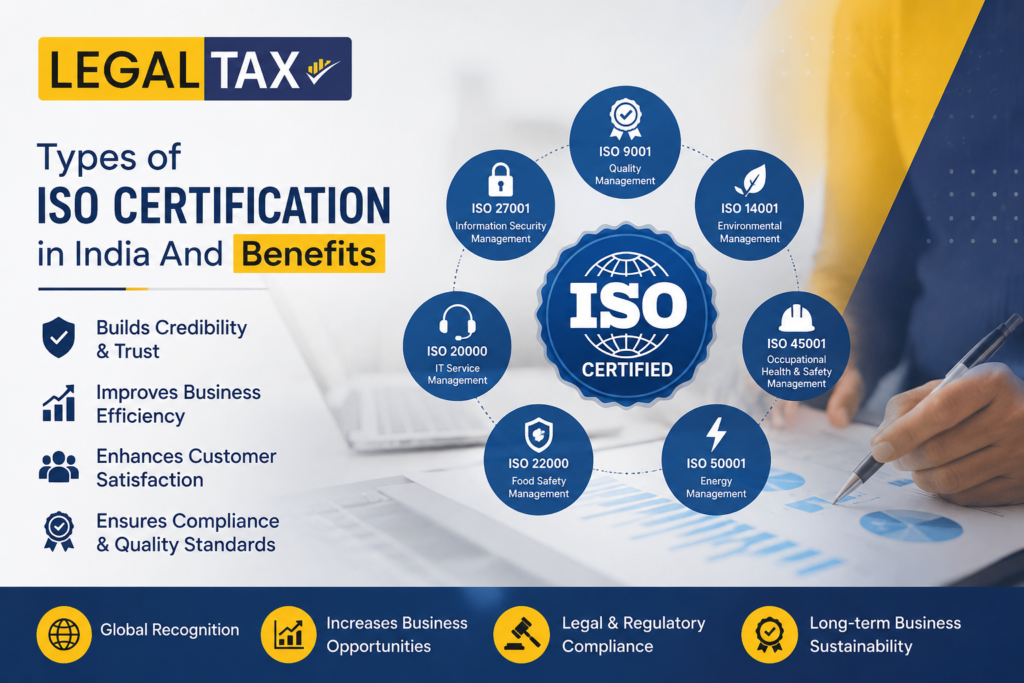
The most common ISO certifications in India include ISO 9001 for Quality Management Systems, ISO 14001 for Environmental Management Systems, ISO 22000 for Food Safety Management Systems, ISO 27001 for Information Security Management Systems, and ISO 45001 for Occupational Health and Safety Management Systems. Each certification focuses on a specific area of business improvement and compliance.
2. Why is ISO certification important for businesses?
ISO certification is important because it demonstrates a company’s commitment to maintaining international standards of quality, safety, and efficiency. It helps businesses improve customer satisfaction, streamline operations, enhance credibility, and gain a competitive advantage in the marketplace.
3. Which ISO certification is best for small businesses and startups?
For most small businesses and startups, ISO 9001 is considered the best certification to begin with. It helps establish effective quality management practices, improve customer satisfaction, and create standardized business processes that support long-term growth.
4. What are the key benefits of ISO certification?
ISO certification offers numerous benefits, including improved operational efficiency, enhanced customer trust, better risk management, increased business opportunities, stronger brand reputation, and easier access to government tenders and corporate contracts that require compliance with international standards.
5. How long does it take to obtain ISO certification in India?
The time required to obtain ISO certification depends on the size of the organization, the chosen ISO standard, and the readiness of internal processes. In general, the certification process can take anywhere from a few days to several weeks, including documentation, implementation, audit, and final certification.
6. Is ISO certification mandatory in India?
ISO certification is generally not mandatory under Indian law. However, many organizations choose to obtain it because it enhances business credibility and may be required for certain tenders, contracts, export opportunities, or industry-specific compliance requirements.
Conclusion
ISO certification is a commercially and operationally significant investment for Indian businesses across virtually every sector. The specific standard or standards most relevant to your organisation depend on your industry, your customers, your regulatory environment, and your business development objectives. But the overarching logic is consistent: ISO certification demonstrates to the market, to customers, and to regulators that your organisation operates to internationally recognised standards.
The benefits of ISO certification — market access, customer confidence, operational efficiency, regulatory alignment, and export credibility — are durable and compound over time. The initial investment in implementation and certification is recovered through contract wins, cost efficiencies, and the reduced risk of quality failures, safety incidents, or information security breaches that come with systematic management.
What undermines the value of ISO certification is treating it as a documentation exercise rather than a genuine management system implementation. Certification obtained by creating paperwork that does not reflect actual practice provides neither the operational benefits nor the credibility that genuine implementation delivers. The organisations that derive lasting value from ISO certification are those that implement it as a real framework for how they operate, not as a badge to display on their website.
Identify the standard most relevant to your sector and customer requirements. Conduct a gap assessment against that standard. Implement the management system genuinely. Obtain certification from an accredited body. Maintain and improve the system through the surveillance audit cycle.
Get Expert ISO Certification Advisory and Compliance Support
🟡 LegalTax.in provides complete ISO certification advisory, documentation preparation, management system implementation support, and compliance services for businesses across all sectors and entity types.
👉 Legal Documentation and Drafting 👉 GST Registration and Filing 👉 Income Tax Return 👉 Private Limited Company Registration 👉 LLP Registration 👉 Partnership Firm Registration 👉 MSME and Udyam Registration 👉 Import Export Code Registration 👉 Startup Registration 👉 GeM Registration
🟡 LegalIP.in provides complete IP registration and brand protection services for businesses across all sectors.
👉 Trademark Registration 👉 Patent Registration 👉 Copyright Registration 👉 Design Registration
🟡 IT and Digital Services
👉 Website Development 👉 SEO Services 👉 Social Media Marketing 👉 Logo Design 👉 Google and Facebook Ads 👉 Branding Services
📞 Call Now: +91 9711939395 🕐 Free Consultation: Monday to Saturday, 9 AM to 6 PM

I’m Aryan Yadav, passionate about SEO and Digital Marketing with a strong interest in helping businesses grow online. I enjoy learning new strategies, exploring digital trends, and creating ideas that deliver value. I believe in continuous growth, creativity, and building meaningful results through smart work and dedication.
Our Clients