Views: 22
Table of Contents
- 1 Introduction
- 2 Structure 1: Sole Proprietorship
- 3 Structure 2: The Limited Liability Partnership for Solo or Small-Team Businesses
- 4 Head-to-Head Comparison
- 5 When Proprietorship Is the Better Choice
- 6 When LLP Is the Better Choice
- 7 Converting a Proprietorship to an LLP
- 8 The GST Dimension: An Important Practical Difference
- 9 Choosing the Right Structure: Practical Questions
- 10 Frequently Asked Questions
- 11 Conclusion
- 12 Get Expert Business Registration and Compliance Support
Introduction
For an individual starting a business in India, the choice of business structure is one of the first and most consequential decisions they will make. Among the available options, two structures stand at opposite ends of the simplicity-protection spectrum: the sole proprietorship, which offers maximum simplicity with minimum formality, and the Limited Liability Partnership, which offers corporate protection and credibility with moderate compliance requirements.
The sole proprietorship is the default business structure for individual entrepreneurs in India. It requires no formal registration to exist, can be started immediately, and involves no ongoing compliance with a central corporate registry. The individual and the business are legally the same person: the business has no existence separate from its owner, and the owner bears unlimited personal liability for all business obligations.
The LLP, by contrast, is a formally incorporated body corporate under the Limited Liability Partnership Act, 2008. For a solo entrepreneur, an LLP requires at least one other partner, mandatory ROC registration, an LLP agreement, annual filings with the Ministry of Corporate Affairs, and a more structured governance framework. In exchange, it offers limited liability protection, separate legal identity, perpetual succession, and significantly greater credibility with banks, large clients, and institutional counterparties.
The choice between these two structures is not academic. It determines how exposed the business owner’s personal assets are to business risk, how the business is perceived by potential clients and lenders, what compliance costs the business incurs annually, and how easily the business can be scaled, transitioned, or valued when the time comes to do any of those things.
This guide provides a comprehensive, practical comparison of sole proprietorship and LLP for Indian small business owners, covering every dimension that matters: legal identity, liability, registration, taxation, banking, compliance, credibility, and suitability for different types of business activity. It is designed to help individual business owners make an informed structural choice rather than defaulting to what is most familiar or immediately convenient.
For sole proprietorship registration and LLP registration across all states, the team at Legal Tax handles complete business registration with accurate documentation.
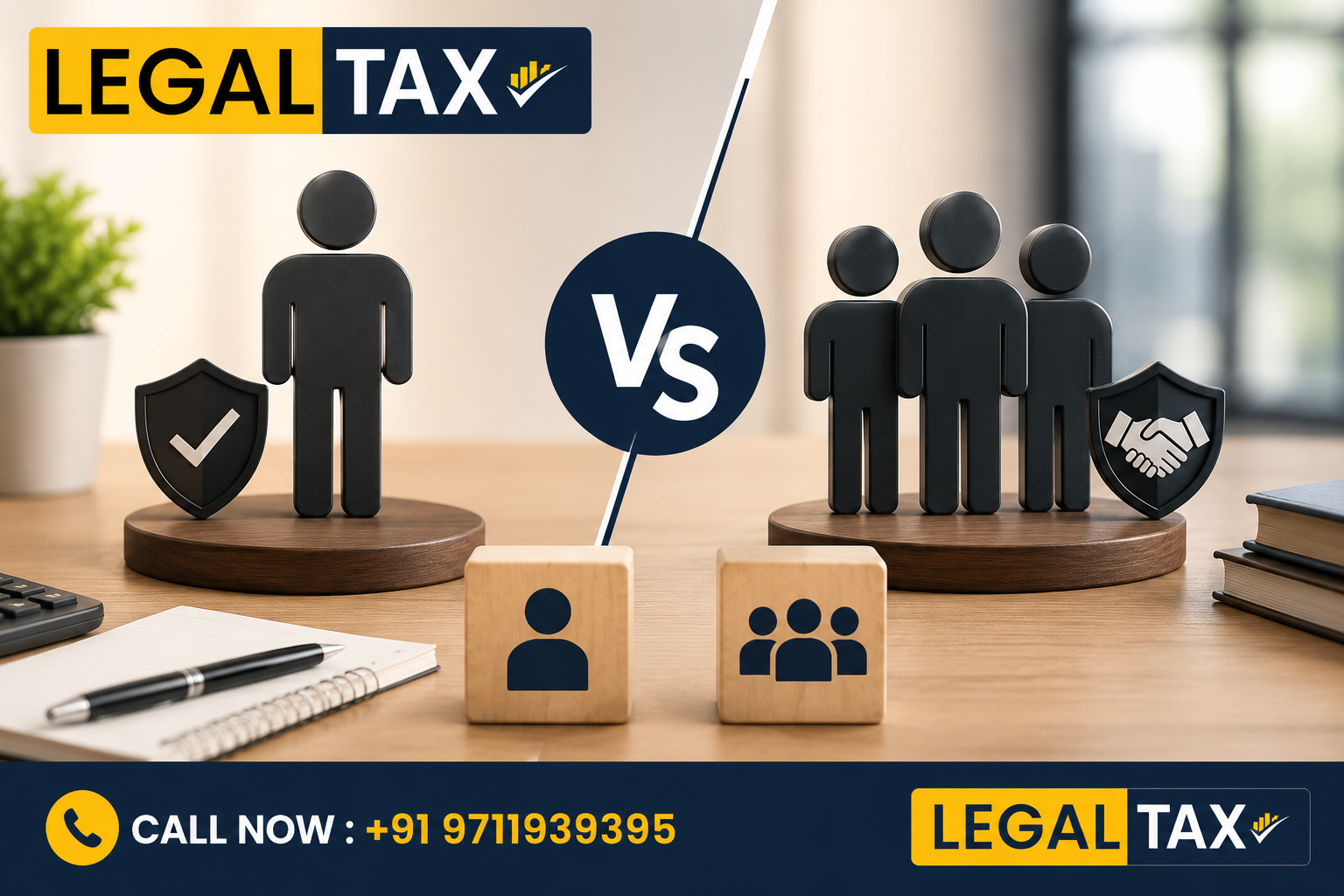
Structure 1: Sole Proprietorship
What It Is
A sole proprietorship is a business owned and operated by a single individual. There is no legal distinction between the owner and the business: the proprietor is the business. Any asset acquired in the business’s name is legally owned by the proprietor. Any contract entered into in the business’s name is a personal contract of the proprietor. Any liability of the business is a personal liability of the proprietor.
The sole proprietorship is the simplest business structure available in India and the one that most informal businesses naturally fall into without any deliberate choice being made. A person who starts selling products online, offering freelance services, or running a local shop without formally registering any other entity is, by default, a sole proprietor.
Registration: No Central Registry
Unlike companies, LLPs, and partnership firms, a sole proprietorship has no central registration with any national authority. There is no government form to file to “become” a sole proprietor. The business exists the moment the owner begins operating it.
However, a sole proprietorship may need to obtain various registrations and licences depending on the nature of its business and its scale:
GST Registration. If annual turnover exceeds Rs. 20 lakh (Rs. 10 lakh in special category states), or for certain categories of business regardless of turnover, GST registration is mandatory. Many sole proprietors who want to supply to GST-registered businesses register voluntarily even below the threshold.
MSME Registration (Udyam Registration). Not mandatory but highly recommended for sole proprietors who want access to MSME schemes, priority sector lending, government procurement preferences, and statutory payment protections.
Shop and Establishment Act Registration. Required in most states for any business premises where employees work or where the proprietor conducts business from a fixed location.
Professional Tax Registration. Required in states that levy professional tax.
Trade Licence. Required from the local municipal authority for most commercial activities.
Sector-Specific Licences. FSSAI for food businesses, drug licences for pharmaceutical businesses, and similar sector-specific registrations as applicable.
For sole proprietorship registration support including GST, MSME, and Shop and Establishment registration, We provides complete registration services.
Legal Identity: No Separation Between Owner and Business
The sole proprietorship has no legal identity separate from its owner. This is the defining characteristic of the structure and the source of both its greatest advantage (simplicity) and its greatest risk (unlimited personal liability).
The business name under which a sole proprietor operates, such as “Sharma Enterprises” or “Priya Creations,” is a trade name or fictitious name used by the proprietor. It has no independent legal existence. Contracts signed in that name are the personal contracts of the proprietor. Debts incurred in that name are the personal debts of the proprietor.
Liability: Unlimited and Total
Every debt and obligation of the sole proprietorship is the personal debt and obligation of the proprietor. If the business owes money to a supplier, a bank, or a client that it cannot pay, the creditor can pursue the proprietor’s personal assets: savings, home, vehicle, jewellery, and any other personal property.
This unlimited personal liability is the most serious structural risk of the sole proprietorship. For many small businesses operating on thin margins, with supplier credit, customer advances, or bank overdrafts, this exposure is very real. A single bad debt, a lost legal case, or an unforeseen business failure can result in the proprietor losing everything they own personally.
Compliance: Minimal but Not Zero
The compliance burden of a sole proprietorship is lower than any other formal business structure:
- No annual returns to be filed with a central corporate registry (unlike companies and LLPs).
- No mandatory audit unless turnover exceeds the threshold specified in the Income Tax Act (Rs. 1 crore for business, Rs. 50 lakh for professionals, subject to specific conditions).
- Income tax return filing is required annually.
- GST returns are required if GST registered.
- Sector-specific licence renewals as applicable.
Taxation: Taxed as an Individual
A sole proprietor’s business income is not taxed separately. It is added to the proprietor’s personal income and taxed at the applicable individual income tax slab rates:
- Up to Rs. 3 lakh: Nil (under the new tax regime).
- Rs. 3 lakh to Rs. 6 lakh: 5%.
- Rs. 6 lakh to Rs. 9 lakh: 10%.
- Rs. 9 lakh to Rs. 12 lakh: 15%.
- Rs. 12 lakh to Rs. 15 lakh: 20%.
- Above Rs. 15 lakh: 30%.
For a highly profitable sole proprietorship with income above Rs. 15 lakh, the 30% tax rate applicable to individuals equals the flat 30% rate at which an LLP is taxed. For proprietorships with income below Rs. 15 lakh, the individual slab rates may result in a lower effective tax rate than an LLP’s flat 30%, making the proprietorship more tax-efficient at lower income levels.
Structure 2: The Limited Liability Partnership for Solo or Small-Team Businesses
What It Is in the Context of a Solo Business
The LLP Act requires a minimum of two partners. A sole proprietor who wants to use the LLP structure must therefore have at least one other person as a partner. This partner can be a spouse, a family member, a business associate, or any other individual who agrees to be named as a partner.
In practice, many small businesses that choose the LLP structure have two partners: the primary business owner and a spouse, sibling, or associate who holds a nominal share and participates in the business to a limited extent. The LLP agreement defines the profit-sharing ratio (which can be highly asymmetric, such as 99:1), the management responsibilities (concentrated in the primary partner), and the rights and obligations of each partner.
For the purposes of this comparison, the LLP with a primary operator and a secondary or nominal partner is treated as the effective equivalent of a solo-operated business in the LLP structure.
Registration: Mandatory and Formal
LLP registration is mandatory, centrally administered through the MCA portal, and involves:
- Name reservation through RUN-LLP.
- Digital Signature Certificates for all designated partners.
- Filing FiLLiP (incorporation form).
- Obtaining Director Identification Numbers for designated partners.
- Filing Form 3 with the LLP agreement within 30 days of incorporation.
- Obtaining PAN and TAN for the LLP.
The registration process typically takes 2 to 5 weeks from start to finish. The total cost ranges from Rs. 10,000 to Rs. 30,000 depending on the capital contribution and the state of registration.
For complete LLP registration, We provides end-to-end registration services.
Legal Identity: Fully Separate From Partners
The LLP is a body corporate with a legal identity entirely separate from its partners. This separation has direct practical benefits:
- Contracts are entered into by the LLP, not by the individual partners personally.
- Property is owned by the LLP in its own name.
- The LLP can sue and be sued independently.
- The LLP continues to exist even if a partner retires or dies.
- Banks, clients, and government agencies deal with the LLP as a distinct legal entity.
Liability: Limited and Protective
Under Section 27 of the LLP Act, a partner of an LLP is not personally liable for the obligations of the LLP solely by reason of being a partner. If the LLP incurs debts it cannot pay, the creditors can pursue the LLP’s assets but generally cannot pursue the personal assets of the partners beyond their agreed capital contribution.
This limited liability protection is the primary reason an individual business owner would choose an LLP over a proprietorship. The financial protection it provides against business risk is structurally built into the LLP, unlike in a proprietorship where the owner’s personal and business assets are legally indistinguishable.
The exception to limited liability applies to acts done by a partner with intent to defraud or for fraudulent purposes. A partner who personally commits fraud is personally liable for the consequences of that fraud.
Compliance: More Than a Proprietorship, Less Than a Company
An LLP must file:
- Form 11 (Annual Return) by 30 May each year.
- Form 8 (Statement of Accounts and Solvency) by 30 October each year.
- Income tax return annually.
- GST returns if GST registered.
The penalty for late filing of Form 11 or Form 8 is Rs. 100 per day per form with no cap. Consistent timely filing is essential.
Mandatory audit applies only where annual turnover exceeds Rs. 40 lakh or capital contribution exceeds Rs. 25 lakh, making the LLP compliance burden significantly lower than a private limited company’s mandatory annual audit requirement.
Taxation: Flat 30% on LLP Income
An LLP is taxed as a separate entity at a flat rate of 30% on its taxable income, plus applicable surcharge and health and education cess. Partners’ remuneration and interest on capital (within the limits prescribed by the Income Tax Act) are deductible from the LLP’s taxable income. Partners’ share of LLP profit is exempt from income tax in their hands.
At the same income level, an individual sole proprietor pays income tax at slab rates, while an LLP pays at a flat 30%. For income above Rs. 15 lakh, the slab rate for individuals is also 30%, making the tax burden approximately equal. For income below Rs. 15 lakh, the individual slab rates are lower than the LLP’s flat 30%, making the proprietorship more tax-efficient at lower income levels.
However, the deductibility of partner remuneration from the LLP’s taxable income can significantly improve the LLP’s effective tax efficiency. If the primary partner draws remuneration from the LLP (deductible by the LLP, taxable in the partner’s hands at individual slab rates), the combined tax burden can be lower than a flat 30% on the full LLP income.
For income tax planning for LLPs and their partners, We provides complete income tax filing and advisory services.
Head-to-Head Comparison
| Dimension | Sole Proprietorship | LLP |
|---|---|---|
| Minimum persons | 1 | 2 |
| Central registration required | No | Yes (ROC) |
| Legal identity | No separate identity | Separate legal entity |
| Personal liability | Unlimited | Limited to capital contribution |
| Perpetual succession | No; ends with proprietor | Yes; continues regardless of partner changes |
| Registration cost | Rs. 2,000 to Rs. 8,000 (various licences) | Rs. 10,000 to Rs. 30,000 |
| Annual MCA compliance | None | Form 11 and Form 8 annually |
| Annual compliance cost | Rs. 2,000 to Rs. 10,000 | Rs. 5,000 to Rs. 50,000 |
| Mandatory audit | Turnover based (Income Tax Act threshold) | Turnover Rs. 40 lakh or capital Rs. 25 lakh |
| Taxation | Individual slab rates (up to 30%) | Flat 30% on LLP income |
| Tax efficiency at income below Rs. 15 lakh | Higher (lower slab rates) | Lower (flat 30%) |
| Tax efficiency at income above Rs. 15 lakh | Similar | Similar; partner remuneration can improve efficiency |
| Banking and credit access | Harder for significant amounts | Easier; treated as corporate entity |
| Client credibility | Lower with large corporates | Higher; preferred counterparty |
| GST registration | In proprietor’s PAN and name | In LLP’s PAN and name |
| Scalability | Limited; must convert to add partners | Easier; add partners through LLP agreement amendment |
| Conversion | Can convert to LLP or company | Can convert to company |
| Closure | Simply cease operations | Formal strike-off or winding-up process |
When Proprietorship Is the Better Choice
The sole proprietorship is the appropriate structure in specific, clearly defined circumstances.
Business is Very Small With Minimal External Liability Risk
For a freelancer, a local service provider, a tutor, a home-based food business, or any small business where the liability risk is limited because the business does not borrow money, does not take on large contracts, and does not operate in sectors where significant claims are possible, the unlimited liability of a proprietorship is a manageable risk that is outweighed by the simplicity and low cost of the structure.
A graphic designer working from home with a handful of clients, earning Rs. 5 to Rs. 10 lakh annually, does not need the structural protection and compliance overhead of an LLP. The proprietorship’s simplicity serves this business well.
Income Is Well Below Rs. 15 Lakh
At lower income levels, the individual slab rates applicable to a proprietor are lower than the flat 30% applicable to an LLP. A proprietor earning Rs. 8 lakh pays income tax at an effective rate significantly lower than 30%. An LLP with the same income pays 30% on the full amount before any deductions for partner remuneration. The tax efficiency of the proprietorship at these income levels is a genuine advantage.
The Business Is Intended to Be Short-Term or Exploratory
A business being started to test a market, a temporary project, or a side venture that may not continue beyond a year or two is well served by the proprietorship structure. The ease of starting and stopping a proprietorship, without formal closure procedures or ROC filings, makes it ideal for exploratory business activities.
Speed of Starting Is Critical
A proprietorship can be started immediately. An LLP takes 2 to 5 weeks to register. For a business that needs to start operating today to meet a specific commercial opportunity, the proprietorship’s immediate availability is a real advantage.
The Business Operates in a Local Market With Local Clients
For businesses that serve local markets, deal primarily with individual consumers, and do not need to compete for large corporate or government contracts that require formal corporate credentials, the proprietorship’s lack of corporate status is not a commercial disadvantage.
When LLP Is the Better Choice
For most small businesses that are seriously evaluating this choice and thinking beyond the immediate term, the LLP’s advantages will outweigh those of the proprietorship.
Liability Exposure Is Meaningful
This is the single most decisive consideration. Any business that:
- Takes bank loans or credit facilities.
- Operates on supplier credit with significant amounts outstanding.
- Takes on contracts with financial consequences for non-performance.
- Operates in sectors where client claims are possible (consulting, IT, healthcare, construction).
- Has personal assets (home, savings, investments) that the owner values and cannot afford to lose.
should seriously consider the LLP. The unlimited personal liability of a proprietorship is not a theoretical risk for businesses in these situations. It is an active exposure that the LLP structure specifically and effectively addresses.
The Business Targets Corporate or Government Clients
Large private sector companies increasingly require their vendors and service providers to be incorporated entities. Government procurement and tender processes often require corporate registration. An LLP registered with the ROC, with annual filings publicly available, presents as a professional, accountable counterparty in a way that a sole proprietorship cannot match.
For IT service providers, consultants, marketing agencies, and professional service firms targeting mid-to-large corporate clients, the LLP’s corporate credibility is not a luxury. It is a commercial necessity.
Bank Finance Is Required or Anticipated
Banks are more comfortable extending working capital credit, term loans, and other financing to LLPs than to sole proprietorships, for two reasons. First, the LLP’s ROC registration, annual filings, and (where applicable) audited accounts provide a clearer and more reliable picture of the business’s financial health. Second, the LLP is a separate legal entity that can grant security over its assets independently of the partners’ personal assets, which simplifies the security creation and enforcement process for the bank.
A sole proprietor who needs bank financing for business growth often finds that the proprietorship structure limits both the amount available and the terms on which it is offered.
The Business Will Have Multiple Partners or Key Employees in the Future
A proprietorship cannot have multiple owners. When a sole proprietor needs to bring in a business partner, the proprietorship must be converted to a partnership firm, an LLP, or a company. This conversion involves cost, time, and legal complexity.
A business owner who can reasonably foresee needing a partner, a key employee with equity participation, or external investor involvement within the next few years is better served by establishing an LLP from the outset than by starting as a proprietorship and converting later.
Income Is Above Rs. 15 Lakh and Growing
At higher income levels, the tax rate on a proprietorship (30% on income above Rs. 15 lakh) equals the LLP’s flat rate. At this level, the LLP’s structural advantages (limited liability, corporate credibility, scalability) come at no additional tax cost compared to the proprietorship. The decision to choose the LLP becomes clearly favourable when liability and credibility considerations are added.
Additionally, the ability to deduct partner remuneration from the LLP’s taxable income means that the LLP can achieve a combined effective tax rate (LLP + partner individual tax) lower than a flat 30% when the partner remuneration deduction is used effectively.
Converting a Proprietorship to an LLP
Many businesses start as sole proprietorships and convert to LLPs as they grow and as the liability exposure, client requirements, or financing needs evolve. The conversion process involves:
- Incorporating a new LLP with the proprietor and at least one other person as partners.
- Transferring the business assets, contracts, and licences from the proprietorship to the LLP.
- Notifying clients, suppliers, and banks of the change in business entity.
- Updating GST registration, MSME registration, and other licences to the LLP.
- Closing the proprietor’s business bank accounts and opening new ones in the LLP’s name.
Unlike the conversion of a partnership firm to an LLP (which has a formal legal mechanism under the LLP Act that preserves business continuity), the conversion of a proprietorship to an LLP is essentially the establishment of a new entity and the transfer of the business to it. There is no automatic legal continuity, though practically the business continues without interruption.
Tax implications of the asset transfer from the proprietorship to the LLP should be assessed with a tax advisor before conversion, as capital gains tax may arise on the transfer of certain assets.
The GST Dimension: An Important Practical Difference
For GST purposes, a sole proprietorship is registered in the proprietor’s name and PAN. The GST registration is personal to the proprietor and reflects the proprietor’s business activities.
An LLP is a separate legal entity with its own PAN and its own GST registration. All business transactions are conducted in the LLP’s name and reflected in the LLP’s GST records.
This difference has a practical implication when the business is converted from a proprietorship to an LLP. The proprietorship’s GST registration cannot be transferred to the LLP. The LLP must obtain a fresh GST registration. All input tax credit in the proprietorship’s GST account must be managed carefully during the transition to avoid losing it.
For GST registration for both proprietorships and LLPs, and for GST transition planning during conversion, Legal Tax provides complete GST services.
Choosing the Right Structure: Practical Questions
For small business owners evaluating this choice, the following questions provide a decision framework.
What is my liability exposure? If the business can incur debts, face claims, or create financial obligations that exceed my ability to pay from business assets alone, and if losing my personal assets would be catastrophic, choose the LLP.
Who are my clients? If I am targeting large corporate or government clients who require incorporated entities as their suppliers, choose the LLP. If I serve individual consumers or small local businesses, the proprietorship may be adequate.
Do I need bank finance? If I anticipate needing bank loans or credit facilities for business growth, the LLP provides better access to financing.
What is my annual income from business? Below Rs. 10 to 12 lakh, the proprietorship’s lower slab rates make it more tax-efficient. Above Rs. 15 lakh, the tax burden is similar and the LLP’s structural advantages dominate the decision.
Will I need a partner or key person with equity participation? If yes, plan for the LLP from the start rather than converting later.
How important is quick startup? If I need to start today, the proprietorship’s immediate availability is an advantage. If I can wait 3 to 5 weeks, the LLP is available.
Am I willing to incur ongoing compliance costs? The LLP’s annual MCA filings add Rs. 5,000 to Rs. 20,000 to annual costs. If this is a meaningful proportion of business income, the proprietorship’s lower compliance overhead may be relevant.
Frequently Asked Questions
What is the main difference between a Proprietorship and an LLP?
A Sole Proprietorship is owned and managed by a single individual, and there is no separate legal identity between the owner and the business. An LLP (Limited Liability Partnership) is a separate legal entity formed by two or more partners, offering limited liability protection to its partners
Which business structure is easier to start?
A Sole Proprietorship is generally easier and less expensive to start. There is no separate registration for a proprietorship, although licenses such as GST registration, Shop and Establishment Registration, or FSSAI registration may be required depending on the business. An LLP requires incorporation with the Registrar of Companies (ROC) and compliance with the LLP Act, 2008.
Which offers better liability protection?
An LLP offers significantly better liability protection. In a proprietorship, the owner is personally liable for all business debts and obligations. In contrast, LLP partners generally have liability limited to their agreed contribution, protecting their personal assets from business liabilities.
Which has lower compliance requirements?
A Sole Proprietorship has fewer legal and compliance requirements. An LLP must maintain statutory records, file annual returns, and comply with ROC regulations. Therefore, a proprietorship is often preferred by small businesses seeking minimal compliance.
Should a small business owner choose a Proprietorship or an LLP?
The choice depends on the nature and goals of the business. A Sole Proprietorship is suitable for small businesses with low risk, limited investment, and simple operations. An LLP is often a better choice for businesses seeking liability protection, long-term growth, professional credibility, and partnership opportunities.
Conclusion
The choice between a sole proprietorship and an LLP is ultimately a choice between simplicity and protection. The proprietorship offers maximum simplicity, zero central registration, minimal compliance, and tax efficiency at lower income levels. The LLP offers limited liability protection, corporate identity, greater banking access, and commercial credibility with large clients, at the cost of mandatory registration, annual MCA filings, and a flat 30% tax rate.
For very small, locally focused, low-liability businesses with modest income, the proprietorship is entirely appropriate and the additional cost and complexity of an LLP are not justified. For businesses with meaningful liability exposure, corporate clients, bank financing requirements, or growth plans that will require partners or investors, the LLP’s protections and credibility advantages make it the clearly superior choice.
The most common mistake Indian small business owners make is defaulting to the proprietorship structure not because it is the right choice for their specific business but because it is the path of least initial resistance. The unlimited personal liability that comes with that choice is not visible until something goes wrong. At that point, the cost of the wrong structural choice can be devastating in a way that no amount of subsequent restructuring can fully repair.
The right time to choose the right structure is before the business starts operating. Choose based on where the business is going, not just where it is starting.
Assess your liability risk. Consider your client profile. Evaluate your income trajectory. And choose the structure that protects both your business and your personal financial security.
Get Expert Business Registration and Compliance Support
🟡 Legal Tax provides complete proprietorship registration, LLP registration, annual compliance, and business advisory services across all states and sectors.
👉 Proprietorship Registration 👉 LLP Registration 👉 Partnership Firm Registration 👉 Private Limited Company Registration 👉 OPC Registration 👉 Startup Registration 👉 GST Registration and Filing 👉 Income Tax Return 👉 MSME Registration 👉 Shop and Establishment Licence 👉 FSSAI Registration 👉 Import Export Code Registration 👉 Legal Documentation and Drafting 👉 ISO Certification 👉 Commercial and Corporate Cases
🟡 IT and Digital Services
👉 Website Development 👉 SEO Services 👉 Social Media Marketing 👉 Logo Design 👉 Google and Facebook Ads 👉 Branding Services
📞 Call Now: +91 9711939395 🕐 Free Consultation: Monday to Saturday, 9 AM to 6 PM

Anjali is a Digital Marketing Expert at LegalTax.in who builds websites that rank and convert. She specializes in SEO-driven web development, helping people find the right legal help online.
Our Clients